ET III Ch.20 Proteins
 Call Kai
 Learn
Learn Practice Test
 Spaced Repetition
 Match
Match Flashcards
 Knowt Play
1/36

There's no tags or description
Looks like no tags are added yet.
Name | Mastery | Learn | Test | Matching | Spaced | Call with Kai | Chat |
|---|
No analytics yet
Send a link to your students to track their progress
37 Terms
Describe proteins
Most important biochemical compound
Function both structurally and dynamically
Form biological membranes along with lipids
Responsible for transport and communication across cell membranes
Act as hormones and antibodies, form a portion of the oxygen-carrying molecules hemoglobin and myoglobin
As enzymes, serve as regulators of all biological reactions
Proteins play a large structural role as collagen and elastin
The focus of an embalmer
What is the composition of proteins?
contain carbon, hydrogen, oxygen, and nitrogen
Very large molecules with molecular masses ranging from 35,000 to 50,000,000
What are proteins polymers of?
Amino acids
Upon hydrolysis what do proteins form?
Mixtures of amino acids
Proteins are hydrolyzed by acids, bases, and enzymes called _________
Proteases
Proteins are composed of a combination of __ amino acids
20
What do the compounds of proteins contain?
Carboxyl groups (-COOH) and the amino group -NH2
What do all amino acids contain?
Another carbon, another hydrogen, and a side chain called an R group
What is a alpha carbon?
The amino group is always attached to the carbon next to the carboxyl group
Match a photo of glycine
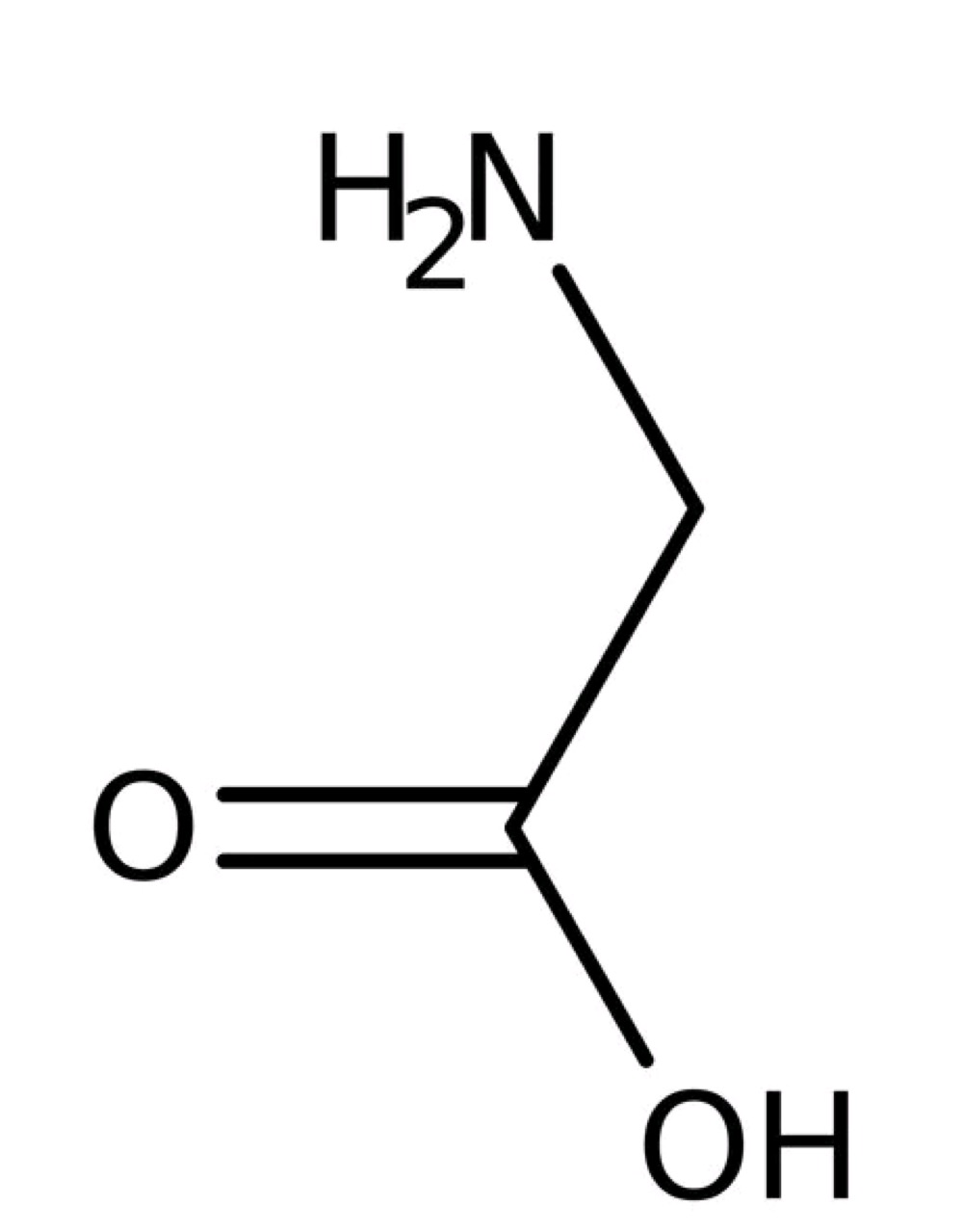
What is glycine?
The simplest amino acid
Used and found absolutely everywhere
what is glycine commonly used in/found in?
Sleep aids
Herbicides
Tail of comet Wild 2
How does amphoterism apply to amino acids?
Amino acids contain a carboxyl group as well as an amino group, allowing them to act as both acids and bases
When carboxyl groups are in a compound, it will act as a
weak acid (proton donor)
Presence of an amino group in a compound will give it ______ properties
basic (proton accepting)
Due to amino acids _____________ nature they buffer or protect solutions against changes in pH by neutralizing either acids or bases that enter them
Amphoteric
What is another name for a dipolar ion?
Twizitterion
What is the product of joining together two or more amino acids?
A dipeptide
What is formed when two or more amino acids come together to make a dipeptide?
A joined amino acid and water
What is the group that joins two amino acids together called?
The peptide linkage
What does a peptide linkage contain?
A carbonyl group and an imide group
What is putrefaction?
Anaerobic decomposition of proteins brought about by the action of enzymes
When does putrefaction begin?
after cellular death
The rate at which putrefaction occurs depends on what?
several factors (temperature, humidity, moisture content of the body, cause of death)
Favored by moisture and the presence of bacteria and increases with temperature
What are the first tissues to be affected by putrefaction?
Tissues containing high concentrations of proteolytic enzymes
Ex. lining of gastrointestinal tract, epithelium of pancreas
What is the chemical reaction that initiates the putrefactive process?
Hydrolysis
Hydrolysis is a chemical property of what:
Water
What happens during hydrolysis?
Biological compounds are broken apart and water is incorporated into their structures
What is necessary for hydrolysis to occur?
Enzymes
What is deamination?
Part of the putrefactive process, it is the removal of the amino group from an amino acid
What are generally the products of deamination?
ammonia and an organic acid
Extensive putrefaction creates high levels of _________, thereby increasing formaldehyde demand
ammonia
The end of the rigor cycle signals the beginning of what cycle?
The decomposition cycle
What is decarboxylation?
Part of the putrefactive process, it is the removal of the carboxyl group from an amino acid
What does deamination produce?
carbon dioxide, water, and an amine
What do amines further decompose into during/after decarboxylation?
ammonia
Decomposition of amino acids containing sulfur liberate what?
hydrogen sulfide