Week 1b: IEQ, IAQ, thermal comfort
 Call Kai
 Learn
Learn Practice Test
 Spaced Repetition
 Match
Match Flashcards
 Knowt Play
1/59

There's no tags or description
Looks like no tags are added yet.
Name | Mastery | Learn | Test | Matching | Spaced | Call with Kai | Chat |
|---|
No analytics yet
Send a link to your students to track their progress
60 Terms
IEQ
Indoor environmental quality
IAQ
Indoor Air Quality
To what value driver is the IEQ most related
User/Basic value
Four physical aspects of IEQ
Thermal
Air quality
Aural (sound)
Visual
IEUQ influences
Health, Comfort, Performance
Energy demand
Circularity
How much of the energy used in buildings is going to IEQ?
More than 60%
HVAC
Heating, ventilation and air conditioning
KIPI framework: Performance indicators
Health and comfort
Safety and security
Usability and positive stimulation
Adaptability and serviceability
What is a building decree
Performance requirements that buildings should adhere to
What are the names of the guidelines
ISO (international), ASHRAE (international), ISSO (Netherlands)
The Program of Requirements with performance requirements are developed for four types of buildings:
Healthy offices
Fresh schools
Healthy dwellings
Long term care facilities
What are the three levels/classes of the PoR
C: Building decree
B: Better quality for health and comfort
A: High quality, (for dwellings) focused on special groups
Verification of PoR healthy dwellings
Low level at hand-over
Long-term with sensors
Detailed measurements in response to complaints
What are the tools to assess the performance of buildings
BREEAM from 1990 about Environmental sustainability
LEED from 1998 about Environmental sustainability
WELL from 2014 about health & comfort
What is the difference between BREEAM/LEED and WELL:
Balance energy demand vs IEQ
What are the three questions to evaluate thermal comfort
How are you feeling now (range from very cold to very hot)
Do you find this (range comfortable to very uncomfortable)
How would you prefer to be now? (range much cooler to much warmer)
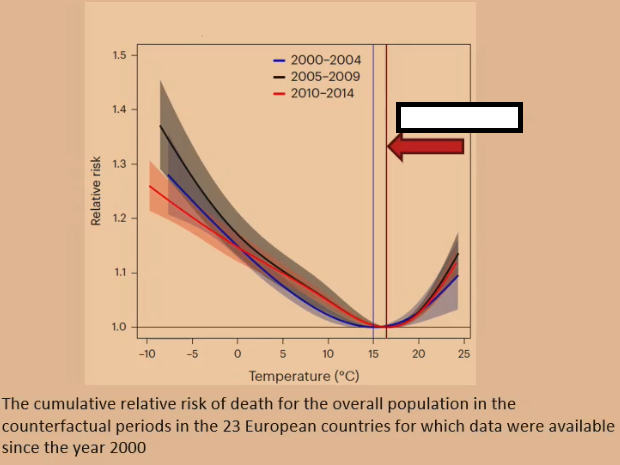
What is the missing word
Adaptation
What should the internal body temperature be
37
How can we change the core temperature
Widening or narrowing the blood veins in order to keep warmth or lose warmth and sweating
What factors in our environment affect heat (loss)
Humidity, air velocity, air temperature, activity, mean radiant temperature, temporal nature of exposure
How do we adapt for warm discomfort
Rate of sweating
How do we adapt to cold discomfort
Skin temperature
What is the right temperature
Ask through survey for a group of people
How to design with thermal comfort in mind
Heat balance approach (a method for the calculation of steady state thermal comfort obtained from climate chamber research)
Adaptive approach: a relation for steady state thermal comfort derived from studies in the field
Heat balance approach formula
H - Edif - Esw - Eres - Cres = R + C (metabolism/internal heat production - evaporation diffuse - evaporation sweat - evaporation respiration - convection respiration = radiation + convection
How did Fanger experiment for the Heat Balance Approach formula
Expose subjects to environmental conditions, measure conditinos and ask perceived thermal sensation
PMV model
Predicted mean value
T mrt in the heat balance approach formula
Average temperature of all the objects in the room
Remarks from PRV model
Often T air and T mrt assumed equal
T operative = (Tair + Tmrt)/2 (because it defers per location in the room)
Air speed low
Color bands (green): three classes standard
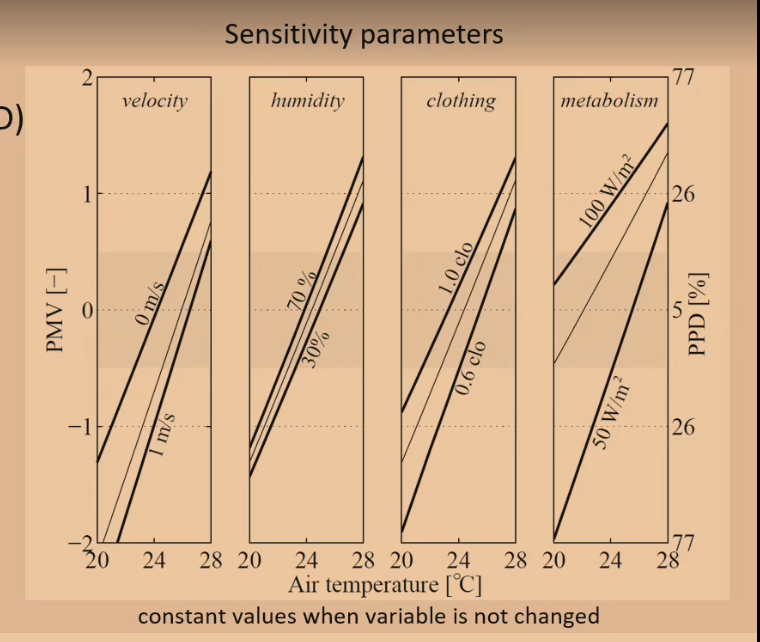
What is a conclusion that can be drawn from this image about humidity, clothing and metabolism
Metabolism and clothing are much more sensitive as compared to relative humidity
Three levels of types of adaptation in the adaptive approach regarding thermal comfort
Behavioural
Psychological (change in sweating rate and vasomotion)
Physiological (if your expectations were not correct, you are more likely to be furstrated)
Test for adaptive approach for thermal comfort
Global field study on the relation between thermal comfort and temperatures. Implicitly assumed that adaptation has taken place

a
a
Asymmetric thermal comfort in a room examples
Asymmetric radiant fields, vertical air temperature gradient, warm or cold floors, draught
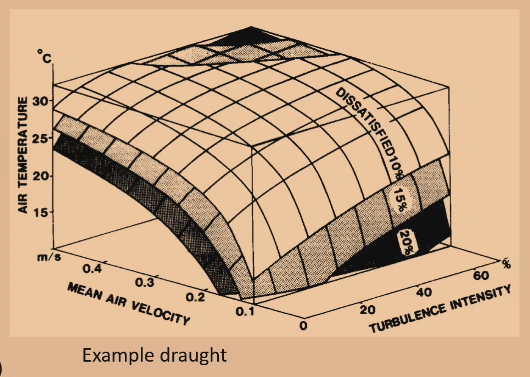
Draught risk =
percentage dissatisfied
Turbulence intensity formula
TI = 100* (vstdev/vmean)
Which one of the approaches should be used when the building is not actively cooled
Adaptive model (or requirements Healthy Dwellings)
Design consideration for behavioural adaptation
Openable windows, thermostats, curtains, local heating or fans
Design consideration for physiological adaptation
Allow variation in temperature
Psychological adaptation
Let temperature changes be understandable for the occupants on the basis of the type of building and outside temperature
Main concepts this lecture:
Thermal comfort models
Heat balance approach (Predicted Mean Vote)
Adaptive approach > types of adaptation
Asymmetric (non-uniform) thermal conditions
Types of contamination
Human body, human activities, furniture, outdoor
Reduce air contamination
Remove source when possible
Ventilate
What is infiltration
Air ‘ventilation’ through leakages
Formula contaminent concentration inside
Ci = Ce + M/V (contamination concentration external + source strength / air volume flow)
What is good or bad
WHO global air quality guidelines
Why do we measure CO2 concentration as measure for air quality
Is produced at a known rate by humans
In many cases most important sources
Dutch Building Decree assumes a CO2 concentration of (…) ppm as sufficient
1200 (other say 900, 750)
What is a note on using CO2 as indicator
CO2 and other contaminations in itself is not regarded a contaminant that affects health, but gives indication of bad ventilation
Outdoor CO2 is around 450 (so presence of persons results in an extra concentration of 1200 - 450 = 750ppm)
What are the assumptions for determining the minimum ventilation flow rate?
All contamination sources limited as much as possible
Humans most important source of CO2
Required ventilation flow rate can be determined based on required CO2 concentration
How to determine the minimum ventilation flow rate
Define desired CO2 concentration
Count amount of people in the room
Calculate using the formula
Ventilation rate for: (in dm³/s)
Living room/bedroom/study room
Kitchen
Bathroom
Toilet
7
21
14
7
Instructions for ventilation direction in dwellings
Supplied in living, bed, study room and exhausted in kitchen, bathroom and toilet.
How to ventilate
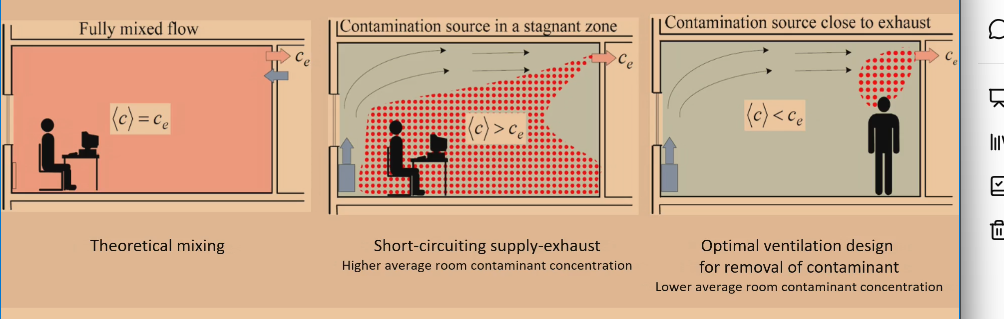
Mixing ventilation (high in, low out)
Displacement ventilation (low cold airco, high out)

Which graphs correspond to which ventilation?
Above mixed, below displacement
a
a
A window is not meant for ventilation, but what is it meant for
Purging (the ability to get rid of something unpleasant)
How can we measure ventilation flow rate
FlowFinder - Measure a supply gril in m³/h
Tracergas technique - Supply contaminant and measure concentration

Names of ventilation systems
Natural supply and exhaust
Mechanical supply, natural exhaust
Natural supply, mechanical exhaust
Mechanical supply and exhaust
Calculate risk of infection
Nc = S(1=e^(-Iqpt/V))