Chapter 1 - An Overview of Cells and Cell Research
 Call Kai
 Learn
Learn Practice Test
 Spaced Repetition
 Match
Match Flashcards
 Knowt Play
1/83

There's no tags or description
Looks like no tags are added yet.
Name | Mastery | Learn | Test | Matching | Spaced | Call with Kai | Chat |
|---|
No analytics yet
Send a link to your students to track their progress
84 Terms
Prokaryotic vs Eukaryotic: Nucleus
P: Absent
E: Present
Prokaryotic vs Eukaryotic: Diameter of a typical cell
P: about 1 um
E: 10-100 um
Prokaryotic vs Eukaryotic: Cytoplasmic organelles
P: Absent
E: Present
Prokaryotic vs Eukaryotic: DNA content (base paris)
P: 1×106 × 5×106
E: 1.5×107 × 5×109
Prokaryotic vs Eukaryotic: Chromosomes
P: Singular circular DNA molecule
E: Multiple linear DNA molecules
What is in all present day cells?
DNA
Mechanisms for replication and gene expression
What is a gene?
Segments of DNA that encode proteins or RNA
Functional units of inheritance
Transcription
nucleotide gene sequence is copied into RNA
Translation
nucleotide sequence of RNA is used to specify the order of amino acids in a protein
All present-day biological membranes are composed of _____
phospholipids
Amphipathic
Water-insoluble (hydrophobic) hydrocarbon chains are joined to a water-soluble (hydrophilic) head groups
True or False: Cells evolved mechanisms for generating energy and synthesizing molecules
True
True or False: Energy metabolism is highly conserved
True
What is the main source of metabolic energy by glycolysis
ATP (adenosine 5’- triphosphate)
Photosynthesis
harness energy from sunligh
no longer need organix molecules
Oxidative metabolism
much more efficient than glycolysis
36 to 38 ATP molecules
What are the two present day prokaryotes?
Archaebacteria
many live in extreme environments
Bacteria
wide range of environments
Prokaryotic Cell Characteristics
Small (1-10 um in diameter)
DNA ranges from 0.6 mill to 5 mill base pairs
Cyanobacteria
photosynthesis evolved
largest and most complex prokaryotes
Cell genomes

Escherichia coli (E.coli)
typical prokaryotic cell
rigid cell wall
plasma membrane
circular DNA
cytoplasm contains ribosomes
Eukaryotic Cell Characteristics
much larger and more complex
Nucleus (Eukaryotic Cells)
largest organelle
linear DNA molecules
site of DNA replication and RNA synthesis
Compartments for metabolic activities in Plants
Chloroplasts (Photosynthesis)
Vacuoles (digestion of macromolecules and storage)
List the structures of a Plant Cell
Cell Wall
Vacuole
Peroxisome
Plasma membrane
Chloroplast
Cytoskeleton
Plasmodesmata
Smooth ER
Rough ER
Mitochondrion
Golgi apparatus
Ribosome
Nucleolus
Nucleus
Compartments for metabolic activities in Animals
Mitochondria = oxidative metabolism
Lysosomes and Peroxisomes = digestion of macromolecules
Endoplasmic reticulum function
processing and transport of proteins and lipid synthesis
Golgi apparatus function
proteins are further processed and sorted
lipid synthesis
Cytoskeleton function
structural framework
determines cell shape and organization
List the structures in an Animal Cell
Cytoskeleton
Nucleolus
Nucleus
Rough ER
Smooth ER
Lysosome
Plasma membrane
Golgi apparatus
Centrioles
Peroxisome
Mitochondrion
Ribosomes
True or False: Many eukaryotes are not unicellular organisms
False, many ARE unicellular
What is the simplest eukaryote?
Yeasts (Saccharomyces cervisiae)
Paramecium
Ciliated protozoan
Specialized for movement and for feeding on bacteria and years
Chlamydomonas
Green algae
Can carry out photosynthesis
When did multicellular organisms evolve, and can they transition from single cel to multicellular? Name an example.
Evolved 1-2 billion years ago
Some multicellular algae have evolutionarily transition from single cells to multicellular organisms
Volvox
Five main tissue types and function
Epithelial cells
Cover the surface of the body and line internal organs
Connective tissues
bone, cartilage, adipose tissue
loose CT formed by fibroblasts
Blood cell types
RBC (erythrocytes) = O2 transport
WBC (granulocytes, monocytes, macrophages, lymphocytes) = inflammatory reactions and the immune response
Nervous tissue
supporting cells, neurons, and sensory cells
Muscle cells
production of force and movement
Experimental models of cells
Fundamental properties of all cells have been conserved during evolution
Experimental models
E. coli
Yeasts
C. elegans
Drosophila melanogaster
Arabidopsis thaliana
Vertebrates
Experimental Models: E. Coli
most throughly studied species
simple and easy to culture
small genome size
selection of genetic variants of a strain are east and rapid
divide every 20 minutes
facilitates fundamental experiments
Experimental Models: Yeasts
Simplest eukaryotes and are a model for eukaryote biology
easily grown and genetic manipulations are feasible
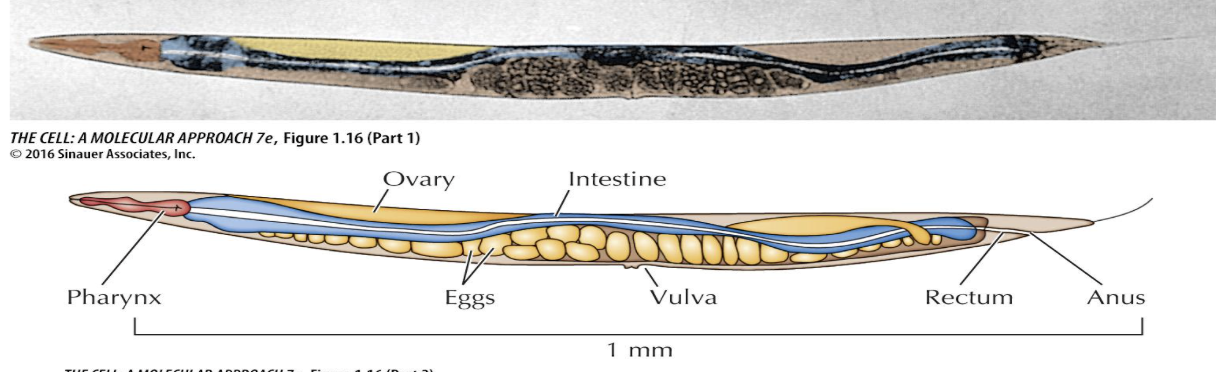
Experimental Models: Caenorhabditis elegans
Nematode
one of the most widely used models
Experimental Models: Drosphila melanogaster
fruit fly
model organism in developmental biology
short reproductive cycle
useful for genetic experiments
Experimental Models: Arabidopsis thaliana
model for plant molecular biology and development
small genome and is easily grown
Experimental Models: Vertebrates
Most complex animals
Xenopus laevis
Zebrafish
One approach for study - use isolated cells in culture
Highly differentiated cells important
Experimental Models: Xenopus laevis
frog
studies of early vertebrate development
produces large numbers of large eggs
Experimental Models: Zebrafish
small and reproduce rapidly
early stages of development easily observed
Experimental Models: Mouse
most common mammal model
genetically engineered mice used to study the functions of genes
high similarity of mouse and human genomes
similar developmental defects
What are the tools used for cell biology?
microscopy
subcellular fractionation
cell culture
types of microorganisms used for studies
Light Microscopy
led to discovery of cells
Robert Hooke coined the term “cell”
1670s, Antony van Leeuwenhoek observed a variety of cells
cell theory
cells arise from preexisting cells
Modern light microscopes
Can magnify objects up to 1000x
Resolution
ability to distinguish objects separated by small distances
more important than magnification

What determines the limit of resolution?
Wavelength of visible light
lambda is fixed at approximately 0.5 um
Numerical aperture (NA), the light-gathering power of the lens
size of the cone of light that enters the lens

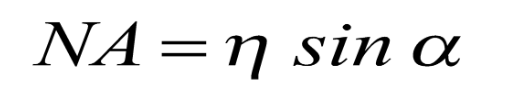
What does each variable stand for?
η = refractive index of the medium
η - 0.1 for air
Maximum for α is 90 degrees,
at which sinα = 1
Theoretical limit of resolution is….

Bright-field microscopy
light passes directly though cell
preserved with fixatives and stained with dyes
techniques can’t be used to study living cells
Phase-contrast microscopy and differential interference-contrast microscopy
convert variations in density or thickness to differences in contrast
these can be used for living cells
Video cameras and computers
image analysis and processing
enhance the contrast of images
Video-enhanced differential interference — contrast microscopy
visualization of the movement of organelles
Fluorescent microscopy
molecular analysis
fluorescent dye is attached to a molecule of interest
the fluorescent dye molecules absorb light at one wavelength and emit light at a different wavelength
Green fluorescent protein (GFP)
fused to any protein of interest using recombinant DNA
tagged protein is expressed in cells and detected by fluorescence microscopy
no need to stain or fix the cells
Fluorescence resonance energy transfer (FRET)
two proteins coupled to different fluorescent dyes
light emitted by one GFP variant excited the second
used to study interactions between proteins in a cell
Confocal microscopy
increases contrast and detail by analyzing fluorescence from a single point

Multi-photon excitation microscopy
excitation of a fluorescent dye at the point upon which the laser beam is focused
localization of excitation minimizes damage to the specimen
Electron microscopy
much greater resolution than light microscopy because of the short wavelength of electrons
Transmission electron microscopy
specimens fixed and stained with salts of heavy metals provide contrast
beam of electrons is passed through the specimen
Electron tomography
3D images by computer analysis of multiple 2D images obtained
Metal shadowing
visualize the surface fo subcellular structures or macromolecules
Freeze fracturing
specimens frozen in liquid nitrogen and then fractured with a knife blade
often splits the lipid bilayer
reveals the interior faces of a cell membrane
Scanning electron microscopy
3D image of cells
electron beam does not pass through specimen
surface of the cell coated with a heavy metal
beam of electrons is used to scan across the specimen
Super-resolution light microscopy
increases resolution of fluorescence microscopy to 10-100 nm
STORM (stochastic optical reconstruction microscopy)
Other types of microscopy
Atomic Force Microscopy
X-ray microscopy
Cryo-electron microscopy (cryo-EM)
Subcellular fractionation
organelles must be isolated from cell to determine the function
Differential centrifugation
separate cell components by size and density
ultracentrifuge spins at very high speeds
Density-gradient centrifugation
organelles are separated by sedimentation through a gradient of a dense substance
Velocity centrifugation
particles of different sizes sediment through the gradient at different rates
Equilibrium centrifugation
separates subcellular components on basis of buoyant density
Viruses
intracellular parasites
cannot replicate on their own
very small
need a host to survive
consist of DNA or RNA surrounded by a protein coat
Bacteriophages
bacterial viruses
simplified the study of bacterial genetics
T4 infects E/coli
Retroviruses
have RNA genome but synthesize a DNA copy of their genome
Cell culture
in vitro culture systems of cells enable cell growth and differentiation studies, and perform genetic manipulations
embryo fibroblasts grow particularly well in culture and a widely studied type of animal cell
HeLa immortal cell line
Henrietta Lacks
durable, prolific and do not die
Embryonic stem cells
differentiate into all of the cell types of adult organisms
gene function in mouse development and can possibly treat diseases by transplantation therapies
Serum-free media
makes culturing cells possible by identifying individual growth factors
Primary culture
initial cell culture from tissues
most normal cells cannot be grown in culture indefinitely
cells can be replated to form secondary cultures
Plant cell cultures
with appropriate growth factors, these produce a mass of undifferentiated cells called a callus
many plant cells capable of differentiation into many different cell types