[TOXICOLOGY] Specific Toxicants
 Call Kai
 Learn
Learn Practice Test
 Spaced Repetition
 Match
Match Flashcards
 Knowt Play
1/64

Earn XP
Description and Tags
Proverbs 16:3
Name | Mastery | Learn | Test | Matching | Spaced | Call with Kai | Chat |
|---|
No analytics yet
Send a link to your students to track their progress
65 Terms
All
[INDUSTRIAL + HOUSEHOLD TOXICANTS]
Which of the following is an example of a solvent?
a. alcohol (OH)
b. glycol
c. aldehydes
d. hydrocarbons
b. CNS disturbances
↑ lipophilicity = ↑ chances of CNS disturbances
[INDUSTRIAL + HOUSEHOLD TOXICANTS]
Increased lipophilicity of solvents increases the risk of:
a. renal obstruction
b. CNS disturbances
c. thrombosis
d. jaundice
b. irritating
[INDUSTRIAL + HOUSEHOLD TOXICANTS]
Aldehydes are generally known to be:
a. sedatives
b. irritating
c. antihypertensive
d. anticonvulsant
d. sensitizers causing allergic reactions
[INDUSTRIAL + HOUSEHOLD TOXICANTS]
Amides commonly act as:
a. bronchodilators
b. anticoagulants
c. CNS stimulants only
d. sensitizers
a. cytotoxicity and mutagenicity
[INDUSTRIAL + HOUSEHOLD TOXICANTS]
Halogenated hydrocarbons are associated with:
a. cytotoxicity and mutagenicity
b. bronchodilation and vasodilation
c. increased acetylcholine activity
d. protein synthesis stimulation
b. CNS depression
[INDUSTRIAL + HOUSEHOLD TOXICANTS]
Alcohol toxicity commonly produces:
a. CNS stimulation
b. CNS depression
c. severe hypertension
d. muscle rigidity
a. antifreeze preparations
[INDUSTRIAL + HOUSEHOLD TOXICANTS]
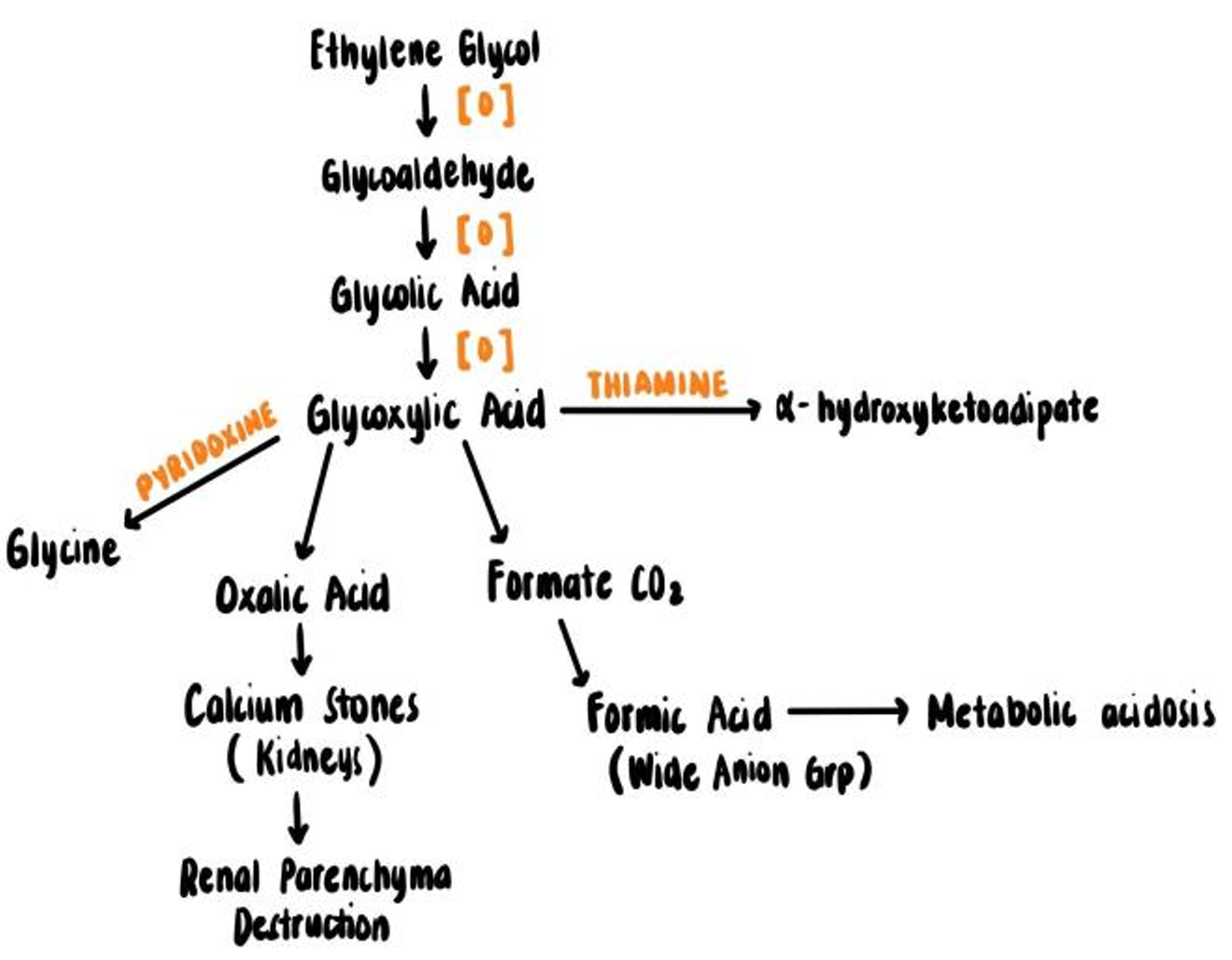
Ethylene glycol is commonly found in:
a. antifreeze preparations
b. oral antiseptics
c. antihistamines
d. bronchodilators
b. transient excitation → CNS depression → coma resembling ethanol (EtOH) intoxication
[INDUSTRIAL + HOUSEHOLD TOXICANTS]
The first stage of ethylene glycol poisoning is characterized by:
a. renal stone formation
b. transient excitation → CNS depression → coma resembling ethanol (EtOH) intoxication
c. cardiopulmonary sx, tachypnea, tachycardia, metabolic acidosis
d. isolated hypertension
c. cardiopulmonary sx, tachypnea, tachycardia, metabolic acidosis
[INDUSTRIAL + HOUSEHOLD TOXICANTS]
The second stage of ethylene glycol poisoning is characterized by:
a. renal stone formation
b. transient excitation → CNS depression → coma resembling ethanol (EtOH) intoxication
c. cardiopulmonary sx, tachypnea, tachycardia, metabolic acidosis
d. isolated hypertension
a. renal stone formation
[INDUSTRIAL + HOUSEHOLD TOXICANTS]
The third stage of ethylene glycol poisoning is characterized by:
a. renal stone formation
b. transient excitation → CNS depression → coma resembling ethanol (EtOH) intoxication
c. cardiopulmonary sx, tachypnea, tachycardia, metabolic acidosis
d. isolated hypertension
a. ethanol (EtOH)
[INDUSTRIAL + HOUSEHOLD TOXICANTS]
Which treatment for toxic alcohol poisoning works by competing with alcohol dehydrogenase?
a. ethanol (EtOH)
b. thiamine/pyridoxine
c. leucovorin
d. fomepizole
a. α-hydroxy-β-ketoadipate
[INDUSTRIAL + HOUSEHOLD TOXICANTS]
Thiamine and pyridoxine help by facilitating conversion to:
a. α-hydroxy-β-ketoadipate
b. cyanomethemoglobin
c. formate
d. acetaldehyde
b. formate to CO₂
[INDUSTRIAL + HOUSEHOLD TOXICANTS]
Leucovorin facilitates the conversion of:
a. methanol to formaldehyde
b. formate to CO₂
c. ethanol to acetaldehyde
d. glycolate to oxalate
c. fomepizole (4-methylpyrazole)
[INDUSTRIAL + HOUSEHOLD TOXICANTS]
Which drug is a direct alcohol dehydrogenase inhibitor?
a. pyridoxine
b. leucovorin
c. fomepizole (4-methylpyrazole)
d. ethanol
b. colorless liquid volatile at room temperature
[INDUSTRIAL + HOUSEHOLD TOXICANTS]
Methanol (wood alcohol) is best described as a:
a. colored solid compound
b. colorless liquid volatile
c. nonvolatile gas
d. viscous oil
d. Methanol
[INDUSTRIAL + HOUSEHOLD TOXICANTS]
Wood alcohol
a. EtOH
b. Formaldehyde
c. HC
d. Methanol
b. non-toxic until metabolized
[INDUSTRIAL + HOUSEHOLD TOXICANTS]
Methanol itself is relatively:
a. highly toxic immediately
b. non-toxic until metabolized
c. mutagenic and toxic
d. nephrotoxic
c. formic acid
[INDUSTRIAL + HOUSEHOLD TOXICANTS]
The toxic metabolite of methanol responsible for major toxicity is:
a. acetaldehyde
b. glycolic acid
c. formic acid
d. lactic acid
a. methanol → formaldehyde → formic acid
[INDUSTRIAL + HOUSEHOLD TOXICANTS]
Methanol is metabolized in which sequence?
a. methanol → formaldehyde → formic acid
b. methanol → formic acid → formaldehyde
c. methanol → ethanol → formate
d. methanol → ketone → acid
c. cytochrome oxidase in the optic nerve
[INDUSTRIAL + HOUSEHOLD TOXICANTS]
Formic acid causes blindness by inhibiting:
a. acetylcholinesterase
b. dopamine receptors
c. cytochrome oxidase in the optic nerve
d. sodium-potassium ATPase
c. metabolic acidosis
[INDUSTRIAL + HOUSEHOLD TOXICANTS]
A major acid-base disturbance seen in methanol poisoning is:
a. respiratory alkalosis
b. metabolic alkalosis
c. metabolic acidosis
d. respiratory acidosis
b. compensation for metabolic acidosis
[INDUSTRIAL + HOUSEHOLD TOXICANTS]
Hyperventilation in methanol poisoning occurs as:
a. a toxic side effect only
b. compensation for metabolic acidosis
c. evidence of pneumonia only
d. a sign of renal failure
d. pale and clammy skin
[INDUSTRIAL + HOUSEHOLD TOXICANTS]
Which skin finding may accompany methanol-induced metabolic acidosis?
a. flushed, dry skin
b. cyanotic rash
c. jaundiced skin
d. pale and clammy skin
b. decreased intracerebral pH
[INDUSTRIAL + HOUSEHOLD TOXICANTS]
Confusion and lethargy in methanol poisoning are related to:
a. increased intracerebral pH
b. decreased intracerebral pH
b. negative inotrope causing myocardial depression
[INDUSTRIAL + HOUSEHOLD TOXICANTS]
Hypotension in methanol poisoning occurs because H⁺ acts as a:
a. positive inotrope
b. negative inotrope
a. H⁺ causes K⁺ to shift outside cells
[INDUSTRIAL + HOUSEHOLD TOXICANTS]
Arrhythmias in methanol poisoning may occur because:
a. H⁺ causes K⁺ to shift outside cells
b. calcium shifts into cells only
c. sodium is completely depleted
d. acetylcholine increases excessively
a. blindness
[INDUSTRIAL + HOUSEHOLD TOXICANTS]
A hallmark severe manifestation of methanol poisoning is:
a. blindness
b. jaundice
c. renal stone formation
d. urinary retention
b. competing with alcohol dehydrogenase
[INDUSTRIAL + HOUSEHOLD TOXICANTS]
Ethanol (EtOH) helps treat methanol poisoning by:
a. increasing methanol metabolism
b. competing with alcohol dehydrogenase
c. neutralizing formic acid directly
d. increasing renal potassium excretion
c. colorless liquid with a pungent odor
[INDUSTRIAL + HOUSEHOLD TOXICANTS]
Formaldehyde is best described as a:
a. colored gas with sweet odor
b. nonvolatile solid compound
c. colorless liquid with a pungent odor
d. tasteless powder
b. embalming liquid
[INDUSTRIAL + HOUSEHOLD TOXICANTS]
Formaldehyde is commonly used as:
a. antifreeze
b. embalming liquid
c. bronchodilator
d. food preservative
d. snowstorm
[INDUSTRIAL + HOUSEHOLD TOXICANTS]
Formaldehyde is commonly used as:
a. antifreeze
b. food preservative
c. bronchodilator
d. snowstorm
a. mucosal irritation
[INDUSTRIAL + HOUSEHOLD TOXICANTS]
A local effect of formaldehyde exposure is:
a. mucosal irritation
b. renal stone formation
c. hypertension
d. hyperglycemia
a. oral, oropharyngeal irritation
[INDUSTRIAL + HOUSEHOLD TOXICANTS]
A local effect of formaldehyde exposure is:
a. oral, oropharyngeal irritation
b. renal stone formation
c. hypertension
d. hyperglycemia
d. conjunctiva
[INDUSTRIAL + HOUSEHOLD TOXICANTS]
A local effect of formaldehyde exposure is:
a. hyperglycemia
b. renal stone formation
c. hypertension
d. conjunctiva
c. metabolic acidosis
[INDUSTRIAL + HOUSEHOLD TOXICANTS]
A systemic metabolic effect of formaldehyde poisoning is:
a. metabolic alkalosis
b. respiratory alkalosis
c. metabolic acidosis
d. respiratory acidosis
a. ammonium salts
[INDUSTRIAL + HOUSEHOLD TOXICANTS]
The treatment for formaldehyde poisoning includes:
a. ammonium salts
b. atropine
c. methylene blue
d. naloxone
a. hydrogen and carbon
[INDUSTRIAL + HOUSEHOLD TOXICANTS]
Hydrocarbons are organic compounds composed of:
a. hydrogen and carbon
b. sodium and chloride
c. oxygen and nitrogen
d. sulfur and phosphorus
b. aromatic and aliphatic HC
[INDUSTRIAL + HOUSEHOLD TOXICANTS]
Petroleum distillates are mixtures of:
a. proteins and carbohydrates
b. aromatic and aliphatic HC
c. amino acids and fats
d. acids and bases
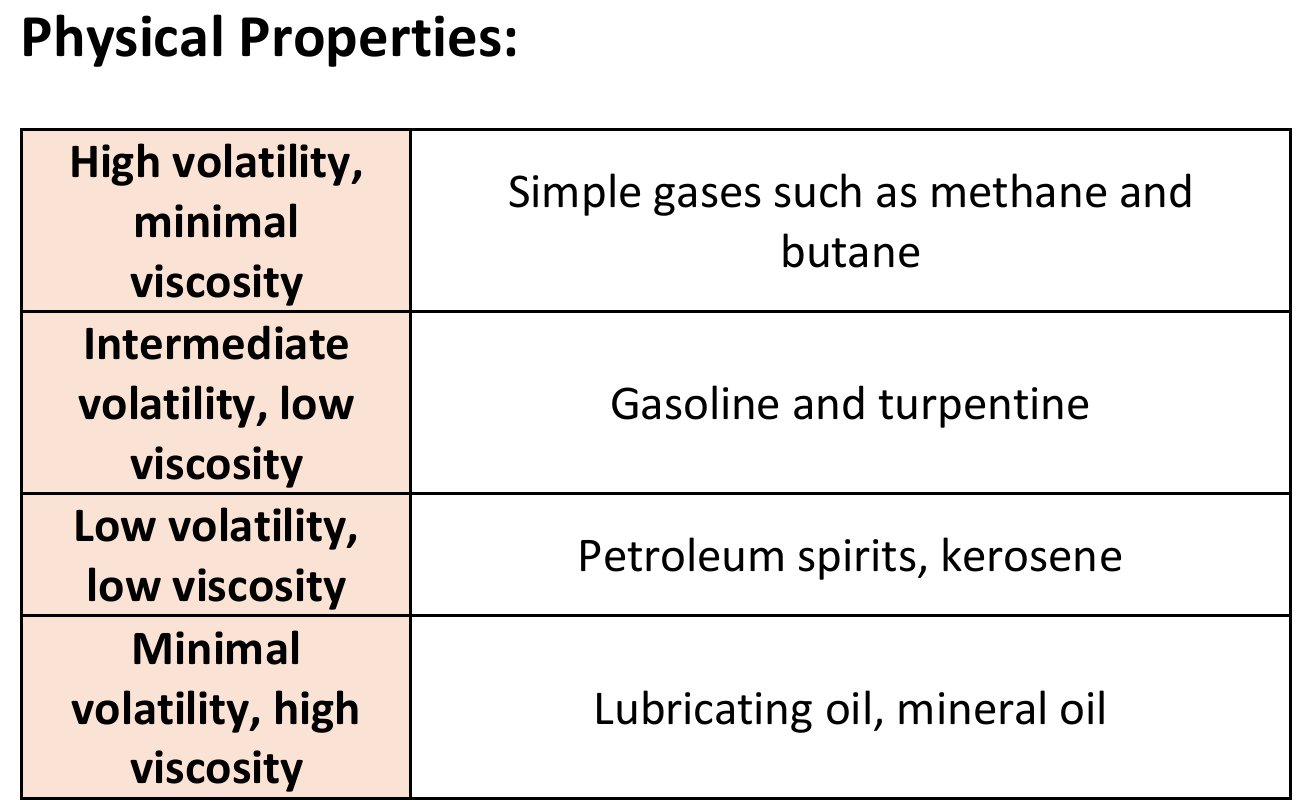
1. D - Lubricating oil
2. F - Methane
3. A - Gasoline
4. B - Petroleum spirits
5. E - Turpentine
6. C - Butane
7. G - Kerosene
8. H - Mineral oil
[INDUSTRIAL + HOUSEHOLD TOXICANTS]
Matching Quiz: Physical Properties of Hydrocarbons and Petroleum Distillates
Column A: Physical Properties | Column B: Examples | |
|---|---|---|
1. Minimal volatility, high viscosity | A. Gasoline | |
2. High volatility, minimal viscosity | B. Petroleum spirits | |
3. Intermediate volatility, low viscosity | C. Butane | |
4. Low volatility, low viscosity | D. Lubricating oil | |
5. Intermediate volatility, low viscosity | E. Turpentine | |
6. High volatility, minimal viscosity | F. Methane | |
7. Low volatility, low viscosity | G. Kerosene | |
8. Minimal volatility, high viscosity | H. Mineral oil |
d. increasing volatility and decreasing viscosity
[INDUSTRIAL + HOUSEHOLD TOXICANTS]
Hydrocarbon aspiration causing increased lung irritation is most associated with:
a. decreasing volatility and increasing viscosity
b. increased viscosity and reduced aspiration
c. low volatility and high protein binding
d. increasing volatility and decreasing viscosity
Burning sensation
Choking
Coughing
Gagging
Atelectasis, bronchopneumonia
CNS manifestation
[INDUSTRIAL + HOUSEHOLD TOXICANTS]
Clinical Presentation of Hydrocarbons and Petroleum Distillates Toxicants:
Burning sensation or Cooling sensation?
Severe asthma or Choking
Pneumonia or Coughing?
Gagging or Severe nausea?
Pulmonary embolism or Atelectasis?
Bronchopneumonia or Aspiration pneumonia?
CNS manifestation or Dermal manifestation?
a. respiratory oxygen support
[INDUSTRIAL + HOUSEHOLD TOXICANTS]
Initial supportive management includes:
a. respiratory oxygen support
b. insulin infusion
c. atropine administration
d. methylene blue
a. selective β₂ agonist
[INDUSTRIAL + HOUSEHOLD TOXICANTS]
Which treatment is used for bronchospasm in hydrocarbon poisoning?
a. selective β₂ agonist
b. naloxone
c. pralidoxime
d. leucovorin
b. increasing viscosity
Mineral oil – ↑ viscosity ↓ aspiration
[INDUSTRIAL + HOUSEHOLD TOXICANTS]
Mineral oil helps reduce aspiration by:
a. decreasing viscosity
b. increasing viscosity
c. inducing emesis
d. neutralizing acid
b. coagulation necrosis
ACIDS – coagulation necrosis – eschar (protective) → deeper layer (protects)
BASES – liquefactive necrosis → deeper penetration
[ACIDS AND ALKALIS]
Acids primarily cause tissue injury through:
a. liquefactive necrosis
b. coagulation necrosis
c. acetylcholinesterase inhibition
d. vasodilation
a. liquefactive necrosis
ACIDS – coagulation necrosis – eschar (protective) → deeper layer (protects)
BASES – liquefactive necrosis → deeper penetration
[ACIDS AND ALKALIS]
Bases primarily cause tissue injury through:
a. liquefactive necrosis
b. coagulation necrosis
c. acetylcholinesterase inhibition
d. vasodilation
a. supportive treatment
[ACIDS AND ALKALIS]
Initial management of acid or base poisoning is mainly:
a. supportive treatment
b. methylene blue administration
c. pralidoxime administration
d. induced emesis
b. perforation develops
[ACIDS AND ALKALIS]
Surgery may be indicated in corrosive poisoning when:
a. bronchospasm occurs
b. perforation develops
c. mild nausea develops
d. headache persists
d. neutralization and dilution
[ACIDS AND ALKALIS]
Which intervention should be avoided in corrosive ingestion?
a. oxygen support
b. surgical evaluation
c. supportive care
d. neutralization and dilution
d. binding to sulfhydryl groups of enzymes, causing inactivation
[HEAVY METALS]
The common mechanism of toxicity of heavy metals is:
a. activation of sulfhydryl groups
b. Anaphylaxis vs Anaphylactoid (not IgE mediated)
c. inhibition of dopamine reuptake
d. binding to sulfhydryl groups of enzymes, causing inactivation
b. chelators
[HEAVY METALS]
The treatment of choice for heavy metal poisoning is:
a. antidopaminergics
b. chelators
c. anticholinergics
d. anticonvulsants
b. FD&C 5
[FOOD ADDITIVES]
Tartrazine is also known as:
a. FD&C 1
b. FD&C 5
c. FD&C 40
d. FD&C 7
a. anaphylaxis or anaphylactoid reactions
[FOOD ADDITIVES]
The mechanism of tartrazine-induced reactions is most similar to:
a. anaphylaxis or anaphylactoid reactions
b. acetylcholinesterase inhibition
c. methemoglobin formation
d. coagulation necrosis
b. not IgE-mediated
[FOOD ADDITIVES]
An anaphylactoid reaction differs from anaphylaxis because it is:
a. IgE-mediated
b. not IgE-mediated
a. hives
[FOOD ADDITIVES]
Which manifestation is commonly seen with tartrazine reactions?
a. hives
b. jaundice
c. petechiae
d. cyanosis
d. difficulty breathing
[FOOD ADDITIVES]
A serious manifestation of tartrazine hypersensitivity is:
a. hematuria
b. constipation
c. dysuria
d. difficulty breathing
a. shock
[FOOD ADDITIVES]
Severe tartrazine reactions may progress to:
a. shock
b. renal stones
c. cirrhosis
d. hyperglycemia
b. epinephrine and antihistamines
[FOOD ADDITIVES]
The drug of choice for severe tartrazine-induced anaphylactic reactions is:
a. atropine
b. epinephrine
c. naloxone
d. pralidoxime
a. anaphylaxis or anaphylactoid reactions
[FOOD ADDITIVES]
The mechanism of Monosodium Glutamate or MSG reactions is most similar to:
a. anaphylaxis or anaphylactoid reactions
b. methemoglobin formation
c. acetylcholinesterase inhibition
d. coagulation necrosis
a. difficulty breathing
[FOOD ADDITIVES]
Which symptom may occur in MSG sensitivity reactions?
a. difficulty breathing
b. hematuria
c. constipation
d. jaundice
a. facial flushing
[FOOD ADDITIVES]
A characteristic feature of MSG syndrome is:
a. facial flushing
b. cyanosis
c. hives
d. renal colic
b. tachycardia
[FOOD ADDITIVES]
Which symptom may occur in MSG sensitivity reactions?
a. shock
b. tachycardia
c. heart block
d. hypotension
b. epinephrine and antihistamine
[FOOD ADDITIVES]
The drug of choice for severe MSG-induced hypersensitivity reactions is:
a. naloxone
b. epinephrine
c. atropine
d. pralidoxime
[FOOD ADDITIVES]
[FOOD ADDITIVES]