3310-Chapter 3: Fluid statics
 Call Kai
 Learn
Learn Practice Test
 Spaced Repetition
 Match
Match Flashcards
 Knowt Play
1/42

There's no tags or description
Looks like no tags are added yet.
Name | Mastery | Learn | Test | Matching | Spaced | Call with Kai | Chat |
|---|
No analytics yet
Send a link to your students to track their progress
43 Terms
Pressure
A normal force exerted by a fluid per unit area
1 Pa
1 N/m2
1 bar = 105 Pa =
0.1 Mpa = 100 kPa
1 atm = 101,325 Pa =
101.325 kPa = 1.01325 bars
1 atm
14.696 psi
psi
lbf/in2
Absolute pressure:
Actual pressure at a given position - measured relative to absolute vacuum (i.e., absolute zero pressure).
Gage pressure:
Difference between the absolute pressure and the local atmospheric pressure. Most pressure-measuring devices are calibrated to read zero in the atmosphere, and so they indicate gage pressure.
Vacuum pressures:
Pressures below atmospheric pressure.
Gage Pressure Calculations
Pgage = Pabs - Patm
Vacuum Pressure Calculation
Pvac = Patm - Pabs
Absolute Pressure Calculation
Pabs = Patm - Pvac
Why is pressure a scalar quantity
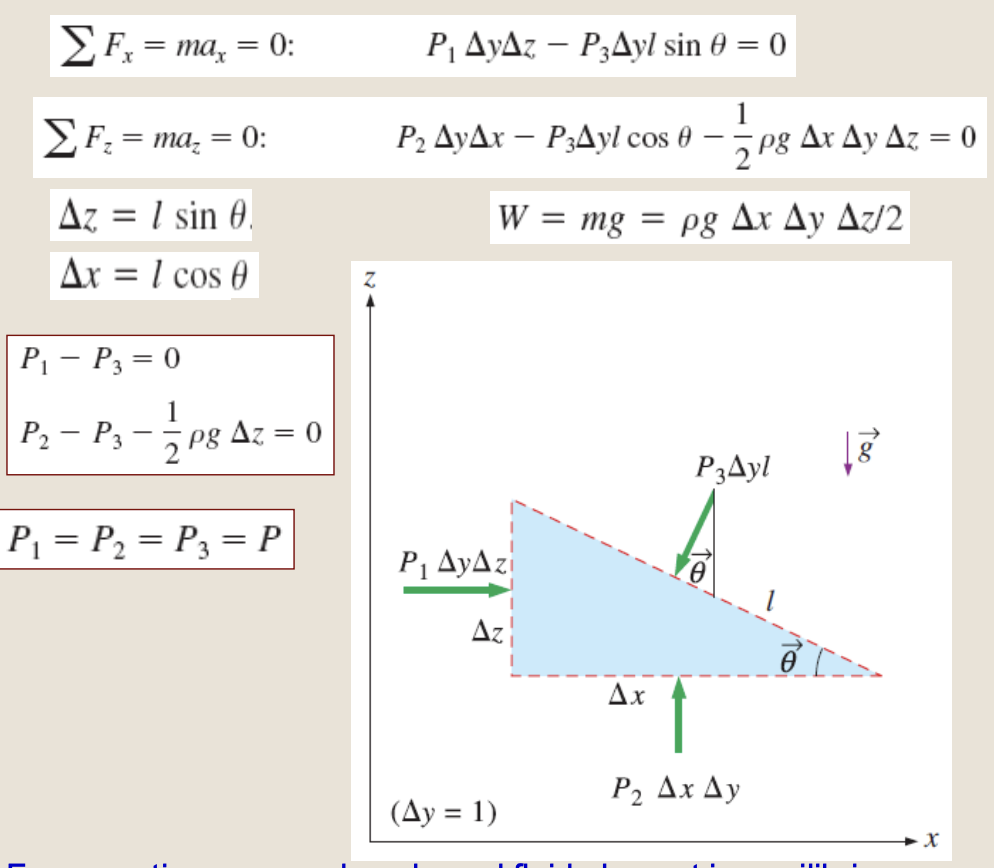
Pressure at any point in a fluid is the same in all directions.
Pressure has magnitude but not a specific direction
The pressure at a point in a fluid is the same in all directions
Applicable to fluids in motion and fluids at rest
Pressure at a point on a wedge shaped fluid element
variation of pressure with depth
Pbelow = Pabove + ρg|∆z| = Pabove + γs|∆z|
P = Patm + ρgh OR Pgage = ρgh
∆P = P2 - P1 = -∫21 ρgdz

Pressure in a room filled with gas
Variation of pressure with height is negligible
Pressure in a liquid
at rest increases linearly with distance from free surface
Assuming incompressible fluid
Pressure change with elevation
Pbelow - Pabove = ρg∆z
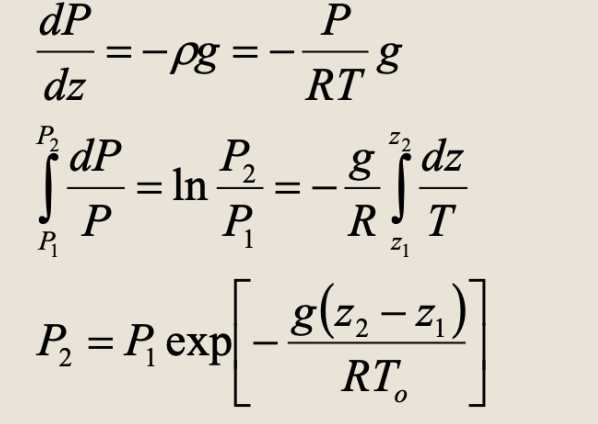
Pressure depth relationship for compressible fluids
Density of gases – temperature and pressure effects significant
Pressure gradient for gases is small bcos specific weight is small (0.07063 vs 62.4 lb/ft3), (0.118 vs 9.81 kN/m3)
Effect of elevation changes on pressure for small distances very small (tanks, pipes)
when elevation difference is thousands of feet
Picture
Standard Atmosphere properties in SI units
Temperature, T = 288.15 K (15oC)
Pressure, p = 101.33 kPa (abs)
Density, ρ = 1.225 kg/m3
Specific weight, g = 12.014 N/m3
Viscosity, µ = 1.789 x 10⁻⁵ N s/m2
Standard Atmosphere properties in BG Units
Temperature, T = 581.67 oR (59.00 oF)
Pressure, p = 2216.2 lb/ft2 (abs) 14.686 lb/in2 (abs)
Density, ρ = 0.002377 slugs/ft3
Specific weight, g = 0.07647 lb/ft3
Viscosity, µ = 3.737 x 10⁻⁷ lb s/ft2
Simon Stevin – Dutch mathematician
Pressure is the same at all points on a horizontal plane in a given fluid regardless of geometry, provided that the points are interconnected by the same fluid. • Note that pressure at H and I are different bcos not interconnected by the same fluid. • The pressure force exerted by a fluid is always normal to the surface

Pascal’s Law
Pressure applied to a confined fluid increases the pressure throughout by the same amount. P1 = P2 → F1/A1 =F2/A2 → F2/F1 = A2/A1
Application of Pascal’s Law
Area ratio A2/A1: Ideal mechanical advantage of hydraulic lift
Lifting a large weight with a small force
•Examples: hydraulic jacks, lifts, brakes, presses
Barometer
Patm = ρgh
PB = PC + Pfgh
The length or cross-sectional area of the tube does not affect the height of the fluid column of a barometer,
The tube diameter is large enough to avoid surface tension (capillary) effects.

Aneroid Brometer
Lower accuracy (+- 0.2 hPa)
• Compact and portable
• Easier to handle and use
• Self recording
• Airplanes as altimeters (height)
• Require calibration

Atmospheric Pressure
The weight of air above that location per unit surface area
Changes with elevation and weather conditions
At high altitudes, a car engine generates less power, and a person gets less oxygen because of the lower density of air
~ 15% drop in density will affect cooking, breathing, airplanes, cooling fans, etc. ~15% drop in pressure
Manometry - Piezometer tube
PA = P1 = Patm + ρgh1
PA = ρgh1
vertical or inclined liquid columns
fluid in container must be liquid
Pressure in container > atmospheric
Piezometer Tube: simplest and accurate (sphygmomanometer for blood pressure measurement)


Manometer
P2 = P1 = Patm + ρgh
Used to measure small and moderate pressure differences
Contains one or more fluids
Overcomes difficulties with the use of a piezometer
Stops at a change in fluid first
pressure difference in measurement - U-tube manometers
Gauge fluids immiscible with other fluids in contact with it
pA + γ1h1 - γ2h2 - γ3h3 = p5 = pB
pA - pB = γ2h2 + γ3h3 -γ1h1

Differential Manometers
In stacked-up fluid layers, the pressure change across a fluid layer of density r and height h is rgh.
Measuring the pressure drop across a flow section or a flow device

Hydrostatic pressure with variable density
ρ = ρ0 √1 + tan²(πs/4H)
ρ0 = density on waters surface
s = vertical distance measure downward
H = thickness of gradient zone
Bourdon tube
hollow metal tube bent like a hook whose end is closed and connected to a dial indicator needle.
Pressure transducer
convert the pressure effect to an electrical effect such as a change in voltage, resistance, or capacitance. Pressure transducers are smaller and faster, and they can be more sensitive, reliable, and precise than their mechanical counterparts.
Strain-gage pressure transducers
Work by having a diaphragm deflect between two chambers open to the pressure inputs.
Piezoelectric transducers
solid-state pressure transducers, work on the principle that an electric potential is generated in a crystalline substance when it is subjected to mechanical pressure
Deadweight Tester
Used primarily for calibration and can measur extremely high pressures
measures pressure directly through application of a weight that provides a force per unit area
Constructed with an internal chamber filled with a fluid (usually oil), along with a tight-fitting piston, cylinder, and plunger.
Weights applied to the top of the piston exerts a force on the oil in the chamber. The total force F acting on the oil at the piston–oil interface is the sum of the weight of the piston plus the applied weights.

Fluid statics
Deals with problems associated with fluids at rest.
no relative motion between adjacent fluid layers, and thus there are no shear (tangential) stresses in the fluid trying to deform it.
Hydrostatics
When fluid is a liquid.
Aerostatics
When fluid is a gas