Exam 3
0.0(0)
Studied by 1 person Call Kai
 Learn
Learn Practice Test
 Spaced Repetition
 Match
Match Flashcards
 Knowt Play
Card Sorting
1/89

Earn XP
Description and Tags
Earthquakes, soils, mass wasting, streams, glaciers, and groundwater.
Last updated 7:24 PM on 5/10/23
Name | Mastery | Learn | Test | Matching | Spaced | Call with Kai | Chat |
|---|
No analytics yet
Send a link to your students to track their progress
90 Terms
1
New cards
earthquake
vibrations of earth produced by the rapid release of energy
Energy released from the source of the earthquake (focus) radiated out in all directions as seismic waves
Energy released from the source of the earthquake (focus) radiated out in all directions as seismic waves
2
New cards
Where does an earthquake happen?
Caused by the sudden slip on a fault located in the Earth’s crust.
3
New cards
How can earthquakes be explained?
theory of plate tectonics
4
New cards
How do you locate an earthquake?
using the difference in the arrival times between P and S wave recordings, which are related to distance
5
New cards
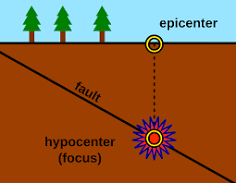
centers of an earthquake
focus (hypocenter)
epicenter
epicenter
6
New cards
focus
AKA hypocenter
the place within Earth where earthquake waves originate
the place within Earth where earthquake waves originate
7
New cards
epicenter
Point on the surface, directly above the focus
8
New cards
fault
a fracture or zone of fractures in the Earth's crust where rocks have moved past each other
9
New cards
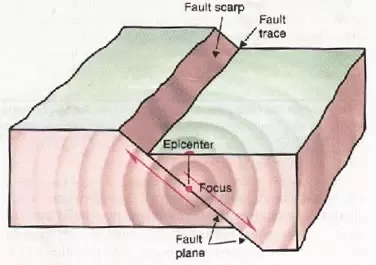
parts of a fault
hanging wall block
foot wall block
foot wall block
10
New cards
hanging wall block
part of a fault
the block named after miners being able to hang lanterns in
usually, on top of the break
the block named after miners being able to hang lanterns in
usually, on top of the break
11
New cards
foot wall block
part of a fault
the block named after miners being able to step on it
usually, on bottom of the break
the block named after miners being able to step on it
usually, on bottom of the break
12
New cards
main types of faults
dip-slip
strike-slip
strike-slip
13
New cards
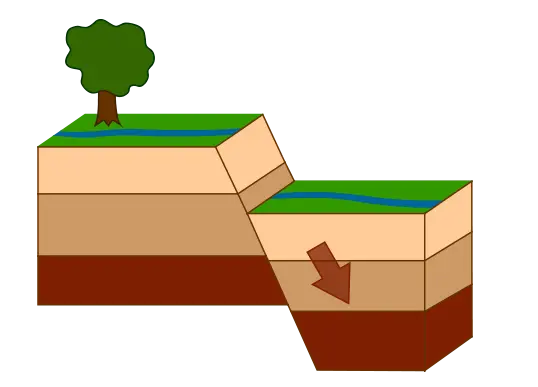
normal fault
A type of fault where the hanging wall moves down relative to the footwall due to tensional forces pulling the rocks apart.
14
New cards
normal fault movement
divergent (pulling)
extensional
extensional
15
New cards
dip-slip fault
a type of fault describing vertical movement up or down along the dip (the fault line)
16
New cards
types of dip-slip faults
normal
reverse
thrust
reverse
thrust
17
New cards
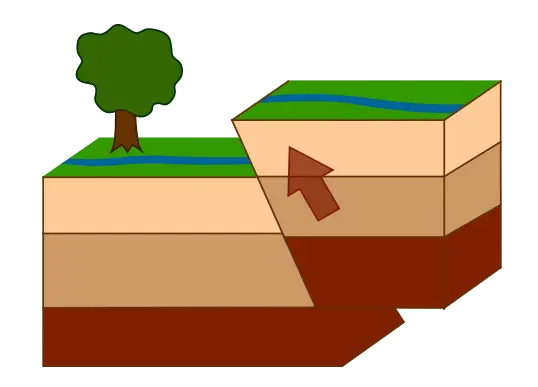
reverse fault
type of fault which the hanging walls moves up relative to the footwall
shortening of the crust occurs
shortening of the crust occurs
18
New cards
reverse fault movement
convergent (coming together)
compressional
compressional
19
New cards
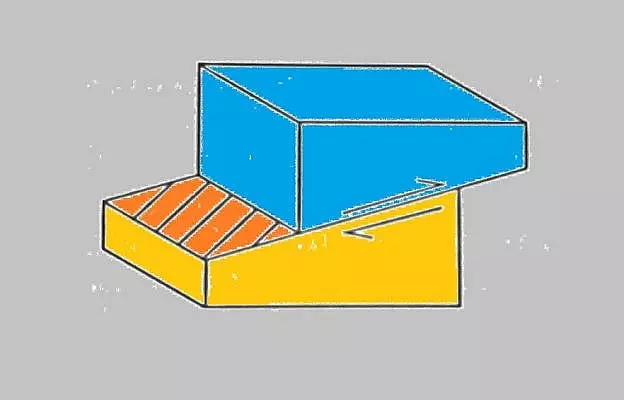
thrust fault
special kind of reverse fault
shallow dip angle (less than 45 degrees)
displaces horizontally
10s of kms
shallow dip angle (less than 45 degrees)
displaces horizontally
10s of kms
20
New cards
evidence of thrust faults
in sedimentary rocks is seen when a sequence of the same rocks are repeated
21
New cards
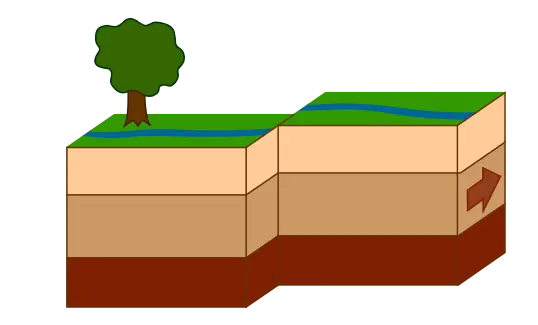
strike-slip fault
a type of fault with displacement in the horizontal direction
movement parallel to strike of the fault line
strike is direction of the line formed by the intersection of the fault plane with the Earth’s surface
movement parallel to strike of the fault line
strike is direction of the line formed by the intersection of the fault plane with the Earth’s surface
22
New cards
strike-slip fault location
associated with plate boundaries
23
New cards
How can you tell if a strike-slip happened to the left or the right?
You look at the features being displaced on the other side - for example, if a river across the fault moved to the left, the crust shifted to the left.
24
New cards
strike-slip fault stress
shear stress
25
New cards
Earthquakes are often preceded by __________________ and followed by _____________.
foreshocks
aftershocks
aftershocks
26
New cards
foreshocks
precede a major earthquake
might be used to predict future earthquakes
might be used to predict future earthquakes
27
New cards
after shocks
adjustments after a major earthquake
usually much weaker than the main quake
usually much weaker than the main quake
28
New cards
elastic rebound theory
explained by H. Reid
rock can only deform so far before it breaks
releases waves of energy that were stored in the rock due to the stress applied to the area
rock can only deform so far before it breaks
releases waves of energy that were stored in the rock due to the stress applied to the area
29
New cards
As part of the elastic rebound theory, earthquakes occur as rock elasticity…
returns to its original shape
30
New cards
San Andreas Fault
\~750 mile fracture that runs from the Salton Sea area of SE California to the Mendocino in NW California
Different portions of the San Andreas Fault system behave in different ways depending on the tectonic stresses
Average displacement of 1-2 inches per year
* In 30 million years, LA will be adjacent to San Francisco
31
New cards
seismology
study of earthquake waves
32
New cards
seismographs
a device put deep within the bedrock of the crust to detect earthquakes
vibrates left and right to write on a rotating drum
produces seismograms
vibrates left and right to write on a rotating drum
produces seismograms
33
New cards
seismograms
strips of paper recorded by a seismograph
can be used to read the different types of earthquake waves
can be used to read the different types of earthquake waves
34
New cards
types of earthquake waves
body waves
surface waves
surface waves
35
New cards
body waves
radiate from the focus
three dimensional
three dimensional
36
New cards
types of body waves
P-wave
S-wave
S-wave
37
New cards
P-wave
type of body wave
occur first (primary)
fastest
push-pull like a slinky
goes through all matter types
occur first (primary)
fastest
push-pull like a slinky
goes through all matter types
38
New cards
S-wave
type of body wave
occurs second (secondary)
second fastest
shear vertical movement
only goes through solid
occurs second (secondary)
second fastest
shear vertical movement
only goes through solid
39
New cards
surface waves
confined to / near surface
2D away from epicenter
are slower than body waves - cause more property damage (3rd to show up)
\
2D away from epicenter
are slower than body waves - cause more property damage (3rd to show up)
\
40
New cards
types of surface ways
Love waves
Rayleigh waves
Rayleigh waves
41
New cards
Love waves
less velocity than S-waves
shearing horizontal motion
3rd to arrive (after S-waves, before Rayleigh waves)
only travel through solids
shearing horizontal motion
3rd to arrive (after S-waves, before Rayleigh waves)
only travel through solids
42
New cards
Rayleigh waves
1/10 velocity of s-waves
very damaging to property
up-and-down rolling motion *and* back-and-forth motion, like Eddy currents in the ocean
4th (last wave)
very damaging to property
up-and-down rolling motion *and* back-and-forth motion, like Eddy currents in the ocean
4th (last wave)
43
New cards
How do you locate an epicenter?
use triangulation:
* Take 3 seismograms from different recording stations
* Circle a radius equal to the distance from the epicenter from each station
* See where the three circles intersect - that is your epicenter
* Take 3 seismograms from different recording stations
* Circle a radius equal to the distance from the epicenter from each station
* See where the three circles intersect - that is your epicenter
44
New cards
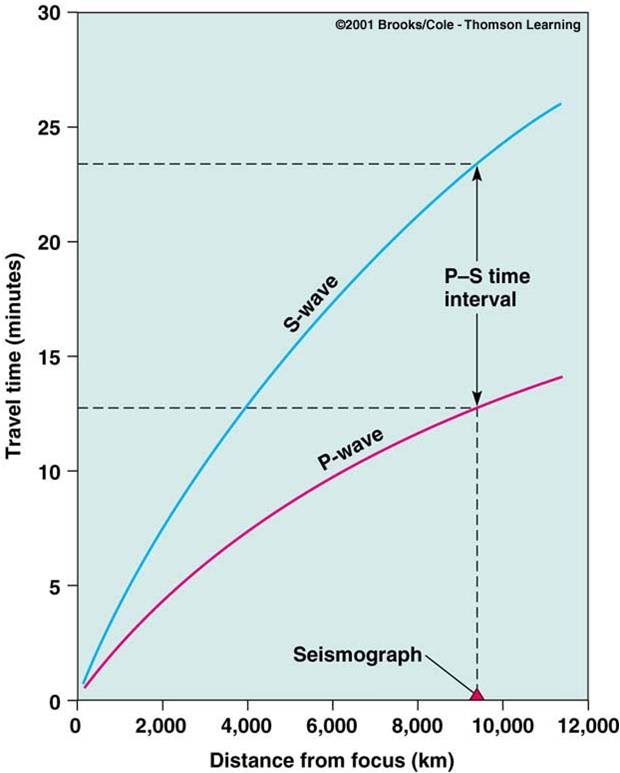
How do you find the distance from the recording stations to the epicenter?
You take the difference in time in seconds between the p-wave and the s-wave.
Plot the interval on a S-P time travel curve - shows you the distance from epicenter the earthquake is.
Plot the interval on a S-P time travel curve - shows you the distance from epicenter the earthquake is.
45
New cards
time travel curve
body waves (p and s waves) go through the earth at different times based on distance
surface waves mostly linear
can find out the distance away from the epicenter a recording center is
surface waves mostly linear
can find out the distance away from the epicenter a recording center is
46
New cards
Earthquake zones are closely correlated with…
plate boundaries
47
New cards
Why do earthquakes occur at plate boundaries?
95% of all energy released by earthquakes occurs along a plate margin
ex. Pacific ring of fire, oceanic ridge system
ex. Pacific ring of fire, oceanic ridge system
48
New cards
An earthquake can be measured by its…
intensity
magnitude
magnitude
49
New cards
earthquake intensity
A measure of the degree of earthquake shaking at a given locale based on the amount of damage
most often measured by Modified Mercalli Intensity Scale (qualitative)
most often measured by Modified Mercalli Intensity Scale (qualitative)
50
New cards
magnitude
introduced by Charles Richter in 1935 (quantitative)
51
New cards
Modified Mercalli Scale
qualitative measure to describe intensity
12 different classes
has some drawbacks
* damage changes with EQ distance
* damage somewhat depends on type of bed rock
* quality of construction matters
* population needs to be seen - what if there’s no one there?
12 different classes
has some drawbacks
* damage changes with EQ distance
* damage somewhat depends on type of bed rock
* quality of construction matters
* population needs to be seen - what if there’s no one there?
52
New cards
Richter scale
quantitative measure to describe magnitude
based on largest seismic wave
designed specifically for southern California
logarithmic scale
drawback: does not estimate adequately size of very large earthquakes with lots of energy released
based on largest seismic wave
designed specifically for southern California
logarithmic scale
drawback: does not estimate adequately size of very large earthquakes with lots of energy released
53
New cards
moment magnitude scale
scale for very large, energetic EQs
derived from displacement amount that occur along a fault zone (not ground away from the site of the EQ)
based on its seismic moment
derived from displacement amount that occur along a fault zone (not ground away from the site of the EQ)
based on its seismic moment
54
New cards
seismic amount
from moment magnitude scale
product of:
* average amount of slip on the fault that produced the EQ
* area actually ruptured
* strength (resistance to distortion)of the rocks that failed
product of:
* average amount of slip on the fault that produced the EQ
* area actually ruptured
* strength (resistance to distortion)of the rocks that failed
55
New cards
regolith
The soft and loose rock particles that result from \n weathering
composed of silicate clay, quartz silt, sand and gravel
rarely seen
composed of silicate clay, quartz silt, sand and gravel
rarely seen
56
New cards
Why is regolith rarely seen in nature?
organic and hydrologic forces quickly act on it, by:
* soil formation
* erosion to create sed rx
* soil formation
* erosion to create sed rx
57
New cards
soil
loose, unconsolidated material on top of bedrock that has been modded / acted upon via physical, chemical and biological processes so that it can sustain rooted plant growth
58
New cards
soil horizons definition
used to assess the factors which have gone into the formation of a specific soil
develop from the top down - each horizion have unique set of physical and chemical properties
develop from the top down - each horizion have unique set of physical and chemical properties
59
New cards
All of the soil horizons together form a…
soil profile
60
New cards
soil horizon types from top to bottom
Horizon A
* A0
* A1
* A2
Horizon B
Horizon C
bedrock
* A0
* A1
* A2
Horizon B
Horizon C
bedrock
61
New cards
A horizon
dark gray to black
rich in organic matter
leaching carries dissolved ions and fine particles
often divided into 3 sublayers
rich in organic matter
leaching carries dissolved ions and fine particles
often divided into 3 sublayers
62
New cards
A0 horizon
surface layer of leaf litter, consists of \n decomposed and non-decomposed organic \n matter (humus)
63
New cards
A1 horizon
humus-rich, dark layer dark in color, layer \n rich in organic material.
Forms just below the \n surface vegetation.
Forms just below the \n surface vegetation.
64
New cards
humus
decomposed plant material found in top soil horizons (A1 horizon especially, that contributes to \n the formation of organic acids (producing slightly \n acidic water) that accelerate leaching
65
New cards
A2 horizon
light colored, bleached out layer, zone of \n leaching.
This is the area where water moves \n downward. The water carries dissolved materials \n to lower horizons
This is the area where water moves \n downward. The water carries dissolved materials \n to lower horizons
66
New cards
B horizon
\
Zone of accumulation \n Accumulates leached material from above \n Enriched in clay minerals and oxides
* Lighter in color, can be red if a lot of iron \n oxides
Harder
Not much in the way of organic material
Zone of accumulation \n Accumulates leached material from above \n Enriched in clay minerals and oxides
* Lighter in color, can be red if a lot of iron \n oxides
Harder
Not much in the way of organic material
67
New cards
C horizon
layer of somewhat weathered parent material
directly above unaltered bedrock
composed of parent rock in various stages of weathering
directly above unaltered bedrock
composed of parent rock in various stages of weathering
68
New cards
bedrock
right underneath the soil horizons of unaltered rock
not part of the soil horizons
not part of the soil horizons
69
New cards
forming soils
well developed, fertile soil can take 100s or 1000s of years
controlled by 5 main processes
controlled by 5 main processes
70
New cards
5 main process of forming soils
parent rock
relief and landscape factors
climate
biosphere
time
relief and landscape factors
climate
biosphere
time
71
New cards
parent rock of soil
original composition influences soil composition
can either be fine or coarse grained, mafic or silicic
can either be fine or coarse grained, mafic or silicic
72
New cards
granitic rock soil type
break down to quartz and feldspars
feldspars break down to clay
feldspars break down to clay
73
New cards
basaltic rock soil tpye
fine grained, no sand, lots of clay
soils may not drain well, but can be fertile
soils may not drain well, but can be fertile
74
New cards
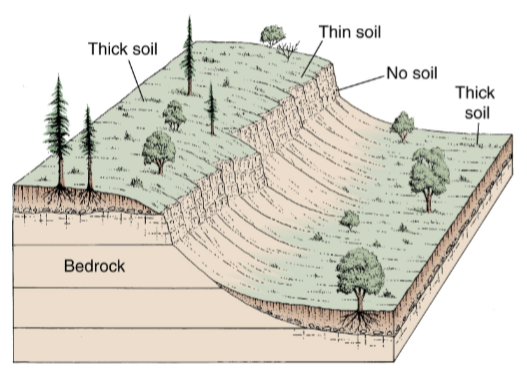
relief and landscape factors on soils
influences the amount and rate of erosion
soils tend to be thick on flat surface and thin on steep slopes, due to the force of gravity
soils tend to be thick on flat surface and thin on steep slopes, due to the force of gravity
75
New cards
climate factors on soil
affects soil thickness and type of soil found
usually can be sorted by wet climate and dry climates
usually can be sorted by wet climate and dry climates
76
New cards
wet climate soils
thick
great deal of water and acids move down the soil horizons, creating accumulations of metal oxides
chemical weathering dominant
great deal of water and acids move down the soil horizons, creating accumulations of metal oxides
chemical weathering dominant
77
New cards
dry climate soils
thin, rocky soils, very little organic matter, little leaching
can have salts form in their soils, due to evaporation of water
physical weathering dominant
can have salts form in their soils, due to evaporation of water
physical weathering dominant
78
New cards
biosphere factor on soils
adds organic matter and mixes soil
plants break up rocks,
burrowing animals bring soil to surface & aerates / hydrates underground
decaying organic material adds CO2 to soil → H2CO3 (carbonic acid)
other organic acids also form to speed up chemical weathering processes
\
plants break up rocks,
burrowing animals bring soil to surface & aerates / hydrates underground
decaying organic material adds CO2 to soil → H2CO3 (carbonic acid)
other organic acids also form to speed up chemical weathering processes
\
79
New cards
time factor on soils
soil forming is slow
character of soil changes with time
as time goes on, soil thickness increases
character of soil changes with time
as time goes on, soil thickness increases
80
New cards
types of soils
residual
transported
transported
81
New cards
residual soils
developed from the weathering of rock directly beneath the soil
may take a long time to develop
ex. decomposed granite, engineers like to build on it because it’s very stable
may take a long time to develop
ex. decomposed granite, engineers like to build on it because it’s very stable
82
New cards
transported soils
did not form from local rock, but instead formed from regolith transported from some other area
usually named depending on their agent of transport (usually water, ice, or wind)
usually named depending on their agent of transport (usually water, ice, or wind)
83
New cards
mass wasting
down slope movement of soil and rock
process of erosion - consequence of weathering
especially problematic in areas of high relief
process of erosion - consequence of weathering
especially problematic in areas of high relief
84
New cards
Mass wasting is mainly due to…
the force of gravity
85
New cards
Mass wasting can also be triggered by…
earthquakes
heavy rain
weakness in the rock
climate
vegetation loss from fires / land clearings
high relief
steep slope angle
water and/or ice
* both as a weight and a lubricant
amount of loose rock and debris along course
heavy rain
weakness in the rock
climate
vegetation loss from fires / land clearings
high relief
steep slope angle
water and/or ice
* both as a weight and a lubricant
amount of loose rock and debris along course
86
New cards
relief
vertical difference between high and low
higher relief causes higher speeds and more momentum in mass wasting
higher relief causes higher speeds and more momentum in mass wasting
87
New cards
role of water in mass wasting
may act to increase/decrease cohesive strength
* dry regolith / soil has little / no cohesion
* damp regolith / soil is sticky
* saturated regolith / soil flows easily
may dissolve cementing material
* dry regolith / soil has little / no cohesion
* damp regolith / soil is sticky
* saturated regolith / soil flows easily
may dissolve cementing material
88
New cards
Water acts as a lubricant in mass wasting by… because…
reducing shear strength
as amount ofwater in debris increases, rate of movement increases as welll
as amount ofwater in debris increases, rate of movement increases as welll
89
New cards
The types of mass movement are based on…
type of material involved
how it moves
water content of material (influence of nature of movement)
velocity
how it moves
water content of material (influence of nature of movement)
velocity
90
New cards