Secret Life of Plants
 Call Kai
 Learn
Learn Practice Test
 Spaced Repetition
 Match
Match Flashcards
 Knowt Play
1/82

There's no tags or description
Looks like no tags are added yet.
Name | Mastery | Learn | Test | Matching | Spaced | Call with Kai | Chat |
|---|
No analytics yet
Send a link to your students to track their progress
83 Terms
5 fundamental themes of biology
structure and function, information flow, energy and matter, interactions, evolution
plants are…
an evolutionary coherent group
the process of science is built on…
hypotheses
hypotheses
proposed explanation about an observation(s)
facts
objectively true piece of evidence
theories
broadly supported explanation about many observations - guide for thinking
Both hypothesis and theories
revisable predictions, have been tested, wide body of repeated testing
How do we test hypothesis
controlled experiments and observational studies
controlled experiments
manipulate a single variable at a time, eliminate confounding variables, measure the process of interest
Independent variable
input, does not depend on others (you change)
dependent variable
effect, you measure
predictor
used to forecast the outcome of another based on its value
treatment group
group of participants who experience a new condition
control
doesn’t receive treatment
response variable
outcome measured to assess effect of variables
confounding variable
factors other than independent that potentially distort the effects of the independent on dependent, covers up response variable/process of interest
Observational studies
identify gradients or categories of your predictor variable, account for confounding variables using statistics, measure the process of interest. Used when not able to do an artificial setting
What is a plant?
An evolutionary coherent group of organisms, descending from a green alga ancestor.
Science
an approach to understanding the natural world that is based on inquiry. Focuses solely on the study of structures and processes that can be observed and measured.
Data
evidence on which scientific inquiry is based
blind experiment
some information is withheld form participants, revealed only after the experiment. Removes bias on the part of the investigators.
Placebo
medically ineffective treatment that allows the placebo group to serve as a control group. Does not know they are receiving an ineffective substitute.
Double-blind
neither the participant nor experimenter knows which group is the control
Ways of evaluating scientific claims
pseudoscience, anecdotal evidence
speudoscience
and field of study that is falsely presented as having a scientific bias
Anecdotal evidence
assertion based on a single or a few examples that do not support conclusion
Properties of life
order, cells, growth and development, energy processing, regulation, reproduction, evolution, response to environment
structure
shape of something
function
what it does
Information flow
received, transmitted, and used.
genes
hereditary units of information consisting of specific sequences of DNA passed on from the previous generation
5 major themes of biology
structure/function, information flow, energy transformations, interacting within systems, evolution
pathways that transform energy and matter
Work requires energy. Input and transformation of energy make life possible. Molecules consumed can be used as both a source of energy and matter. Matter is recycled. Action of decomposers complete cycle. Metabolism, inhibition, molecules swapping chemical partners.
metabolism
vast network of interconnected chemical reactions. Continually converts energy from one form to another.
When a single protein in a metabolic pathway is inhibited, cells lose the ability to…
extract the energy stored in chemical bonds of glucose
Interactions within biological systems
biosphere, ecosystems, communities, populations, organisms, organ systems/organs, tissues, cells, organelles, molecules and atoms
biosphere
consists of all the environments on earth that support life and all life (Ex: soil, oceans, lakes, and bodies of water, lower atmosphere)
ecosystems
all living organisms in a particular area and all nonliving components with which life interacts (Ex: soil, water, and light)
communities
all organisms in an ecosystem (ex: iguanas, crabs, seaweed, and bacteria)
populations
groups of interacting individuals of one species
organisms
individual living thing
organ systems and organs
organisms body consists of 2 or more organs
tissues
each organ made up of several different tissues. Consists of a group of similar cells performing a specific function.
cells
smallest unit that can display characteristics of life.
organelles
functional components of cells
molecules and atoms
clusters of even smaller chemical units
Natural selection
individual with traits best suited tot he local environment are more likely to survive and reproduce.
Natural selection results in…
unequal reproductive success and evolutionary adaptations.
evolution
the process of change
Evolution is… (not definition)
the fundamental principle of life and core theme that unifies all biology
Origin of Species
1859 Darwin, species living today arose form a succession of ancestors. Descent with modification.
Which is not a characteristic of all living organisms?
composed of multiple cells
Place the following levels of biological organization in order from smallest to largest: atom, biosphere, cell, ecosystem, molecule, organ, organism, population, tissue.
Atom, molecule, cell, tissue, organ, organism, population, ecosystem, biosphere
Which is the smallest level capable of demonstrating all o f the characteristics of life?
cell
Plants use the process of photosynthesis to convert the energy in sunlight to chemical energy in the form of sugar. While doing so, they consume carbon dioxide and water and release oxygen. Explain how this process functions in both the cycling of chemical nutrients and the flow o f energy through an ecosystem.
Photosynthesis cycles nutrients by converting the carbon in carbon dioxide to sugar, which is then consumed by other organisms. Additionally, the oxygen in water is released as oxygen gas. Photosynthesis contributes to energy flow by converting sunlight to chemical energy, which is then also consumed by other organisms, and by producing heat.
How does natural selection cause a population to become adapted to its environment over time?
On average, those individuals with heritable traits best suited to the local environment produce the greatest number of offspring that survive and reproduce. This increases the frequency of those traits in the population over time. The result is the accumulation of evolutionary adaptations.
Which statement best describes the logic of the process of sciencel
Test results may or may not support my hypothesis
Which statement best distinguishes hypotheses from theories in sciencel
Hypotheses usually are narrow in scope; theories have broad explanatory power and are supported by a lot o f evidence.
…. is the core theme that unifies all areas of biology.
Evolution
What distinguishes a fact from an opinion?
A fact should be confirmed to be the same by all observers, opinions can differ.
By comparing genes between green sea turtles and humans, insight can be gained into how those genes encode specific physical traits.
Example of information flow
Although green sea turtles consume a lot of vegetation, they get few nutrients from each mouthful, requiring them to graze frequently.
Example of pathways that transofmr energy and matter
As global climate changes, green sea turtles alter many aspects o f their behavior.
Example of interactions within bio systems
The fruits of wild species of tomato are tiny compared with the giant beefsteak tomatoes available today. This difference in fruit size is almost entirely due to the larger number of cells in the domesticated fruits. Plant biologists have recently discovered genes that are responsible for controlling cell division in tomatoes. Why would such a discovery be important to producers of other kinds of fruits and vegetables?
A discovery by plant biologists on the genes that are responsible for controlling cell division in tomatoes would be important to producers of other kinds of fruits and vegetables because those producers could manipulate this gene to develop larger varieties or versions of other fruits and vegetables, increasing profit for themselves.
The fruits of wild species of tomato are tiny compared with the giant beefsteak tomatoes available today. This difference in fruit size is almost entirely due to the larger number of cells in the domesticated fruits. Plant biologists have recently discovered genes that are responsible for controlling cell division in tomatoes. Why would such a discovery be important to the study of human development and disease?
The discovery by plant biologists regarding genes that are responsible for controlling cell division would be important to the study of human development and disease because cell growth and regulation is universal across organisms, similar in both humans and plants. Thus, scientists could use what they’ve learned about the tomato cell division and apply it to cancer research and other diseases associated with uncontrolled cell division
The fruits of wild species of tomato are tiny compared with the giant beefsteak tomatoes available today. This difference in fruit size is almost entirely due to the larger number of cells in the domesticated fruits. Plant biologists have recently discovered genes that are responsible for controlling cell division in tomatoes. Why would such a discovery be important to our basic understanding of biology?
Discovering the genes responsible for controlling cell division helps explain the fundamental link between genetics, cell proliferation, and overall organ size in living organisms. It also connects DNA to cellular reproduction, displaying how genes affect the organism.
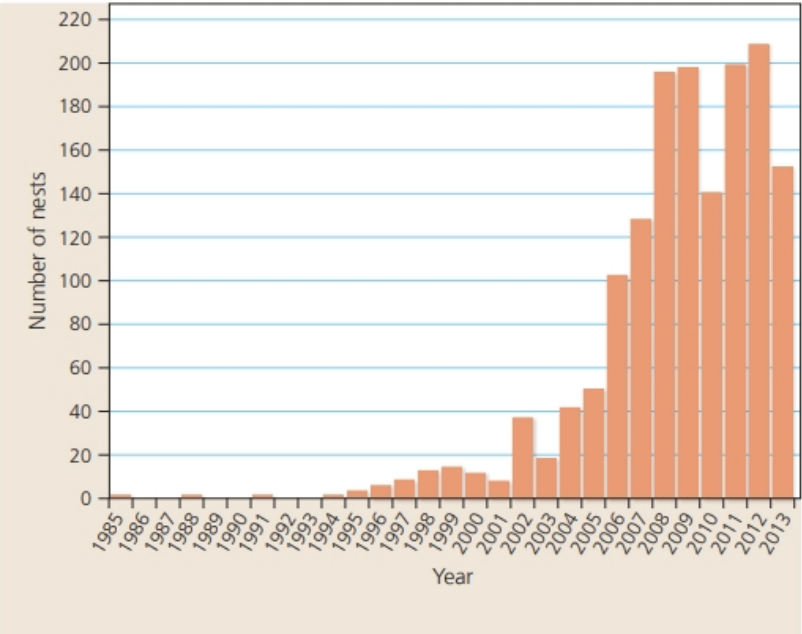
The Kemp's ridley sea turtle (Lepidochelys kempii) is a critically endangered species. The graph presents the number of Kemp's ridley sea turtle nests found in the Padre Island National Seashore in Texas over a span of years. Write a one-sentence summary of the results presented in the graph.
From 1985 to 2013, the number of Kemp’s ridley sea turtle nests found in the Padre Island National Seashore in Texas increased dramatically.
An atom can be changed into an ion by adding or removing…
electrons
An atom can be changed into a different isotope by adding or removing __ _
neutrons
If you change the number of….. the atom becomes a different element
protons
A nitrogen atom has 7 protons, and the most common isotope of nitrogen has 7 neutrons. A radioactive isotope of nitrogen has 9 neutrons. What are the atomic numbers and mass numbers of the stable and radioactive forms of nitrogen?
Nitrogen has an atom number of 7. The mass number of the stable form is 14 while the mass number of the radioactive form is 16.
Why are radioactive isotopes useful as tracers in research on the chemistry of life?
Organisms incorporate radioactive isotopes of an element into their molecules just as they do nonradioactive isotopes, and researchers can detect the presence of the radioactive isotopes.
What is chemically nonsensical about this structure? H-C=C-H
Carbon only has three bonds instead of 4. Since carbon has 4 valence electrons, in this case it would need 4 bonds on order to make sense.
Why is it unlikely that two neighboring water molecules would be arranged like this? Hydrogen facing one another
With molecules, opposites attract, therefore two partial positive charges would repel one another rather than attract.
Which of the following is not a chemical reaction?
Ice melts to form liquid water.
Some people in your study group say they don't understand what a polar molecule is. You explain that a polar molecule
is slightly negative at one end and slightly positive at the other end.
Explain how the unique properties of water result from the fact that water is a polar molecule.
Because water is polar, and has both negative and positive poles, it can stick to itself more easily, forming hydrogen bonds. Water’s properties such as cohesion, temperature regulation, and its ability to act as a solvent all arise due to its “stickiness”.
Explain why it is unlikely that life could exist on a planet where the main liquid is methane, a nonpolar molecule that does not form hydrogen bonds.
A nonpolar molecule would not have the hydrogen bonds available to make water act as the basis for life.
A can of cola consists mostly of sugar dissolved in water. with some carbon dioxide gas that makes it fizzy and makes the pH less than 7. Describe the cola using the following terms: solute, solvent, acidic, aqueous solution.
Cola is an aqueous solution, water is the solvent, sugar is the solute, and carbon dioxide gas makes the liquid acidic.
Cells are constantly rearranging molecules by breaking existing chemical bonds and forming new ones.
energy transformations
The polarity of water molecules helps explain water's ability to support life.
structure and function
The release of C02 from a factory in one region can cause ocean acidification that affects coral reefs in another region.
Interactions within systems
You observe that trout lilies are more resilient to
extreme cold than bloodroot. Which of these is a
hypothesis to explore why this occurs?
Trout lilies produce a natural antifreeze protein that bloodroot lacks,
which protects trout lilies from extreme cold