4) Anesthetic Agents
 Call Kai
 Learn
Learn Practice Test
 Spaced Repetition
 Match
Match Flashcards
 Knowt Play
1/20

There's no tags or description
Looks like no tags are added yet.
Name | Mastery | Learn | Test | Matching | Spaced | Call with Kai | Chat |
|---|
No analytics yet
Send a link to your students to track their progress
21 Terms
What are the common routes of administration of general anesthetics?
Inhalation
IV
How do you define general anesthesia? What are its 3 stages?
→ reversible state of CNS depression, which results in the loss of response to and perception of stimuli
Induction
Maintenance
Recovery
Why are inhaled anesthetics used only for maintenance?
→ b/c depth of anesthesia can be rapidly altered by simply changing the [inhaled gas]
some agents have pungent odors or cause respiratory irritation, making them unsuitable for the induction stage (e.g., isoflurane & desflurane)
How is potency of inhalation anesthetics determined?
→ defined as minimum alveolar concentration (MAC)
↑ MAC = ↓ potency
How can blood solubility influence anesthetic action? Give an example.
→ Determines the induction and recovery speed, based on the blood:gas partition coefficient
↑ blood solubility gasses = dissolve more fully in the blood = sustained induction and recovery (e.g., isoflurane)
↓ blood solubility gasses = very rapid onset and recovery (e.g., desflurane)
Compare the action of nitrous oxide and isoflurane in terms of induction and recovery.
Compared to isoflurane, NO has:
slower induction
faster recovery
Give the receptors involved in action of general anesthetics.
γ-aminobutyric acid (GABAA) receptors
NMDA receptors
inhibitory glycine receptors in spinal motor neurons
nicotinic Ach receptors
What is malignant hyperthermia? In what category of patients is it commonly seen?
→ rare, life-threatening condition that can occur in a small % of patients exposed to halogenated hydrocarbons
seen in burn victims, muscular dystrophy, myopathy, myotonia & osteogenesis imperfecta pt
How is malignant hyperthermia treated? How does the drug act?
Dantrolene - blocks Ca2+ from SR of muscle cells → heat production & relaxes muscle tone
How is thiopental useful as a anesthetic?
→ ultra-short-acting barbiturate with ↑ lipid solubility
used for rapid induction
What are the concerns in using opioids along with general anesthetics?
hypotension
resp depression
nausea
vomiting
What is the concern in using Ketamine in young patients?
induce hallucinations in young adults
What are the common delivery routes for local anesthetics?
topical administration
infiltration
perineural/neuraxial blocks (spinal, epidural, caudal)
How is the onset, potency and duration of local anesthetics influenced?
Onset: depend on pKa
↓ pKa = quicker onset
Potency and Duration: depend on lipid solubility
↑ lipid solubility = ↑ potency = longer duration of action
How are ester and amide local anesthetics metabolized?
Amides are biotransformed in the liver
Esters are biotransformed by plasma cholinesterase (pseudocholinesterase)
Compare the stability, onset and systemic toxicity of ester and amide local anesthetics.
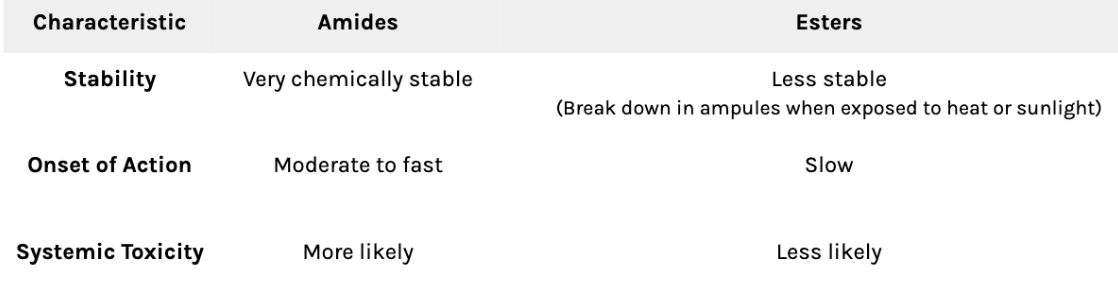
Why are anesthetic adjuncts used along with anesthetics?
→ used to make the anesthetic experience safe and pleasant
e.g., relieving anxiety, preventing nausea, providing extra analgesia, facilitating intubation
What are the 2 categories of skeletal muscle relaxants? How do they differ from each other?
What are the 2 categories of neuromuscular blocking agents? Give an example in each category.
NMBs
drugs interfere with transmission at the neuromuscular end plate
lack CNS activity
used during surgical procedures or in the intensive care unit to produce muscle paralysis and facilitate endotracheal intubation
e.g., Succinylcholine
Spasmolytics/antispasmodics
"centrally acting" muscle relaxants
used to reduce spasticity in various painful conditions (e.g., chronic back pain or fibromyalgic conditions)
e.g., Diazepam
What are the 2 categories of NMB agents? Give an example in each category.
Depolarizing Agents (e.g., succinylcholine)
Nondepolarizing Agents (e.g., tubocurarine, pancuronium, vecuronium)