Semaphores
 Call Kai
 Learn
Learn Practice Test
 Spaced Repetition
 Match
Match Flashcards
 Knowt Play
1/4

There's no tags or description
Looks like no tags are added yet.
Name | Mastery | Learn | Test | Matching | Spaced | Call with Kai | Chat |
|---|
No analytics yet
Send a link to your students to track their progress
5 Terms
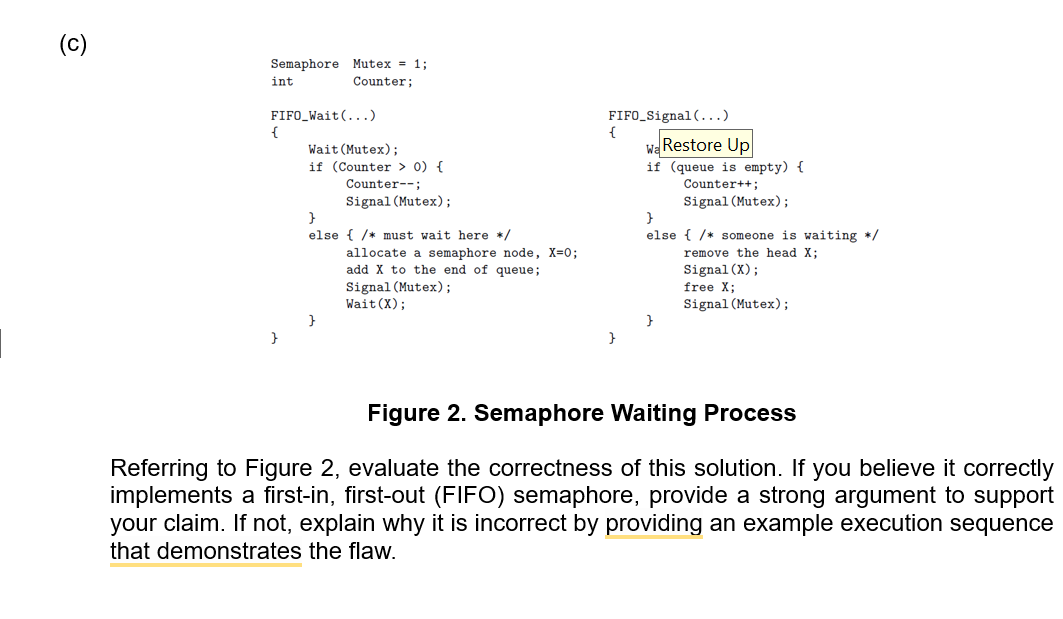
Step 1: Understand the Code Behavior
The code implements a FIFO semaphore using a queue to manage waiting processes. Each process creates a private semaphore (X) when resources are unavailable (Counter == 0). Processes are added to the queue in arrival order. On FIFO_SIGNAL, the head of the queue is signaled to wake up the first waiting process. Key steps:
FIFO_WAIT: Locks
Mutex, checksCounter, enqueues private semaphoreX, releasesMutex, waits onX.FIFO_SIGNAL: Locks
Mutex, signals the head of the queue if not empty, incrementsCounterotherwise.
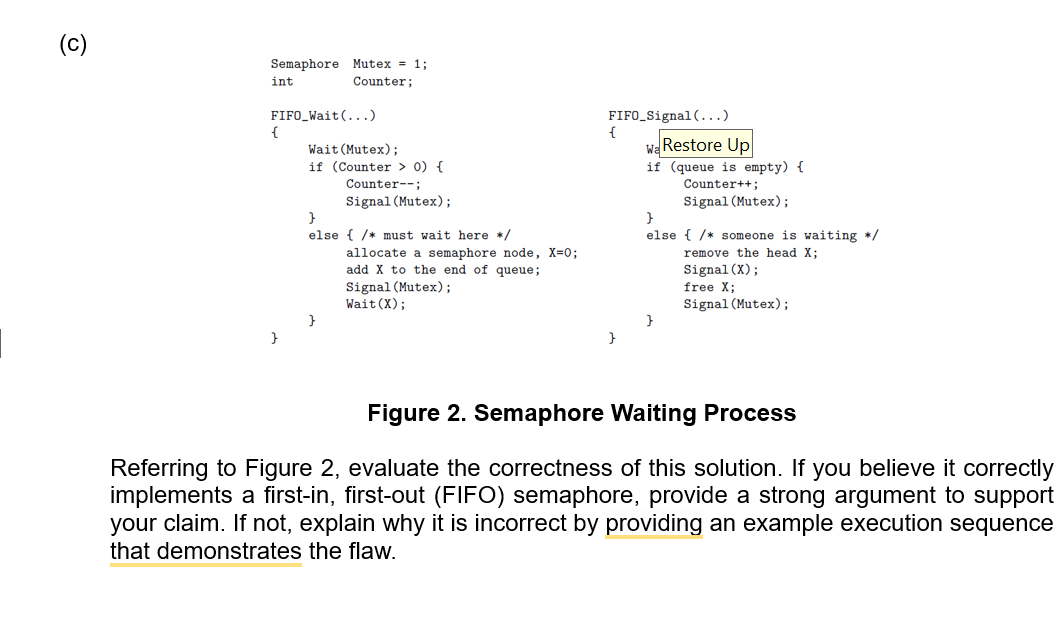
Step 2: Verifying FIFO Order
The design attempts FIFO order by:
Adding processes to the end of the queue.
Signaling the head of the queue on
FIFO_SIGNAL.
Apparent correctness: If the queue is properly synchronized, the first process to wait should be the first to proceed.
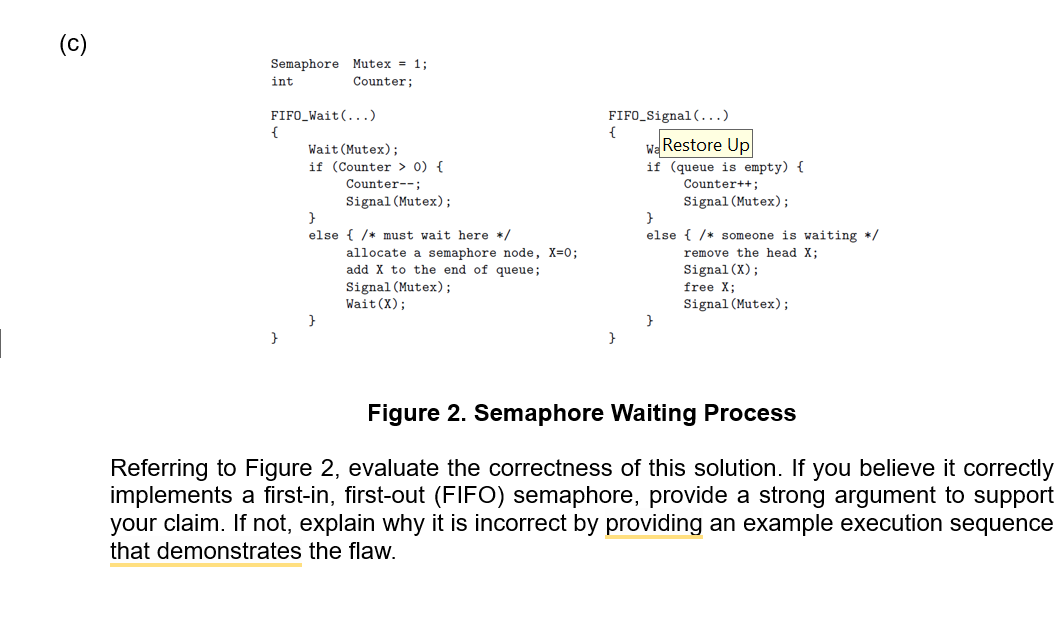
Identify the Potential Flaw
Critical flaw: The code releases the Mutex before waiting on X in FIFO_WAIT:
add X to the end of Q;
Signal(Mutex); // Release mutex BEFORE waiting!
Wait(X);       // Gap: Signal might arrive here.
This creates a race condition:
A
FIFO_SIGNALcan signalXbefore the process starts waiting onX.The signal is lost, causing the process to block indefinitely.
Later processes may be signaled first, violating FIFO.
Why this breaks FIFO:
The earliest process (e.g., P1) might miss its signal, allowing later processes (e.g., P2/P3) to proceed first.
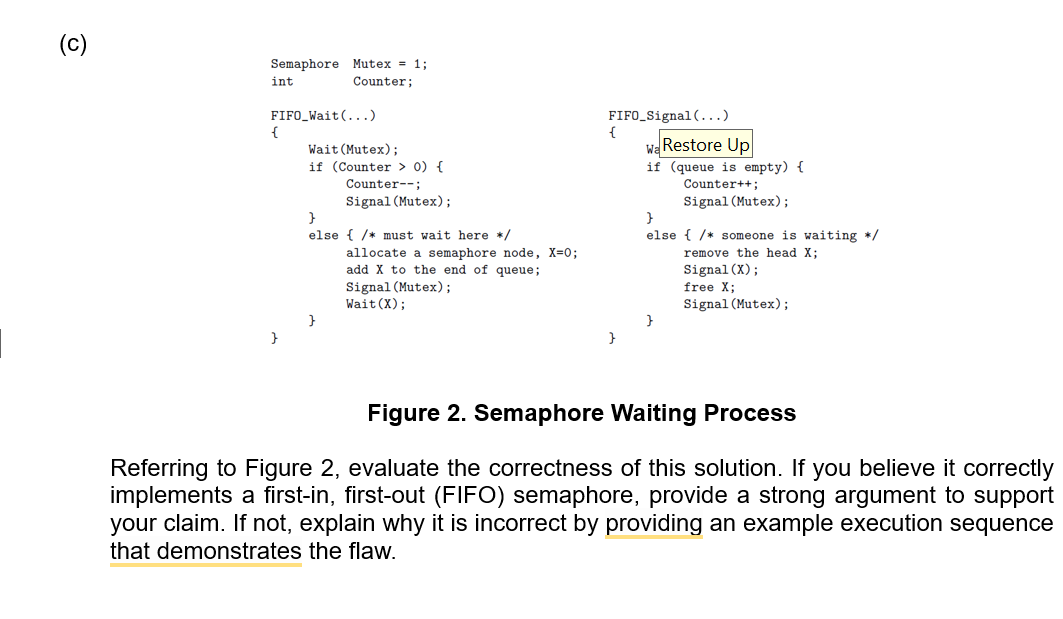
Step 4: Example Execution Sequence
Processes P1, P2, P3 call
FIFO_WAITwhenCounter = 0:Each creates
X1,X2,X3and adds them to the queue:[X1, X2, X3].All release
Mutexand prepare to wait on theirX.
FIFO_SIGNAL sequence:
First signal: Signals
X1(head of queue).If P1 hasn’t started
Wait(X1)yet (paused by the OS), the signal is lost.
Second signal: Signals
X2(new head).P2 proceeds.
Third signal: Signals
X3.P3 proceeds.
Result:
P1 remains blocked forever, despite being first in the queue.
FIFO violation: P2 and P3 acquire resources out of order.
Conclusion
The implementation is incorrect due to the race condition between releasing Mutex and waiting on X. To fix it, use atomic "unlock + wait" operations (e.g., condition variables) to eliminate the gap. Without this, FIFO fairness cannot be guaranteed.