Penny Book Chapter 5: pancreas
 Call Kai
 Learn
Learn Practice Test
 Spaced Repetition
 Match
Match Flashcards
 Knowt Play
1/59

There's no tags or description
Looks like no tags are added yet.
Name | Mastery | Learn | Test | Matching | Spaced | Call with Kai | Chat |
|---|
No analytics yet
Send a link to your students to track their progress
60 Terms
1. What results in a shortened main pancreatic duct that works to drain only the pancreatic head and not the entire pancreas?
A. Pancreatic divisum
B. Annular pancreas
C. Acute pancreatitis
D. Zollinger-Ellison syndrome
A. Pancreatic Divisum
2. All of the following are part of the exocrine function of the pancreas except for the:
a. production of lipase.
b. production of glucagon.
c. production of amylase.
d. production of sodium bicarbonate.
b. production of glucagon.
3. What is another name for the accessory duct of the pancreas?
a. Duct of Santorini
b. Duct of Langerhans
c. Duct of Oddi
d. Duct of Wirsung
a. Duct of Santorini
4. Which of the following results from the maldevelopment of the two embryologic elements of the pancreas and consequent obstruction of the duodenum?
a. Pancreatic divisum
b. Annular pancreas
c. Whipple syndrome
d. Zollinger-Ellison syndrome
b. Annular pancreas
5. Which of the following is associated with development of cysts within the pancreas?
a. Autosomal recessive polycystic kidney disease
b. von Hippel-Lindau disease
c. Zollinger-Ellison syndrome
d. Endoscopic retrograde cholangiopancreatography
b. von Hippel-Lindau disease
6. The most common form of malignancy of the pancreas is:
a. cystadenocarcinoma.
b. islet cell tumors.
c. cystadenoma.
d. adenocarcinoma.
d. adenocarcinoma.
7. The Whipple procedure is performed on patients who have:
a. chronic pancreatitis.
b. acute pancreatitis.
c. pancreatic carcinoma.
d. pancreatic transplants.
c. pancreatic carcinoma.
8. Which of the following is the enzyme released by the pancreas that neutralizes stomach acid?
a. Insulin
b. Somatostatin
c. Glycogen
d. Sodium bicarbonate
d. Sodium bicarbonate
9. The most common location of adenocarcinoma of the pancreas is within the:
a. head of the pancreas.
b. neck of the pancreas.
c. body of the pancreas.
d. tail of the pancreas.
a. head of the pancreas.
10. Which of the following is a peripancreatic fluid collection that results from the inflammation of the pancreas?
a. Pus
b. Trypsin
c. Phlegmon
d. Chyme
c. Phlegmon
11. The most common location of focal pancreatitis is within the:
a. head of the pancreas.
b. neck of the pancreas.
c. body of the pancreas.
d. tail of the pancreas.
a. head of the pancreas.
12. All of the following are sonographic features of chronic pancreatitis except:
a. dilated pancreatic duct
b. calcifications within the pancreas
c. pancreatic pseudocyst
d. diffusely hypoechoic pancreas
d. diffusely hypoechoic pancreas
13. Which of the following would be the least likely complication of a pancreatic transplant?
a. Hematoma
b. Biloma
c. Ascites
d. Urinoma
b. Biloma
14. All of the following are classic clinical features of acute pancreatitis except:
a. leukocytosis
b. back pain
c. weight gain
d. fever
c. weight gain
15. Which of the following laboratory values appears to be more specific for acute pancreatitis?
a. Amylase
b. Lipase
c. Aspartate aminotransferase
d. Serum glutamic oxaloacetic transaminase
b. Lipase
16. Which type of pancreatic transplantation is more common?
a. Exocrine enteric drainage
b. Exocrine bladder drainage
c. Endocrine bladder drainage
d. Endocrine enteric drainage
a. Exocrine enteric drainage
17. One of the most common locations for a pancreatic pseudocyst is within the:
a. paracolic gutters.
b. groin.
c. spleen.
d. lesser sac.
d. lesser sac.
18. Which of the following would be the least likely cause of acute pancreatitis?
a. Alcohol abuse
b. Hepatitis
c. Trauma
d. Gallstones
b. Hepatitis
19. Which of the following is the most common islet cell tumor?
a. Granuloma
b. Gastrinoma
c. Insulinoma
d. Cystadenoma
c. Insulinoma
20. Which of the following laboratory findings elevates first in the presence of acute pancreatitis?
a. Amylase
b. ALP
c. ALT
d. Lipase
a. Amylase
21. Courvoisier gallbladder is found in the presence of:
a. hepatitis
b. cholecystitis and chronic pancreatitis
c. adenocarcinoma in the head of the pancreas
d. islet cell tumor in the tail of the pancreas
c. adenocarcinoma in the head of the pancreas
22. A gastrinoma of the pancreas can produce:
a. autosomal recessive polycystic kidney disease
b. von Hippel-Lindau disease
c. Zollinger-Ellison syndrome
d. hyperinsulinemia
c. Zollinger-Ellison syndrome
23. The muscle that controls the emptying of bile and pancreatic juices into the duodenum is the:
a. sphincter of Vater
b. sphincter of Oddi
c. ampulla of Vater
d. ampulla of Oddi
b. sphincter of Oddi
24. What is another name of the main pancreatic duct?
a. Duct of Santorini
b. Duct of Langerhans
c. Duct of Oddi
d. Duct of Wirsung
d. Duct of Wirsung
25. All of the following are clinical findings associated with pancreatic adenocarcinoma except:
a. epigastric pain
b. weight loss
c. jaundice
d. decreased amylase and lipase
d. decreased amylase and lipase
26. The portion of the bowel that encompasses the head of the pancreas is the:
a. duodenum.
b. jejunum.
c. ileum.
d. cecum.
a. duodenum.
27. Which cells perform the exocrine function of the pancreas?
a. Whipple cells
b. Islets of Langerhans
c. Delta cells
d. Acinar cells
d. Acinar cells
28. The most common echogenicity of an acutely inflamed pancreas is:
a. anechoic
b. hyperechoic
c. hypoechoic
d. calcified
c. hypoechoic
29. Which of the following would be the most likely vascular complication of acute pancreatitis?
a. Thrombosis in the splenic vein
b. Pseudoaneurysm of the superior mesenteric artery
c. Thrombosis of the main portal vein
d. Stenosis of the superior mesenteric artery
a. Thrombosis in the splenic vein
30. The arterial blood supply to the head of the pancreas is via the:
a. superior mesenteric artery
b. splenic artery
c. gastroduodenal artery
d. hepatic artery
c. gastroduodenal artery.
31. One clinical sign of an insulinoma is the presence of:
a. hypoglycemia
b. elevated alpha-fetoprotein
c. hepatitis
d. Zollinger-Ellison syndrome
a. hypoglycemia
32. What is the early sonographic appearance of acute pancreatitis?
a. Calcifications within the gland
b. Pancreatic pseudocyst
c. Normal
d. Hyperechoic glandular echotexture
c. Normal
33. Within which parts of the pancreas are mucinous cystadenocarcinomas most often located?
a. Uncinate process and neck
b. Head and neck
c. Body and tail
d. Fundus and neck
c. Body and tail
34. Coexisting obstruction of the common bile duct and pancreatic duct may be referred to as the:
a. double-barrel shotgun sign
b. Courvoisier sign
c. Mirizzi sign
d. double-duct sign
d. double-duct sign
35. Courvoisier gallbladder is the:
a. enlargement of the pancreatic duct secondary to coexisting masses within the pancreatic body and gallbladder
b. palpable gallbladder caused by a biliary obstruction in the area of the pancreatic head
c. gallbladder disorder associated with the buildup of cholesterol crystals within the gallbladder wall
d. type of gallbladder carcinoma that is the result of chronic cholecystitis
b. palpable gallbladder caused by a biliary obstruction in the area of the pancreatic head
36. The pancreas is an:
a. intraperitoneal organ
b. retroperitoneal organ
b. retroperitoneal organ
37. Which part of the pancreas is located right lateral to superior mesenteric vein, anterior to inferior vena cava, and inferior to portal vein?
a. Head
b. Neck
c. Body
d. Tail
a. Head
38. What vascular structure outlines the pancreatic tail posteriorly?
a. Superior mesenteric artery
b. Inferior mesenteric vein
c. Portal confluence
d. Splenic vein
d. Splenic vein
39. Which part of the pancreas is located anterior to portal confluence?
a. Uncinate process
b. Pancreatic body
c. Pancreatic neck
d. Pancreatic tail
c. Pancreatic neck
40. Which of the following is the hormone released by the pancreas that encourages the body's use of glucagon?
a. Insulin
b. Somatostatin
c. Glycogen
d. Sodium bicarbonate
a. Insulin
41. What are the cells of the pancreas that produce amylase and lipase?
a. Acinar
b. Beta
c. Delta
d. Alpha
a. Acinar
42. The pancreatic tail is located medial to the:
a. duodenum
b. jejunum
c. splenic hilum
d. liver hilum
c. splenic hilum
43. Which of the following would be most likely to increase an individual's likelihood of developing chronic pancreatitis?
a. Hashimoto thyroiditis
b. Splenic varices
c. Hepatitis
d. Hyperparathyroidism
d. Hyperparathyroidism
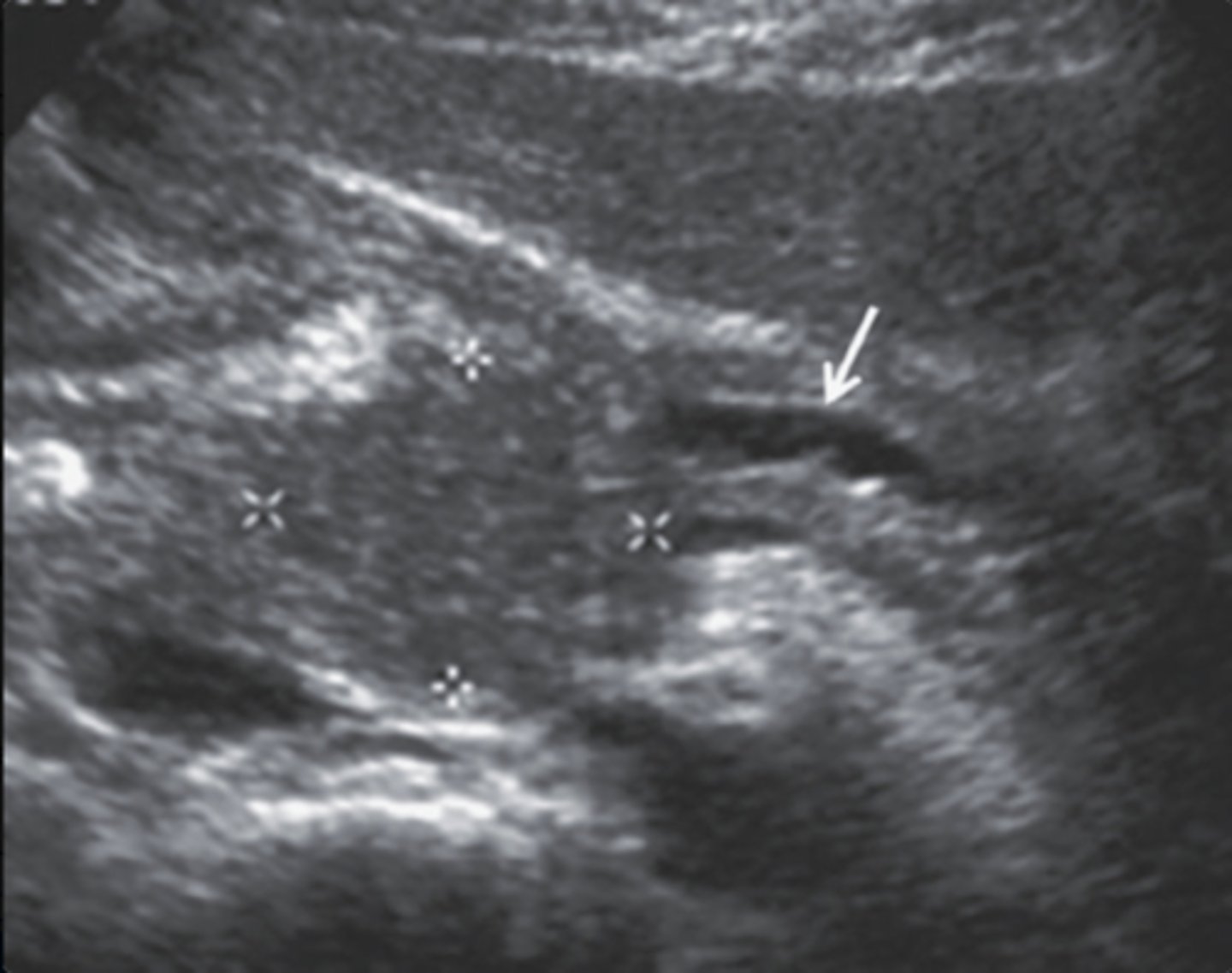
44. A 52-year-old female patient in Figure 5-18 has weight loss, a palpable gallbladder, and elevated ALP. What does the arrow in this image indicate?
a. Splenic vein
b. Superior mesenteric vein
c. Common bile duct
d. Main pancreatic duct
d. Main pancreatic duct
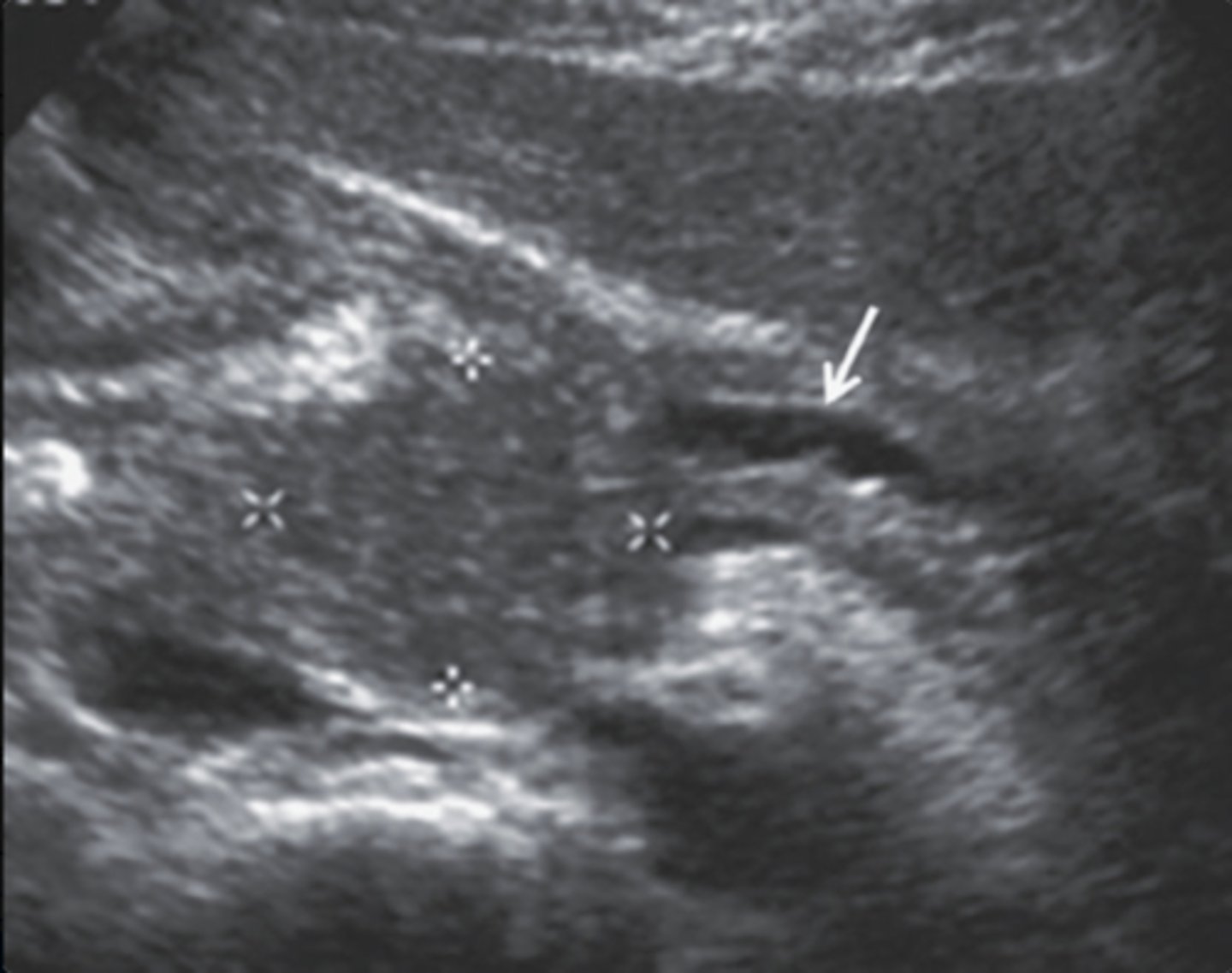
45. Given the patient's history in Figure 5-18, what are calipers in the image most likely measuring?
a. Pancreatic adenocarcinoma
b. Insulinoma
c. Pancreatic adenoma
d. Pancreatic cystadenocarcinoma
a. Pancreatic adenocarcinoma
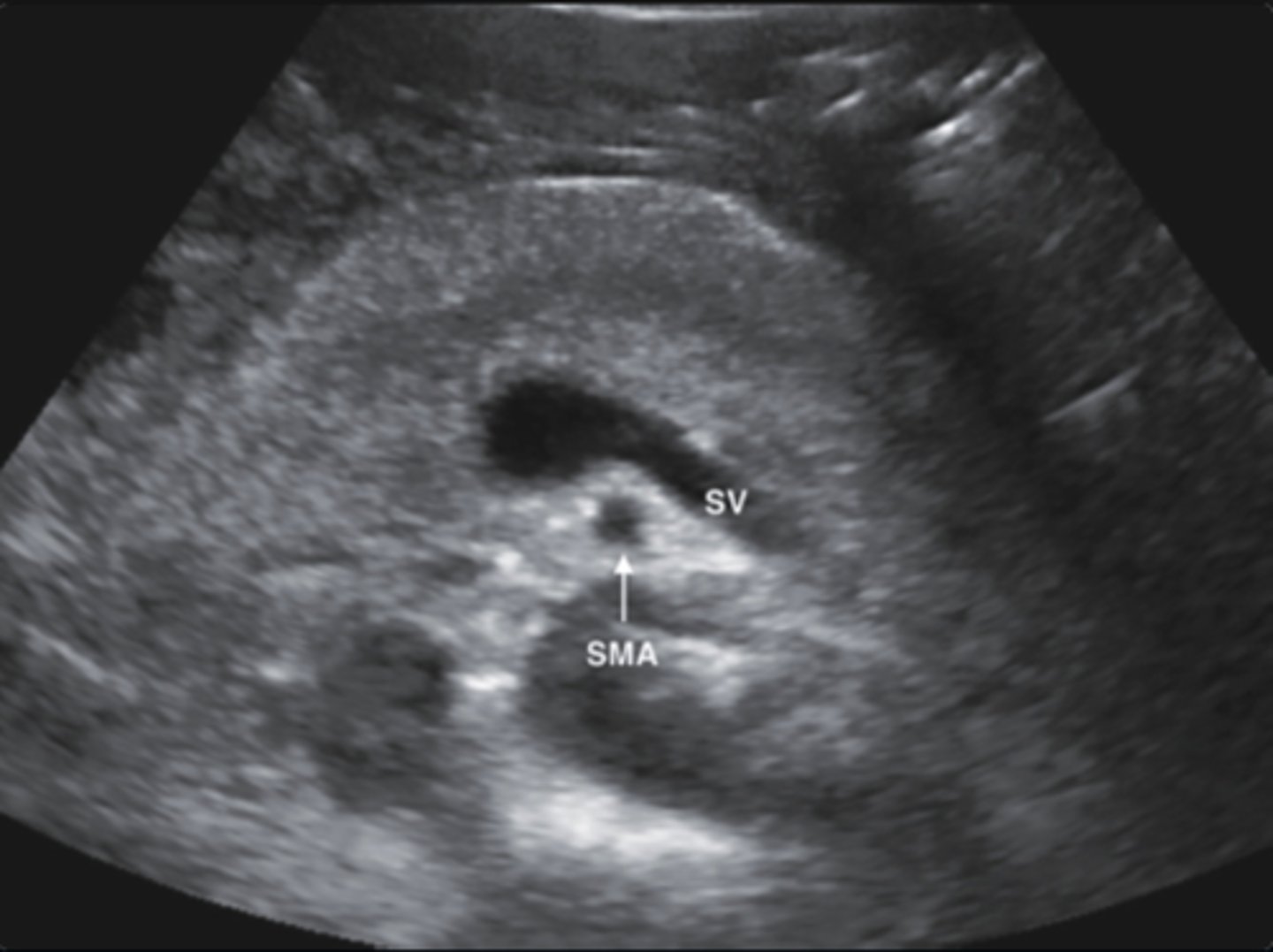
46. The patient in Figure 5-19 presented with back pain and elevated amylase. What is the most likely diagnosis?
a. Gastrinoma
b. Acute pancreatitis
c. Chronic pancreatitis
d. Pancreatic adenocarcinoma
b. Acute pancreatitis
47. What is the most common form of pancreatitis?
a. Hemorrhagic pancreatitis
b. Necrotizing pancreatitis
c. Interstitial edematous pancreatitis
d. Hereditary pancreatitis
c. Interstitial edematous pancreatitis
48. Which of the following is not included in the Whipple triad?
a. Hypertension
b. Hypoglycemia
c. Low fasting glucose
d. Relief with intravenous glucose administration
a. Hypertension
49. What does the Whipple triad indicate?
a. Gastrinoma
b. Insulinoma
c. Somatostatinoma
d. Pancreatic adenocarcinoma
b. Insulinoma
50. What performs the endocrine function of the pancreas?
a. Islets of Langerhans
b. Acinar cells
c. Main pancreatic duct
d. Pancreatocytes
a. Islets of Langerhans
51. What other structure is also typically transplanted simultaneously with the pancreas?
a. Spleen
b. Bladder
c. Kidney
d. Left lobe of the liver
c. Kidney
52. Cystic fibrosis is associated with an increased risk of:
a. pancreatic cysts.
b. pancreatic calcifications.
c. pancreatic duct stones.
d. pancreatic cystadenocarcinoma.
a. pancreatic cysts.
53. Amylase converts:
a. sugar to starch.
b. starch to sugar.
c. sugar to fat.
d. fat to starch.
b. starch to sugar.
54. Which of the following would best describe the sonographic appearance of acute pancreatitis?
a. Hyperechoic and atrophic
b. Calcifications throughout an enlarged gland with an enlarged main pancreatic duct
c. Hypoechoic and atrophic
d. Hypoechoic and enlarged
d. Hypoechoic and enlarged
55. Which of the following would best describe the sonographic appearance of chronic pancreatitis?
a. Atrophic, hyperechoic gland with parenchymal calcifications and enlarged main pancreatic duct
b. Enlarged gland with parenchymal calcifications and diffuse edema
c. Shrunken, hypoechoic gland with intraparenchymal irregularities
d. Enlarged gland, peripancreatic fluid, intraparenchymal hypoechoic foci, and intraductal sludge
a. Atrophic, hyperechoic gland with parenchymal calcifications and enlarged main pancreatic duct
56. Which of the following vascular complication would be most likely associated with acute pancreatitis?
a. Renal vein thrombosis
b. Inferior mesenteric vein aneurysm
c. Abdominal aortic aneurysm
d. Splenic vein thrombosis
d. Splenic vein thrombosis
57. What is the most common sonographic appearance of pancreatic adenocarcinoma?
a. Hyperechoic mass
b. Hypoechoic mass
c. Anechoic mass
d. Calcified mass
b. Hypoechoic mass
58. What is another name for the Whipple procedure?
a. Hepato-pancreatectomy
b. Duodenectomy
c. Pancreaticoduodenectomy
d. Renopancreaticoduodenectomy
c. Pancreaticoduodenectomy
59. Which of the following would be the least likely sonographic finding in a patient with acute pancreatitis?
a. Pancreatic pseudocyst
b. Phlegmon
c. Choledocholithiasis
d. Periportal cuffing
d. Periportal cuffing
60. What part of the pancreas is located posterior to the superior mesenteric vein?
a. Uncinate process
b. Pancreatic tail
c. Pancreatic neck
d. Pancreatic head
a. Uncinate process