TOPIC 3.2: Filtration (API Isolation)
 Studied by 0 people
 Call Kai
 Learn
Learn Practice Test
 Spaced Repetition
 Match
Match Flashcards
 Knowt Play
1/10

There's no tags or description
Looks like no tags are added yet.
Name | Mastery | Learn | Test | Matching | Spaced | Call with Kai |
|---|
No study sessions yet.
11 Terms
What is filtration?
The desired drug substance (ie. API) is synthesized via chemical reaction and remains in a dissolved state within a solution in the batch reactor
FIltration is the separation of solids from a solid-liquid mixture (slurry) by means of a porous medium or screen which retains the solids while allowing the liquid to pass
In Pharmaceutical application, solid is the valuable product (ie. API) and liquid is the waste (ie. mother liquor)
Results in separation of the solids as wet cake → need to wash and dry to yield high purity API
What is cake filtration?
A solid-liquid process where slurry is forced through a filter medium with pores smaller than the slurry’s solid’s particle size
The liquid (ie. filtrate) passes through while the solids get retained, accumulating as cake on the medium
Cake Filtration — Key Characteristics
Used for slurries with a high proportion of solids.
Solids build up as a cake, increasing thickness and flow resistance over time.
Lab equipment: Büchner funnel and flask.
Industrial equipment: Agitated Nutsche Filter.
Cake Filtration — Principle (Why is the initial stage critical?)
The initial stage is critical as:
Flow rate is highest at the start since the resistance is minimum
Too-high initial flow can plug filter pores → greatly increasing resistance
The arrangement of the first particle layers greatly influences the entire cake structure
Cake Filtration — Principle (Effects of solids concentration)
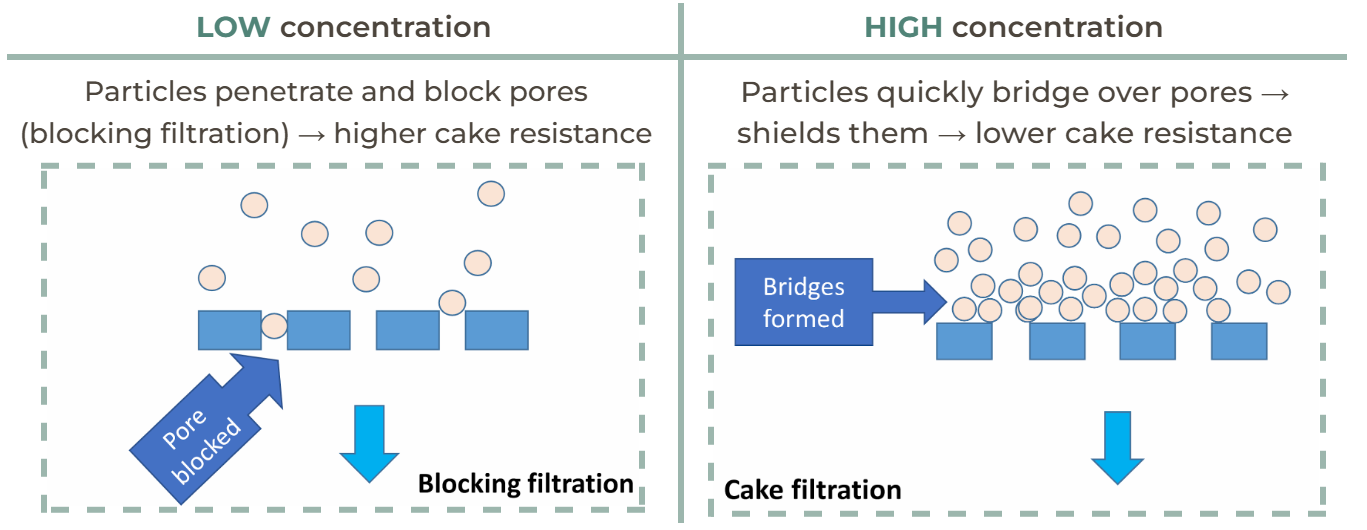
LOW concentration | HIGH concentration |
Particles penetrate and block pores (blocking filtration) → higher cake resistance | Particles quickly bridge over pores → shields them → lower cake resistance |
Delayed cake filtration
During regular filtration, resistance to filter cake progressively increases → reduces rate of filtrate flow
Delayed cake filtration delays / reduces build-up of cake by limiting cake thickness
Cake thickness remains constant → allows constant filtrate flow
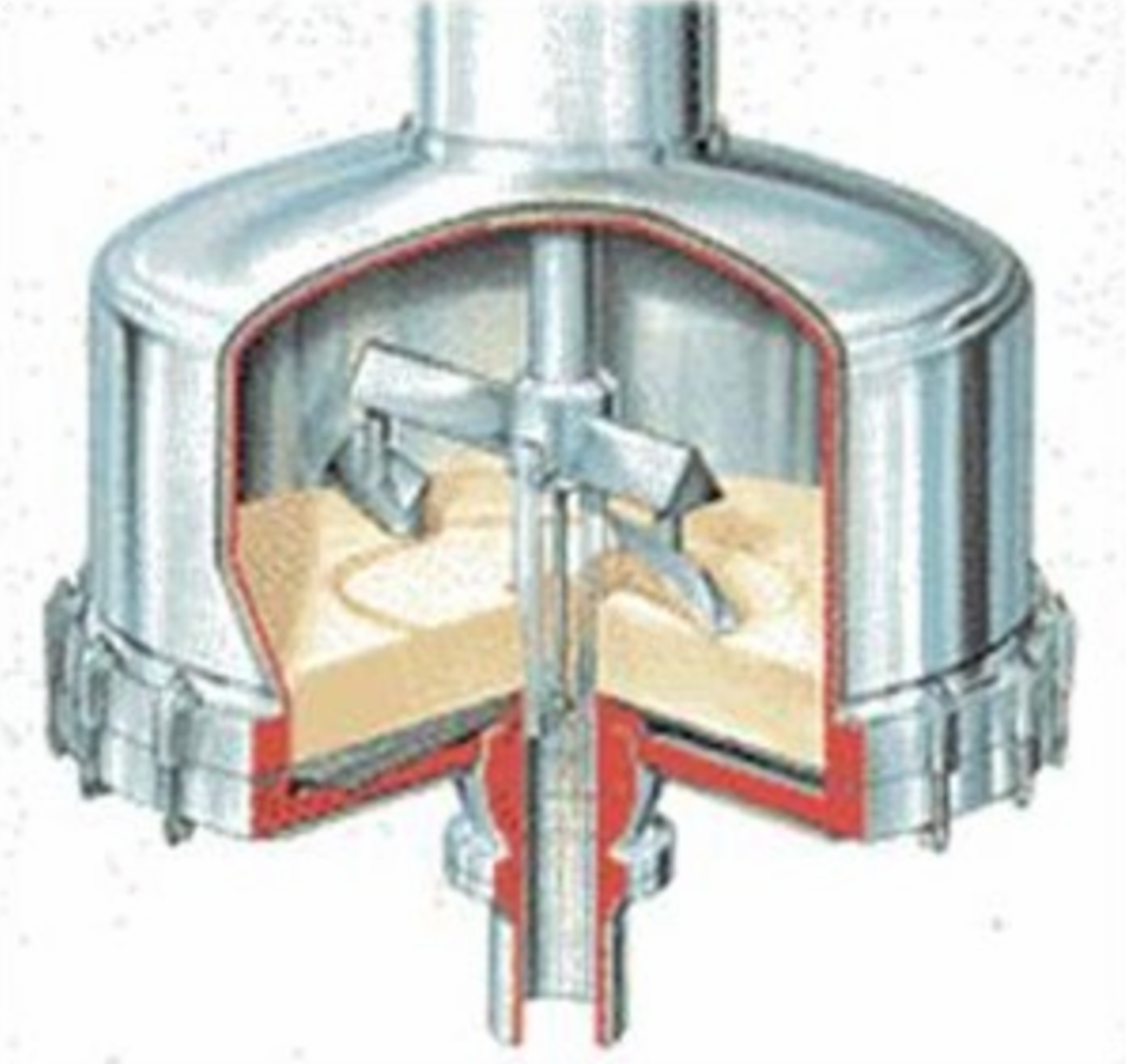
Agitated Nutsche filter is needed
Comes with an agitator → thickness is limited to the clearance between agitator blades and filter medium
Filtrate flows through cake at a constant rate BUT solids are retained in the suspension
BUT if solid concentration starts to increase, particles will start to make permanent physical contact with each other → ↑ resistance to flow → ↓ filtrate flow
Rate of Filtration — Formula
dV/dt ∝ (A △P) / (rμL)
Rate of Filtration — Constant Pressure vs Constant Rate
PARAMETER | CONSTANT PRESSURE FILTRATION | CONSTANT RATE FILTRATION |
Filtration Area (A) | Constant | |
Resistance (r) & Filtrate Viscosity (µ) | Constant | |
Thickness (L) | Increases | |
Differential pressure (ΔP) | Kept constant | Increases to keep dV/dt constant |
Flow rate dV/dt | Decreases eventually | Kept constant |
More frequently adopted for practical reasons → easier to operate | ||
Factors Affecting Rate of Filtration (Cycle Time)
FACTOR | EFFECT(S) |
Resistance, r |
↓ Resistance = ↑ rate of filtration |
Thickness, L |
↓ Thickness = ↑ rate of filtration |
Filtration Area, A | ↑ Filtration Area = ↑ rate of filtration |
Filtrate Viscosity, µ | ↓ Viscosity of filtrate = ↑ rate of filtration |
Pressure difference across cake and filter medium, ∆P |
↑ Differential pressure = ↑ rate of filtration |
Filter Medium
Acts as a support for the filter cake while the initial layer of cake is the true filter
MUST satisfy cGMP requirements:
Sintered stainless steel, polypropylene, or 100% cellulose material (Non shedding type)
High mechanical strength, and chemical resistance
Able to withstand sanitization temperatures of 80 °C during Cleaning-in-place (CIP)
“Equipment used in the manufacture, processing, packing, or holding of a drug product shall be of appropriate design, adequate size, and suitably located to facilitate operations for its intended use and for its cleaning and maintenance” |
Should offer minimum resistance to filtrate flow
Easy cake removal is essential for maximizing product yield recovered
Washing of Filter Cake
To remove traces of mother liquor, unreacted starting material, by-product or impurities from the cake
Directly reduces the impurity level in the final drug substance
Prevents the crystals from re-dissolving in the residual mother liquor during drying
Washing liquid MUST have:
Maximum solubility of the unwanted impurities (to prevent crystallization of the impurities)
Minimum solubility of the product (to prevent product loss to the washes)
Low boiling point and inert to cake (improves drying productivity)
Washing is done in 2 stages:
Displacement washing – Mother liquor is directly displaced from cake surface by washing liquid (removes 90% of filtrate)
Diffusion washing – Remaining mother liquor diffuses into the washing liquid from the less accessible voids
Re-slurry washing – Cake is re-suspended in fresh washing liquid to form a slurry → filter again
Channeling is the main problem encountered during cake washing
Washing liquid forms preferred paths ("channels") through the cake, leaving some areas unwashed → incomplete washing
Can use lower pressure during washing than during filtration OR use an agitator to smooth the surface