Biological Diversity: Plant Classification and Structures
 Call Kai
 Learn
Learn Practice Test
 Spaced Repetition
 Match
Match Flashcards
 Knowt Play
1/53

There's no tags or description
Looks like no tags are added yet.
Name | Mastery | Learn | Test | Matching | Spaced | Call with Kai | Chat |
|---|
No analytics yet
Send a link to your students to track their progress
54 Terms
Thallophytes
Simplest form of a plant with no specialized vascular system.
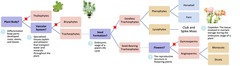
Bryophytes
Aquatic and land habitats; Dominant gametophyte stage (haploid-n); E.g., Mosses, liverworts, hornworts.
Tracheophytes
Grow vertically and tall; Dominant sporophyte stage (diploid-2n); E.g., Ferns and Pine trees.
Angiosperms
Most diverse land-based plant; Produce flowers and have pollen; Bear their seeds in fruits.
Pollen
Undergo double fertilization; Contains non-flagellated male gametes.
Microsporocytes
Diploid (2n) cells that undergo meiosis to produce four microspores (n).
Megasporocyte
Diploid (2n) cell in the ovary that undergoes meiosis to produce four megaspores (n).
Double Fertilization
One male gamete (n) fuses with the female egg gamete (n) to form an embryo/zygote (2n) & another male gamete fuses with polar nuclei to form endosperm (3n).
Endosperm
Triploid (3n) tissue formed from the fusion of a male gamete with polar nuclei.
Zygote
Diploid (2n) cell formed from the fusion of a male gamete and a female egg gamete.
Embryo
Develops from the zygote (2n) after fertilization.
Monocots
Plants with one cotyledon, parallel veins, scattered vascular bundles, and flower parts in multiples of 3; E.g., Lilies and Kentucky bluegrass.
Dicots
Plants with two cotyledons, net-like veins, ringed vascular bundles, and flower parts in multiples of 4 or 5; E.g., Oak trees.
Synergid Cells
Two cells that help attract/guide pollen tube to the female gametophyte.
Antipodal Cells
Cells with an unknown function in the embryo sac.
Cotyledon
The first leaf or leaves that appear from a germinating seed.
Seed Coat
Protective outer covering of a seed, which is diploid (2n).
Ovary
Part of the flower that contains the ovules and where fertilization occurs.
Stigma
The part of the flower that receives pollen.
Style
The stalk that connects the stigma to the ovary.
Embryo Sac
The female gametophyte that develops within the ovule.
Pollen Tube
Structure that grows from the pollen grain to deliver sperm to the ovule.
Gametophyte
The haploid stage in the plant life cycle that produces gametes.
Sporophyte
The diploid stage in the plant life cycle that produces spores.
Dermal Tissue
Epidermal cells covering outside of plant parts → secrete waxy protective substance (cuticle) in aerial (above ground) portions of plant.
Seed Coat
Tough outer covering of seed that protects embryo/seed content.
Phototropism
Bending of a plant in response to light.
Gravitropism
Bending of a plant in response to gravity.
Thigmotropism
Growth response to mechanical stimuli.
Vascular Tissue
Conducts water and minerals throughout plant.
Xylem
Transports water and minerals throughout plant.
Phloem
Transports sugar throughout plant.
Endosperm
Primary storage tissue.
Auxin
Influences plant's response to light + gravity to stimulate growth/elongation.
Gibberellins
Promote flower + stem elongation.
Cytokinins
Stimulate cytokinesis (cell division).
Abscisic Acid
Inhibits growth and promotes seed dormancy.
Ethylene Gas
Promotes fruit ripening, flower production, and leaf abscission.
Epidermis
Protective layer covered w/ cuticle to reduce transpiration (water loss through evaporation).
Spongy Mesophyll
Intracellular spaces allow for gas travel.
Palisade Mesophyll
Has cells w/ chloroplasts and is the primary site for leaf photosynthesis.
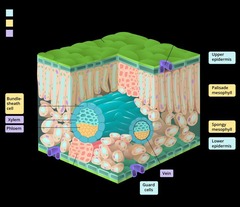
Stomata
Microscopic pore in epidermis that allows for gas exchange between plant and external environment.
Photoperiodism
A plant's response to changes in length of day and night (photoperiod).
Vascular Bundles
Consist of xylem and phloem - surrounded by bundle sheath cell.
Axillary bud
Bud that can develop into a flower or shoot.
Short-day plants
Flower when sunlight is less than half the day.
Long-day plants
Flower when sunlight is more than half the day.
Guard Cells
Specialized epidermal cells to control opening of stomata and permit gas exchange.
Epicotyl
Part of the embryo above the cotyledons.
Hypocotyl
Part of the embryo below the cotyledons.
Radicle
Part of the embryo that develops into the root.
Cotyledon
Provide mechanical support and transfer nutrients from endosperm to embryo.
Bean seed
Example of a dicot seed.
Cord seed
Example of a monocot seed.