12-07: Algebraic Vectors
0.0(0)
Studied by 3 people View linked note
 Call Kai
 Learn
Learn Practice Test
 Spaced Repetition
 Match
Match Flashcards
 Knowt Play
Card Sorting
1/23

Last updated 7:40 PM on 10/2/22
Name | Mastery | Learn | Test | Matching | Spaced | Call with Kai | Chat |
|---|
No analytics yet
Send a link to your students to track their progress
24 Terms
1
New cards
Torque
________ is also the cross product of two vectors.
2
New cards
scalar multiple
Is a(n) ________ of the original vector (collinear)
3
New cards
right hand rule
The ________ is used to determine the orientation of axes in 3 space.
4
New cards
coordinate system
A 2D ________ has 4 quadrants.
5
New cards
magnitude
The ________ measures the twisting effect of the applied force.
6
New cards
algebraic vector
A(n) ________ is a vector expressed using coordinates as opposed to a magnitude and a direction.
7
New cards
vector projection
Scalar and ________ are more often found using their algebraic vectors.
8
New cards
Torque
________ is measured if the length is given in meters and the force is in Newtons.
9
New cards
coordinate system
A 3D ________ has eight octants.
10
New cards
Collinear vectors
vectors that have the same direction but different magnitude
11
New cards
Finding the perimeter given only the vertices
find each magnitude and add them up
12
New cards
converting to component form
Draw a diagram
Use SOH CAH TOA to find x and y respectively (x and y component)
Put both answers in as coordinates, surrounded by square brackets
Use SOH CAH TOA to find x and y respectively (x and y component)
Put both answers in as coordinates, surrounded by square brackets
13
New cards
The magnitude of an algebraic vector
Found by calculating the vector sum of the x and y components (Pythagorean theorem for hypotenuse)
14
New cards
Unit vectors
vectors that have a magnitude and are written with an ˆon top
15
New cards
î
[1, 0]
16
New cards
ˆj
(0,1)
17
New cards
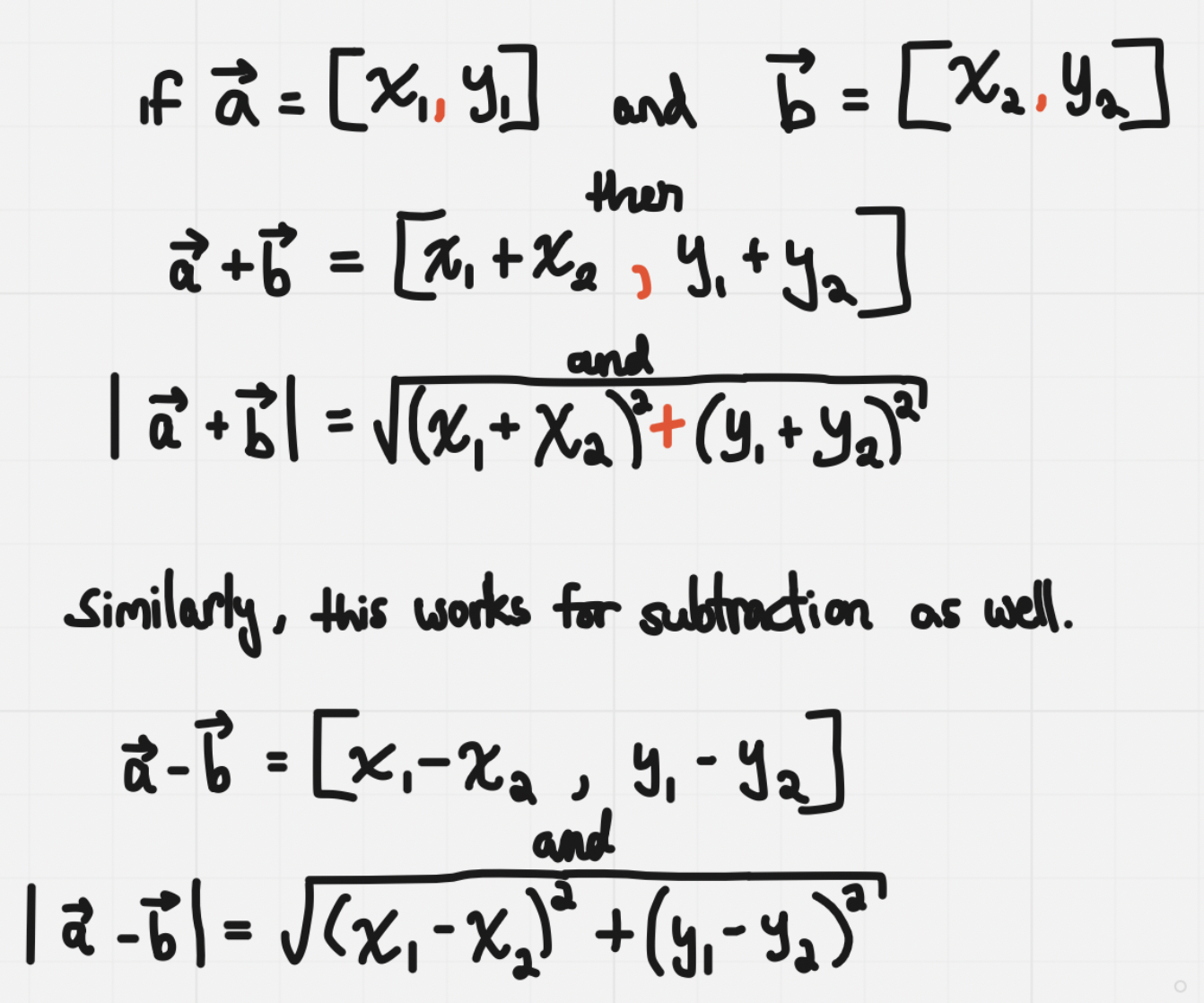
Adding and subtracting algebraic vectors
To find the sum or difference of 2 or more algebraic vectors, simply add or subtract their components
18
New cards
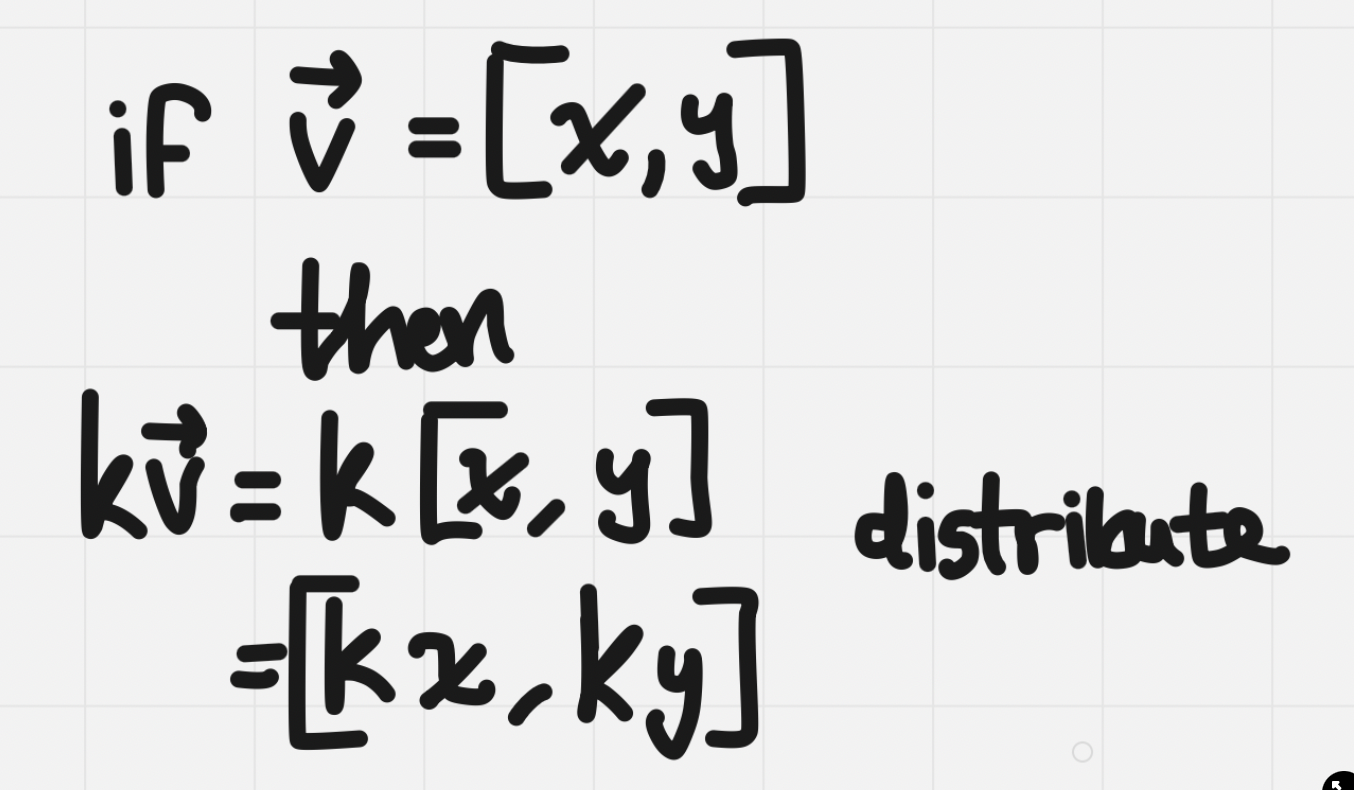
Multiplying vectors by scalars
When multiplying algebraic vectors by scalars, simply multiply each component by the scalar
19
New cards
Colinear vectors
vectors that have the same direction but different magnitude. They are always scalar multiples of each other
To determine if 2 vectors are collinear, we can determine if there is some scalar k we can multiply both vectors by to make them equivalent
To determine if 2 vectors are collinear, we can determine if there is some scalar k we can multiply both vectors by to make them equivalent

20
New cards
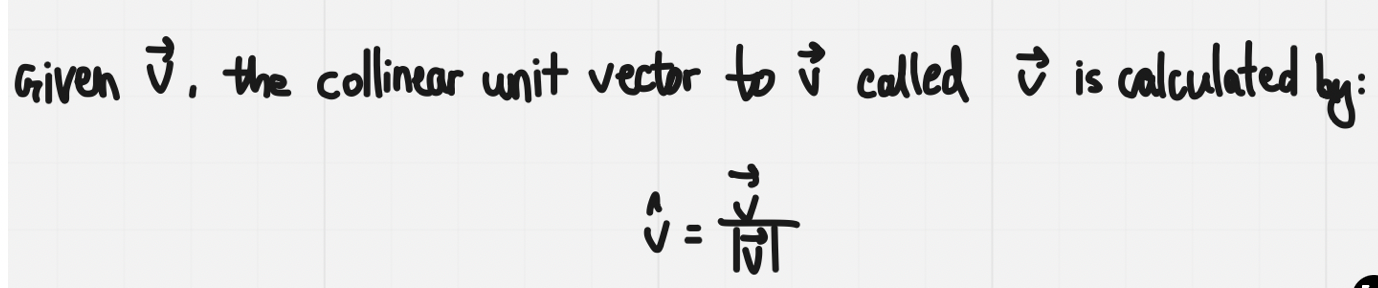
A collinear unit vector to a vector must have the following criteria
Has a magnitude of 1 (units)
Is a scalar multiple of the original vector (collinear)
Is a scalar multiple of the original vector (collinear)
21
New cards
Finding the perimeter given only the vertices (points)
find each magnitude and add them up
22
New cards
ˆk (unit vector for z)
[0, 0, 1]
23
New cards
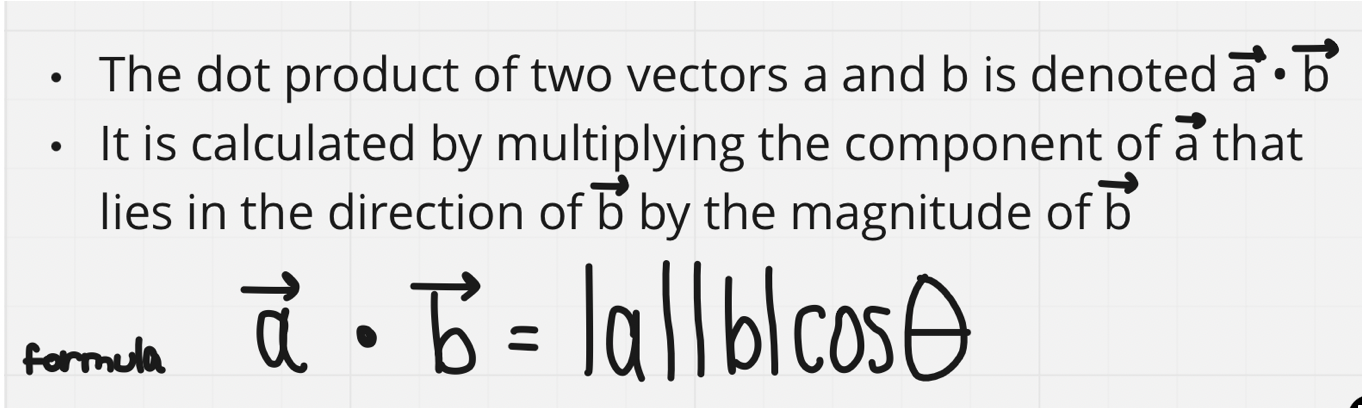
Dot product
The dot product always produces a scalar (not a vector) and is sometimes referred to as the scalar product
The dot product formula (above) is often used when we’re given geometric vectors or angles between 2 vectors
We can also determine by: x1x2,y1y2
The dot product formula (above) is often used when we’re given geometric vectors or angles between 2 vectors
We can also determine by: x1x2,y1y2
24
New cards
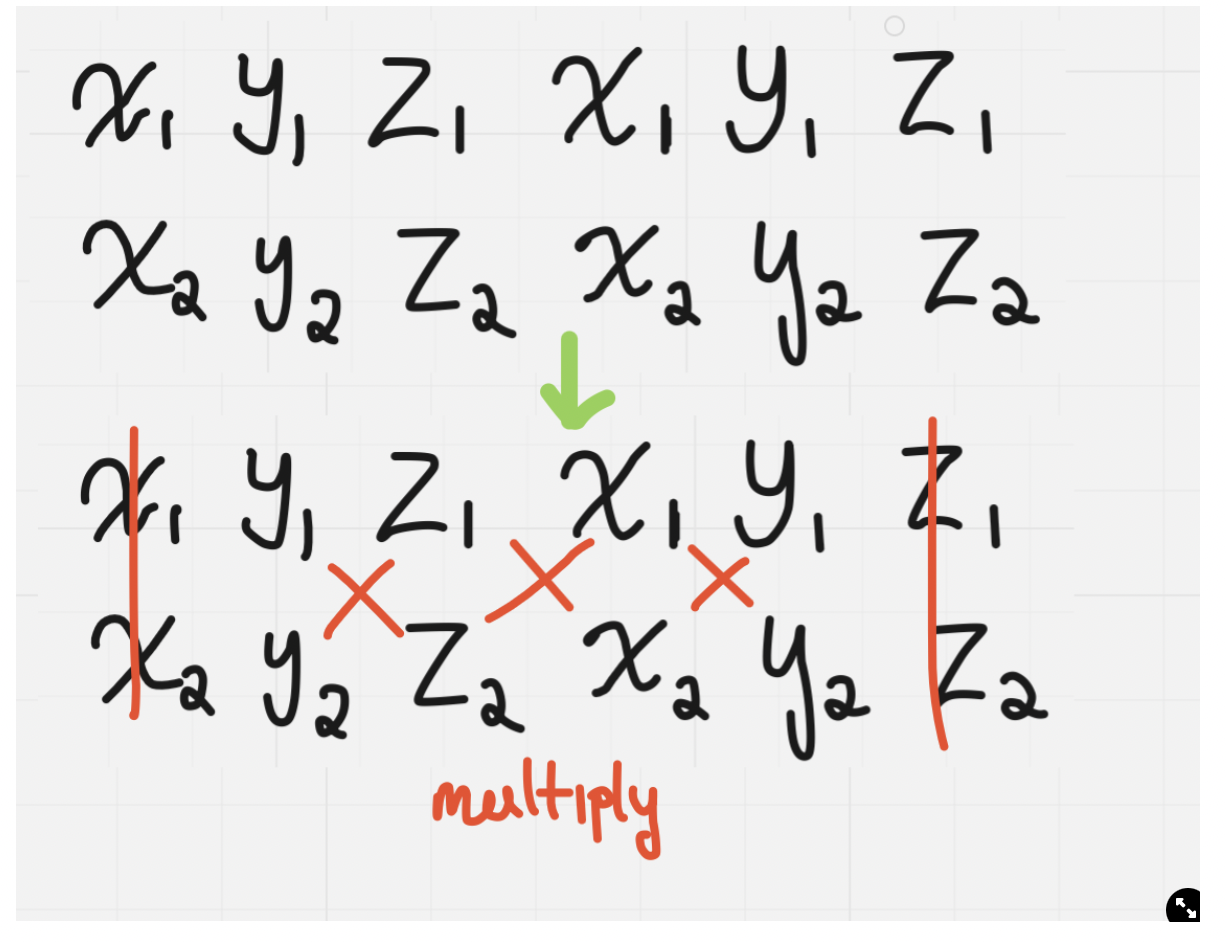
Cross Product
only for 3D vectors
Subtract what you have crossed filling out the x, y and z component
Subtract what you have crossed filling out the x, y and z component