The determinants of cardiac output
 Studied by 0 people
 Call Kai
 Learn
Learn Practice Test
 Spaced Repetition
 Match
Match Flashcards
 Knowt Play
1/32

Earn XP
Description and Tags
Best to use as flashcards with answer with definition.
Name | Mastery | Learn | Test | Matching | Spaced |
|---|
No study sessions yet.
33 Terms
2 circulatory concepts shown by Guyton et al
Heart is necessary to maintain cardiac output
Heart does not normally limit cardiac output
At what pressure do veins collapse?
1-2 mmHg below atmospheric pressure
At what point can the heart no longer increase the arteriovenous pressure gradient?
Venous pressure becomes negative
Central venous pressure in a healthy heart?
Almost zero
What limits cardiac output?
Venous return
What is the main determinant of cardiac output?
Mean systemic filling pressure
What determines the maximum flow rate for a given resistance?
The mean pressure
Mean systemic filling pressure
Mean pressure in the system - pressure that would eventually exist everywhere if the heart stopped.
How can mean systemic filling pressure be increased?
extra filling (blood transfusion); constricting filled volume
Unstressed volume
volume of blood that just fills the circulation without stretching the vessel walls
What is the maximum arteriovenous pressure gradient set by?
mean filling pressure
Can the heart change the mean pressure?
No
What determines the maximum cardiac output?
Mean pressure
CO
Cardiac output (l min-1)
ABP
Arterial blood pressure (mmHg)
TPR
Total peripheral resistance (mmHg.min.l-1)
MSFP
Mean systemic filling pressure (mmHg)
RAP
right atrial pressure (mmHg)
Darcy’s law
Flow = Pressure gradient / resistance
Why does increased afterload increase force of cardiac contraction?
Ventricles stretch
What does increased total peripheral resistance cause?
Increased arterial blood pressure
What is mean systemic filling pressure determined by?
Volume of blood
Mean tension in blood vessel walls
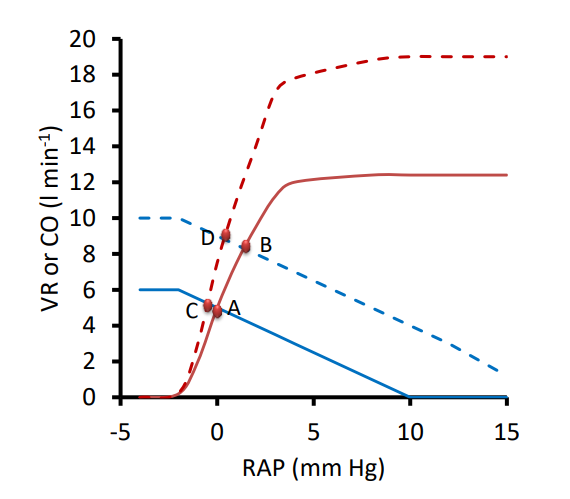
What is happening at point A? (solid lines = without stimulation; dashed lines = with sympathetic stimulation)
System is not stimulated (resting)
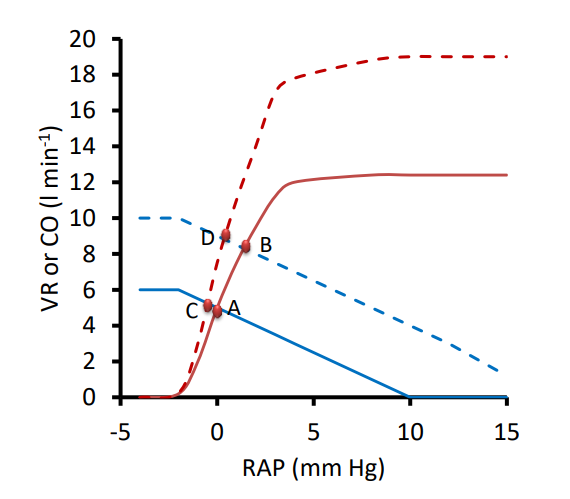
What is happening A-B? (solid lines = without stimulation; dashed lines = with sympathetic stimulation)
Sympathetic venoconstriction increases mean systemic filling pressure
Venous return curve shifted upwards
Venous return exceeds cardiac output
Right atrial pressure increases
cardiac output increases
system settles at point B
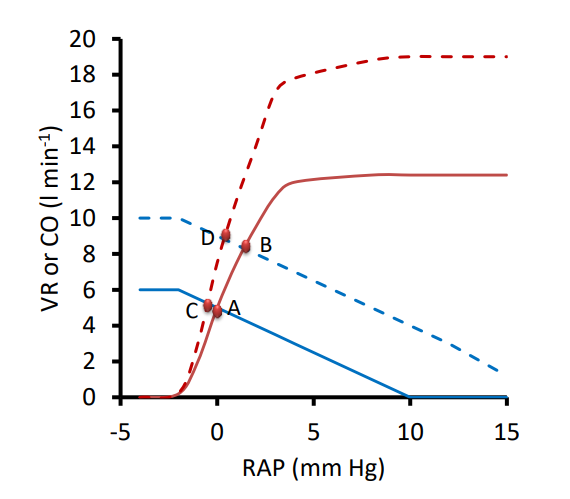
What is happening at B? (solid lines = without stimulation; dashed lines = with sympathetic stimulation)
Raised right atrial pressure and cardiac output
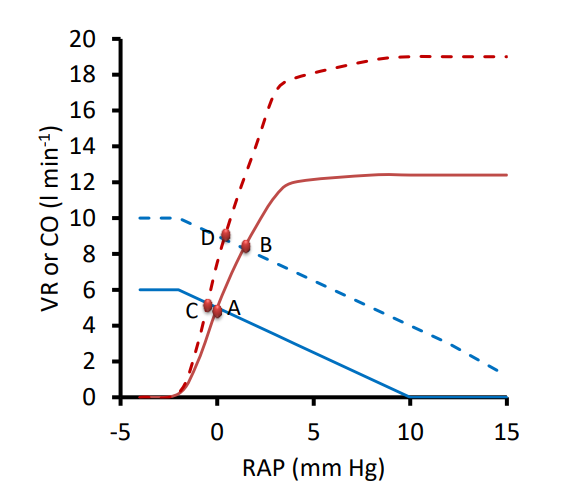
What is happening from B-C? (solid lines = without stimulation; dashed lines = with sympathetic stimulation)
Cardiac output curve shifts to higher outputs at right atrial pressure
Drives right atrial pressure negative
Increase in cardiac output is minimal
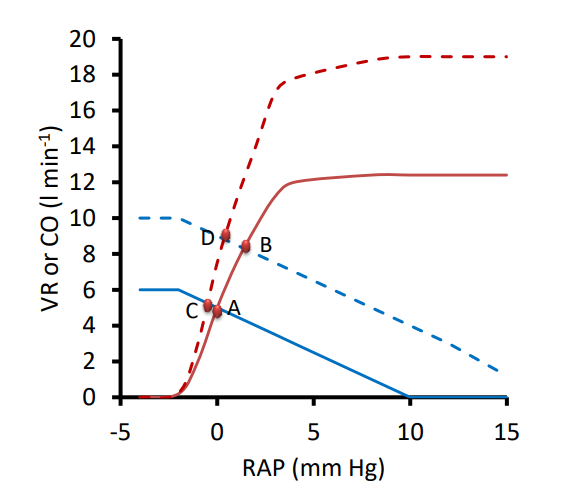
What is happening at point D? (solid lines = without stimulation; dashed lines = with sympathetic stimulation)
Higher cardiac output
right atrial pressure remains at zero
How are Guyton curves helpful?
Consider effect of various changes to the circulation
Circulatory shock
When cardiac output is inadequate to supply sufficient metabolic substrates for aerobic respiration to all tissues
Symptoms of circulatory shock
Hypotension, tachycardia, reduced organ perfusion (e.g. low urine output, loss of consciousness)
Hypovolaemic shock
Failure of cardiac output due to severe loss of circulating volume.
Cardiogenic shock
Shock caused by cardiac pathology
Distributive shock
Shock caused by a severe fall in vascular tone