GI Tract and Peritoneum and Retroperitoneum
 Call Kai
 Learn
Learn Practice Test
 Spaced Repetition
 Match
Match Flashcards
 Knowt Play
1/97

Earn XP
Description and Tags
Sonography Focused
Name | Mastery | Learn | Test | Matching | Spaced | Call with Kai | Chat |
|---|
No analytics yet
Send a link to your students to track their progress
98 Terms
parietal and visceral
what are the 2 divisions of the peritoneum?
parietal peritoneum
what is the peritoneum type that is serous, semi-permeable, lines the abdominal wall, and has anterior and posterior extensions?
lesser omentum and falciform ligament
what are the two parietal anterior extensions?
lesser omentum
what has “fatty skin” and lies between the stomach, duodenum, and porta hepatitis?
falciform ligament
what attaches the anterior liver to the diaphragm and abdominal wall?
the greater omentum and mesentery
what are the two extensions of the posterior parietal?
greater ommentum
what is a sheath of fat that covers the intestines and attaches to bottom of the stomach?
mesentery
what extends off the posterior abdomen wall and has 2 sections?
water, electrolytes, leukocytes, antibodies, salt, cells
what are some things that the peritoneal fluid contains?
the greater and lesser sac
what are the two peritoneal compartments?
the retroperitoneal
what lies behind the peritoneum?
anterior pararenal space, perirenal space, posterior pararenal space
what are the three divisions of the retroperitoneal?
anterior pararenal space
what lies between the posterior peritoneum and the anterior and posterior renal fascia?
anterior pararenal space
what space includes the duodenum, pancreas, ascending and descending colon, and roots of small bowel mesentery?
perirenal space
what space is contained by gerotia’s fascia and the largest area in the Retroperitoneum?
perirenal space
what space contains kindeys, renal vessels, adrenal glands, uterus and collecting systems, aorta and IVC, lymph nodes, fat
posterior pararenal space
what space contains no major organs and houses some vessels and fatty tissue
posterior parietal peritoneum
what is the anterior retroperitoneal border?
posas and ql muscle and spine
what is the posterior retroperitoneal border?
tranversalis fascia and peritoneal mesentery
what is the lateral retroperitoneal border?
diaphragm
what is the superior retroperitoneal border?
pelvic brim
what is the interior retroperitoneal border?
esophagus, stomach, duodenum, jejunum, ileum, colon, rectum
list out the oral to end of sequence of the GI tract
lumen interface, mucosa, submucosa, muscularis propria, and serosa
what is the outer to inner gut signature layers?
bright, dark, bright, dark, bright
name the sequence of bright and dark for the gut signatures from outer to inner
jejunum
what part of the small bowel has more conspicuous valvulae conniventes and is commonly central?
ileum
what part of the small bowel has less prominent folds; follow towards the ileocecal valve?
the large bowel
what has haustra?
peristalsis
what is the term for when spontaneous movement changes the wall and lumen over time?
compressibility
what is it called when a gentle graded pressure changes loop shape and improves the window?
skin, subcutaneous fat/superficial fascia, muscle and aponeuroses, transversalis fascia, extraperitoneal fat, parietal peritoneum
what are the 6 layers of the abdominal wall?
linea alba
what is the midline fascia?
linea semilunaris
what is the lateral rectus border?

rectus sheath
what is the aponeurotic envelope?

inguinal ligament
what is the asis to pubic tubercle?

rectus abdominis
what is this muscle?
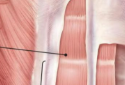
external oblique
what is this muscle?

internal oblique
what is this muscle?

transversus abdominis
what is this muscle?

left and right psoas major
what is this muscle?

quadratus lumborum
what is this muscle?

small bowel
where do most of the digestive processes take place?
large bowel
where does much of the remaining fluid get absorbed and undigested products are eliminated?
pharynx
what extends from the under surface of the skull to the level of cricoid cartilage?
esophagus
what begins at the cricoid cartilage and ends at the stomach after passing through the left dome of the diaphragm?
cardiac (esophageal) orifice
what is the entrance of the esophagus into the stomach called?
peritoneum
what is the serous membrane that covers the abdominal and pelvic viscera or internal organs and lines the walls of the abdomen and pelvis?
parietal peritoneum
what layer of the peritoneum lines the walls of the pelvic and abdominal cavities?
visceral
what layer of the peritoneum covers the organs?
greater sac
which peritoneal cavity extends from the diaphragm into the pelvis?
lesser sac
which peritoneal cavity lies behind the stomach and communicates with the other sac?
epiploic foramen or foramen of winslow
what is the oval window opening called where the lesser sac communicates with the greater sac?
peritoneal ligaments
what are 2 layer folds that connect internal organs to other organs?
mesenteries
2 layer folds of peritoneum that connect parts of intestine to posterior abdominal wall
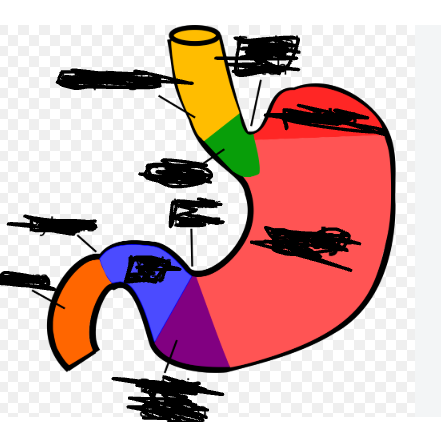
esophagus
what it the yellow part of the stomach?

cardia
what is the green part of the stomach?

cardial notch
what is the arrow pointing to the curve in the green called?

fundus
what is the bright red part of the stomach called?
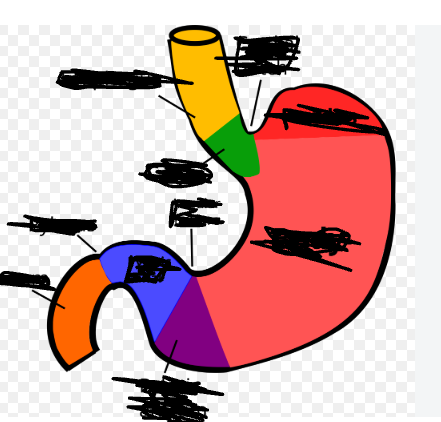
body
what is the big red portion of the stomach called?

pyloric antrum
what is the purple part of the stomach called?
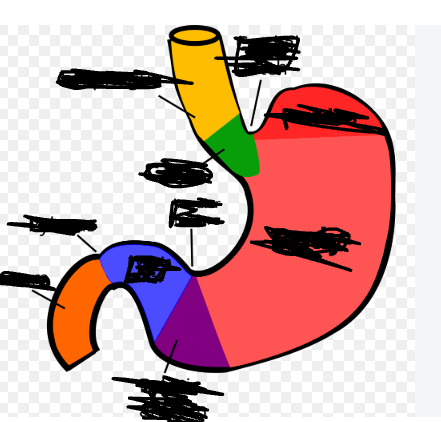
pyloric canal
what is the blue part of the stomach called?

angular incisure
what is the arrow pointing to above the purple called?

pylorus
what is the line between the blue and orange part of the stomach called?
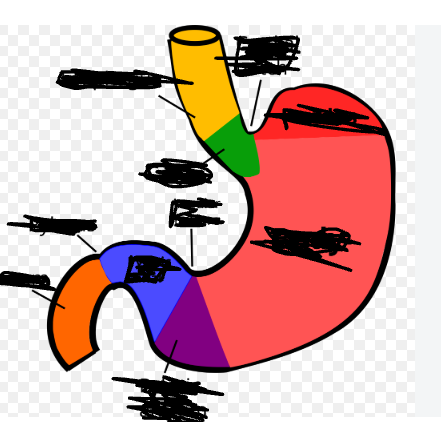
duodenum
what is the orange part?
duodenum, jejunum, ileum
what are the three parts of the small bowel?
duodenal bulb, descending duodenum, transverse duodenum, and ascending duodenum
what are the 4 parts of the duodenum
duodenal bulb
what part of the duodenum begins at the pylorus and ends at the medial side of the gallbladder neck?
descending duodenum
which part of the duodenum is retroperitoneal with limited mobility and receives common bile duct and main pancreatic duct?
transverse duodenum
the gallbladder, right lobe of the liver and medial portion of the left lobe of the liver are anterior to this part of the duodenum
ascending duodenum
this part of the duodenum attaches to the jejunum at the duodenojejunal flexure. And is held in place by the suspensory ligament.
intra
the jejunum and ileum are ___peritoneal
jejunum
what occupies the umbilical and left iliac regions?
ileum
what part of the small bowel occupies the umbilical, hypogastric, right iliac, and pelvic regions? And it opens into the cecum (inner side of large bowel)?
cecum, ascending colon, transverse colon, descending colon, rectum, and anus
what are the divisions of the large bowel?
hepatic flexure
what is the name of the right colic flexure?
splenic flexure
what is the name of the left colic flexure
cecum
what part of the large bowel has a blind cul-de-sac. appendix opens into this
ascending colon
what part of the large bowel arises from right iliac fossa, across the iliac crest, and to the visceral surface of the right lobe of the liver
transverse colon
what part of the large bowel is anterior to the duodenum
descending colon
what part of the large colon goes into the left iliac fossa and becomes the sigmoid colon?
rectum
what penetrates the levator Ani muscle to become the anus
esophagus
what gets its blood supply from the gastric branch and left inferior phrenic arteries?
jejunum
what part of the small bowel has greater vascularity, larger villi, and Brunner (duodenal) glands
haustra
what moves contents through the colon?
celiac, SMA, and IMA
what vasculature provides blood flow to the small and large intestines?
celiac artery
what vasculature provides blood flow to the duodenum?
gastrin
what is the endocrine hormone released from the stomach that stimulates secretion of gastric acid?
cholecystokinin
what is released by the presence of fat in the intestine and regulates gallbladder contraction and gastric emptying?
secretion
what is released by the small bowel “natures anti acid” and stimulates secretion of bicarbonate and lowers acid content of intestine.
duodenum, gallbladder, and portal confluence
what forms a triad to localize the head of the pancreas?
neoplasm
what is the abnormal and uncontrolled growth of tissue, tumor
ulceration of bowel
what is an open sore or break in inner lining of small and large intestines?
intussusception
what is it called when one part of the intestine slides inside an adjacent section
ascites
the abnormal buildup of excess fluid inside abdomen
ileus
paralysis of bowel loops
stenosis
abnormal narrowing of body passage, canal, blood vessel
fistula
abnormal tunnel or connection that forms between 2 body structures
meckel diverticulum
remains of yolk sack projecting from the side of the ileum