Chapter 2: Basic Principles of Physiology-Membrane Transport
 Call Kai
 Learn
Learn Practice Test
 Spaced Repetition
 Match
Match Flashcards
 Knowt Play
1/229

There's no tags or description
Looks like no tags are added yet.
Name | Mastery | Learn | Test | Matching | Spaced | Call with Kai | Chat |
|---|
No analytics yet
Send a link to your students to track their progress
230 Terms
What are the three major functions of the plasma membrane?
Barrier between intracellular and extracellular environments
Regulation of transport across the membrane
Communication with other cells
What does semi-permeable mean when describing the plasma membrane?
The membrane allows some substances to cross while restricting others
What does intracellular mean?
Inside the cell
What does extracellular mean?
Outside the cell
How does the plasma membrane function as a barrier?
It separates the intracellular environment from the extracellular environment
What does it mean that the plasma membrane regulates transport?
It controls the exchange of substances across the membrane
In what directions can substances be exchanged across the plasma membrane?
Into the cell or out of the cell
What is the third major function of the plasma membrane besides acting as a barrier and regulating transport?
Communication with other cells
How can the plasma membrane act as a barrier while still allowing substances to enter and leave the cell?
The plasma membrane is semi-permeable, so it separates the intracellular and extracellular environments while allowing controlled exchange of substances.
A membrane controls which substances move between the inside and outside of a cell. Which plasma membrane function does this demonstrate?
Regulation of transport
What three major categories of membrane transport are listed on the transport slide?
Diffusion
Active transport
Vesicular transport
What two types of diffusion are listed on the membrane transport slide?
Simple diffusion and facilitated diffusion
Is diffusion a passive or active form of membrane transport?
Passive transport
What is a concentration gradient?
A difference in the concentration of a substance between two areas.
What is the direction of net molecular movement during diffusion?
From HIGH concentration → LOW concentration
Does passive diffusion require cellular energy to drive movement down a concentration gradient?
No
What is the main difference between simple diffusion and facilitated diffusion?
Simple diffusion occurs directly through the lipid bilayer, while facilitated diffusion uses a membrane transport protein
Why is facilitated diffusion considered passive even though it uses a membrane protein?
The substance still moves down its concentration gradient without cellular energy driving the movement
What happens to a concentration difference as diffusion occurs?
The concentration difference becomes smaller as molecules become more evenly distributed.
What does equilibrium mean during diffusion?
Molecules continue moving, but there is no net change in their distribution

In the diffusion figure, what does the horizontal lipid bilayer represent?
The plasma membrane separating extracellular fluid from the cytoplasm

At the beginning of the diffusion figure, where is the concentration of blue molecules highest?
In the extracellular fluid outside the cell
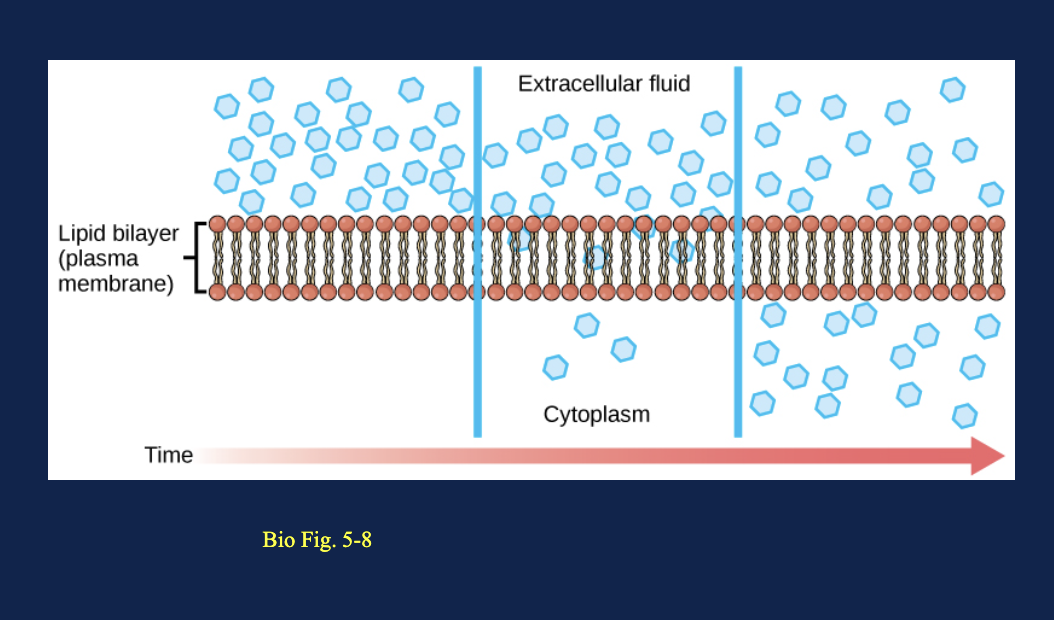
In the diffusion figure, why is there net movement of blue molecules from the extracellular fluid into the cytoplasm?
The molecules are moving from higher concentration outside the cell toward lower concentration inside the cell

What happens to the distribution of blue molecules over time in the diffusion figure?
The molecules become more evenly distributed across the two sides of the plasma membrane.
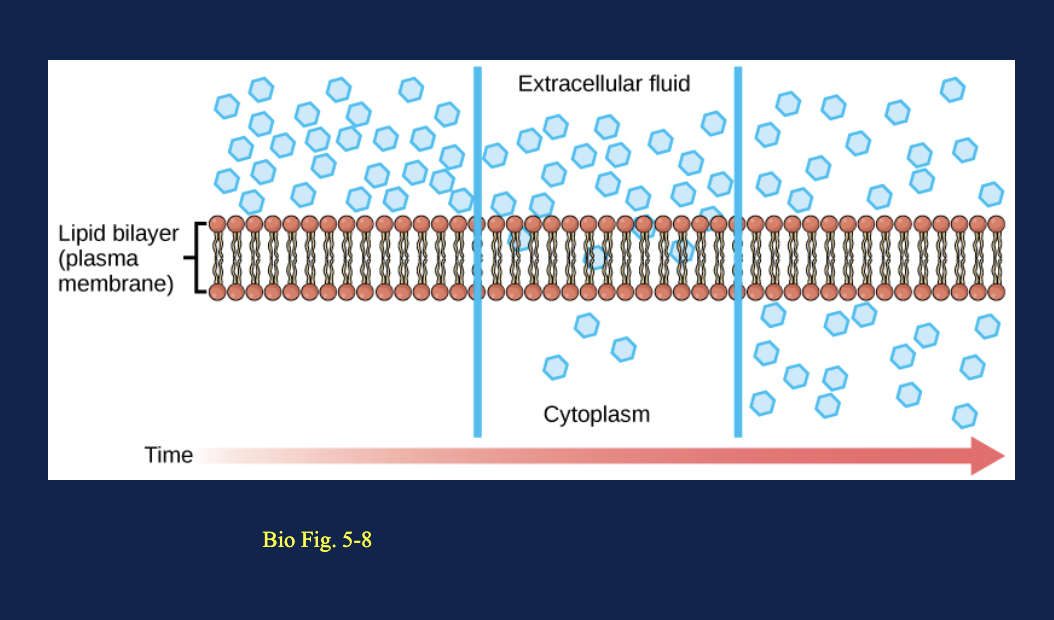
What type of diffusion is illustrated when molecules pass directly through the lipid bilayer without a transport protein?
Simple diffusion
How does a concentration gradient cause net diffusion across a plasma membrane?
A difference in concentration causes net movement from the area of higher concentration toward the area of lower concentration.
A molecule moves from high concentration to low concentration through a membrane protein without cellular energy input. What type of transport is occurring?
Facilitated diffusion
What is diffusion?
The tendency of molecules to disperse, or spread out, until an equilibrium of concentration is reached
What does disperse mean in the definition of diffusion?
To spread out
In what direction do molecules show net movement during diffusion?
From high concentration → low concentration
What does it mean for molecules to move down their concentration gradient?
They show net movement from an area of high concentration → an area of low concentration
What causes diffusion according to the slide?
Random molecular motion
How does random molecular motion produce diffusion when concentrations are unequal?
Random molecular motion results in net movement from the area of higher concentration toward the area of lower concentration
Why is diffusion considered passive transport?
It does not require cellular energy to drive the movement
How long does diffusion proceed when a concentration gradient exists?
Until equilibrium is reached
What does equilibrium mean in diffusion?
The molecules have become evenly distributed so there is no net change in concentration
Do molecules stop moving when diffusion reaches equilibrium?
No. Molecules continue random molecular motion, but there is no net movement that changes the concentrations.
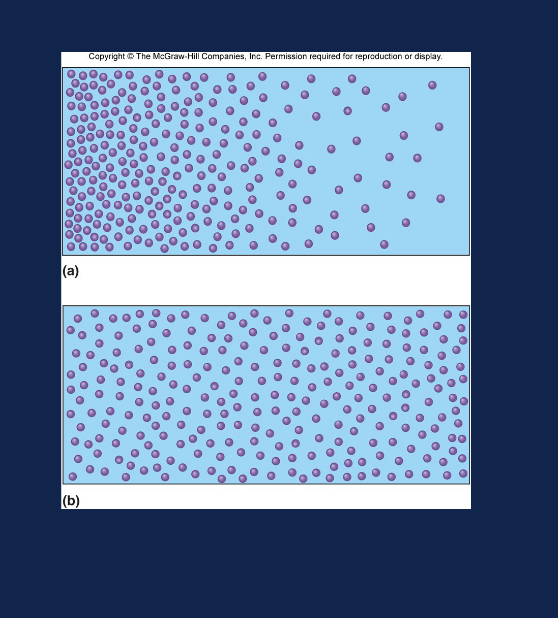
In the diffusion figure, what does panel (a), with many molecules on the left and fewer on the right, represent?
An unequal distribution of molecules that creates a concentration gradient.
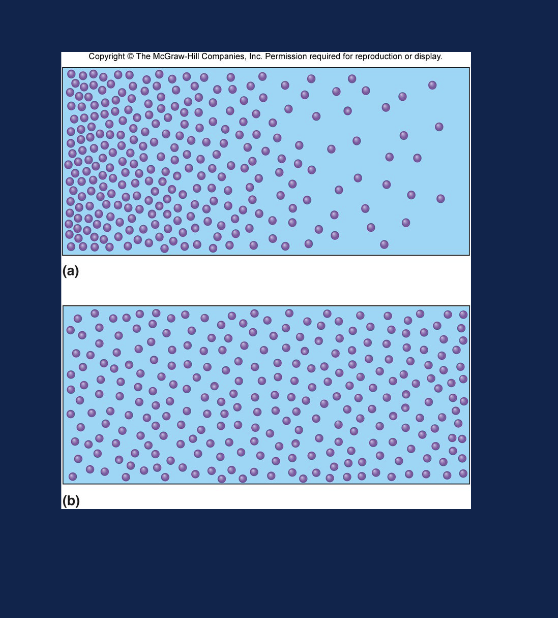
In the diffusion figure, what does panel (b), with molecules evenly distributed throughout the space, represent?
Equilibrium
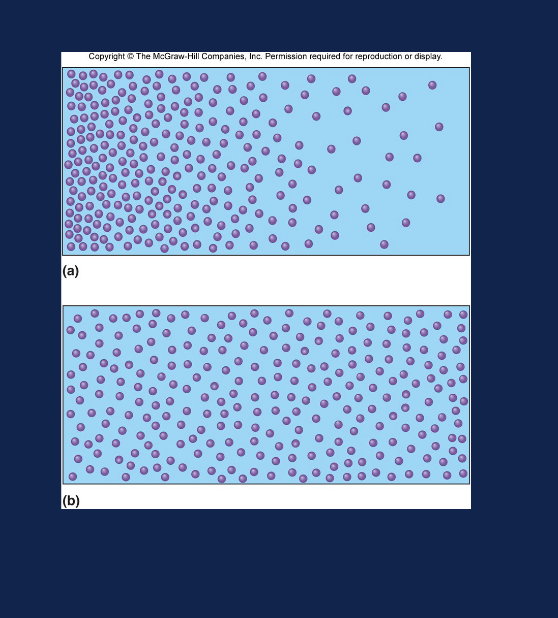
What change occurs from panel (a) to panel (b) in the diffusion figure?
Molecules disperse from an uneven distribution toward an even distribution through diffusion
Molecules are more concentrated on one side of a space than the other and begin spreading toward the less concentrated region without cellular energy. What process is occurring?
Diffusion
What is simple diffusion across the plasma membrane?
Passive movement of molecules directly through the lipid bilayer from high concentration → low concentration
Does simple diffusion require a membrane transport protein?
No. Molecules move directly through the lipid bilayer
What types of molecules are especially able to cross the plasma membrane by simple diffusion?
Hydrophobic/lipophilic molecules
What does lipophilic mean?
Lipid-soluble or "lipid-loving."
What examples of molecules capable of simple diffusion are listed on the slide?
Ethanol
Vitamin A, D, E
O2
CO2
H2O
What is the diffusion of H₂O called?
Osmosis
What three factors determine the rate of simple diffusion according to the slide?
Concentration gradient
Size of molecules
Lipid solubility
How does the size of the concentration gradient affect the rate of simple diffusion?
A larger concentration gradient produces faster diffusion
How does molecular size affect the rate of simple diffusion?
Smaller molecules diffuse faster than larger molecules
How does lipid solubility affect the rate of simple diffusion through the plasma membrane?
Greater lipid solubility allows faster diffusion through the lipid bilayer
Why do lipophilic molecules readily undergo simple diffusion across the plasma membrane?
Because the plasma membrane is a lipid bilayer, lipid-soluble molecules can pass through its lipid portion relatively easily
What combination of factors would favor the fastest rate of simple diffusion?
A large concentration gradient, small molecular size, and high lipid solubility

How can you recognize simple diffusion in a plasma membrane diagram?
Molecules move directly through the lipid bilayer from high → low concentration without a transport protein

In the simple diffusion figure, why do the small uncharged molecules initially show net movement from the extracellular fluid into the cytoplasm?
Their concentration is higher outside the cell than inside, so they move down their concentration gradient

What process should you recognize when a figure shows H₂O moving across a semipermeable membrane?
Osmosis
A small lipid-soluble molecule moves directly through the plasma membrane from high to low concentration without ATP. What transport mechanism is occurring?
Simple diffusion
What is the main difference between simple diffusion and facilitated diffusion?
Simple diffusion occurs directly through the lipid bilayer, while facilitated diffusion requires a membrane transport protein; both are passive.
What is facilitated diffusion?
Passive movement of a substance down its concentration gradient with the help of a membrane protein
Why is facilitated diffusion called “facilitated”?
A membrane protein helps the substance cross the membrane
What two types of membrane proteins can perform facilitated diffusion on this slide?
Channel proteins and carrier proteins
What does it mean that a facilitated diffusion protein is selective or specific?
It transports particular substances rather than allowing every substance to cross
What does gated mean for a channel protein?
The channel can open or close to regulate passage through the membrane
What type of substances are transported through the channel proteins shown on the facilitated diffusion slide?
Small ions
How does a carrier protein transport a substance across the plasma membrane?
The substance interacts with the carrier, the carrier changes shape, and the substance is released on the other side
What is a conformational change in a carrier protein?
A change in the protein's shape
What larger molecules are listed as examples of substances transported by carrier proteins?
Glucose and amino acids
Does facilitated diffusion require ATP to drive transport?
No. Facilitated diffusion is passive
Why can facilitated diffusion use a membrane protein and still be considered passive transport?
The protein helps the substance cross, but the substance still moves down its concentration gradient without ATP driving the movement
What is the main difference between channel proteins and carrier proteins in facilitated diffusion?
Channel proteins provide a passageway through the membrane, while carrier proteins undergo a conformational change to transport substances
What is the main difference between simple diffusion and facilitated diffusion?
Simple diffusion occurs directly through the lipid bilayer, while facilitated diffusion uses a membrane protein; both are passive
How can you recognize a gated channel protein in a facilitated diffusion diagram?
Look for a membrane protein with a passageway that can switch between a closed and open state
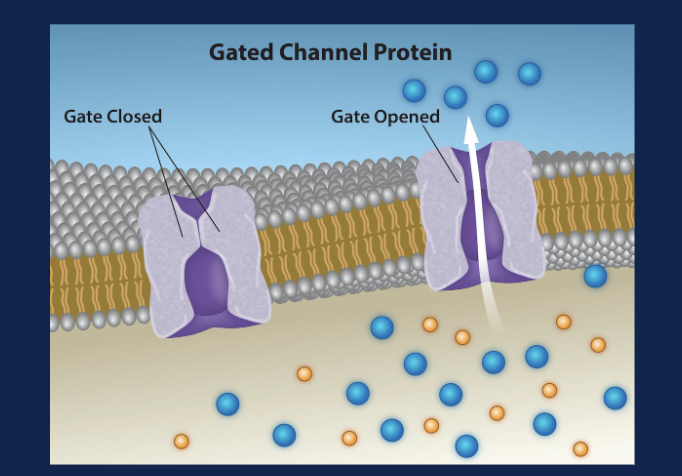

What happens when the gated channel protein shown in the facilitated diffusion figure opens?
Small ions can move through the channel across the membrane
How can you recognize a carrier protein in a facilitated diffusion diagram?
Look for a protein that interacts with the transported substance and changes shape to move it across the membrane
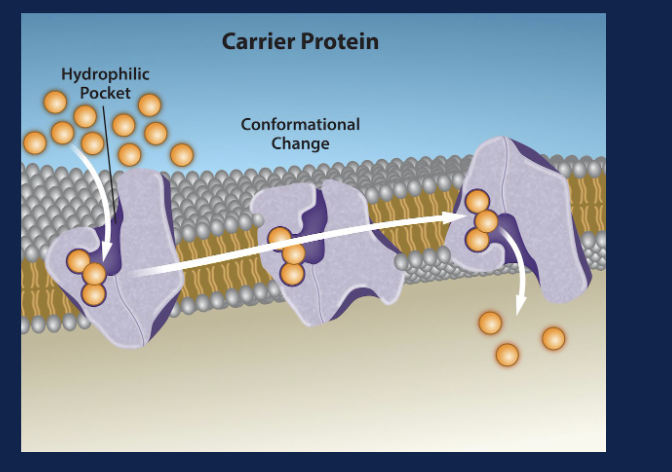
What does the conformational change shown in the carrier-protein figure accomplish?
It changes the carrier's shape so the transported molecules can be moved across and released on the other side of the membrane

A membrane protein opens a pore that allows small ions to cross down their concentration gradient. What type of protein is being used?
A channel protein
Glucose moves down its concentration gradient after interacting with a membrane protein that changes shape. What type of protein is being used?
A carrier protein
What determines the rate of simple diffusion according to the rates-of-diffusion slide?
The concentration gradient
What two factors determine the rate of facilitated diffusion?
The concentration gradient
The number of available transport proteins
What does flux mean on a membrane transport graph?
The rate at which a substance crosses the membrane
How does increasing the concentration gradient affect the rate of simple diffusion?
A larger concentration gradient increases the rate of simple diffusion.
What is transport maximum in facilitated diffusion?
The highest transport rate reached when all available transporters are occupied
What does transporter saturation mean during facilitated diffusion?
All available transport proteins are occupied.
Why does increasing solute concentration eventually stop increasing the rate of facilitated diffusion?
All available transport proteins become occupied, so transport maximum is reached
Why can facilitated diffusion reach a transport maximum while simple diffusion does not have the same transporter limitation?
Facilitated diffusion depends on a limited number of transport proteins that can become occupied, while simple diffusion occurs directly through the membrane

What does the X-axis represent on the rates-of-diffusion graph?
Extracellular solute concentration.

What does the Y-axis represent on the rates-of-diffusion graph?
Flux into the cell, or the rate of solute movement into the cell.
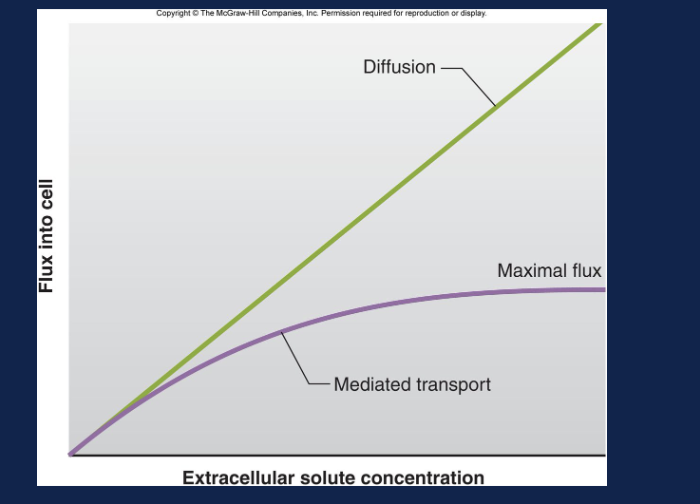
How can you identify simple diffusion on the rates-of-diffusion graph?
It is the straight line that continues increasing as extracellular solute concentration increases.
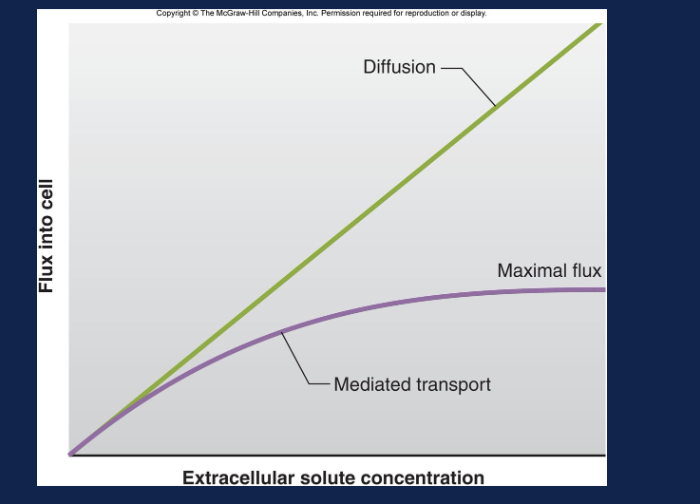
How can you identify facilitated or mediated transport on the rates-of-diffusion graph?
It is the curve that increases at first and then plateaus at maximal flux

What does the plateau of the mediated-transport curve represent on the rates-of-diffusion graph?
Maximal flux, where all available transporters are occupied
If extracellular solute concentration increases but facilitated diffusion no longer increases, what has occurred?
The transport proteins have become saturated and transport maximum has been reached
How does the number of available transport proteins affect the maximum rate of facilitated diffusion?
The number of available transport proteins limits how much solute can be transported at one time.
What four mechanisms can regulate transport proteins according to the slide?
Binding of a regulatory molecule
Changes in membrane potential
Covalent modification, such as phosphorylation
Insertion or removal of transport proteins from the membrane
How can binding of a regulatory molecule regulate a transport protein?
Binding of the regulatory molecule can change the transport protein's activity
What is membrane potential?
The electrical difference across the plasma membrane
How can changes in membrane potential regulate transport proteins?
Changes in membrane potential can alter the activity of certain transport proteins.
What is phosphorylation?
The addition of a phosphate group to a molecule, such as a protein
What type of transport-protein regulation is phosphorylation an example of?
Covalent modification
How can covalent modification regulate a transport protein?
Chemically modifying the protein can change its activity
How can insertion or removal of transport proteins regulate membrane transport?
It changes the number of transport proteins available in the membrane