4.5 - Transport of gases in the blood
 Call Kai
 Learn
Learn Practice Test
 Spaced Repetition
 Match
Match Flashcards
 Knowt Play
1/19

There's no tags or description
Looks like no tags are added yet.
Name | Mastery | Learn | Test | Matching | Spaced | Call with Kai | Chat |
|---|
No analytics yet
Send a link to your students to track their progress
20 Terms
How is oxygen transported around the body?
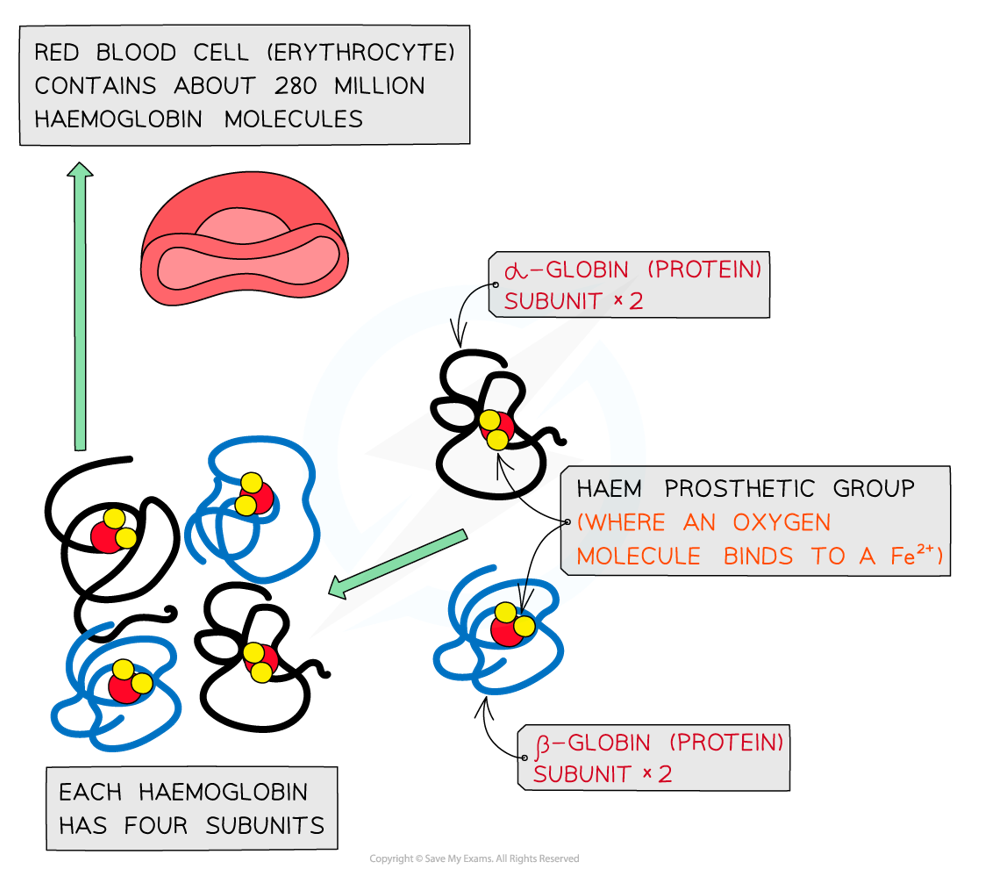
Oxygen is carried in erythrocytes (red blood cells) bound to the protein, haemoglobin
What is the structure of a haemoglobin molecule?
Globular & water-soluble protein:
quaternary structure (ionic & hydrogen bonds & disulphide bridges between R groups)
four polypeptide chains (2 alpha & 2 beta), each carrying a prosthetic haem group containing an Fe2+ ion
What is the function of haemoglobin?
Present in red blood cells → oxygen molecules bind to the haem groups & are carried around the body to where they are needed in respiring tissues
Define ‘affinity of haemoglobin for oxygen’
The ability of haemoglobin to attract, or bind, oxygen
Define ‘saturation of haemoglobin with oxygen’
When haemoglobin is holding the maximum amount of oxygen it can bind (4 molecules)
Define ‘loading/association of haemoglobin’
The binding of oxygen to haemoglobin
Define ‘unloading/dissociation of haemoglobin’
When oxygen detaches, or unbinds, from haemoglobin
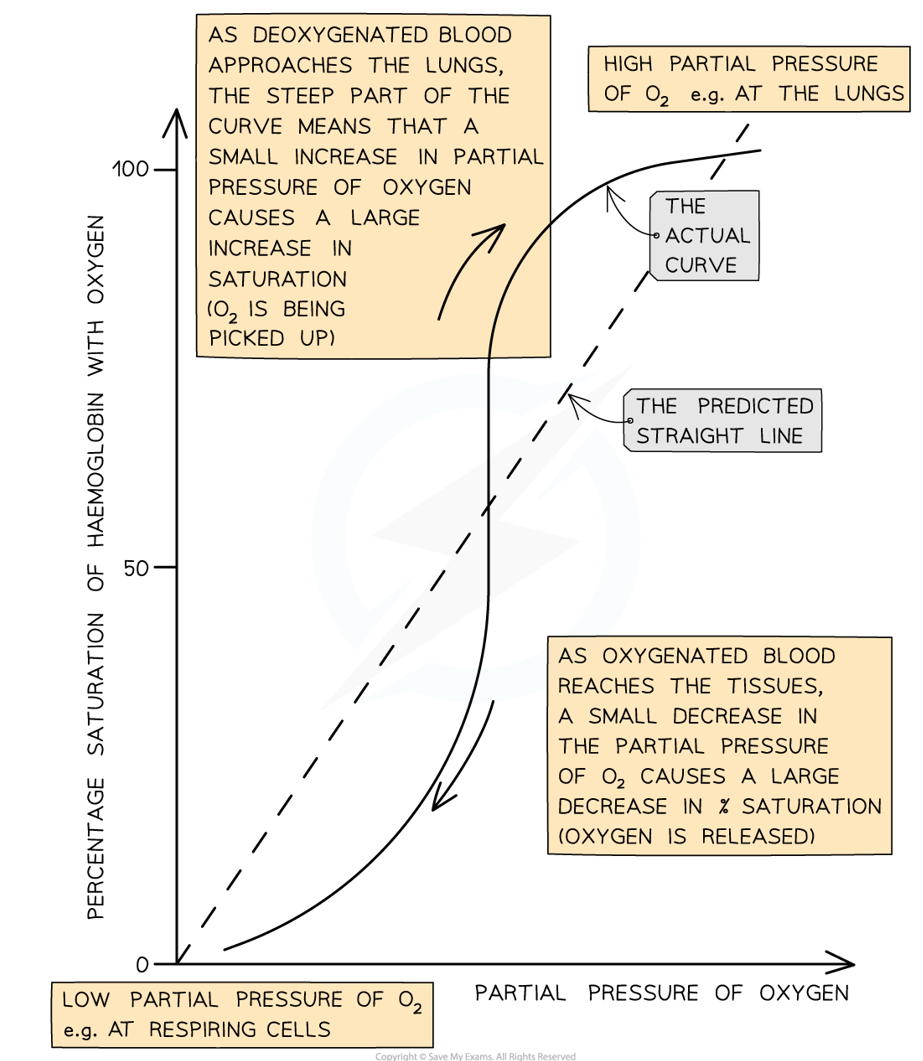
What is an oxygen dissociation curve?
Shows how much oxygen combines with haemoglobin at different partial pressures of oxygen (oxygen concentrations)
Explain why the oxygen dissociation curve is sigmoidal (s-shaped)
Because of the co-operative binding of oxygen to the 4 polypeptide chains
Binding of the oxygen molecule changes the shape of the haemoglobin molecule, therefore facilitates the binding of other oxygen molecules
What is partial pressure?
The pressure an amount of a gas present in a mixture of gases contributes to the total pressure of the gas mixture
Where is oxygen loaded & unloaded?
Oxygen is loaded in regions with a high partial pressure (e.g. alveoli)
Oxygen is unloaded in regions with a low partial pressure (e.g. respiring tissues)
What is the Bohr effect?
The reduction of the oxygen-carrying capacity of haemoglobin caused by increasing concentrations of CO2
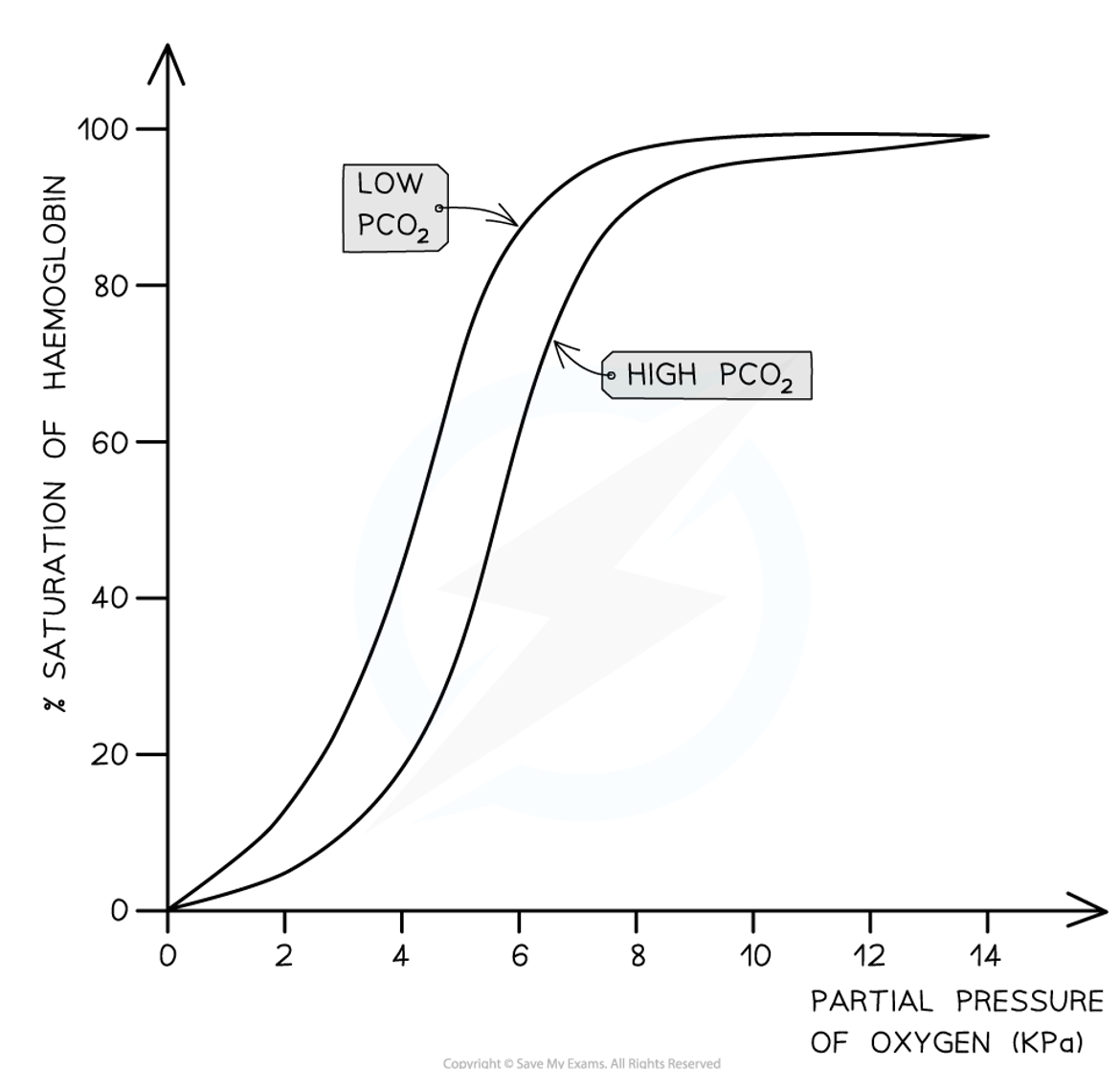
What does the Bohr effect show happens to the oxygen dissociation curve?
Low partial pressure of CO2 in the alveoli means the curve shifts to the left → increased affinity, so loads more oxygen
High partial pressure of CO2 at respiring tissues means the curve shifts to the right → decreased affinity, so unloads more oxygen
What are the golden rules for oxygen dissociation curves?
Right for Release:
the further to the right the curve, the lower haemoglobin's affinity for oxygen → binds oxygen less easily & releases it more readily
Left for Loves oxygen:
the further to the left the curve, the higher haemoglobin's affinity for oxygen → binds oxygen more easily & releases it less readily
The more active the tissue, the greater the right shift & the more oxygen is unloaded. Why is this?
Increased rate of respiration produces more CO2, lowering pH & causes haemoglobin to change shape
This leads to more oxygen being unloaded for aerobic respiration
Where does a human foetus obtain its oxygen from?
The placenta
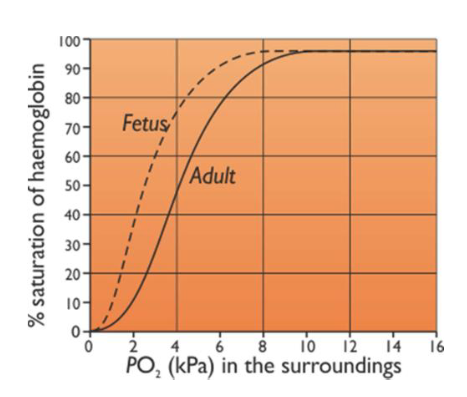
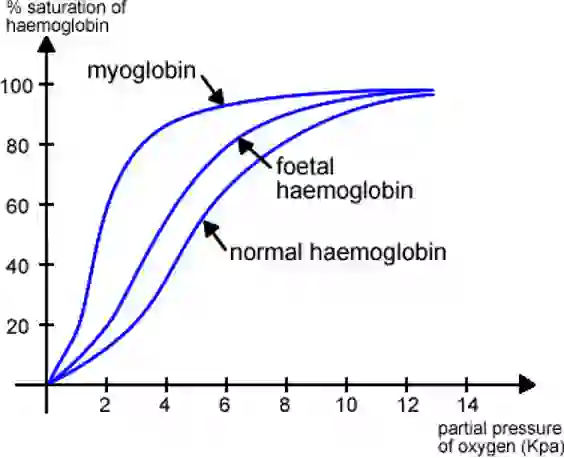
How does foetal haemoglobin differ from adult haemoglobin?
Foetal haemoglobin has a higher affinity for oxygen at the same partial pressure than adult haemoglobin → oxygen dissociation curve shifts to the left
What is myoglobin?
A globular protein only found in muscle cells of mammals with high metabolic demands
Has a single peptide chain & carries oxygen attached to one, single haem group
How does myoglobin’s oxygen dissociation curve differ from haemoglobin’s?
Myoglobin has a higher affinity for oxygen than haemoglobin, especially at low partial pressures → oxygen dissociation curve shifts to the left
So in muscle cells, oxygen will unload from haemoglobin & bind to myoglobin
What is a useful function of myoglobin?
Acts as a reservoir for oxygen within the muscles → enables them to keep working longer when oxygen demand exceeds supply