Mechanisms of Learning, Psychopathology, and Depressive Realism in Psychology
 Studied by 0 people
 Call Kai
 Learn
Learn Practice Test
 Spaced Repetition
 Match
Match Flashcards
 Knowt Play
1/86

There's no tags or description
Looks like no tags are added yet.
Name | Mastery | Learn | Test | Matching | Spaced |
|---|
No study sessions yet.
87 Terms
What is the main theory discussed in relation to depressive realism?
Helplessness theory, which suggests that depressed individuals have generalized expectancies of independence between their responses and outcomes.
What do depressed individuals believe according to Seligman's theory?
They believe they are powerless to control the world.
What are some symptoms induced by learned helplessness training in animals and humans?
Low mood, loss of interest, weight loss, sleep problems, fatigue, worthlessness, poor concentration, and psychomotor problems.
How many DSM symptoms of major depressive disorder are induced by learned helplessness training?
8 out of the 9 symptoms.
What expectation do non-depressed individuals have according to Alloy & Abramson's findings?
They have a generalized expectation of control.
What is the definition of contingency in the context of learning?
Contingency refers to the relationship between responses and outcomes, defined as ΔP = P(O|R) - P(O|~R).
What does a ΔP of 0 indicate in terms of control judgments?
It indicates that there is no relationship between responses and outcomes.
What was the sample size of the study on depressive realism, and how were participants categorized?
64 undergraduates (32 males and 32 females), categorized into depressed and non-depressed groups based on BDI scores.
What task were participants asked to perform in the depressive realism study?
Participants were asked to determine how much control they had over a green light by pressing a button.
What were the two levels of outcome density used in the depressive realism study?
0.25 (low outcome density) and 0.75 (high outcome density).
What significant interaction was noted in the depressive realism study?
The interaction between p(O) and mood was significant, particularly prevalent in female participants.
What is the implication of depressive realism regarding control judgments?
Depressed individuals do not have an expectation of control, which does not interfere with their judgments of non-contingencies.
Who conducted the original research on learned helplessness?
Seligman and Maier in 1967.

What is the purpose of measuring contingency in learning?
To understand the relationship between responses and outcomes in instrumental learning.
What does the term 'depressive realism' refer to?
The idea that depressed individuals may have a more accurate perception of reality regarding control and outcomes compared to non-depressed individuals.
What is the role of the inter-trial interval (ITI) in the depressive realism study?
The ITI of 14 seconds was used between trials to measure participants' responses over time.
What is the significance of the study's findings for understanding depression?
It suggests that depressive realism may provide insights into how depressed individuals perceive control and outcomes differently from non-depressed individuals.
What does the BDI stand for in the context of the study?
Beck Depression Inventory, a tool used to assess depression levels in participants.
What is the effect of mood on judgments of control according to the study?
Mood significantly affects judgments of control, with differences noted between depressed and non-depressed individuals.
What is the main question posed by the lecture regarding learning and emotion?
Do you learn better when you are sad?
What is the primary focus of Professor Mark Haselgrove's lecture?
The relationship between mechanisms of learning and psychopathology, particularly depressive realism.
What is the outcome of the depressive realism study regarding control ratings?
Participants rated their judgment of control over the green light on a scale from 0 (no control) to 100 (complete control).
What is the main difference in self-esteem between depressed and non-depressed individuals according to Alloy & Abramson (1979)?
Depressed individuals have low self-esteem, while non-depressed individuals have higher self-esteem.
How do non-depressed individuals typically distort reality to enhance their self-esteem?
They overestimate their control over desired behaviors and underestimate their control over undesired behaviors.
What is the motivation of depressed individuals regarding self-esteem?
Depressed individuals have a specific motivation to preserve their self-esteem.
What is the key question regarding depressive realism and P(O) levels?
Why is depressive realism restricted to high levels of P(O)?
What was the outcome of Vazquez's (1987) replication of Alloy & Abramson's study?
The outcome was a red light, involving 16 female Spanish undergraduates, with 8 depressed and 8 non-depressed participants.
What was the result of Bryson et al. (1984) in their replication of Alloy & Abramson's study?
Neither depressed nor non-depressed individuals showed an illusion of control.
What are some problems identified in the meta-analysis of depressive realism studies?
Lack of a gold standard for objective reality, inadequate assessment of depression, and limited external validity.
What solutions were proposed to address the problems in the meta-analysis of depressive realism?
Studies were coded for comparison to objective standards of reality and for how depression was assessed (interview vs. self-assessment).
What was the sample size and participant count in the meta-analysis of depressive realism?
75 studies included, testing 7305 participants, with only 11 including a treatment-seeking group.
What was the finding regarding the optimistic bias in dysphoric/depressed individuals in the meta-analysis?
The dysphoric/depressed group tended to be biased optimistically, but the effect size was less than small (mean d= .14).
How did non-dysphoric individuals' optimistic bias compare to that of dysphoric individuals?
Non-dysphorics illustrated a greater optimistic bias (d=.29) compared to dysphorics.
What was the relationship between the method of depression assessment and the findings of depressive realism?
Studies using self-report were more likely to find depressive realism than those using clinical interviews.
What was the intra-class correlation between raters/coders in the meta-analysis?
The intra-class correlation ranged from .87 to .91.
What were the two tasks used in Matute's (1996) study on mediators of depressive realism?
The two tasks were an escape task with a 90dB noise and a beep task with a quieter beep.
What was the goal of participants in the tasks used in Matute's (1996) study?
Participants aimed to maximize a reward or get something to work, rather than discover the causal structure of the world.
What was the sample size of participants in Matute's (1996) study on depressive realism?
32 undergraduates were involved in the study.
What was the significance of the ΔP value in the tasks used in Matute's (1996) study?
Both tasks had a ΔP value of 0.
What is one key aspect that needs to be examined regarding judgments of control under 0 contingency in depressive realism?
How judgments of control might relate to depression.
What was the primary focus of Alloy & Abramson (1979) in their motivational theory?
The focus was on how depressed and non-depressed individuals perceive control over their behaviors.
What did the meta-analysis reveal about the effect sizes for studies with high and low external validity?
Almost identical effect sizes were found for studies low and high on external validity.
What is the significance of having a treatment-seeking group in studies on depressive realism?
Only 11 out of 75 studies included a treatment-seeking group, highlighting a gap in research.
What was the sample size of the participants in the study on mediators of depressive realism?
32 undergraduates were initially tested.
What were the two tasks participants performed in the study?
The two tasks were 'Escape' with a 90dB noise and 'Beep' with a quieter beep.
What were the instructions given to the Analytical Group in the study?
They were encouraged to respond on 50% of trials to assess their control.
What were the instructions given to the Naturalistic Group in the study?
They were encouraged to obtain the outcome.
What does E. A. Skinner (1985) suggest about depressed individuals' responsiveness?
Depressed individuals are generally less responsive.
What correlation was found between BDI score and probability of responding?
There was a negative correlation (r = -0.31, p < .01), indicating that higher BDI scores corresponded to lower probability of responding.
What correlation was found between probability of responding and judgment of control?
There was a positive correlation (r = 0.32, p < .01), indicating that lower probability of responding corresponded to lower judgment of control.
What was the sample size in the online study with dysphoric and non-dysphoric participants?
66 participants were tested.
What was the main finding of Blanco et al. (2012) Experiment 1 regarding mood and response probability?
A marginally significant correlation (p = .057) was found when treating mood as a continuous variable.
What did Blanco et al. (2012) Experiment 2 manipulate?
They manipulated the probability of responding (P(R)) via instructions, independent of depressive symptoms.
What was the effect of intervening on the mediator variable P(R) in the study?
Intervening on P(R) abolished the depressive realism effect.
What conclusion did Blanco et al. (2012) draw regarding depression and realism?
Depression is a distal cause of realism, while response probability is a more proximal cause.
What is the significance of the illusion of control according to the study?
The illusion of control protects individuals by fostering optimistic beliefs about their ability to control aspects of their lives.
What was the focus of the ITI hypothesis in Msetfi et al. (2005)?
The ITI hypothesis investigates whether there is something special about the Inter-trial Interval (ITI) in relation to outcome density bias.
What was the outcome of Allan & Jenkins (1980) regarding the ITI?
Removing the ITI resulted in no outcome density bias.
What was the sample size in Blanco et al. (2012) Experiment 1?
The sample size was 50 participants.
What task was used in Blanco et al. (2012) Experiment 1?
Participants were required to produce blue flashes on the screen by pressing a key.
What does the negative correlation between BDI score and response probability suggest?
It suggests that as depressive symptoms increase, the likelihood of responding decreases.
What is the relationship between response probability and judgment of control?
As response probability decreases, judgment of control also decreases.
What were the two groups in Blanco et al. (2012) Experiment 2 based on instructions?
The two groups were assigned Naturalistic and Analytic instructions.
What is the implication of clinical interventions based on the study's findings?
Clinical interventions that increase patient activity and responding may help develop healthy, optimistic illusions.
What are the two variations of the Inter-Trial Interval (ITI) used in the study by Msetfi et al. (2005)?
Long (15 s) and Short (3 s)
How do depressed participants differ from non-depressed participants in their use of ITI information according to the study?
Depressed participants incorporate ITI information into their calculation of contingency, increasing delta p for high outcome density; non-depressed participants do not incorporate ITI information and treat contingencies equivalently.
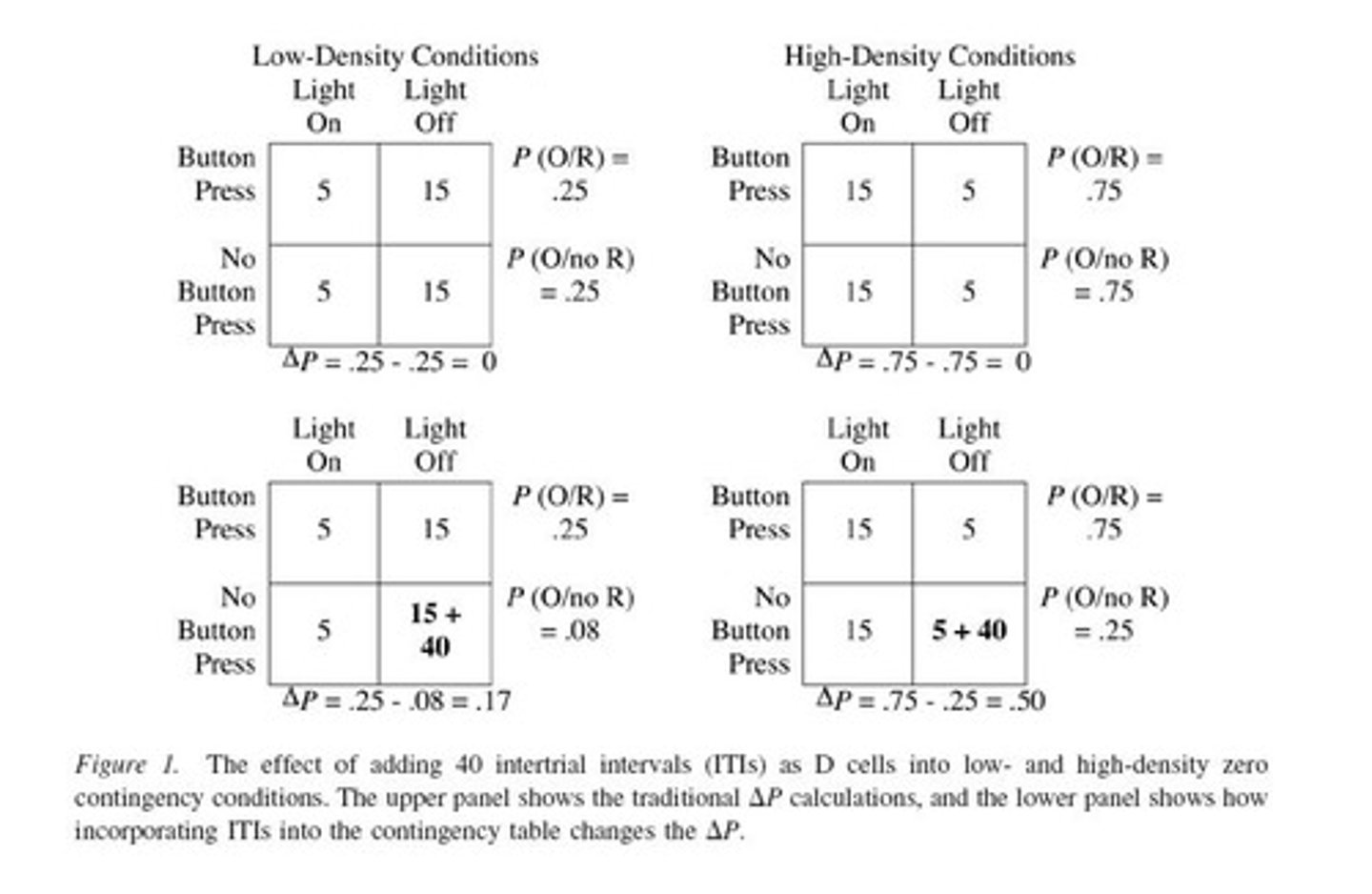
What is the relationship between mood and the judgment of action-outcome relationships as suggested by the study?
Low mood leads to accurate judgments of zero-contingencies, while high mood leads to optimistic judgments of zero-contingencies.
What cognitive deficit do depressed individuals exhibit according to the AX continuous performance task?
Depressed individuals have a deficit in processing contextual information.
What does the AX continuous performance task require participants to do?
Respond when they see 'X' (Target) only after 'A' (Context) is presented.
What are the implications of the findings on depressive realism for clinical interventions?
Understanding how mood influences action-outcome judgments can inform clinical interventions for depression.
What effect does the amount of responding have on the judgment of action-outcome relationships in individuals with low mood?
The amount of responding can influence how people with low mood judge the relationship between actions and outcomes.
What is the significance of the effect of mood on judgment of action-outcome relationships?
The effect is small but significant across studies and varies among individuals.
What is the main takeaway regarding the relationship between mood and contingency judgments?
Our mood affects how we judge the relationship between our actions and their outcomes.
What did Morrow & Nolen-Hoeksema (1990) suggest about depressed individuals and their attention during ITI?
Depressed individuals may divert their attention during ITI, leading to a lack of use of contextual information.
What does the study suggest about the role of mindfulness in clinical interventions for depression?
Mindfulness encourages awareness of the current context and its relation to events, which may help address deficits in context processing.
What are the two outcome densities mentioned in the study?
High outcome density (P(O) = 0.75) and Low outcome density (P(O) = 0.15).
What does delta p refer to in the context of the study?
Delta p refers to the difference in perceived contingency between high and low outcome density conditions.
How does the study define the relationship between mood and zero-contingencies?
Individuals in low mood judge zero-contingencies accurately, while those in high mood judge them optimistically.
What is the significance of the findings regarding depressed participants and the ITI in the context of depressive realism?
Depressed participants' incorporation of ITI information into contingency calculations may explain their unique perspective on outcomes.
What is the purpose of the practice exam MCQs mentioned in the notes?
To prepare students for upcoming assessments on ExamSys.
What is the overall theme of the notes regarding depressive realism?
The notes explore how mood affects cognitive processing and judgment of action-outcome relationships.
What type of task did Msetfi et al. (2009) use to assess context processing in depressed individuals?
The AX continuous performance task.
What does the study suggest about the variability of the mood effect on contingency judgments?
The effect is very variable, indicating that individual differences play a role.
What is the key insight about depressed individuals and their evaluation of relationships between actions and outcomes?
Depressed individuals may evaluate these relationships differently due to deficits in processing contextual information.
What is a potential factor influencing how people respond during action-outcome learning in low mood?
The activities they engage in between learning actions and outcomes can influence their responses.
What does the study imply about the importance of contextual information in judgment processes?
Contextual information is crucial for accurate judgment of action-outcome relationships, especially for depressed individuals.
What is the significance of the study by Msetfi et al. (2005) in understanding depressive realism?
It highlights how mood influences cognitive processing and the interpretation of contingencies.