16. Intracellular Messengers - Part 1 "Diversity of Second Messengers"

0.0(0)
studied byStudied by 0 people
0.0(0)
full-widthCall Kai
learnLearn
examPractice Test
spaced repetitionSpaced Repetition
heart puzzleMatch
flashcardsFlashcards
GameKnowt Play
Card Sorting

1/15

encourage image

There's no tags or description

Looks like no tags are added yet.

Study Analytics
Name
Mastery
Learn
Test
Matching
Spaced

No study sessions yet.

16 Terms

1
New cards

What are first and second messengers in neurophysiology?

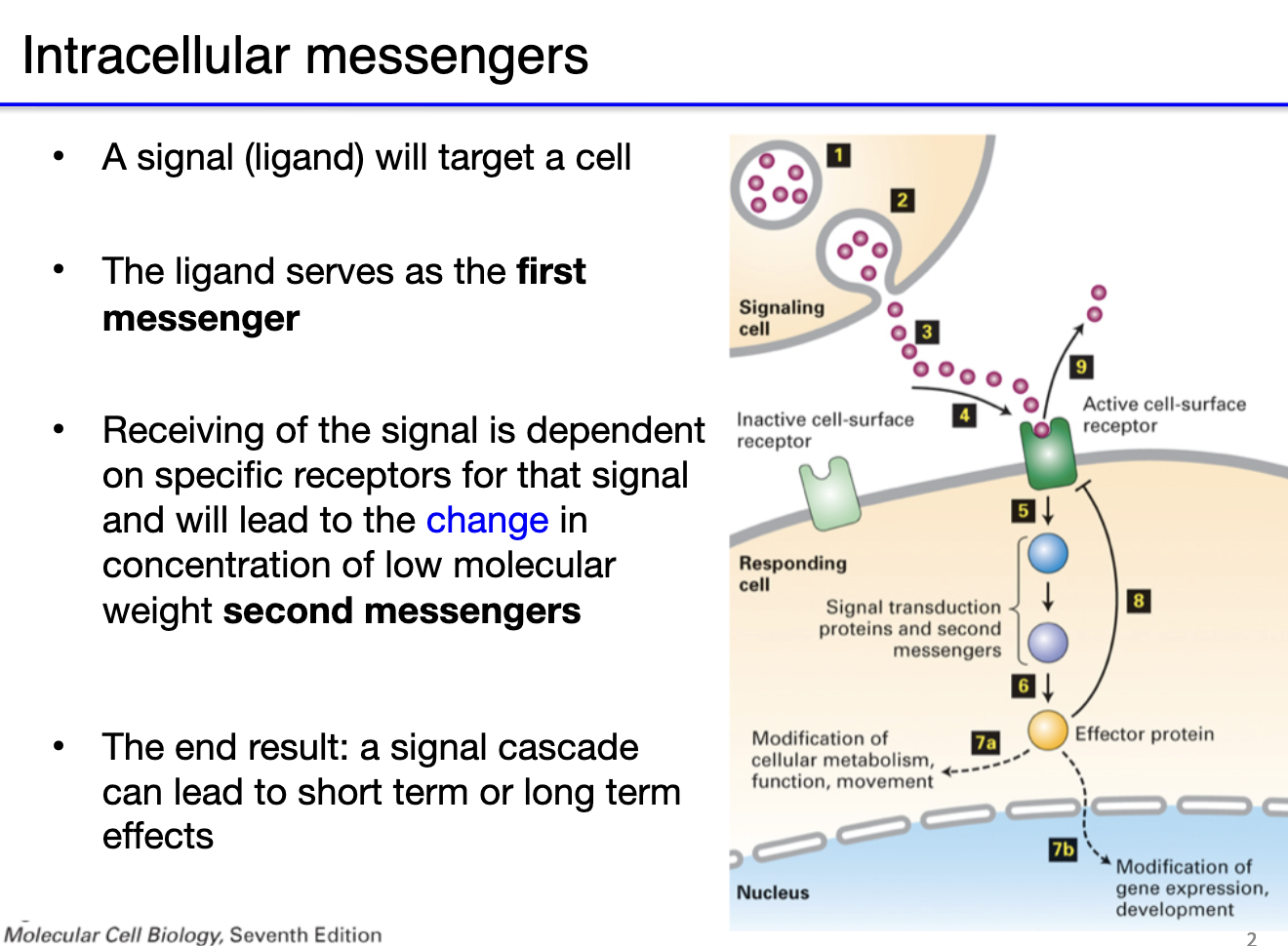
First Messenger:

  • Ligand binds receptor on target cell (e.g., neurotransmitters, hormones)

  • Initiates signal at cell surface

  • Direct effect possible (ionotropic receptors open → no second messenger)

Second Messenger:

  • Intracellular molecule that transduces the signal

  • Often triggered by metabotropic receptors

  • Activates signaling cascades → short- or long-term effects (e.g., metabolism, gene expression)

Flow:
Ligand (first messenger) → receptor → change in concentration of second messengers → signal cascade → cellular response
<p><strong>First Messenger:</strong></p><ul><li><p>Ligand binds receptor on target cell (e.g., neurotransmitters, hormones)</p></li><li><p>Initiates signal at cell surface</p></li><li><p>Direct effect possible (ionotropic receptors open → no second messenger)</p></li></ul><p><strong>Second Messenger:</strong></p><ul><li><p>Intracellular molecule that transduces the signal</p></li><li><p>Often triggered by metabotropic receptors</p></li><li><p>Activates signaling cascades → short- or long-term effects (e.g., metabolism, gene expression)</p></li></ul><p><strong>Flow:</strong><br>Ligand (first messenger) → receptor → change in concentration of second messengers → signal cascade → cellular response</p><p></p>
2
New cards

What’s the difference between direct and indirect neurotransmission?

  • Direct transmission: NT binds ionotropic receptor → receptor itself is the channel → fast, direct gating.

  • Indirect transmission: NT binds metabotropic receptor (e.g., G protein-coupled receptor, tyrosine kinase) → receptor activates a signaling cascade → channel affected indirectly → slower response.

<ul><li><p><strong>Direct transmission:</strong> NT binds ionotropic receptor → receptor itself is the channel → fast, direct gating.</p></li></ul><ul><li><p><strong>Indirect transmission:</strong> NT binds metabotropic receptor (e.g., G protein-coupled receptor, tyrosine kinase) → receptor activates a signaling cascade → channel affected indirectly → slower response.</p></li></ul><p></p>
3
New cards

What are the main types of second messengers and their role?

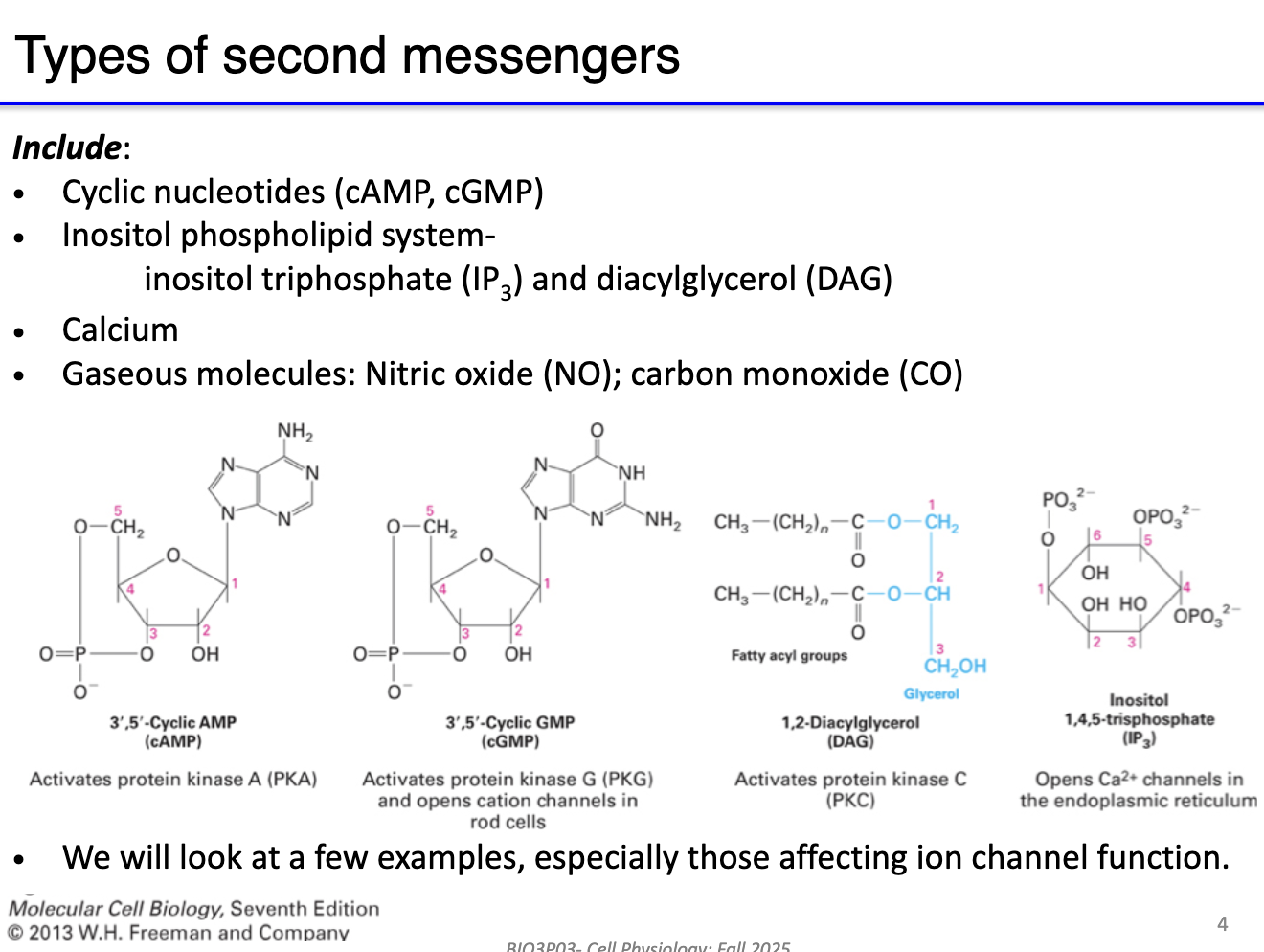
  • Second messengers: Intracellular molecules that transduce signals from receptors to intracellular targets.

  • Key examples:

    • cAMP, cGMP – cyclic nucleotides

    • IP3 – inosital trophosphate signaling

    • Calcium (Ca²⁺)

    • Gaseous molecules – nitric oxide (NO), carbon monoxide (CO) - NOT TESTABLE

  • Function: Initiate signaling cascades in muscle and neurons; amplify or propagate extracellular signals.
<ul><li><p><strong>Second messengers:</strong> Intracellular molecules that transduce signals from receptors to intracellular targets.</p></li><li><p><strong>Key examples:</strong></p><ul><li><p><strong>cAMP, cGMP</strong> – cyclic nucleotides</p></li><li><p><strong>IP3</strong> – inosital trophosphate signaling</p></li><li><p><strong>Calcium (Ca²⁺)</strong></p></li><li><p><strong>Gaseous molecules</strong> – nitric oxide (NO), carbon monoxide (CO)&nbsp;- NOT TESTABLE</p></li></ul></li><li><p><strong>Function:</strong> Initiate signaling cascades in muscle and neurons; amplify or propagate extracellular signals.</p></li></ul><p></p>
4
New cards

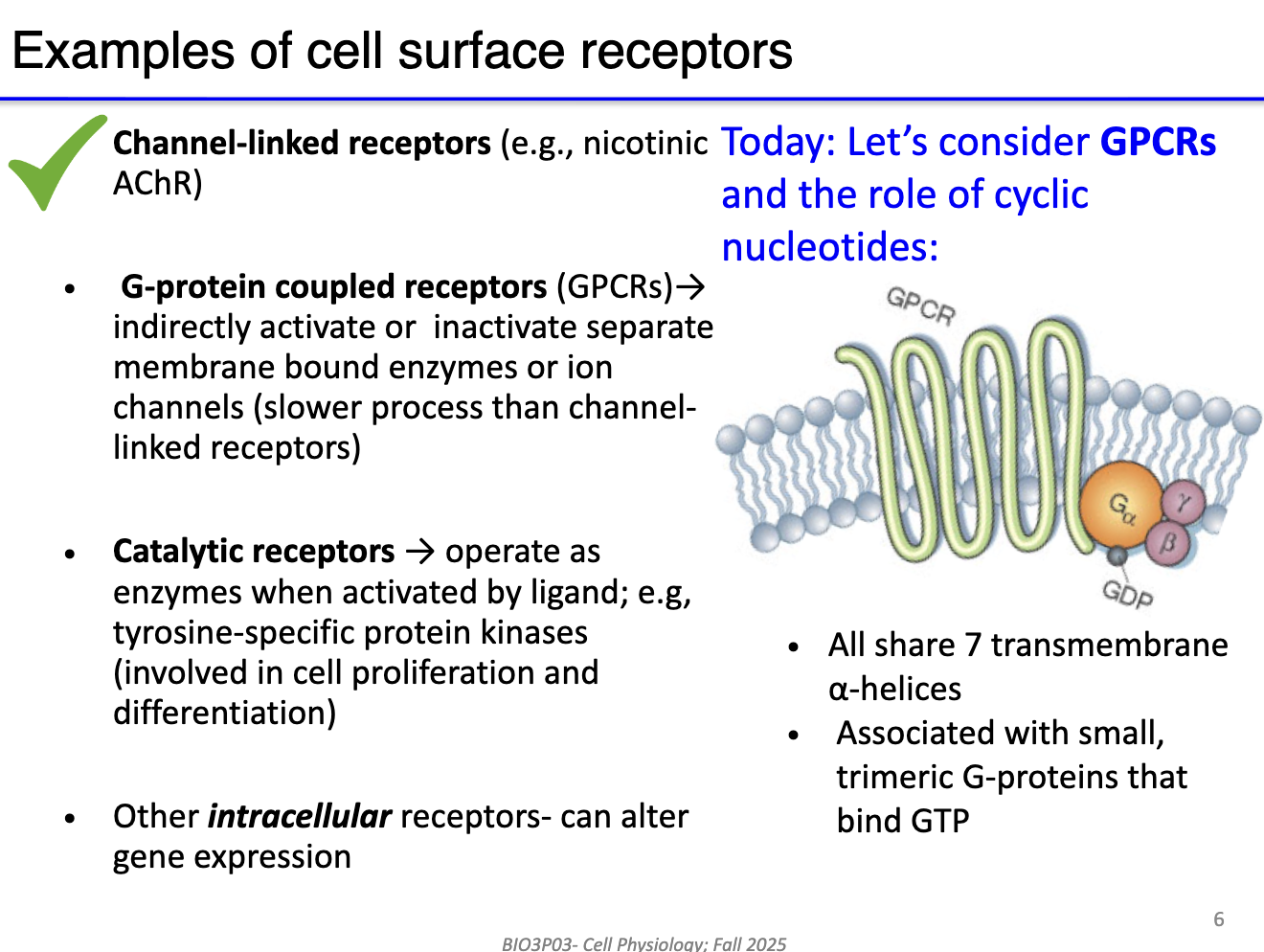
What are the main types of cell surface receptors and key features of G protein-coupled receptors (GPCRs)?

  • Channel-linked receptors: Ionotropic (e.g., nicotinic AChR) → direct gating, fast signaling.

  • G protein-coupled receptors (GPCRs): Indirect, receptor separate from channel → triggers signaling cascade.

  • Catalytic receptors: Activate enzymes → amplify signal through second messengers (involved in cell proliferation and differentiation).

  • Intracellular/nuclear receptors: Alter gene expression (not a focus in this course).
<ul><li><p><strong>Channel-linked receptors:</strong> Ionotropic (e.g., nicotinic AChR) → direct gating, fast signaling.</p></li><li><p><strong>G protein-coupled receptors (GPCRs):</strong> Indirect, receptor separate from channel → triggers signaling cascade.</p></li><li><p><strong>Catalytic receptors:</strong> Activate enzymes → amplify signal through second messengers (involved in cell proliferation and differentiation).</p></li><li><p><strong>Intracellular/nuclear receptors:</strong> Alter gene expression (not a focus in this course).</p></li></ul><p></p>
5
New cards

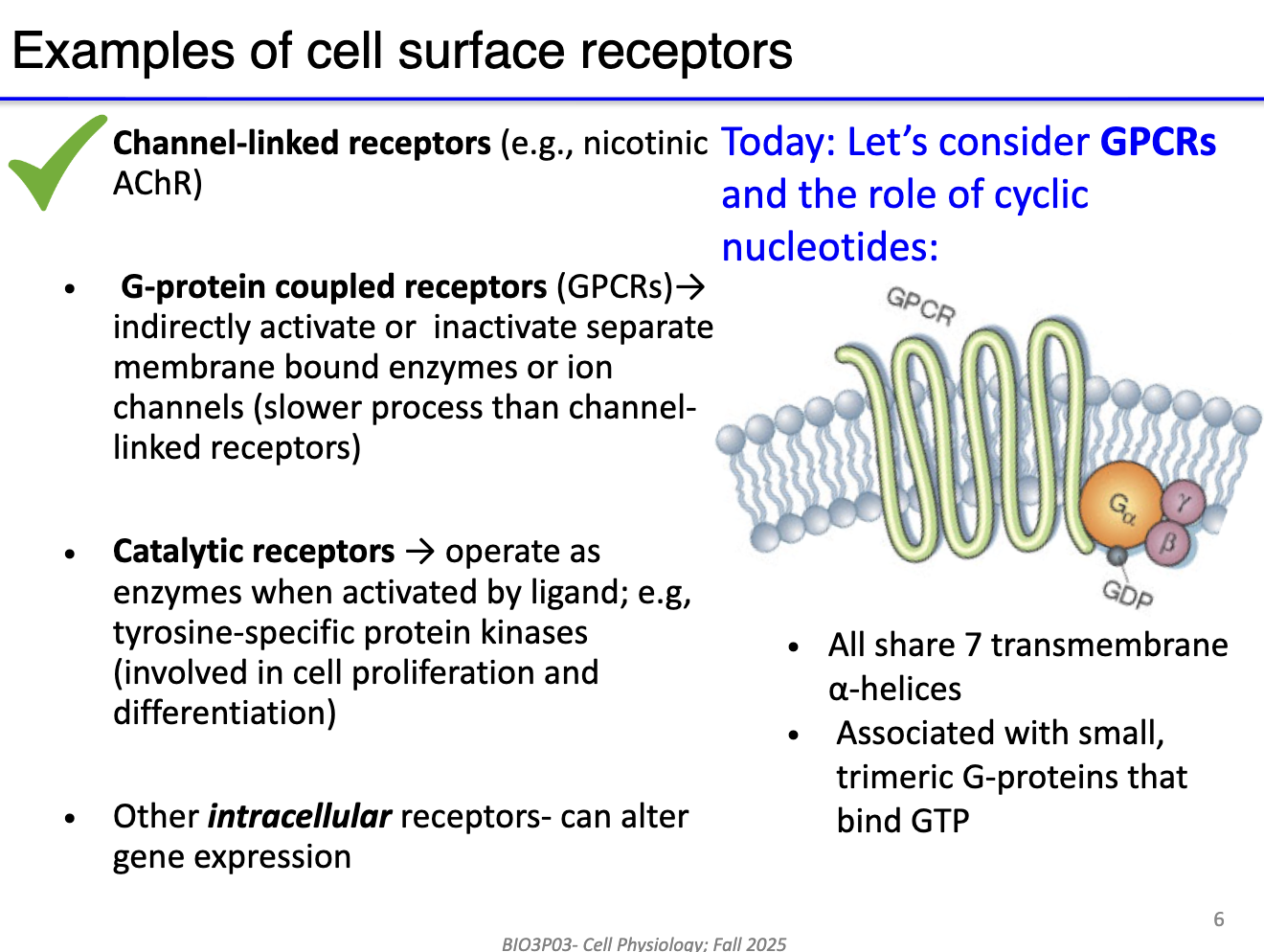
What is the structure of the GPCR?

  • 7 transmembrane helices (“serpentine”)

  • Coupled to trimeric G protein (α, β, γ subunits)

  • G protein binds GDP (inactive) or GTP (active)

  • Can amplify signals via second messenger production.
<ul><li><p>7 transmembrane helices (“serpentine”)</p></li><li><p>Coupled to <strong>trimeric G protein</strong> (α, β, γ subunits)</p></li><li><p>G protein binds GDP (inactive) or GTP (active)</p></li><li><p>Can amplify signals via second messenger production.</p></li></ul><p></p>
6
New cards

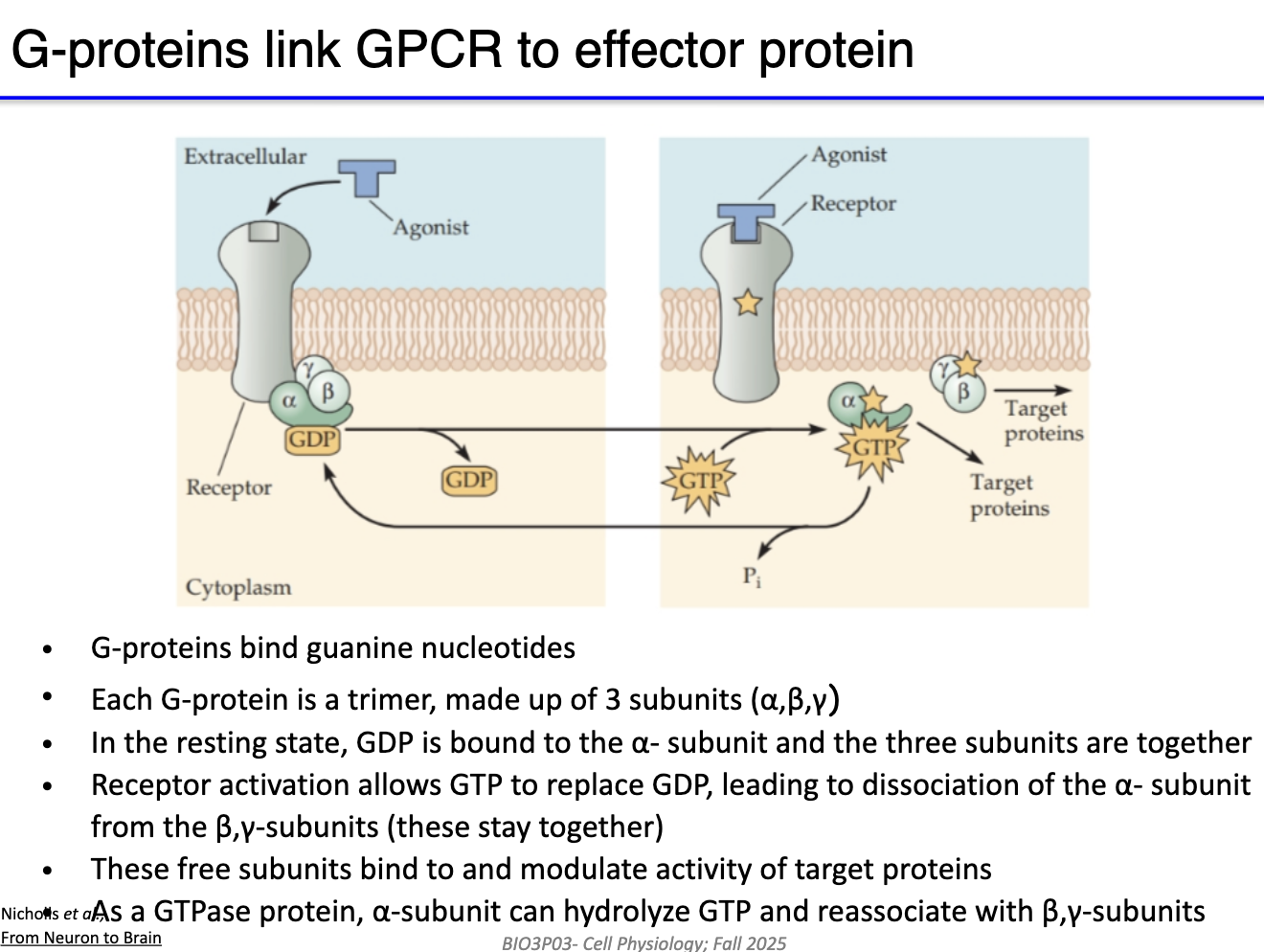
How do G-proteins transmit signals from GPCRs to target proteins?

  • Unbound state: GPCR not bound to agonist; G protein complex associated with GDP.

  • Agonist/NT binding: NT binds → conformational change → GDP released, GTP binds α-subunit.

  • Subunit activation: α-subunit (or βγ complex) separates to modulate effector proteins (e.g., channels).

  • Signal duration: Active until α-subunit hydrolyzes GTP → GDP; subunits reassemble with GPCR.

  • Key point: One agonist binding can activate the G protein complex for a duration determined by GTP hydrolysis.
<ul><li><p><strong>Unbound state:</strong> GPCR not bound to agonist; G protein complex associated with GDP.</p></li></ul><ul><li><p><strong>Agonist/NT binding:</strong> NT binds → conformational change → GDP released, GTP binds α-subunit.</p></li><li><p><strong>Subunit activation:</strong> α-subunit (or βγ complex) separates to modulate effector proteins (e.g., channels).</p></li><li><p><strong>Signal duration:</strong> Active until α-subunit hydrolyzes GTP → GDP; subunits reassemble with GPCR.</p></li><li><p><strong>Key point:</strong> One agonist binding can activate the G protein complex for a duration determined by GTP hydrolysis.</p></li></ul><p></p>
7
New cards

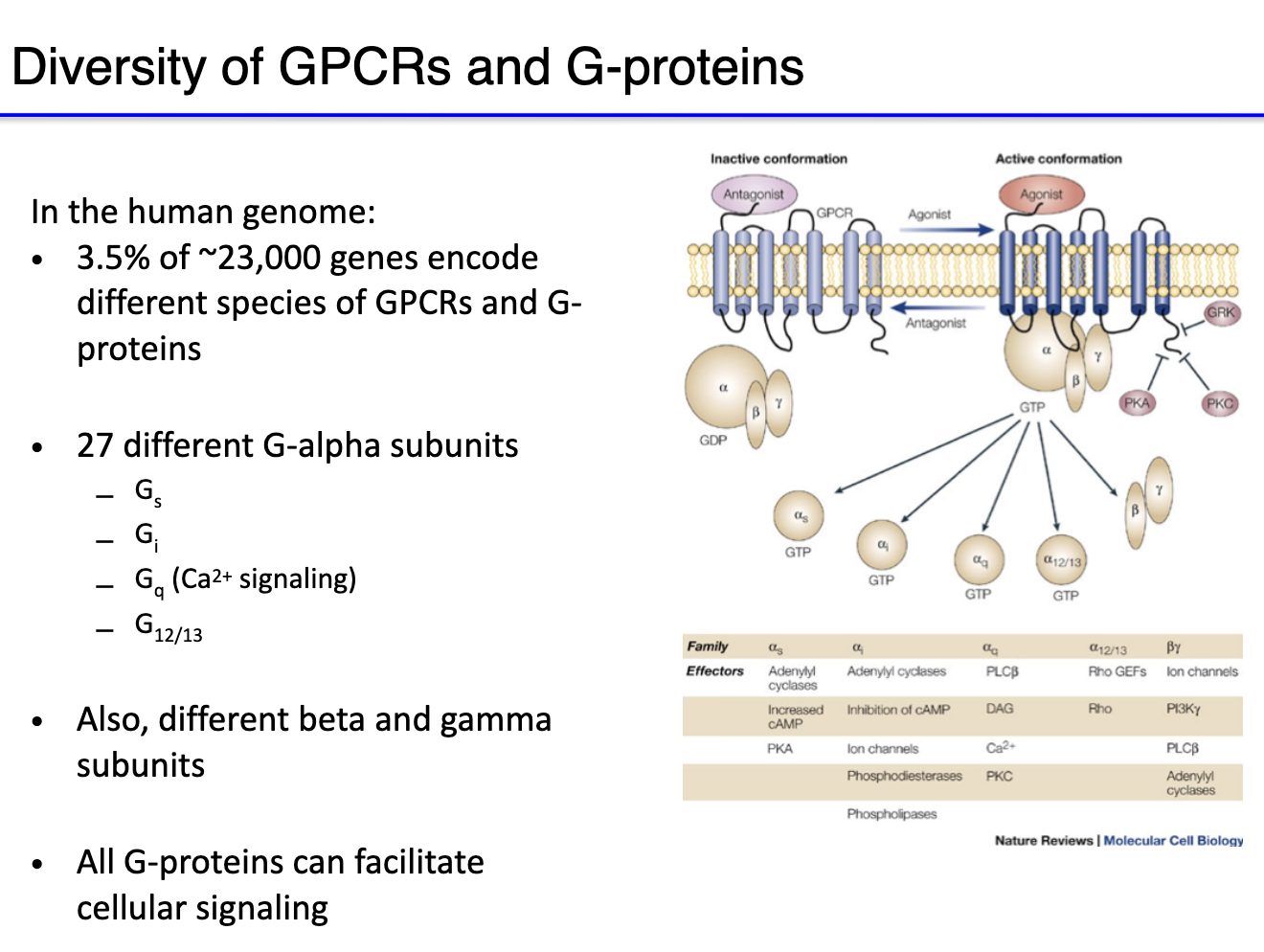
What is the diversity and role of G protein subunits in GPCR signaling?

  • Human genome ~23,000 genes → ~3.5% related to GPCR pathways.

  • GPCR inactive when unbound or bound to antagonist.

  • Agonist binding → activates G protein complex (GTP binds α-subunit).

  • 27 Gα subunits, including:

    • Gs → stimulatory → activates adenylyl cyclase → ↑cAMP (second messenger)

    • Gi → inhibitory → inhibits adenylyl cyclase → ↓cAMP

    • Gq → involved in calcium signaling

    • G12/13 (not important for this course)

  • Beta & gamma subunits: mostly regulatory; sometimes directly modulate channels.

  • All G-protein can facilitate cellular signaling.
<ul><li><p>Human genome ~23,000 genes → ~3.5% related to GPCR pathways.</p></li></ul><ul><li><p>GPCR inactive when unbound or bound to antagonist.</p></li><li><p>Agonist binding → activates G protein complex (GTP binds α-subunit).</p></li><li><p><strong>27 Gα subunits</strong>, including:</p><ul><li><p><strong>Gs</strong> → stimulatory → activates adenylyl cyclase → ↑cAMP (second messenger)</p></li><li><p><strong>Gi</strong> → inhibitory → inhibits adenylyl cyclase → ↓cAMP</p></li><li><p><strong>Gq</strong> → involved in calcium signaling</p></li><li><p><strong>G12/13 </strong>(not important for this course)</p></li></ul></li><li><p><strong>Beta &amp; gamma subunits:</strong> mostly regulatory; sometimes directly modulate channels.</p></li><li><p>All G-protein can facilitate cellular signaling.</p></li></ul><p></p>
8
New cards

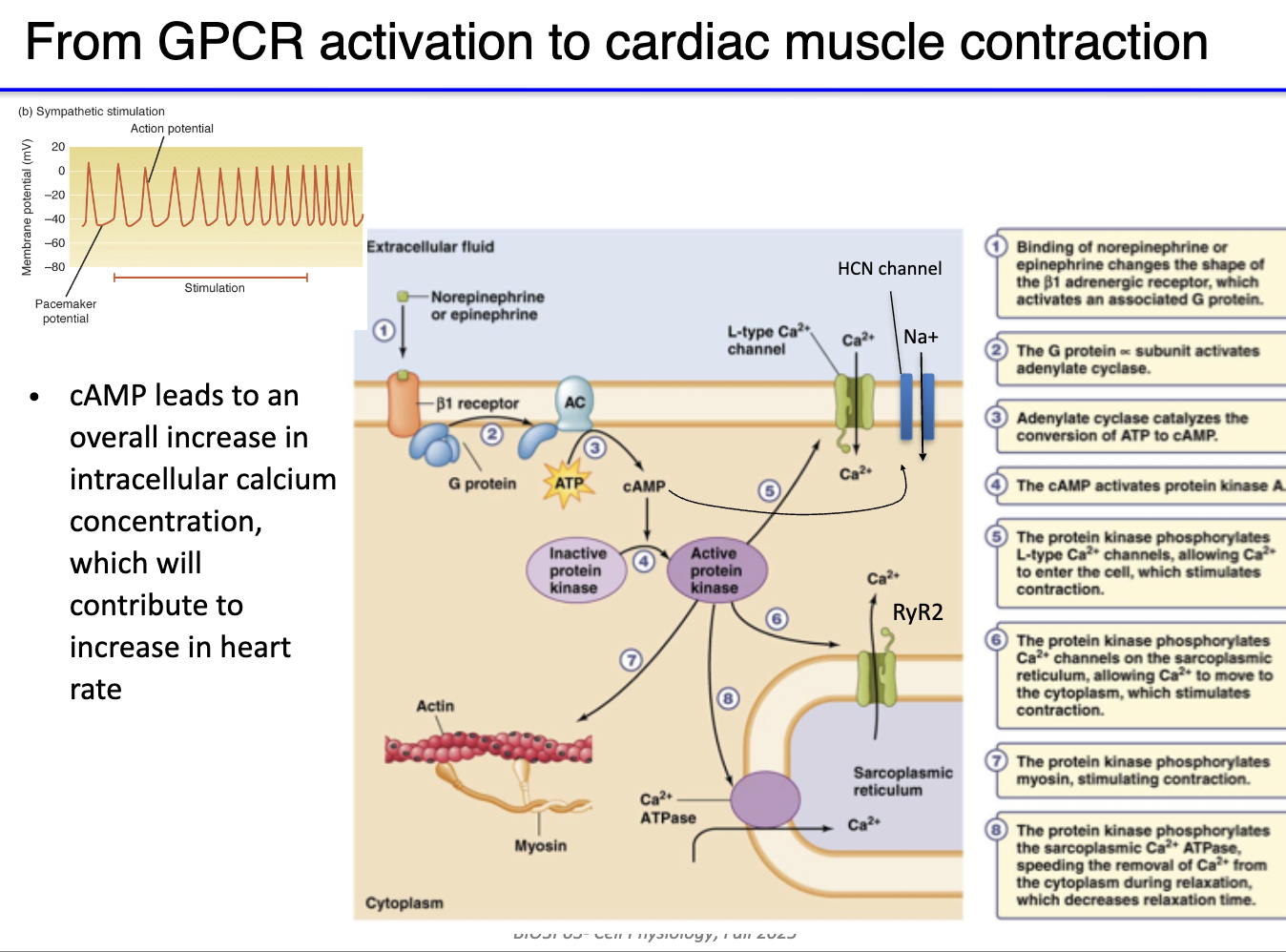
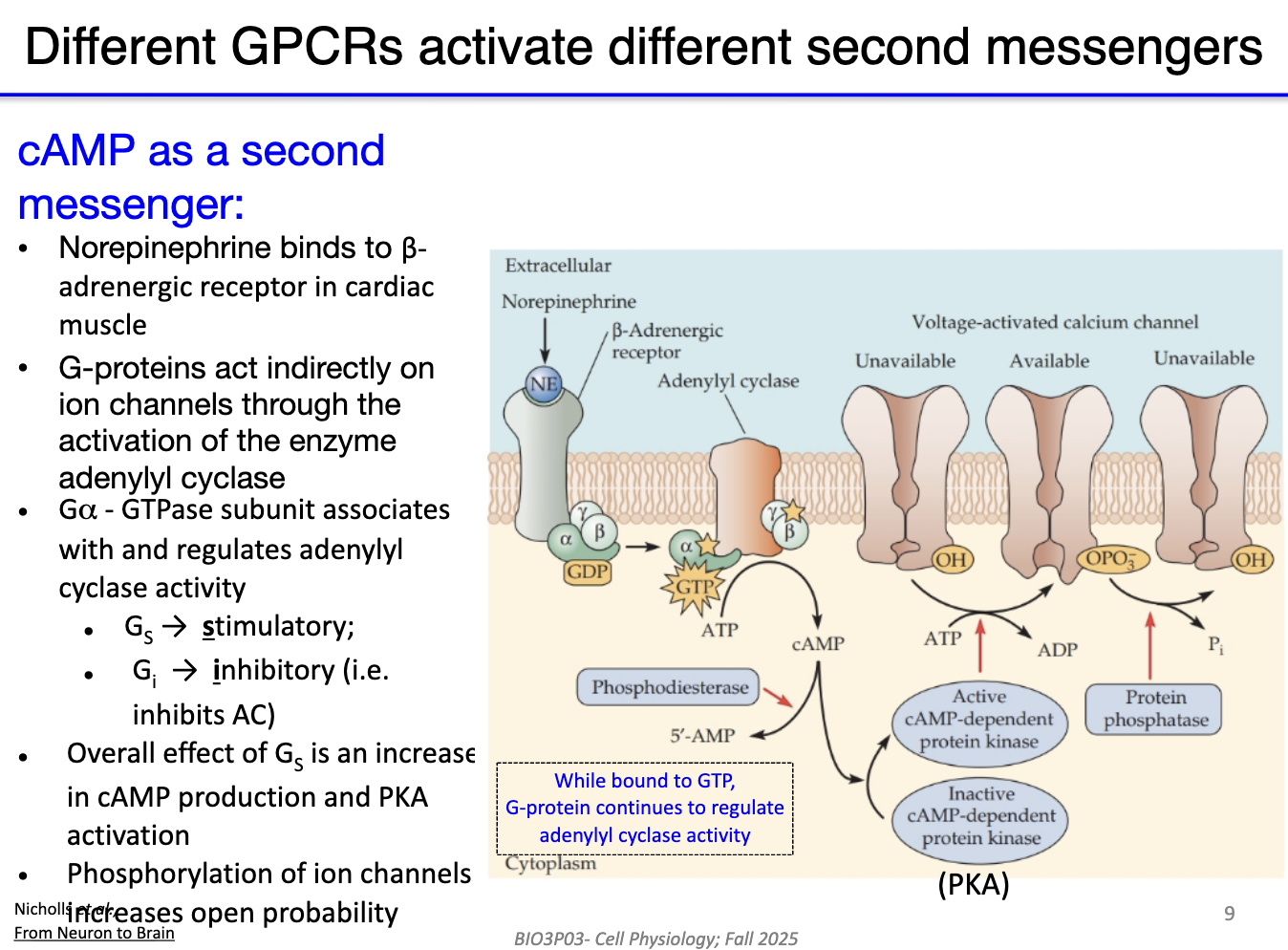
How does norepinephrine activate the beta-adrenergic receptor and downstream cAMP signaling?

  • Norepinephrine binds beta-adrenergic receptor (a GPCR).

  • GPCR-bound G protein sheds GDP → alpha subunit binds GTP.

  • Beta & gamma subunits activate adenylyl cyclase.

  • Adenylyl cyclase converts ATP → cAMP (second messenger).

  • cAMP activates Protein Kinase A (PKA).

  • PKA opens voltage-activated calcium channels.

  • Overall effect: stimulatory, increasing cellular activity.
<ul><li><p>Norepinephrine binds <strong>beta-adrenergic receptor</strong> (a GPCR).</p></li><li><p>GPCR-bound G protein sheds GDP → alpha subunit binds <strong>GTP</strong>.</p></li><li><p><strong>Beta &amp; gamma subunits</strong> activate <strong>adenylyl cyclase</strong>.</p></li><li><p><strong>Adenylyl cyclase</strong> converts ATP → <strong>cAMP</strong> (second messenger).</p></li><li><p><strong>cAMP</strong> activates <strong>Protein Kinase A (PKA)</strong>.</p></li><li><p>PKA opens <strong>voltage-activated calcium channels</strong>.</p></li><li><p>Overall effect: <strong>stimulatory</strong>, increasing cellular activity.</p></li></ul><p></p>
9
New cards

How does cAMP activate Protein Kinase A (PKA)?

  • PKA = tetramer → 2 regulatory (R) subunits + 2 catalytic (C) subunits.

  • At low cAMP: R subunits bind and inhibit C subunits.

  • When cAMP increases: cAMP binds R subunits → causes conformational change.

  • R subunits release the C subunits.

  • Free C subunits = active PKA.

  • Active PKA phosphorylates target proteins, including channels → promotes channel opening.

<ul><li><p>PKA = <strong>tetramer</strong> → 2 regulatory (R) subunits + 2 catalytic (C) subunits.</p></li><li><p>At low cAMP: <strong>R subunits bind and inhibit C subunits</strong>.</p></li><li><p>When cAMP increases: cAMP <strong>binds R subunits</strong> → causes conformational change.</p></li><li><p>R subunits <strong>release</strong> the C subunits.</p></li><li><p>Free <strong>C subunits = active PKA</strong>.</p></li><li><p>Active PKA <strong>phosphorylates target proteins</strong>, including channels → promotes <strong>channel opening</strong>.</p></li></ul><p></p>
10
New cards

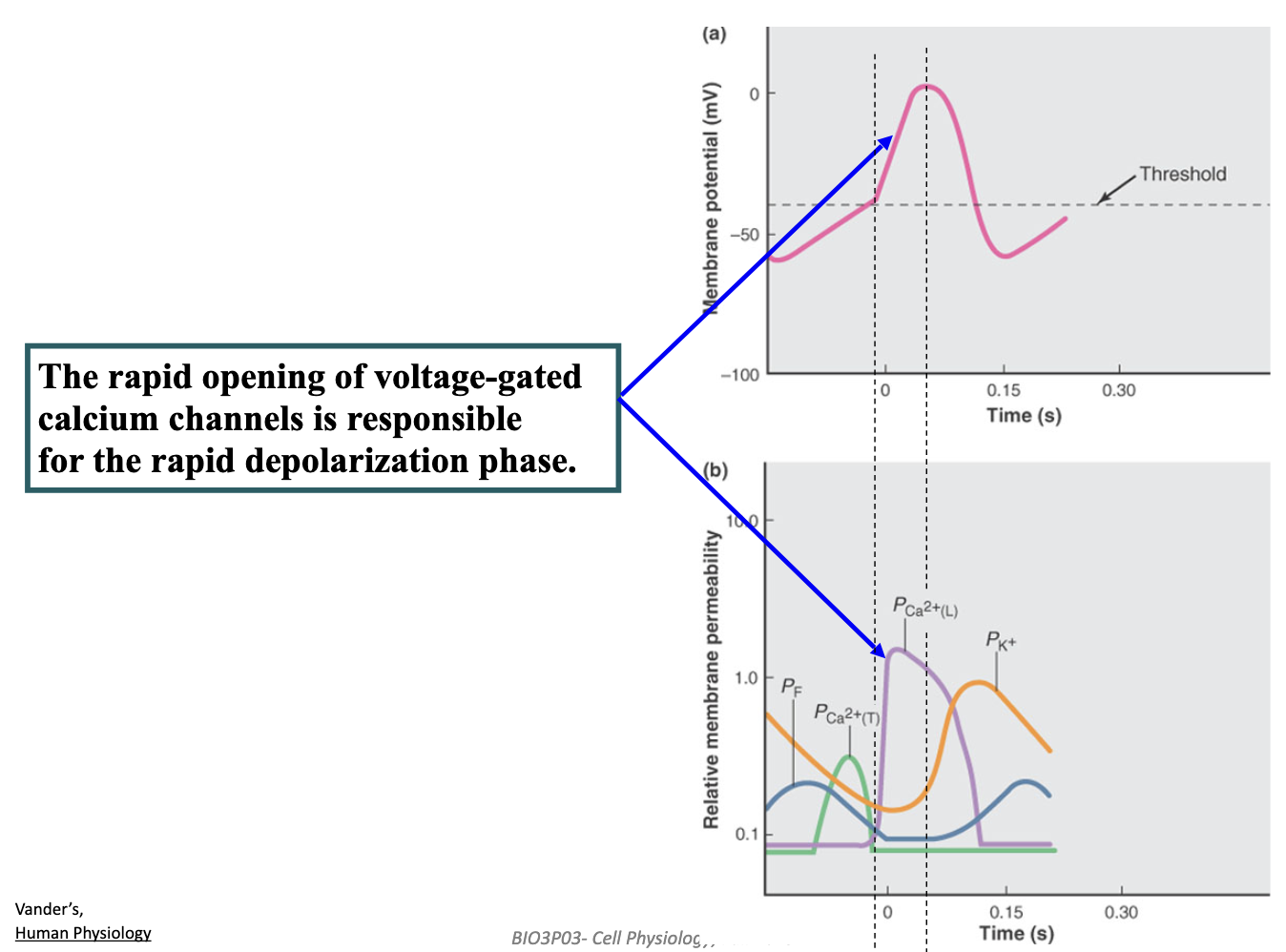
How do pacemaker cells in the heart generate an autonomous rhythmic heartbeat?

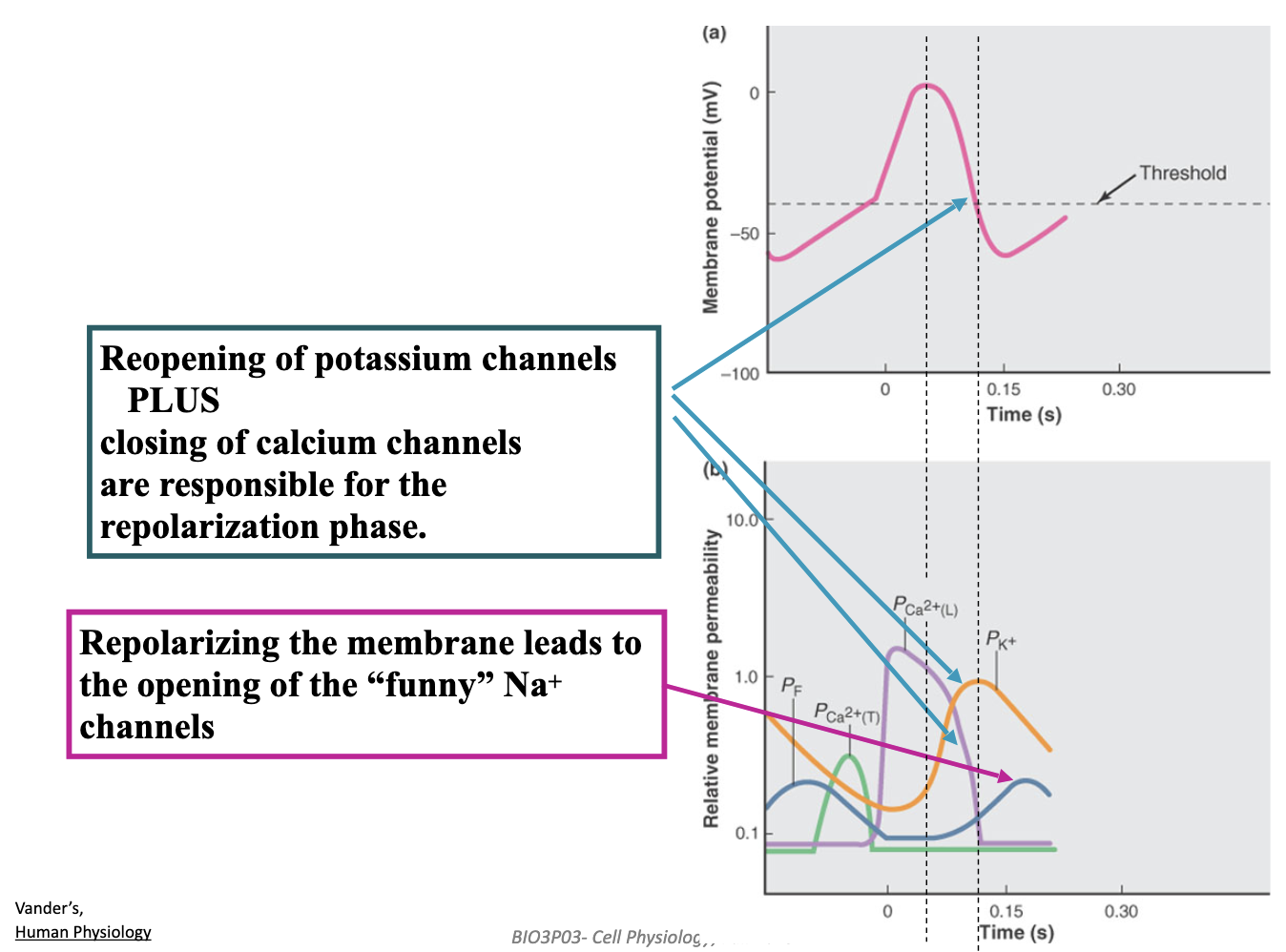
  • Hyperpolarization opens HCN (“funny”) channels, causing slow Na⁺ influx → start of the pacemaker depolarization.

  • Rising depolarization then opens T-type Ca²⁺ channels → pushes cell to threshold.

  • L-type Ca²⁺ channels open at threshold → action potential upstroke.

  • K⁺ efflux + Ca²⁺ channels closing → repolarizes the cell.

  • Resulting hyperpolarization reopens HCN channels → cycle repeats → automatic rhythm.
<ul><li><p><strong>Hyperpolarization</strong> opens <strong>HCN (“funny”) channels</strong>, causing slow <strong>Na⁺ influx</strong> → start of the pacemaker depolarization.</p></li><li><p>Rising depolarization then opens <strong>T-type Ca²⁺ channels</strong> → pushes cell to <strong>threshold</strong>.</p></li><li><p><strong>L-type Ca²⁺ channels</strong> open at threshold → action potential upstroke.</p></li><li><p><strong>K⁺ efflux</strong> + <strong>Ca²⁺ channels closing → </strong>repolarizes the cell.</p></li><li><p>Resulting <strong>hyperpolarization</strong> reopens <strong>HCN</strong> channels → cycle repeats → <strong>automatic rhythm</strong>.</p></li></ul><img src="https://knowt-user-attachments.s3.amazonaws.com/5441b4da-78fd-449c-a212-675e5cd9cece.png" data-width="100%" data-align="center" alt=""><img src="https://knowt-user-attachments.s3.amazonaws.com/5f93466e-eaa3-454a-af5f-ec2f713c5cd4.png" data-width="100%" data-align="center" alt=""><p></p>
11
New cards

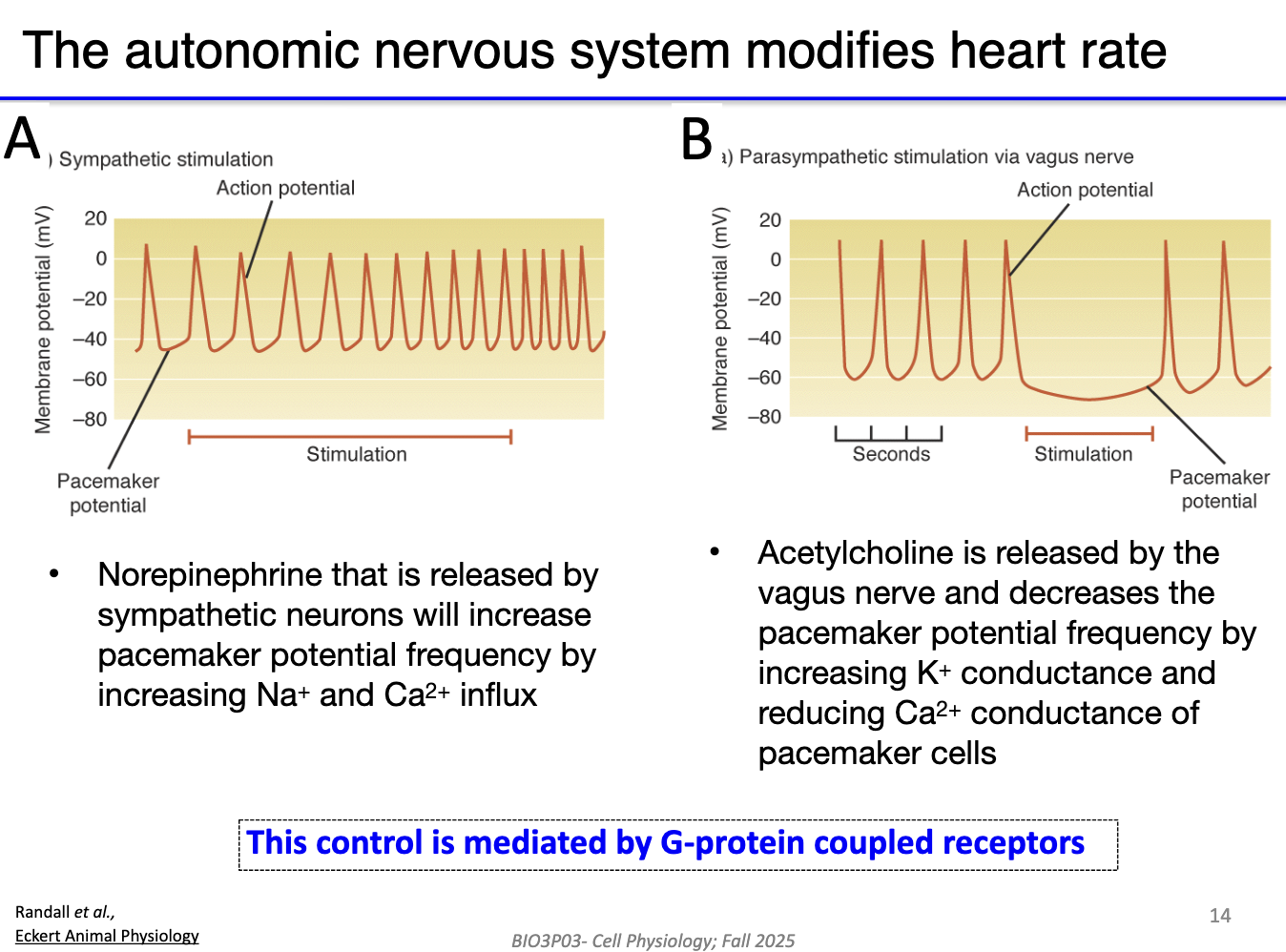
How do the sympathetic and parasympathetic nervous systems regulate heart rate in pacemaker cells?

  • Sympathetic (fight-or-flight): Norepinephrine ↑ funny current + Ca²⁺ currents → steeper pacemaker depolarization → faster heart rate (action potentials closer together).

  • Parasympathetic (vagus nerve): Acetylcholine ↑ K⁺ efflux + ↓ funny current + Ca²⁺ currents → slower depolarization → slower heart rate.

  • Heart rate is controlled by a balance of “gas” (sympathetic) and “brake” (parasympathetic), acting simultaneously on pacemaker cells.
<ul><li><p><strong>Sympathetic (fight-or-flight):</strong> Norepinephrine ↑ funny current + Ca²⁺ currents → steeper pacemaker depolarization → <strong>faster heart rate</strong> (action potentials closer together).</p></li><li><p><strong>Parasympathetic (vagus nerve):</strong> Acetylcholine ↑ K⁺ efflux + ↓ funny current + Ca²⁺ currents → slower depolarization → <strong>slower heart rate</strong>.</p></li><li><p>Heart rate is controlled by a <strong>balance</strong> of “gas” (sympathetic) and “brake” (parasympathetic), acting simultaneously on pacemaker cells.</p></li></ul><p></p>
12
New cards

How does sympathetic stimulation (NE) increase heart rate in pacemaker cells?

  • NE binds β₁-adrenergic GPCR on pacemaker cells

  • Gs protein activated → α-subunit stimulates adenylyl cyclase

    • Convert ATP → cAMP production

  • cAMP + PKA both increase activity of L-type Ca²⁺ channels

    • Channels open more easily → more Ca²⁺ influx

    • Faster depolarization → higher action potential frequency

  • Result: ↑ heart rate

<ul><li><p><strong>NE binds β₁-adrenergic GPCR</strong> on pacemaker cells</p></li><li><p><strong>Gs protein</strong> activated → <strong>α-subunit stimulates adenylyl cyclase</strong></p><ul><li><p>Convert ATP → <strong>cAMP</strong> production</p></li></ul></li><li><p><strong>cAMP + PKA</strong> both increase activity of <strong>L-type Ca²⁺ channels</strong></p><ul><li><p>Channels open more easily → <strong>more Ca²⁺ influx</strong></p></li><li><p>Faster depolarization → <strong>higher action potential frequency</strong></p></li></ul></li><li><p>Result: <strong>↑ heart rate</strong></p></li></ul><p></p>
13
New cards

How does parasympathetic stimulation (ACh) decrease heart rate in pacemaker cells?

  • ACh released from vagus nerve → ACh binds muscarinic M₂ GPCR on pacemaker (SA node) cells

  • GPCR activates G protein → βγ subunits dissociate

  • βγ subunits open voltage-gated K⁺ channels → K⁺ efflux

  • Hyperpolarizes membrane potential → slower depolarization toward threshold

  • Slower pacemaker potential → decreased action potential frequency → lower heart rate

    • Gi subunit role: Inhibits adenylyl cyclase → reduces Ca²⁺ current

  • Overall effect: Acts as a “brake” on sympathetic stimulation → balances heart rate regulation

**In lecture he kept saying vagal nerve.

<ul><li><p>ACh released from vagus nerve → ACh binds <strong>muscarinic M₂ GPCR</strong> on pacemaker (SA node) cells</p></li><li><p>GPCR activates G protein → βγ subunits dissociate</p></li><li><p>βγ subunits open voltage-gated K⁺ channels → K⁺ efflux</p></li><li><p>Hyperpolarizes membrane potential → slower depolarization toward threshold</p></li><li><p>Slower pacemaker potential → decreased action potential frequency → lower heart rate</p><ul><li><p>Gi subunit role: Inhibits adenylyl cyclase → reduces Ca²⁺ current</p></li></ul></li><li><p><strong>Overall effect:</strong> Acts as a “brake” on sympathetic stimulation → balances heart rate regulation</p></li></ul><p>**In lecture he kept saying vagal nerve.</p>
14
New cards

How does the GPCR-mediated inositol phospholipid (IP3/DAG) signaling pathway work?

  • GPCR activation: Ligand binds GPCR → α subunit of Gq protein separates from βγ subunits

  • Gq protein: α subunit activates phospholipase C β (PLCβ)

  • Substrate: PLCβ catalyzes PIP2 → DAG + IP3

  • Second messengers:

    • IP3: Diffuses through cytoplasm → interacts with Ca²⁺ channels on ER/SR → Ca²⁺ release

    • DAG: Stays in inner membrane leaflet → activates protein kinase C (PKC) and D

  • Outcome: Initiates intracellular signaling cascades → downstream effects (e.g., calcium signaling, protein phosphorylation)

  • Notes:

    • PLCγ/tyrosine kinase pathways not tested in this course

    • Distinct from Gs/cAMP pathway; uses Gq/PLCβ → IP3/DAG instead of adenylyl cyclase

<ul><li><p><strong>GPCR activation:</strong> Ligand binds GPCR → <strong>α subunit of Gq protein separates</strong> from βγ subunits</p></li><li><p><strong>Gq protein:</strong> α subunit activates <strong>phospholipase C β (PLCβ)</strong></p></li><li><p><strong>Substrate:</strong> PLCβ catalyzes <strong>PIP2 → DAG + IP3</strong></p></li><li><p><strong>Second messengers:</strong></p><ul><li><p><strong>IP3:</strong> Diffuses through cytoplasm → interacts with <strong>Ca²⁺ channels on ER/SR</strong> → Ca²⁺ release</p></li><li><p><strong>DAG:</strong> Stays in inner membrane leaflet → activates <strong>protein kinase C (PKC) and D</strong></p></li></ul></li><li><p><strong>Outcome:</strong> Initiates intracellular signaling cascades → downstream effects (e.g., calcium signaling, protein phosphorylation)</p></li><li><p><strong>Notes:</strong></p><ul><li><p>PLCγ/tyrosine kinase pathways <strong>not tested</strong> in this course</p></li><li><p>Distinct from Gs/cAMP pathway; uses <strong>Gq/PLCβ → IP3/DAG</strong> instead of adenylyl cyclase</p></li></ul></li></ul><p></p>
15
New cards

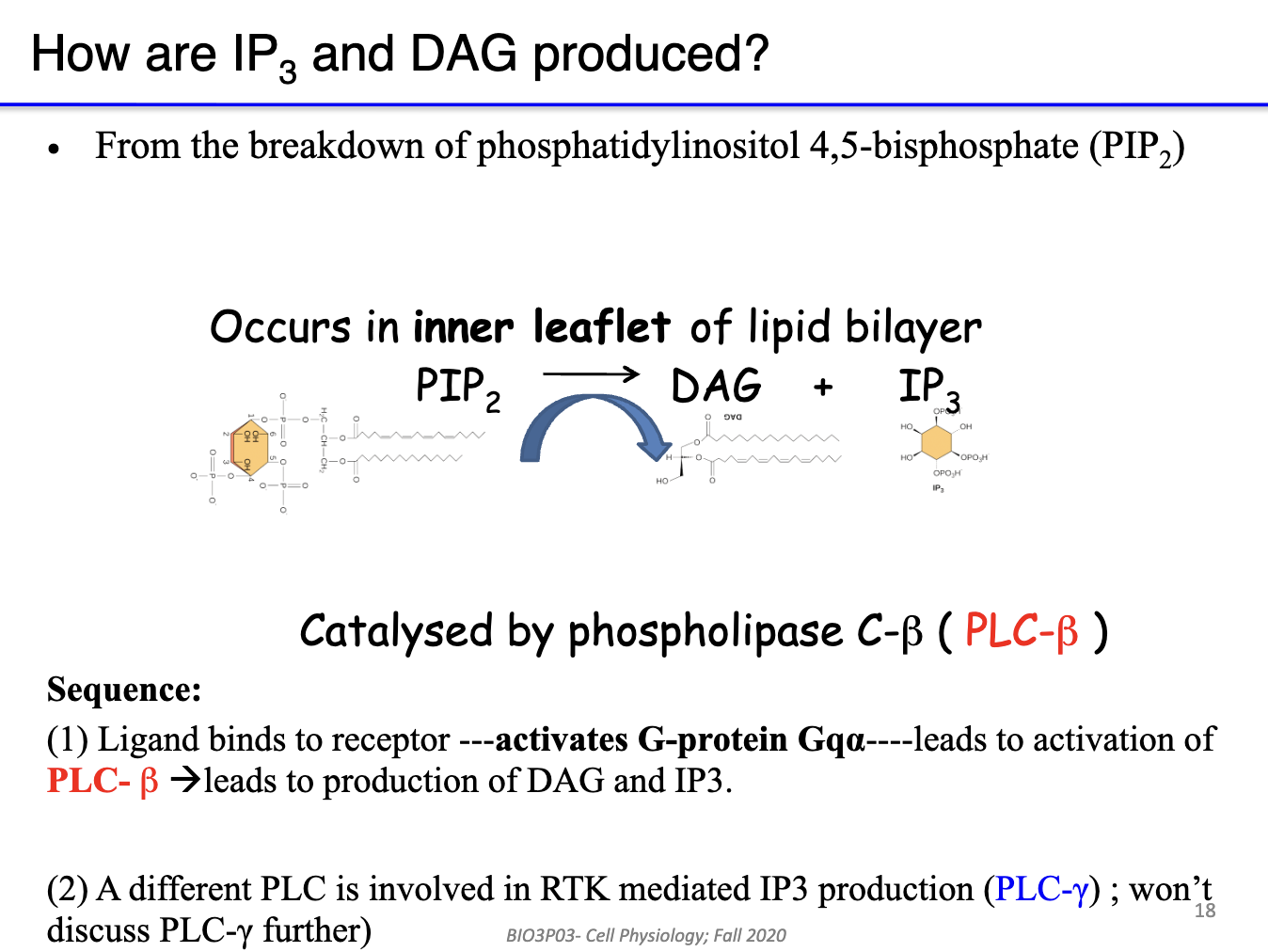
How does PIP₂ produce DAG and IP3 in Gq GPCR signaling, and what are their roles?

  • PIP₂ (phosphatidylinositol 4,5-bisphosphate) is the substrate

  • GPCR ligand binds → Gq α-subunit activates PLC-β

  • PLC-β cleaves PIP₂ → DAG + IP3

    • DAG: lipid-based, stays in inner leaflet of membrane → activates PKC locally

    • IP3: soluble, diffuses through cytoplasm → binds ER/SR → releases Ca²⁺

  • Outcome: DAG & IP3 act as second messengers for downstream signaling

  • Note: PLC-γ (tyrosine kinase-associated) not relevant here
<ul><li><p><strong>PIP₂ (phosphatidylinositol 4,5-bisphosphate)</strong> is the substrate</p></li><li><p><strong>GPCR ligand binds → Gq α-subunit activates PLC-β</strong></p></li><li><p><strong>PLC-β cleaves PIP₂ → DAG + IP3</strong></p><ul><li><p><strong>DAG</strong>: lipid-based, stays in inner leaflet of membrane → activates <strong>PKC</strong> locally</p></li><li><p><strong>IP3</strong>: soluble, diffuses through cytoplasm → binds ER/SR → releases <strong>Ca²⁺</strong></p></li></ul></li><li><p>Outcome: DAG &amp; IP3 act as <strong>second messengers</strong> for downstream signaling</p></li><li><p><strong>Note</strong>: PLC-γ (tyrosine kinase-associated) not relevant here</p></li></ul><p></p>
16
New cards

How does Gq GPCR signaling lead to second messenger responses?

  • GPCR activated by ligand → Gq α-subunit exchanges GDP → GTP

  • Gq α-subunit activates PLC-β

  • PLC-β cleaves PIP₂ → DAG + IP3

    • DAG: stays in inner membrane → activates PKC

    • IP3: diffuses through cytoplasm → releases Ca²⁺ from ER/SR

  • Outcome: DAG & IP3 serve as second messengers, initiating downstream cellular responses
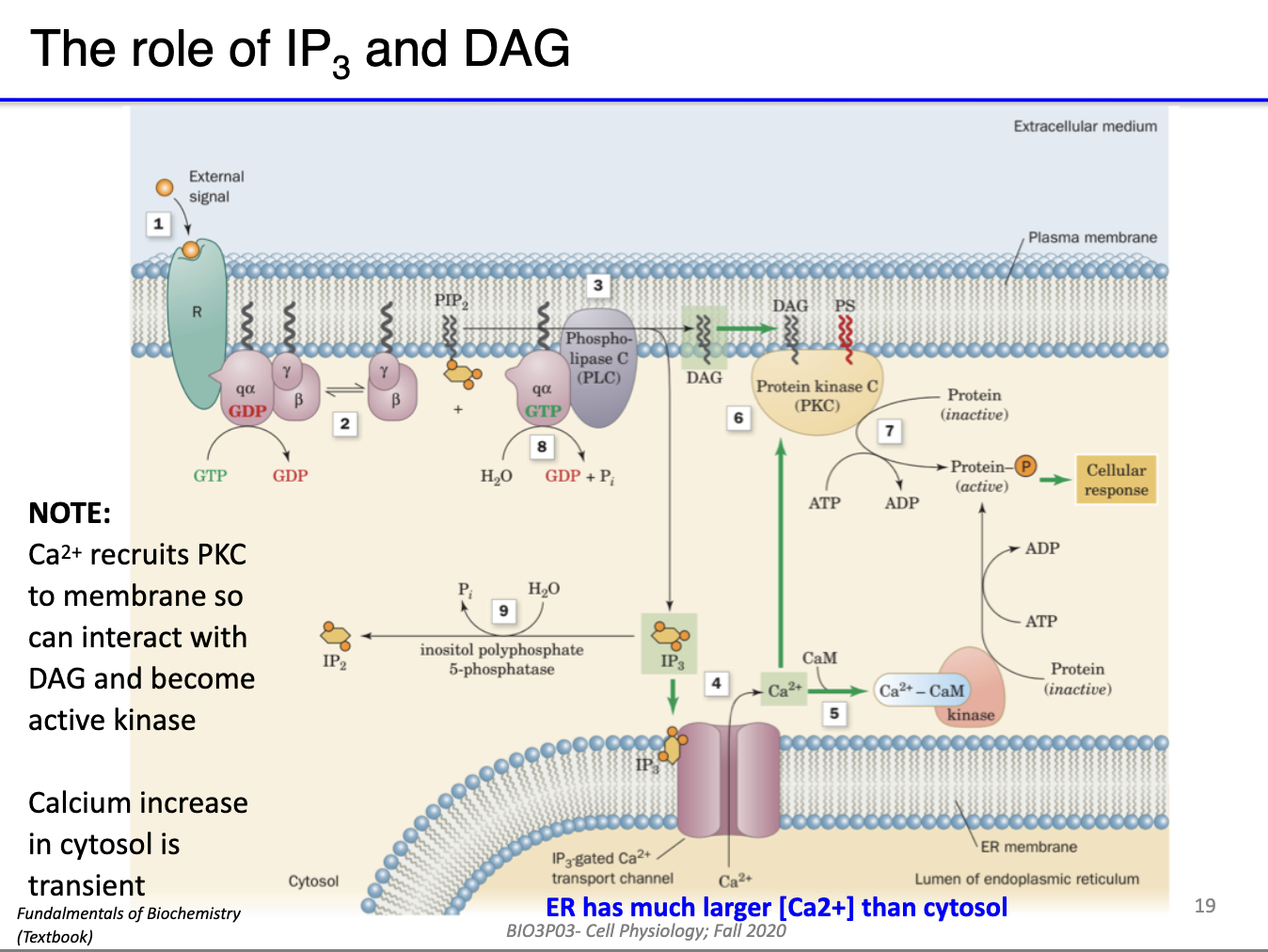
<ul><li><p><strong>GPCR activated</strong> by ligand → <strong>Gq α-subunit</strong> exchanges GDP → GTP</p></li><li><p><strong>Gq α-subunit activates PLC-β</strong></p></li><li><p><strong>PLC-β cleaves PIP₂ → DAG + IP3</strong></p><ul><li><p><strong>DAG</strong>: stays in inner membrane → activates <strong>PKC</strong></p></li><li><p><strong>IP3</strong>: diffuses through cytoplasm → releases <strong>Ca²⁺</strong> from ER/SR</p></li></ul></li><li><p><strong>Outcome</strong>: DAG &amp; IP3 serve as <strong>second messengers</strong>, initiating downstream cellular responses</p></li></ul><p></p>