Mass Spectrometry
 Call Kai
 Learn
Learn Practice Test
 Spaced Repetition
 Match
Match Flashcards
 Knowt Play
1/21

There's no tags or description
Looks like no tags are added yet.
Name | Mastery | Learn | Test | Matching | Spaced | Call with Kai | Chat |
|---|
No analytics yet
Send a link to your students to track their progress
22 Terms
What happens in mass spectrometry?
charged ions pass through an electric field into a beam of energy and are separated based on their mass/charge ratio
a detector counts the ions and their abundance
M+ peak
matches weight of the original, pre-fragmented compound
M+1 peak
present if there is a C13 isotope in the spectrum
How to determine the number of carbons give M+ and M+1 peak
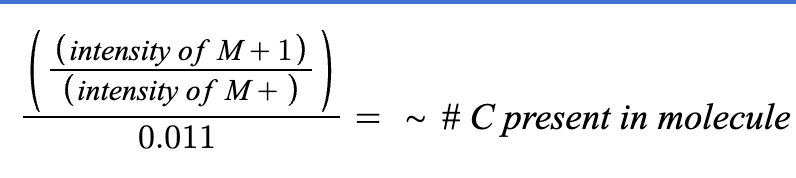
formula
the intensity of the peak
is its height
Rule of 13
divide the M+ peak by 13 to determine the number of C and H molecules
the quotient is the #C
the quotient + the remainder is #H
IHD formula

Lowest IHD
more likely formula
adding O to molecular formula
subtract one C and 4 H for every O added
adding N to molecular formula
subtract one C and 2 H for every N added
changing C to H
1 C is equivalent to 12 H
Nitrogen rule
MW even = #N even
MW odd = #N odd
Halogen prescence
M+2 peak indicates halogen
if M+ and M+2 peak exist in ratio of 3:1, Cl is present
if M+ and M+2 peak exist in ratio of 1:1, Br is present
Calculating molecular formula with halogen present
subtract the molecular weight of the halogen, add one H
then once the rule of 13 calculations are done, take out an H and put the X back in
fragmentation occurs to make what kind of products?
stable carbocations
Beta cleavage
Occurs for saturated heteroatoms (O, N, S, X)
The bond adjacent to the C attached to the fxn group breaks because an e- is fired at it
splits the molecule into a neutral radical and a stable cation
half arrow represents movement of single electrons
Example beta cleavage
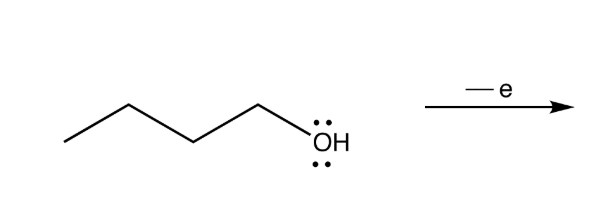

M-15 and M-29 groups
show methyl and ethyl fragments
fragments only show up if they are
charged (cation or radical cation)
Carbonyl compounds can do
McLafferty RAR and alpha cleavage
McLafferty RAR

can occur if there is a gamma C (3 away from fxn group) with H
uses double headed arrows to move e- from H bond to next bond down and to alpha bond
results in neutral alkene
and radical cation, O grabs H

Alpha cleavage

break bond that is alpha to carbonyl
results in radical and resonance stabilized cation
