Ch 4 BIO LEC: Cell to Organ System Structure and Function in Human Biology
 Call Kai
 Learn
Learn Practice Test
 Spaced Repetition
 Match
Match Flashcards
 Knowt Play
1/51

There's no tags or description
Looks like no tags are added yet.
Name | Mastery | Learn | Test | Matching | Spaced | Call with Kai | Chat |
|---|
No analytics yet
Send a link to your students to track their progress
52 Terms
What are unicellular organisms?
Organisms that consist of just one cell and depend on their immediate external environment.
What are multicellular organisms?
Organisms that consist of many cells, are larger in size, and can maintain a favorable external environment.
What are tissues?
Groups of specialized cells that are similar in structure and perform a common function.
What are the four primary types of tissues?
Epithelial, connective, muscle, and nervous tissues.
What are the two basic purposes of epithelial tissues?
To line body cavities and cover surfaces, and to form glands.
What are exocrine glands?
Glands that secrete products into hollow organs or ducts.
What are endocrine glands?
Glands that secrete hormones into the blood for distribution throughout the body.
What are the three shapes of epithelial cells?
Squamous (flattened), cuboidal (cube-shaped), and columnar (tall, rectangular).

What is the difference between simple and stratified epithelial tissues?
Simple tissues are single-layered, while stratified tissues are multiple-layered for protection.
What is the basement membrane?
A noncellular layer beneath epithelial tissue that provides structural support and attaches it to connective tissue.
What are tight junctions?
Cell junctions that seal plasma membranes tightly together, found in the digestive tract lining and bladder.

What are adhesion junctions?
Junctions that permit some movement between cells and allow tissues to stretch and bend.
What are gap junctions?
Protein channels that enable movement of materials between adjacent cells, found in the liver and heart.
What are the general functions of connective tissues?
Support softer organs, connect body parts, store fat, and produce blood cells.
What is the matrix in connective tissues?
The non-living extracellular ground substance that provides strength to connective tissues.
What are the four general types of fibrous connective tissue?
Loose, dense, elastic, and reticular connective tissues.

What is the function of cartilage?
Transitional tissue from which bone develops, maintaining shape and cushioning joints.

What is the structure of bone?
Contains few living cells, a matrix composed of calcium phosphate, and numerous blood vessels.
What are the components of blood?
A fluid matrix (plasma), red blood cells, white blood cells, and platelets.
What is the function of adipose tissue?
Fat storage, providing insulation and cushioning for internal organs.

What happens to adipocytes during weight loss?
Their size reduces, but the number of adipocytes does not necessarily decrease.
What are fibroblasts?
Cells in connective tissue that produce and secrete proteins forming fibers like collagen and elastin.

What are the types of fibers in fibrous connective tissue?
Collagen (strong, slightly flexible), elastic (thinner, can stretch), and reticular (thin interconnective fibers).
What is the role of chondrocytes?
Mature cells in cartilage that maintain the matrix and structure.
What is the main characteristic of specialized connective tissues?
They serve specific functions, such as cartilage, bone, blood, and adipose tissue.
What is the significance of the extracellular matrix in connective tissues?
It provides structural support and determines the characteristics of the tissue.
What is the primary function of muscle cells?
Muscle cells shorten or contract, producing movement.
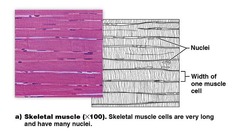
What are muscle cells also known as?
Muscle fibers.
What are the three types of muscle tissue?
Skeletal muscle, cardiac muscle, and smooth muscle.
How do skeletal muscles move body parts?
They connect to tendons which attach to bone and contract to move body parts.
What type of control do skeletal muscles have?
Voluntary control, under conscious control.
Where is cardiac muscle located?
Only in the heart.
What enables coordinated contraction of the heart?
Gap junctions that allow direct electrical connections between adjoining cardiac muscle cells.
What is the primary function of smooth muscle?
Surrounds hollow organs and tubes, such as blood vessels and the digestive tract.

What is the role of neurons in the nervous system?
Generate and transmit electrical impulses.

What are the structural components of a neuron?
Cell body, dendrites, and axon.
What is the function of glial cells?
Surround and protect neurons, providing nutrients.
What are organs composed of?
Two or more tissue types joined together to perform specific functions.
What is an example of an organ and its function?
The heart, which pumps blood.
How many organ systems make up the human body?
11 organ systems.

What is the anterior cavity divided into?
Thoracic cavity and abdominal cavity.

What are the four types of tissue membranes?
Serous, mucous, synovial, and cutaneous membranes.
What does the integumentary system include?
Skin, hair, nails, and glands.
What are the functions of the skin?
Protects from dehydration, injury, serves as defense against microorganisms, regulates body temperature, makes vitamin D, and provides sensation.
What are the two major layers of the skin?
Epidermis and dermis.

What type of cells are keratinocytes?
Cells that provide a tough waterproof protein (keratin) and are actively dividing at the base of the epidermis.

What is the role of melanocytes in the skin?
Contain dark pigment (melanin) that protects against ultraviolet radiation.
What is interstitial fluid?
Clear fluid that fills the space between cells, serving as a source of nutrients and repository for wastes.
What is homeostasis?
Relative constancy of the conditions within the internal environment.
What is a negative feedback control system?
A system that detects deviations from normal and counteracts them.

What are the components of a negative feedback control system?
Controlled variable, sensor, control center, and effector.

What is an example of positive feedback?
The process of childbirth, where a change in a controlled variable amplifies the original change.