Phys Deck 1: Lab Techniques, Acids/Bases, Circuits, Gases, Phase Changes
 Call Kai
 Learn
Learn Practice Test
 Spaced Repetition
 Match
Match Flashcards
 Knowt Play
1/34

There's no tags or description
Looks like no tags are added yet.
Name | Mastery | Learn | Test | Matching | Spaced | Call with Kai | Chat |
|---|
No analytics yet
Send a link to your students to track their progress
35 Terms
What is the stationary phase in TLC?
Polar silica gel (or alumina)
What is the mobile phase in TLC?
A nonpolar (or less polar) solvent that moves up the plate by capillary action.
Which compounds travel farther on a TLC plate?
Nonpolar compounds
Why do polar compounds stay near the bottom in TLC?
They form stronger interactions with the polar silica and move more slow
What does a high Rf value indicate?
Compound traveled farther
Usually less polar
If pH < pKa, is a group protonated or deprotonated?
Protonated
f pH > pKa, is a group protonated or deprotonated?
Deprotonated
Which side of the pKa favors the protonated form?
The lower pH side
What is the equation for capacitance?
C=κε0A/d
Capacitance increases with
larger plate area
dielectric constant
Capacitance decreases with:
greater plate separation
What happens to capacitance if plate area increases?
Capacitance increases
What happens to capacitance if plate separation increases?
Capacitance decreases
On the MCAT, what biological structure acts like a capacitor?
The cell membrane
Why does inhibiting the Na⁺/K⁺ pump decrease membrane voltage?
Because ion gradients slowly disappear, so less charge is stored across the membrane
What happens to the resting membrane potential when the Na⁺/K⁺ pump is inhibited?
It becomes less negative (depolarizes)
What equation is used to calculate percent increase?
new-original/original *100
Which gas law describes pressure, volume, moles, and temperature?
PV=nRT
At what pressure is the normal boiling point measured?
1 atm
What does the liquid-gas boundary on a phase diagram represent?
Boiling and condensation equilibrium.
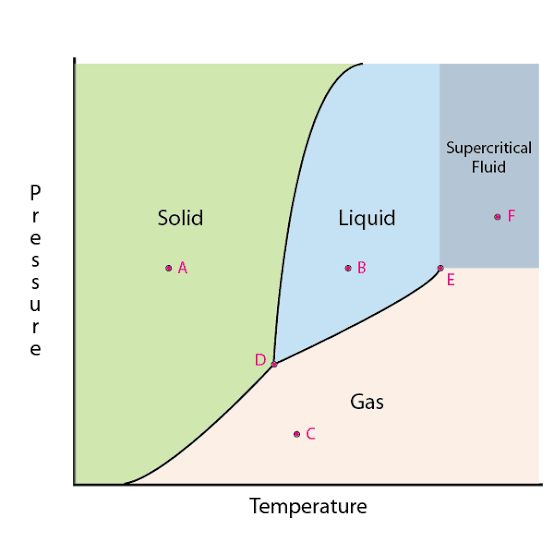
How do you convert C to K?
C+ 273
What is the torque equation?
τ=rFsinθ
For rotational equilibrium, what must be true?
Clockwise torque = counterclockwise torque
Net torque=0
If one object is heavier, where should it be placed relative to the pivot?
Closer to the pivot
What equation relates energy and frequency?
E=hf
If energy stays constant, what happens to frequency?
Frequency stays constant
Heat transfer through direct contact is called...
Conduction
Heat transfer through moving fluids is called...
Convection
What is forced convection?
Convection caused by an external source
Heat transfer through electromagnetic waves is called...
Radiation
Does dissolving an ion automatically change its oxidation state?
No
Oxidation state only changes through a redox reaction
What happens when a common ion is added to an equilibrium?
The equilibrium shifts to consume that ion
-Adding a product ion forces the equilibrium position to move in reverse to use up the extra ions.
What happens to AgI solubility if NaI is added?
Solubility decreases because of the common ion effect
If one product is removed from a dissolution equilibrium, what happens?
The equilibrium shifts right, causing more solid to dissolve
What does filamentous contamination visible under a low-power light microscope suggest in a cell culture?
Fungal contamination
Fungi can form visible filamentous hyphae.
Bacteria and viruses are too small to see with a low-power light microscope