Series 7 - PassPerfect Exam, Series 7 License
 Call Kai
 Learn
Learn Practice Test
 Spaced Repetition
 Match
Match Flashcards
 Knowt Play
1/184

There's no tags or description
Looks like no tags are added yet.
Name | Mastery | Learn | Test | Matching | Spaced | Call with Kai | Chat |
|---|
No analytics yet
Send a link to your students to track their progress
185 Terms
Under IRS regulations, a gain or loss upon current disposition of an asset is first considered to be long term if the asset has been held for over:
A. 6 Months
B. 1 Year
C. 2 Years
D. 5 Years
B. 1 Year - under 12 months, IRS considers short term (don't mix up with 6mo)
The "Trade-Through" Rule of Regulation NMS applies to all of the following except:
A. NYSE Issues
B. NYSE American Issues
C. NASDAQ Issues
D. OTC Equity Issues
D. OTC Equity Issues - Rule 611 prohibits exchanges from trading-through the better priced quote of another market (this is what links exchanges together)
Which of the following statements are true regarding contributions to 403(b) tax deferred annuities and the distributions from these plans after age 59 1/2?
I. Contributions are made with before tax dollars
II. Contributions are made with after tax dollars
III. Distributions are 100% taxable
IV. Distributions are tax free
I and III - 403(b) plans are just like 401(k) with regard to taxation.
Under Reg SHO, a "threshold" security is one that:
I. Is easy to borrow
II. Is hard to borrow
III. Cannot be sold short under any circumstances
IV. Must be bought-in if sold short and not delivered within 13 consecutive settlement days
II and IV - Threshold securities are securities that are 'hard to borrow' and the SEC doesn't want large outstanding short positions within them, hence the required buy in after 13 days (counting trade date)
Which of the following statements are true regarding original issue municipal bonds?
I. Municipal original issue discount bonds must be accreted
II. Municipal original issue discount bonds may be accreted
III. Municipal original issue premium bonds must be amortized
IV. Municipal original issue premium bonds may be amortized
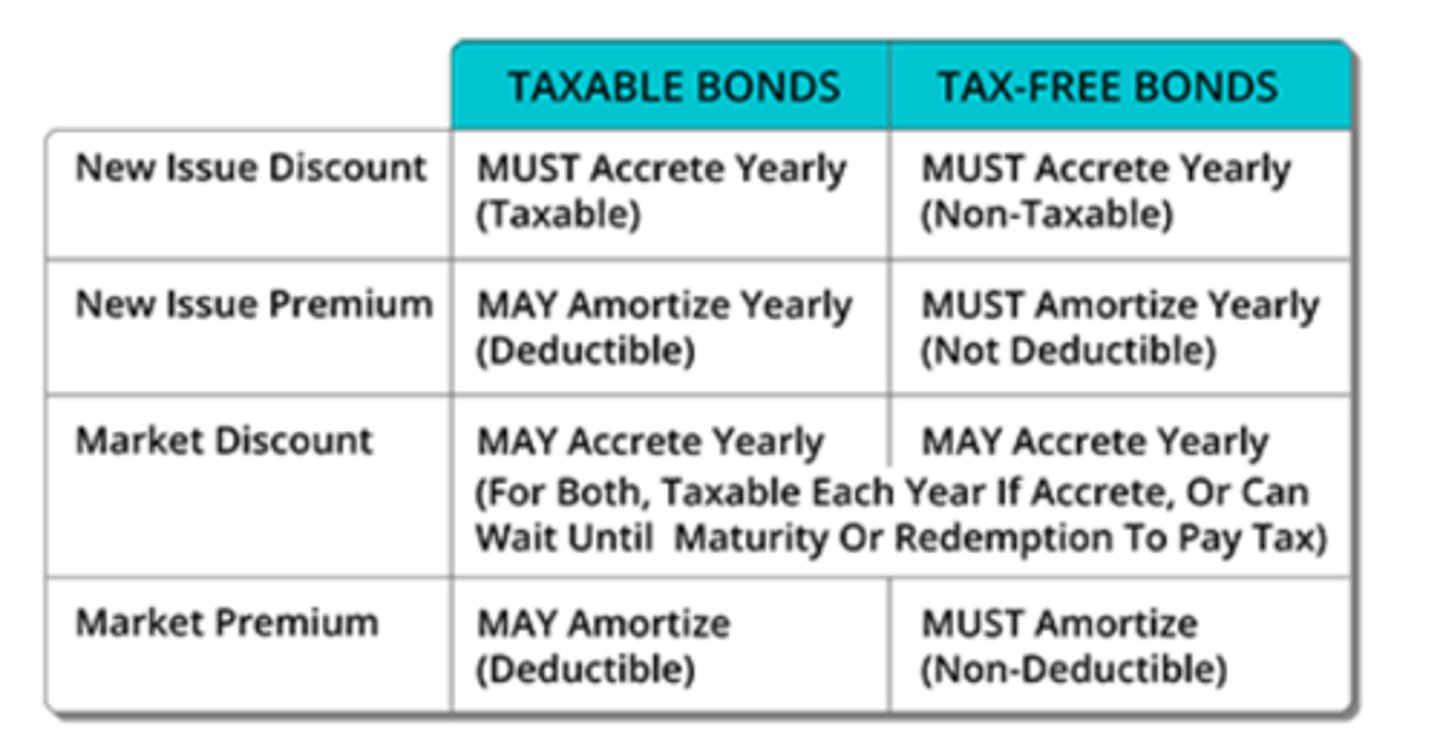
I and III - See the chart, or remember:
Corporate/Gov/Taxable Bonds = MAY, except new issue discount bonds
Municipal/Tax-Free Bonds = MUST, except secondary market discount bonds
To open an account for a limited partnership, the required signatures are those of the:
A. General Partner(s) only
B. Limited Partner(s) only
C. Both the general and limited partner(s)
D. A majority of the general and limited partners
A. General Partner(s) only - Because limited partners are considered passive investors, only the general partner, who takes on unlimited risk, is required to sign.
A margin account shows the following:
Long Market Value = $12,000
Debit = $4,000
Which statements are true about the excess equity in the account?
I. Marginable stock can be purchased in an equal amount to the excess
II. Marginable stock can be purchased in an amount that is twice the excess
III. If the excess equity is withdrawn, the debit increases by an equal amount
IV. If the excess equity is withdrawn, the debit increases by twice the amount
II and III - If an account has excess equity (SMA), the exact amount of SMA may be borrowed, or twice the amount may be purchased in marginable shares (because margin is 50%).
A short margin account shows the following balances:
Credit = $52,000
SMV = $24,000
At what market value with the account be at the minimum maintenance margin level set by the self-regulatory organizations?
A. $30,000
B. $35,000
C. $40,000
D. $45,000
C. $40,000 - For short accounts, the minimum maintenance margin is 30%. To find the market value, use the market value at maintenance formula:
Market Value at Maintenance = Credit Balance / (100% + 30% = 1.3)
Because equity is equal to 30%, and the market value itself is 100%, adding them together creates credit, 130% of market value.
What is the maximum amount that can be excluded from the gift tax?
A. $100,000
B. $17,000
C. $6,000,000
D. Unlimited
B. $17,000 - The first $17,000 can be excluded from a gift given from one person to another, unless it is a married couple, then it is unlimited.
What is the maximum amount that can be excluded from the gift tax between spouses?
A. $100,000
B. $17,000
C. $6,000,000
D. Unlimited
D. Unlimited - The first $17,000 can be excluded from a gift given from one person to another, unless it is a married couple, then it is unlimited.
Which issuers are likely to have high Beta coefficients? (Much higher than +1)
A. Semi-conductor manufacturer
B. Pharmaceutical manufacturer
C. Public utility
D. Food processor
A. Semi-conductor manufacturer - Beta measures volatility with the market (+2 = moves twice as fast as the overall market, .5 = moves half as fast as the market). Utilities, pharmaceutical companies, food companies, etc. are stable in a changing market. Semi-conductors are normal non-defensive companies that move with the market.
A single 30-year old investor has no current investments and $20,000 in a savings account. The customer earns $150,000 per year and has discretionary investment funds of $25,000 per year. Which of the following is an appropriate asset allocation for this customer?
A. 80% Aggressive Growth Fund, 20% Emerging Markets Fund
B. 80% Emerging Markets Fund, 20% Aggressive Growth Fund
C. 30% Aggressive Growth Fund, 30% Emerging Markets Fund, 30% Growth Fund, 10% Money Market Fund
D. 30% Money Market Fund, 30% Treasury Securities Fund, 30% Blue Chip Stock Fund, 10% Aggressive Growth Fund
C. 30% Aggressive Growth Fund, 30% Emerging Markets Fund, 30% Growth Fund, 10% Money Market Fund - More diversification is almost always better, as A is too concentrated in one fund, B is too risky and too concentrated, and D is too conservative for the customer's age.
A customer sells 1 ABC Jan 50 Put @ $5, and deposits cash equal to the aggregate exercise price. If ABC declines to $35, the customer must deposit:
A. $0
B. $500
C. $1,000
D. $1,500
A. $0 - the cash deposit covers the short position, covering the maximum loss. So if a stock declines, the position is considered 'fully covered' and doesn't require extra margins to be paid.
Which security from the same issuer is likely to give the highest current yield?
A. Warrant
B. Common stock
C. Convertible preferred stock
D. Non-convertible preferred stock
D. Non-convertible preferred stock - Warrants give no yields, common stock trades smaller yields for growth potential, and preferred stock is like bonds, with no growth potential but higher yields, and convertible is lower because of the conversion feature.
US Corporations issuing Eurodollar bonds are:
I. Subject to foreign currency exchange risk
II. Not subject to foreign currency exchange risk
III. Subject to filing with the SEC
IV. Not subject to filing with the SEC
II and IV - Because they are issued outside of the US, they don't have to register with the SEC, and because they are issued in US dollars, people in other countries buying them may have foreign currency exchange risk, but the issuing US corporations don't because everything is done in US dollars.
Under Reg T, payments must be made by:
A. Promptly
B. Business day after trade date (T+1)
C. Second business day after trade date (T+2)
D. Fifth business day after trade date
A. Promptly - the answer is "promptly" but it is really settlement + 2 (S+2, not T+2) plus two more additional days (grace days) for a total of 4 business days.
S+2 + 2 day grace period = 4 business days
What does it mean for a municipality to defease its debt? What will it use to do this?
Defease means to 'shift' debt around. A municipality will do this to move debt claims from one form of collateral to another to 'get the debt off its books'. This is usually done with US Gov securities, US Gov agency securities, and occasionally bank deposits. It is NOT done with other municipal securities, typically because they don't pay enough.
A pattern day trading account has a high market value during the day of $200,000 and a "0" position at the end of the day. The minimum maintenance margin requirement is:
A. $0
B. $25,000
C. $50,000
D. $100,000
C. $50,000 - The day trader minimum maintenance margin is the greater of either $25,000 or 25% of the day's high.
$200,000 * 25% = $50,000 > $25,000
Which of the following statements are true about CMOs in a period of falling interest rates?
I. CMO prices rise slower than similar maturity regular bond prices
II. CMO prices rise faster than similar maturity regular bond prices
III. The expected maturity of the CMO will shorten due to a slower prepayment rate than expected
IV. The expected maturity of the CMO will shorten due to a faster prepayment rate than expected.
I and IV - CMOs are buffered from price changes a little, but they will experience prepayment issues when rates fall because more people will pay off and refinance their homes for better rates.
The target allocation for a specific asset class has been set at 20% of total assets under an asset allocation scheme. The manager is permitted to reduce this percentage to 15%; and can increase it to 25%; as he or she sees fit. If this action is taken by the manager, this is termed:
A. Portfolio rebalancing
B. Strategic asset management
C. Tactical asset management
D. Active asset management
C. Tactical asset management
Strategy = setting
Tactical = changing
The target allocation for a specific asset class has been set at 20% of total assets under an asset allocation scheme. The manager is permitted to reduce this percentage to 15%; and can increase it to 25%; as he or she sees fit. The setting of the 20% target allocation is called:
A. Portfolio rebalancing
B. Strategic asset management
C. Tactical asset management
D. Active asset management
B. Strategic asset management - Strategy = setting, tactical = changing.
A customer buys 100 shares of ABC stock at $30 per share. The customer then sells 1 ABC 30 Call contract for a premium of $300. The call contract expires unexercised. After expiration, what is the customer's cost basis for ABC shares?
A. $2,700
B. $3,000
C. $3,300
D. $6,000
B. $3,000 - Because the expiration of the call is short term (options are almost all short-term), the $300 premiums gained are taxed separately as short term gains, and thus not included in the customer's cost basis.
Which of the following does Regulation NMS apply to?
I. NYSE
II. NYSE American
III. NASDAQ
IV. OTC
I, II, and III - NMS has to do with linking exchanges to ensure the best prices; the OTC is not an exchange, and is therefore not regulated by Reg NMS.
What constitutes a failed auction for an Auction Rate Security?
I. Lack of bids
II. Lack of offers
III. Clearing rate below bid rate
IV. Clearing rate above bid rate
I and III - an auction fails when there are more sellers than buyers, so if there are too few bids, the auction will fail. The clearing rate is the minimum rate that must be met for the bids to be accepted, so if this isn't at least met, the auction will fail as well.
Which of the following statements are true about a regular way stock trade effected in a cash account?
I. Payment is required in part
II. Payment is required in full
III. Settlement occurs the same business day
IV. Settlement occurs in two business days
II and IV - Cash = no margin = must be paid in full, and stock trades effected settle in two business days, regardless of whether it is a cash account or not.
A customer buys stock in a margin account, but does not pay in the 4 business days required under Regulation T. The brokerage firm can take all of the following actions EXCEPT:
A. Sell out the position and freeze the account for 90 days
B. Request an extension from FINRA
C. Sell out the account and remit balances to the customer
D. Use existing SMA (credit line) in the margin account to meet the requirement
C. Sell out the account and remit balances to the customer - The brokerage can do everything, including use any available SMA balance in the account, to try to cover the position, but cannot liquidate the entire account.
Interest received from which of the following securities is exempt from state and local tax?
I. Treasury Bonds
II. Federal Farm Credit Funding Corporation Bonds
III. GNMA Bonds
IV. FHLMC Bonds
I and II - Treasury bonds are taxed at the fed level, so they are exempt from state and local, and so are Federal Farm Credit Funding Corporation Bonds because they are also technically direct issue from the federal government. GNMA and FHLMC bonds are paid via mortgages, and so get taxed at all levels.
Block trades on the NYSE that are too large for Super Display Book are:
A. Given directly to the Specialist/DMM for execution
B. Given to Floor Brokers, who may only execute them as "Fill or Kill" orders
C. Only executable during normal trading hours
D. Routed to Third Market Makers who effect the transaction on a principal basis
D. Routed to Third Market Makers who effect the transaction on principal basis - When block trades are too large for the SDB they can be routed to Third Market Makers. They cannot be directly given to Specialists/DMMs, but they can be given to Floor Brokers (but they do not have to execute them as 'fill or kill' orders).
An OTC equity trader has received a large influx of buy orders for ABC stock and, to fill them, has taken a short position in the firm's inventory account. The dealer would most likely:
A. Increase the ask price in the Pink OTC Market
B. Decrease the bid price in the Pink OTC Market
C. Decrease the mark-up to customers that buy
D. Place a "OW" in the Pink OTC Market
B. Decrease the bid price in the Pink OTC Market - If there are too many sellers, it means that the bid price is too high, tempting everyone to sell. If the trader decreases the Bid price, it will discourage sellers.
A customer buys 100 shares of ABC stock at $50 and sells 1 ABC Jan 50 Call @ $4 and sells 1 ABC Jan 50 Put @ $3. The customer's maximum potential loss is:
A. $700
B. $4,300
C. $9,300
D. Unlimited
C. $9,300 - The worst case scenario for any long position is that the stock value goes to zero. If this happened in this scenario, the call would expire unused, but the put would be exercised, forcing the client to buy 100 shares at $50, given them a total of 200 shares they paid $50 each for that are now worth 0 (total of $10,000). Since they still earned the $700 in premiums for selling the call and put, this is subtracted for a total of: $10,000 - $700 = $9,300 lost if the stock goes to zero.
Based solely upon fluctuations in foreign currency exchange rates, the net asset value per share, valued in US dollars, if an international bond mutual fund, would increase if:
I. The value of the US dollar increases
II. The value of the US dollar decreases
III. Interest rates increase in the United States
IV. Interest rates increase in foreign countries
II and IV - International bond mutual funds are valued based on the currency they are denominated in, therefore when compared to the US dollar, if the foreign currency strengthens or the dollar weakens, the fund increases in value. If the US dollar gets stronger, the international fund, valued in foreign currency, decreases in its purchasing power. When it comes to interest rates, an increase in rates in countries also affect the strength of their currency: increasing interest rates in foreign countries can be used to strengthen a currency against the dollar, again raising the NAV of the fund.
Which of the following statements are true regarding the requirements of the MSRB for handling written customer complaints?
I. All customer complaints must be resolved
II. If the customer alleges in a complaint that there has been a monetary loss, the MSRB must be notified
III. The municipal principal must handle the resolution of each written customer complaint
IV. The municipal principal must retain a file of all customer complaints with their resolutions
I, III, and IV - This is a trick question about what the MSRB actually does. Remember, they are a rule-making body only; they can't enforce anything. So even if they were notified of a specific complaint, they would just pass it on to FINRA who is in charge of enforcing and taking action with regard to broker-dealers. Therefore, there is no requirement to notify the rule-making board about rules being broken.
Which of the following items are taxable to a limited partnership?
I. Short term gains
II. Long term gains
III. Ordinary income
IV. None of the above
IV. None of the above - This is a question about the partnership level vs. the partner level. Because partnerships allow for the total 'flow through' of everything (gains and losses), they are not taxable. Where the funds end up is taxable (the partners themselves).
"Restriction" in a margin account:
I. Is defined by the Federal Reserve Board
II. Is defined by the Financial Industry Regulatory Authority
III. Occurs if the account falls below initial Regulation T margin
IV. Occurs if the account falls below minimum maintenance margin
I and III - The restriction is defined by FRB, not FINRA, and has to do with the Reg T margin requirement.
Which of the following are determining factors when marking a competitive bid for municipal issues?
I. Type of income source backing the bonds
II. Yields of similar bonds in the market
III. Maturities of the bonds
IV. Par value of the bonds
I, II, III - The par value of the bonds are all $1,000 so it has no bearing on the interest rates being bid.
Which bond will be most volatile?
A. A short-term bond with a low coupon rate
B. A short-term bond with a high coupon rate
C. A long-term bond with a low coupon rate
D. A long-term bond with a high coupon rate
C. A long-term bond with a low coupon rate - The longer the term and the lower the coupon rate on a bond, the higher the volatility.
A corporate investor may exclude from taxation, part of:
I. Cash dividends received from common stock investments
II. Cash dividends received from preferred stock investments
III. Interest received from convertible bond investments
IV. Interest received from non-convertible bond investments
I and II - the 50% that corporations can exclude from taxes are for dividends from stock only, NOT interest from bonds.
A growth investor would consider a company's:
A. Price / Earnings ratio
B. Price / Book Value ratio
C. Stock price appreciation rate
D. Market share
C. Stock price appreciation rate - growth investors are just looking for growth when determining the best investments.
A municipal bond dealer quotes 10 year 3 1/2% revenue bonds at 97 1/4 - 98. The dealer's spread per $1,000 is:
I. $0.75
II. $7.50
III. 7.5 basis points
IV. 75 basis points
II and IV - Remember that 1 basis point = $.10, so it takes 75 basis points to total $7.50.
A corporation buys furniture and fixtures, paying cash. Which of the following choices are affected?
I. Current assets
II. Current liabilities
III. Net worth
IV. Net working capital
I and IV - If it is bought with cash, then cash goes down (a current asset) and since it wasn't bought on credit, the current liabilities are unaffected. Net worth can only be affected by profit and loss, not by buying these types of assets. Net working capital is directly affected by current assets, and so is adjusted when cash is used for the purchase.
A customer buys 1 ABC Jul 55 Call @ $2 and I ABC Jul 60 Put @ $5 on the same day. Just prior to expiration, the stock is trading at $59 and the customer closes the positions at intrinsic value. The customer has a net loss of:
A. $50
B. $100
C. $200
D. $700
C. $200 - When closing at intrinsic value, don't look at the premiums, only the strike price and the market price. The 55 call was in the money by 4 points, and the 60 put was in the money by 1 point, for a total of 5 points. The customer had spent 7 points ($700) buying the two positions, and only made 5 points ($500) when he closed them out, netting a loss of $200.
To create a debit time spread, which statement is true?
A. Buy near and sell far
B. Sell near and buy far
C. Buy near and buy far
D. Sell near and sell far
B. Sell near and buy far - a time spread is the same as a calendar spread. To create a credit or debt time/calendar spread, remember:
Calendar Debit Spread = Buy Far, Sell Near
Calendar Credit Spread = Sell Far, Buy Near
"DBS - Debits Sell Near"
The exchange traded fund(s) based on indexes by industry sector or country are known as:
A. DIAs
B. QQQs
C. SPDRs
D. I-Shares
D. I-Shares - I for Industry!
Quotes published in the news media for mutual funds show:
A. Bid price at NAV; Ask price at NAV plus an average sales charge
B. Bid prices at NAV; Ask prices at NAV plus the maximum sales charge
C. Bid prices at NAV less any redemption fees; Ask price at NAV plus an average sales charge
D. Bid price at NAV less any redemption fees; Ask price at NAV plus the maximum sales charge
B. Bid prices at NAV; Ask prices at NAV plus the maximum sales charge - bid prices are just flat NAV, but ask prices include the maximum possible sales charge to try to be as transparent as possible.
Which of the following creates a collar?
I. Purchase of a put at a strike price below the stock price
II. Purchase of a put at a strike price above the stock price
III. Sale of a call at a strike price below the stock price
IV. Sale of a call at a strike price above the stock price
I and IV - A collar is the purchase of a put below and the sale of a call above the stock price:
Sell Call
Stock
Buy Put
Collar = SCBP
When comparing a CMO Planned Amortization Class (PAC) to a CMO Targeted Amortization Class (TAC), all of the following statements are true except:
A. Both PACs and TACs offer the same degree of protection against extension risk
B. PACs differ from TACs in that TACs do not offer protection against a decrease in prepayment speeds
C. PACs are similar to TACs in that both provide call protection against increasing prepayment speeds
D. TAC pricing will be more volatile compared to PAC pricing during periods of rising interest rates
A. Both PACs and TACs offer the same degree of protection against extension risk.
TAC offers protection from prepayment risk, but not as much from extension risk
PAC offers protection from prepayment risk and extension risk
The amount of accretion to be reported for tax purposes on an original issue discount bond requires the use of all of the following EXCEPT:
A. Purchase price
B. Market value
C. Redemption price
D. Maturity
B. Market value - the accretion schedule is not affected by the current market value
The Standard and Poor's Composite Average is most affected by price changes in:
A. Technology Stocks
B. Utility Stocks
C. Energy Stocks
D. Industrial Stocks
A. Technology Stocks
S&P 500 Index Breakdown:
Technology - 24%
Industrial - 10%
Energy - 6%
Utilities - 3%
Which of the following statements are true?
I. Fundamental analysts look at earning trends, balance sheet strengths, liquidity ratios, etc.
II. Fundamental analysis look at chart movements, trading volumes, advance/decline ratios, etc.
III. Technical analysts look at earning trends, balance sheet strengths, liquidity ratios, etc.
IV. Technical analysts look at chart movements, trading volumes, advance/decline ratios, etc.
I and IV - Fundamental analysts look at fundamentals, while technical analysts look at charts and trends
The difference between a Correspondence and a Retail Communication is:
A Correspondence is made to 25 or fewer people and a Retail Communication is made to 25 or more people.
If a customer effects a short sale, the broker-dealer:
I. Will borrow the shares to be sold from someone else
II. Will buy the shares to be sold from someone else
III. Can demand that shares be replaced within the first 7 days of establishment of the position
IV. Can demand that the shares be replaced at any time
I and IV - The BD can borrow shares from someone else, but they can also demand that the shares be replaced at any time (no 7-day limit).
For municipal transactions effected on a yield basis, how are these bonds generally priced?
I. Discount bonds are priced to maturity date
II. Discount bonds are priced to the near-term call date
III. Premium bonds are priced to maturity date
IV. Premium bonds are price to the near-term call date
I and IV - Discount bonds are priced normally while premium bonds are priced to the near-term call date since they are so much more likely to be called.
A trust indenture is required for a(n):
A. Treasury Bond
B. Agency Bond
C. Corporate Debenture
D. General Obligation Bond
C. Corporate Debenture - Under the Trust Indenture Act of 1939, all non-exempt offerings must have a trust indenture.
What are the features of a Short Stock + Long Call (Protective Call) position?
Max Gain: Breakeven Point
Max Loss: Strike Price - Breakeven Point
Breakeven Point: Original Stock Price - Premium
Bullish Hedge
What are the features of a Long Stock + Short Call (Covered Call) position?
Max Gain: Strike Price - Breakeven Point
Max Loss: Breakeven Point
Breakeven Point: Original Stock Price - Premium
Income when the market is flat
What are the features of a Long Stock + Long Put (Protective Put) position?
Max Gain: Unlimited
Max Loss: Breakeven Point - Strike Price
Breakeven Point: Original Stock Price + Premium
Bearish Hedge
What are the features of a Short Stock + Short Put (Covered Put) position?
Max Gain: Breakeven Point - Strike Price
Max Loss: Unlimited
Breakeven Point: Stock Price + Premium
Define Interest Rate Risk
The risk of capital losses to which investors are exposed because of changing interest rates.
Define Inflation Risk (Purchasing Power Risk)
The risk that rising inflation will raise interest rates, causing the value of bonds to fall lower and investors to lose purchasing power.
Define Marketability Risk
The risk that the security will be difficult to sell - not an issue for governments, a bit of an issue for corporations, and a huge issue for municipal issues.
Define Liquidity Risk
The risk that an asset cannot be sold on short notice without incurring a loss.
Define Spreads
Buying and Selling the same Stock and same Type of option.
example:
Buy ABC Oct 50 Call @ 4
Sell ABC Oct 30 Call @ 1
Define this position (vertical, horizonal, or diagonal):
Short ABC Jan 10 Put @ $2
Long ABC Jan 20 Put @ $.50
This is a Vertical Spread.
Define Legislative Risk
The potential for an investor to be adversely affected by changes in investment or tax laws.
Define Call Risk
The risk to bondholders that a bond may be called away from them before maturity (more likely when interest rates are dropping)
Is this position Bullish or Bearish?
Short ABC Jan 10 Put @ $2
Long ABC Jan 20 Put @ $5
This position is Bearish - If the sell/short price is lower, it is bearish. If the buy/long position is lower, the position is bullish.
Remember: Bulls sell high!
Is this position Bullish or Bearish?
Short ABC Jan 30 Put @ $2
Long ABC Jan 20 Put @ $5
This position is Bullish - If the sell/short price is lower, it is bearish. If the buy/long position is lower, the position is bullish.
Remember: Bulls sell high!
Define Reinvestment Risk
The risk that a fixed-income investor will not be able to reinvest interest payments or the par value at attractive interest rates. Happens when rates are falling
Define Exchange Rate Risk
The risk related to having international operations in a world where relative currency values vary
Define Political Risk
The likelihood that political forces will cause drastic changes in a country's business environment that will adversely affect the profit and other goals of a particular business enterprise. (Not the same as Legislative Risk)
What are the four tools of the Federal Government?
Discount Rate
Open Market Operations
Reserve Requirements
Margin
Remember: DORM!
To tighten credit, the Fed will...
Raise the Federal Discount Rate and perform a Reverse Repurchase Agreement
To loosen credit, the Fed will...
Lower the Federal Discount Rate and perform a Repurchase Agreement
Define Nominal Yield Curve
An upward-sloping yield curve indicates that long-term interest rates are generally higher than short-term interest rates. (Typical when the Fed is trying to stimulate the economy)
Define Flat Yield Curve
A yield curve that indicates that interest rates do not vary much at different maturities.
Define Inverted Yield Curve
A downward-sloping yield curve indicates that short-term interest rates are generally higher than long-term interest rates.
Define Repurchase Agreement
The Fed purchases securities with an agreement that the seller will repurchase them in a short period of time. For example, an overnight repurchase agreement is when the Fed buys U.S. Gov securities with an agreement to sell them back the next day - this injects cash into the dealer and loosens credit.
Define Reverse Repurchase Agreement
The Fed sells securities with an agreement to repurchase them in a short period of time. For example, an overnight repurchase agreement is when the Fed sells U.S. Gov securities with an agreement to buy them back the next day - this drains cash from the dealer and tightens credit.
Rapid tightening by the Fed is likely to result in which of the following yield curves?
A. Stable
B. Normal
C. Flat
D. Inverted
D. Inverted
Rank from Highest to Lowest:
Federal Funds Rate
Discount Rate
Prime Rate
Broker (Call) Loan Rate
Prime Rate
Broker (Call) Loan Rate
Discount Rate
Federal Funds Rate
Remember: Pretty Boys Don't Fight!
Define Nominal Yield
The interest rate, also known as the "coupon rate," which is stated on the bond certificate.
Define Current Yield
bond's annual coupon interest divided by purchase price; measure of a bond's return
Define Yield to Maturity
The rate of return a bondholder will receive if the bond is held to maturity.
Annual income (+/- Annual Capital Gain/Annual Capital Loss) / (Purchase Price + Redemption Price)2 <-Average
*Note: Annual Capital Gain/Annual Capital Loss can be found by taking the difference from par and dividing it by the years to maturity.
Define Registrar
This is an outside firm (usually a bank or trust company) to act as registrar for their shares. The registrar maintains the integrity of the list of all shareholder names and addresses and is given the responsibility to make sure the company does not issue more shares than authorized under its charter.
Define Transfer Agent
Hired by the corporation (usually a bank or trust company), the Transfer Agent receives reports about the trades, cancels old shares which have been sold and issues new shares. The transfer agent keeps an accurate record of the shareholders updated daily. Transfer agents usually also handle the mailing to shareholders (e.g., dividends, corporate reports, and voting materials).
The registrar acts as what with regard to the transfer agent?
The 'watchdog' - The registrar watches for transfer agent mistakes.
Define Book-Entry Certificate
No physical issues, recorded electronically only.
Define Ex-Date
The first date on which a security is traded that the buyer is not entitled to receive distributions previously declared. (One day before the Record Date for Cash Dividends.)
The last day to buy stock regular way and receive a dividend is:
Two days before the Record Date.
Under an "Anti-Dilutive" covenant, if a corp. declares a stock dividend, which statements are true?
1. The Conversion Price is Decrease
2. The Conversion Price is Unaffected
3. The Conversion Ratio is Increased
4. The Conversion Ratio is Unaffected
1 and 3 - When a stock dividend is declared under an anti-dilutive covenant, the terms of conversion are adjusted. By issuing additional common shares, each share will be proportionately worth less. To adjust the conversion terms, the Conversion Price is Reduced and the number of common shares that the security can convert into (the Conversion Ratio) is Increased.
If interest rates fall, issuers will most likely call:
Preferred issues trading at a premium.
What is the P/E Ratio?
Price/Earnings Ratio = Market Price of Security/Earnings per Share
To find the multiple, or the Price Earnings Ratio: market price of security/earnings per share.
Define Earnings Per Share (EPS)
EPS = Market Price/"Multiple"
If the multiple is provided, it can be used to find the EPS by dividing the market price.
To find the multiple, or the Price Earnings Ratio: market price of security/earnings per share.
What is a "Multiple"?
Multiples - if a stock is selling in the market at a "multiple" of X, this means that the market price is X times the current Earnings per Share. To find the multiple, or the Price Earnings Ratio: market price of security/earnings per share.
A company's common stock is selling in the market at a multiple of 15. If the market price of common is current $15, what is the earnings per share?
$1.00 - Since the market price is at $15 and the P/E Ratio is 15, earnings per share is $1.00.
How often are ADR dividend payments made?
Semi-Annually
Define Dividend Payout Ratio
Dividend Payout Ratio = Common Dividends/Earnings for Common
Define Term Bond Issue
All bonds issued mature at same time and have the same interest rate.
Define Serial Bond Issue
Bonds are issued on the same day with different interest rates and several maturity dates so that a portion of the issue is redeemed periodically.
Define Series Bond Issue
A bond issue where the bonds have the same maturity but different dates of issuance. (These are rarely used and usually for financing long-term construction projects.)