lecture 22 - DNA replication
 Call Kai
 Learn
Learn Practice Test
 Spaced Repetition
 Match
Match Flashcards
 Knowt Play
1/11

There's no tags or description
Looks like no tags are added yet.
Name | Mastery | Learn | Test | Matching | Spaced | Call with Kai | Chat |
|---|
No analytics yet
Send a link to your students to track their progress
12 Terms
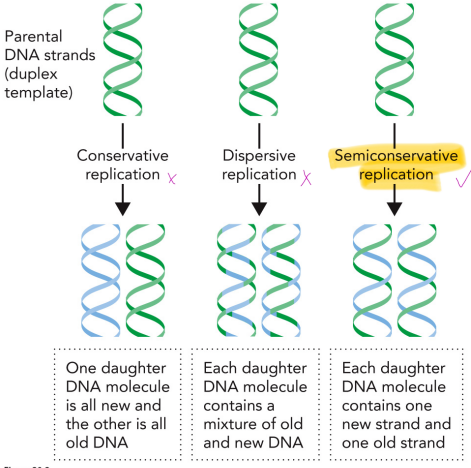
three hypothesized mechanisms for DNA replication
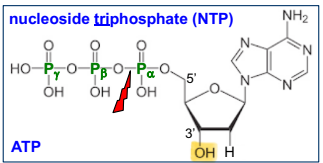
what are dNTPs and how many phosphates do they have?
building blocks and energy source for DNA replication
things needed for DNA synthesis/replication:
DNA template strand
dNTPs (deoxynucleoside triphosphates)
DNA or RNA ‘primer’ to provide first 3’-OH
Mg2+ ions (cofactor for polymerase)
DNA polymerase - large protein complex that includes the enzyme that catalyzes the addition of dNTPs on the 3’OH end of the primer
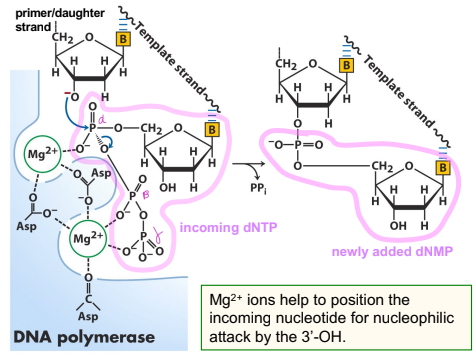
simple diagram of DNA replication, and diff names for growing strand

growing strand/daughter strand/primer strand
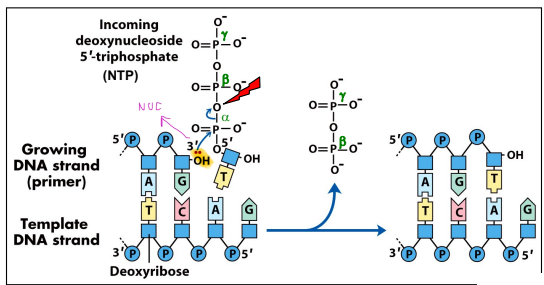
DNA Replication: diagram of Phosphodiester Bond Formation via Nucleophilic Attack
The 3'-OH of the primer attacking the α-phosphate of the incoming dNTP (nucleophilic attack, "NUC")
Release of pyrophosphate (PPi, the β-γ phosphate group shown breaking away)
Chain elongation in the 5'→3' direction
Template-directed base pairing (A-T, G-C)
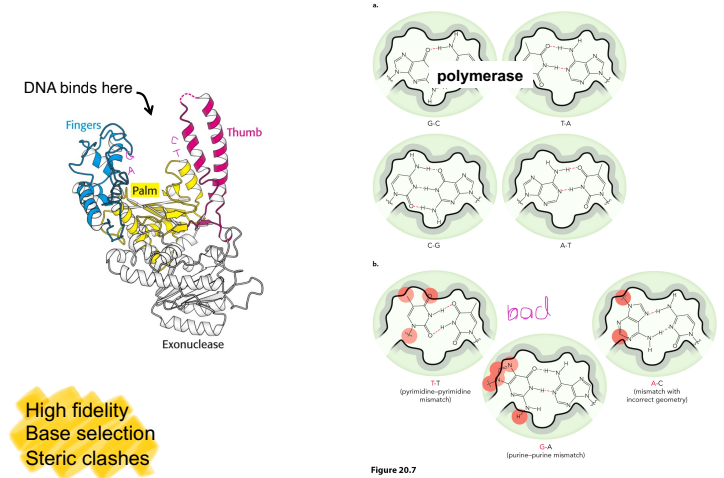
how does the shape of DNA polymerase’s active site faciliate formation of correct base pairing
correct base pairs fit well into polymerase active site, mismatches do not
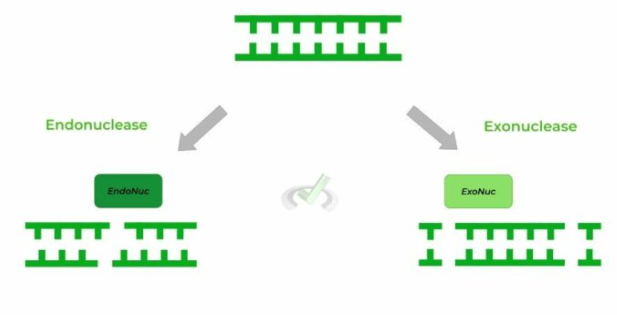
What is an endonuclease and an exonuclease?
Endonucleases cut WITHIN the nucleic acid chain
They help fix damaged DNA or fight off harmful viruses.
Exonucleases cut at the ENDS.
They check and fix mistakes during DNA copying (proofreading) and help clean up old RNA.
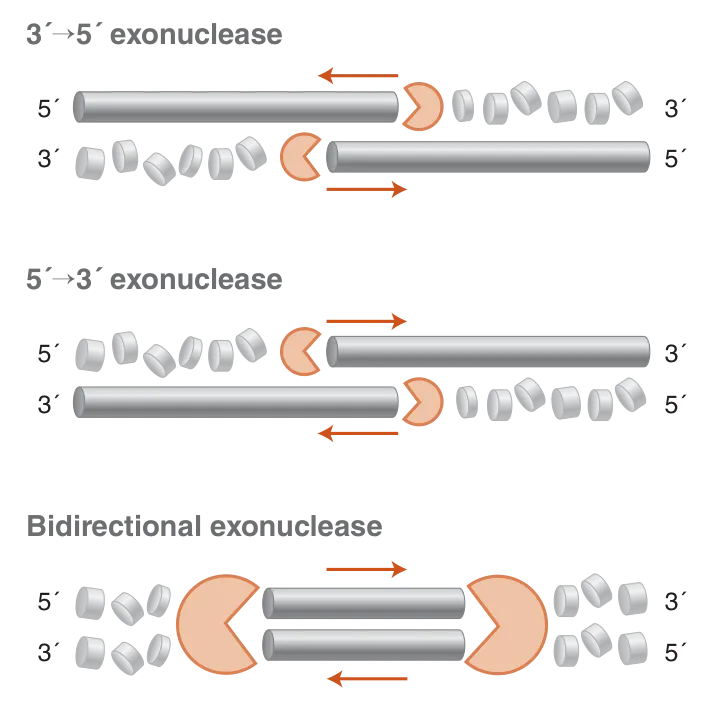
What is a 5’-->3’ exonuclease? vs 3’--->5’ exonuclease?
5’-->3’ Exonuclease:
Removes RNA primers during DNA replication.
Participates actively in DNA repair processes like nick translation (such as the activity found in DNA Polymerase I).
3’-->5’ Exonuclease:
Acts as a proofreading mechanism during DNA replication.
Detects and cuts out incorrectly matched (misincorporated) nucleotides at the growing 3' end before the polymerase moves forward.
replication forks
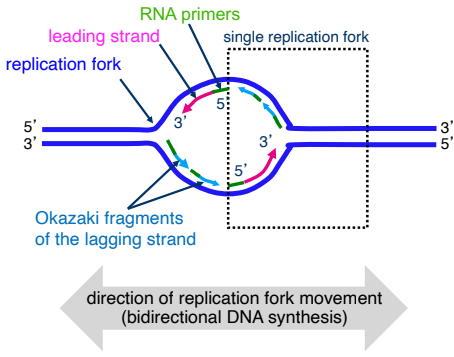
DNA synthesis occurs at replication forks simultaneously for both parents strands, always 5’ → 3’ direction
DNA is partially unwound at “replication forks.” Both strands are used as templates for the synthesis of new strands in a 5’→ 3’ direction. The leading strand is synthesized continuously, whereas the lagging strand is, by necessity, is synthesized in short pieces (Okazaki fragments)
Both new strands are synthesized in a coordinated fashion by a single multimeric DNA polymerase III complex
origins of replication
In all cells (eukaryotic, prokaryotic) with circular or linear DNA molecules, DNA
replication begins at defined sequences termed “origins of replication” (ori).
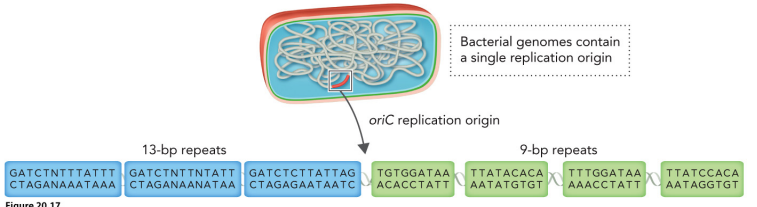
often there are multiple origins prokaryotes, like E. coli, have circular chromosomes with a single origin of replication -“oriC”
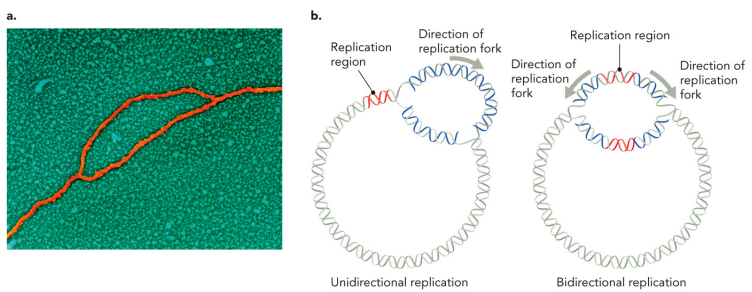
the ori opens up (DNA strands are separated by a helicase) to form 2 replication forks
in E. coli, replication is bidirectional, with a DNA polymerase III complex operating at each of the 2 replication forks

prokaryotic replication and its two key elements
prokaryotic replication is initiated at a single sequence in the bacterial genome called oriC
two key elements(both very AT rich to faciliate unwinding of dsDNA):
three repeats of a highly conserved 13-bp sequence
four repeats of a conserved 9-bp sequence
two possible mechanism for DNA replication from a single origin
unidirectional and bidirectional