Strat 2 Midterm
 Call Kai
 Learn
Learn Practice Test
 Spaced Repetition
 Match
Match Flashcards
 Knowt Play
1/16

There's no tags or description
Looks like no tags are added yet.
Name | Mastery | Learn | Test | Matching | Spaced | Call with Kai |
|---|
No analytics yet
Send a link to your students to track their progress
17 Terms
3 characteristics of a multinational enterprise (MNE)
Substantial direct investment in foreign countries (not just trading relationships of an import-export business)
Active, coordinated management of these offshore assets (not simply holding them as a passive financial portfolio)
Strategic and organizational integration of operations located in different countries
What are 2 traditional motivs to internationalize vs. 3 modern motivations
Traditional:
1. Market seeking: fill out capacity, exploit comp advs and economies of scale and scope
2. Resource seeking (resource-based theory)
Secure key supplies
Exploit factor cost differences (access low-cost factors of production), lower cost capital
Modern (post 1970)
Industry internalization forces: scale economies, ballooning R&D investments, shortening product life cycles, home country regulations
Global scanning and learning capability: Access to emerging trends, new tech, and best skills worldwide (effect of globalization)
Competitive positioning: eg. use global operations to pre-empt others, cross-subsidize markets
4 disadvantages and 5 challenges of internationalization
Disadvantages
Risk of failure
High amount of resources required
Negative image in the domestic market
Decision may be difficult to reverse
Challenges
Economic differences
Political-legal environment
Cultural environment
Technological environment
Local industry structure
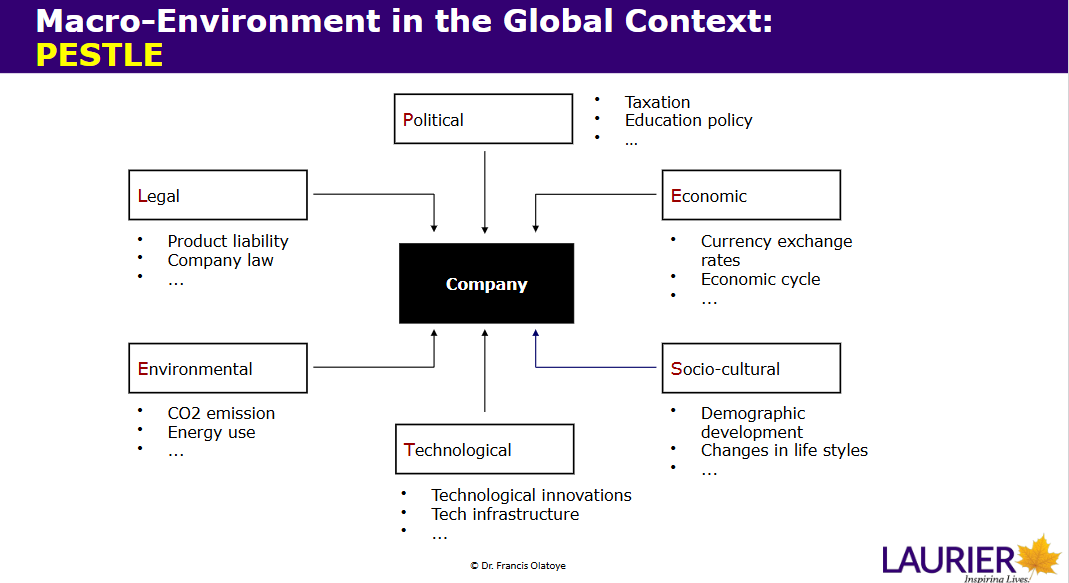
MACRO Environment: PESTEL
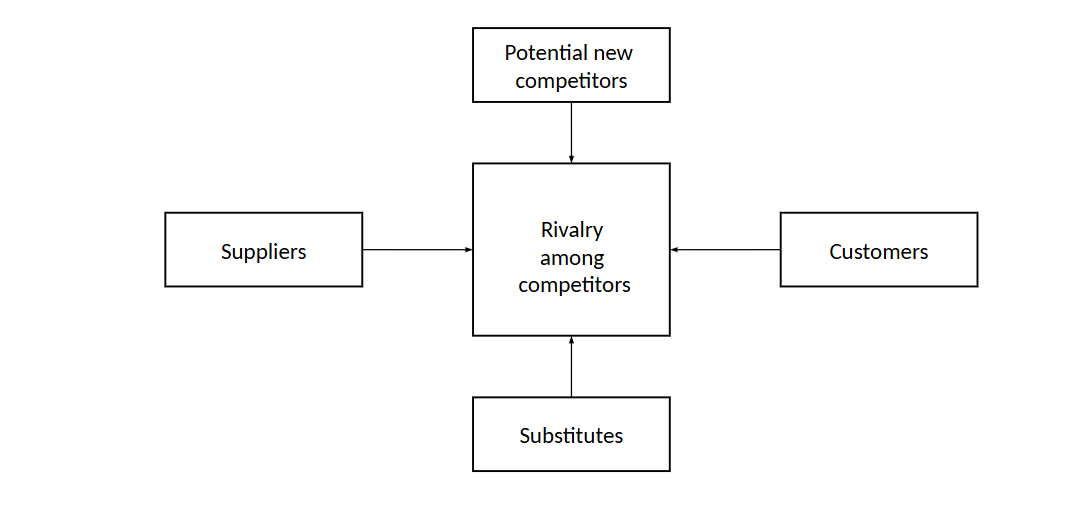
MICRO Environment: Porter’s 5 Forces
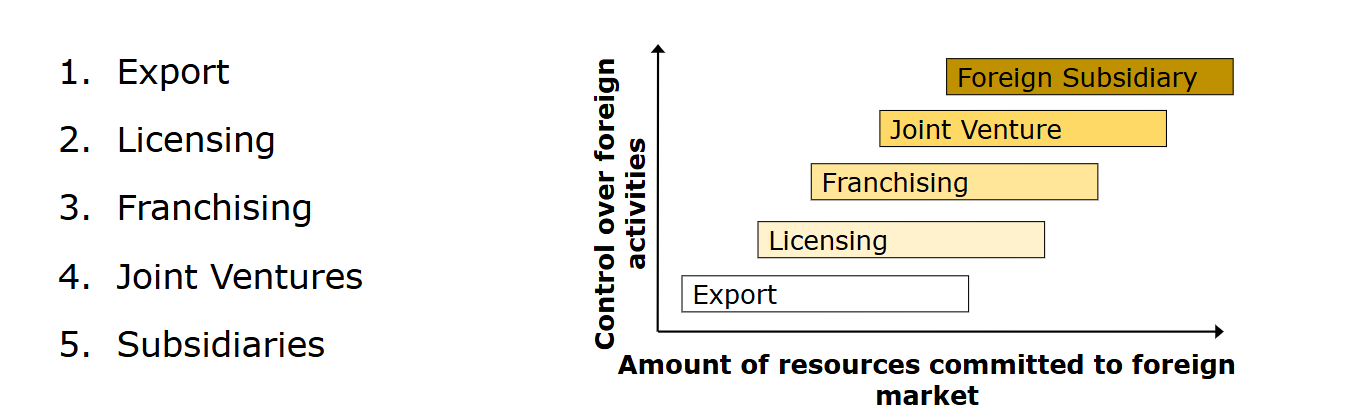
What are the means of internalization (control over foreign activities on y axis, amount of resources committed to foreign market x axis)
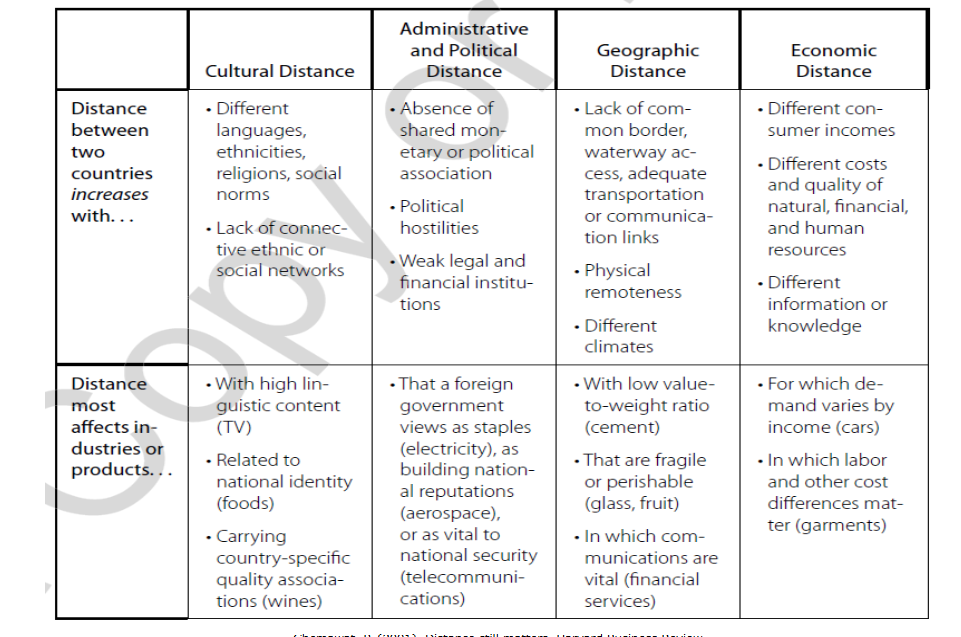
CAGE Framework
Cultural distance: different languages, different religions, different social norms
Administrative and political distance: Trade and political unions, common currency, tarriffs, trade quotas, restrictions on foreign direct investment, subsidies to local firms, property rights, corruption, weak institutions, political instability
Geographic distance: distance to country, within-country distances, access to waterways and oceans, transportaion and communication infrastructures
Economic distance: wealth and income of customers, resource and factor costs
Global integration and national responsiveness for internalization strategies
Global: Low national responsiveness, high global integration
Multinational: High national responsiveness, low global integration
Transnational: High national responsiveness+ high global integration
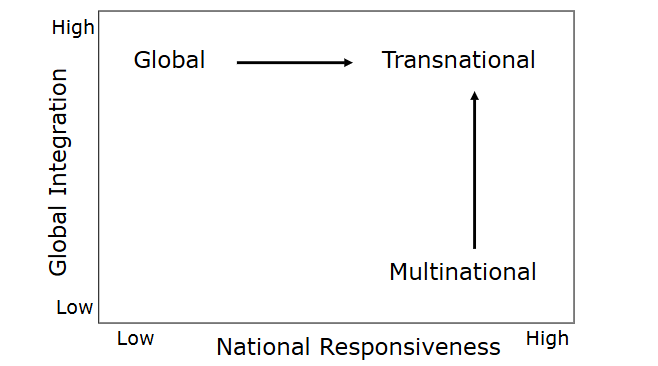
What are the mentalities for global, multinationa, and transnational?
Global: company views world as a single unit of analysis; products are developed for the global market; emphasis on global efficiency; operations managed centrally
Multinational: Company overseas markets are considered a portfolio of local opportunities; local adaptations to products and strategies
Transnational: Company simultaneously responds to local needs and global demands; balance local responsiveness and global efficiency; dispersed, specialized, and integrated global activities
What are the 3 major drivers of internationalization?
Need for cross-market or global integration
National or local responsiveness
Worldwide innovation and learning
Forces for global integration + coordination
Economies of scale and scope
Factor cost differentials (labour, raw materials)
Increasingly liberalized environment for trade (EU, USMCA, WTO, CETA) - Trade agreements
MNEs/Global competitors as change agents:
change product/operational context to foster global integration and coordination (eg. starbucks with premium coffee shops)
Forces for national or local responsiveness (think CAGE)
Cultural differences: customer behaviour and preferences
National infrastructure: technical standards (eg. voltage, tv broadcast)
Government demands, political risk: national laws and regulations, host country pressures and demands
Local competitors success: Culturally sensitive flexibility and responsiveness, appeal to nationalism
Customers: income, preference, habits, consumption patterns
Economy: GDP, disposable income, inflation, growth
Forces for worldwide innovation and learning
Increased need due to:
shortening product life-cycles
Increased cost of R&D
Emergence of global technology standards (think USB-C)
Competitors ability to develop and diffuse innovational globally
How do global, multinational, and transnational industries respond to diverse forces differently?
Global: Affects those shaped primarily by economic forces for globalization (eg. consumer electronics) and need for global integration. Successful MNEs are those that capitalize on highly centralized, scale-intensive manufcaturing and R&D operations and leveraging them through worldwide exports of standardized global products
Multinational: Those shaped primarily by national, cultural, social, and political forces of localization - successful MNEs are those building strong, resourceful national subsidiaries sensitive to local needs and able to develop or adapt products and strategies to respond to their local needs, opportunities, and demands
Transnational strategies: Means responding to all 3 forces, industries are increasingly becoming this, should be the goal of all MNCs
Political risk framework
Understand
what is my org’s political risk appetite?
time horizong of major investments, availability of alt investments, ease of exiting investments, visibility to consumers
is there a shared understanding of our risk appetite
make sure its a concern from boardroom to sales floor
how can we reduce blind spot?
foster creative thinking, guard against groupthink
Analyze
how can we get good information about the political risks we face?
how can we ensure rigorous analysis?
challenge assumptions and mental models, understand which assets are valuable + vulnerable
how can we integrate political risk analysis into biz decisions?
Mitigate
how can we reduce exposure to the political risks we have identified
strategies: dispersing critical assets, creating surge capacity and slack in supply chain, sharing political risk assessments and mitgation strategies
do we have a good system and team in place for timely warning and action
set up effective warning systems, establish protocols so that repsonses to specific conditions r triggered automaticall
how can we limit the damage when something bad happens
build relationships with external stakeholders
Respond
are we capitalizing on near misses
are we reacting effectively to crises
are we developing mechanisms for continuous learning
What are techniques MNEs use to mitigate country political risks
Recruiting local partners
Limiting R&D in nations with leaky IP protection
Purchasing insurance against political risks (from multilateral investment guarantee agency or AIG)
Diversifying their FDI across diff countries