Apes Unit 4: Earth Systems and Resources
0.0(0)
Studied by 6 people Call Kai
 Learn
Learn Practice Test
 Spaced Repetition
 Match
Match Flashcards
 Knowt Play
Card Sorting
1/186

Earn XP
Description and Tags
Last updated 8:36 PM on 10/18/22
Name | Mastery | Learn | Test | Matching | Spaced | Call with Kai | Chat |
|---|
No analytics yet
Send a link to your students to track their progress
187 Terms
1
New cards
Core
Dense mass of solid nickel, iron, and radioactive elements that release massive amount of heat
2
New cards
Mantle
liquid layer of magma surrounding core, kept liquified by intense heat from core
3
New cards
Asthenosphere
solid, flexible outer layer of mantle, beneath the lithosphere
4
New cards
Lithosphere
thin, brittle layer of rock floating on top of mantle (broken up into tectonic plates)
5
New cards
Crust
very outer layer of the lithosphere, earth’s surface
6
New cards
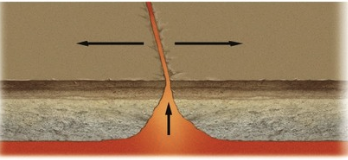
Divergent Plate Boundary
Rising magma plume from mantle forces plates to move away from each other
7
New cards
What do divergent plate boundaries form?
mid-oceanic ridges, volcanoes, seafloor spreading, and rift valleys (on land)
8
New cards
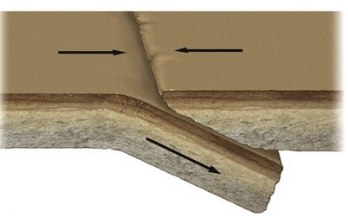
Convergent Plate Boundary
Plates that move towards each other
9
New cards
What can convergent plate boundaries lead to?
subduction
10
New cards
Subduction
one plate being forced beneath another
11
New cards
What do convergent plate Boundaries form?
mountains, island arcs, earthquakes, and volcanoes
12
New cards
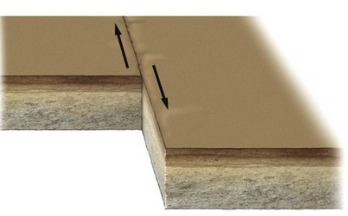
Transform Fault Plate Boundary
Plates slide past each other in opposite directions
13
New cards
What do Transform Fault Plate Boundaries form?
earthquakes
14
New cards
Convergent Cycle (Divergent) pt.1
Magma heated by earth’s core rises towards lithosphere
15
New cards
Convergent Cycle (Divergent) pt.2
Rising magma cools & expands, forcing oceanic plates apart
16
New cards
What does Convergent Cycle (Divergent) pt.2 create?
mid ocean ridges, volcanoes, spreading zones or “seafloor spreading"
17
New cards
Convergent Cycle (Divergent) pt.3
Magma cools, and solidifies into new lithosphere
18
New cards
Convergent Cycle (Divergent) pt.4
Spreading magma forces oceanic plate into cont. (subduction zone)
19
New cards
Convergent Cycle (Divergent) pt.4 can lead to...
Sinking oceanic plate melts back into magma +
also forces magma up, creating narrow, coastal Mtns. (Andes) & volcanoes on land
also forces magma up, creating narrow, coastal Mtns. (Andes) & volcanoes on land
20
New cards
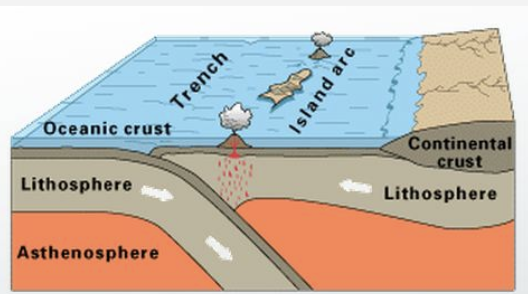
Convergent Boundary = Subduction Zone: Oceanic-Oceanic
one plate subducts underneath other
21
New cards
Convergent Boundary = Subduction Zone: Oceanic-Oceanic forces magma up to lithosphere surface, forming...
mid ocean volcanoes, Island arcs, and Off-shore trench
22
New cards
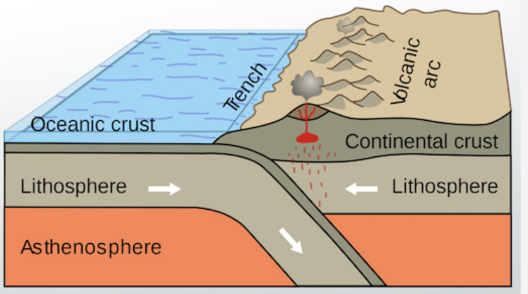
Convergent Boundary = Subduction Zone: Oceanic-Continental
dense oceanic plate subducts beneath cont. Plate & melts back into magma
23
New cards
Convergent Boundary = Subduction Zone: Oceanic-Continental forces magma up to lithosphere surface forming...
Coastal Mountains (Andes), Volcanoes on land, trenches, and tsunamis
24
New cards
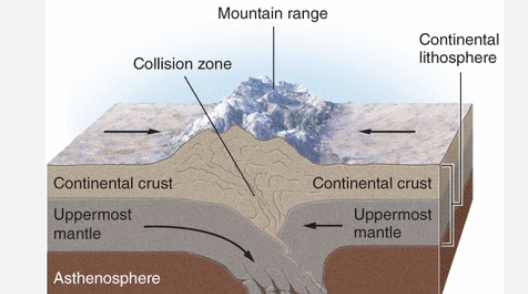
Convergent Boundary = Subduction Zone: Continental-Continental
one plate subducts underneath other, forcing surface crust upward
25
New cards
Convergent Boundary = Subduction Zone: Continental-Continental forms...
(mountains)
26
New cards
Example of Convergent Boundary = Subduction Zone: Continental-Continental mountain...
Himalayas
27
New cards
Transform Fault Boundary creates earthquakes by...
Occurs when rough edges of plates get stuck on each other, pressure builds as plates keep sliding, but edges stay stuck, when stress overcomes the locked fault, plates suddenly release, slide past each other and release energy that shakes the lithosphere
28
New cards
Ring of Fire
pattern of volcanoes all around pacific plate
29
New cards
Ex of Ring of Fire
Japan
30
New cards
Hotspots
a place where molten material from earth's mantle reaches the lithosphere
31
New cards
Ex of Hotspots
iceland, Hawaii
32
New cards
Divergent Plate Boundary image:
33
New cards
Convergent Plate Boundary image:
34
New cards
Transform Fault Plate Boundary image:
35
New cards
Convergent Boundary = Subduction Zone: image of Oceanic-Oceanic
36
New cards
Convergent Boundary = Subduction Zone: image of Oceanic-Continental :
37
New cards
Convergent Boundary = Subduction Zone: image of Continental-Continental
38
New cards
Plate Tectonics
The theory that the lithosphere of Earth is divided into plates, most of which are in constant motion
39
New cards
Tectonic Cycle
The sum of the processes that build up and break down the lithosphere
40
New cards
Seafloor Spreading
The formation of new ocean crust as a result of magma pushing upward and outward from earth's mantle to the surface
41
New cards
Fault
A fracture in rock caused by a movement of Earth's crust
42
New cards
Seismic Activity
The frequency and intensity if earthquakes experienced over time
43
New cards
Fault Zone
A large expanse of rock where a fault has occurred
44
New cards
Earthquake
The sudden movement of Earth's crust caused by a release of potential energy along a geological fault and usually causing a vibration or trembling at the Earth's surface
45
New cards
Epicenter
The exact point on the surface of earth directly above the location where rock ruptures during an earthquake
46
New cards
Richter Scale
A scale that measures the largest ground movement that occurs during an earthquake
47
New cards
Tsunami
A series of waves in the ocean caused by seismic activity or an undersea volcano
48
New cards
Rock Cycle
The geological cycle governing the constant formation, alteration, and destruction of rock material that results from tectonics, weathering, and erosion, among other processes
49
New cards
Igneous Rock
Rock formed directly from magma
50
New cards
Intrusive Igneous Rock
Igneous rock that forms when magma rises up and cools in a place underground
51
New cards
Extrusive Igneous Rock
Rock that forms when magma cools above the surface of earth
52
New cards
Fracture
In geology, a crack that occurs in rock as it cools
53
New cards
Sedimentary Rock
Rock that forms when sediments such as muds, sands, or gravels are compressed by overlying sediments
54
New cards
Metamorphic Rock
Rock that forms when sedimentary rock, igneous rock, or metamorphic rock is subjected to high temperature and pressure
55
New cards
Physical Weathering
The mechanical breakdown of rocks and minerals
56
New cards
Chemical Weathering
The breakdown of rocks and minerals by chemical reactions, the dissolving of chemical elements from rocks, or both
57
New cards
Biological Weathering
roots of trees crack rocks
58
New cards
Acid Precipitation
Precipitation high in sulfuric acid and nitric acid from reactions between water vapor and sulfur and nitrogen oxides in the atmosphere
59
New cards
Acid Precipitation is also known as...
Acid Rain
60
New cards
Acid Precipitation/Acid Rain is an example of ___ Weathering
Chemical
61
New cards
Erosion
The physical removal of rock fragments from a landscape or ecosystem
62
New cards
Erosion occurs when...
Transport of weathered rock fragments by wind and rain or
carried to new location and deposited (deposition)
carried to new location and deposited (deposition)
63
New cards
Deposition
Accumulation or depositing of eroded material such as sediment, rock fragments, or soil
64
New cards
Parent Material
The underlying rock material from which the inorganic components of a soil are derived
65
New cards
Soil Degration
The loss of some or all of a soil's ability to support plant growth
66
New cards
Horizon
A horizontal layer in a soil defined by distinctive physical features such as texture and color
67
New cards
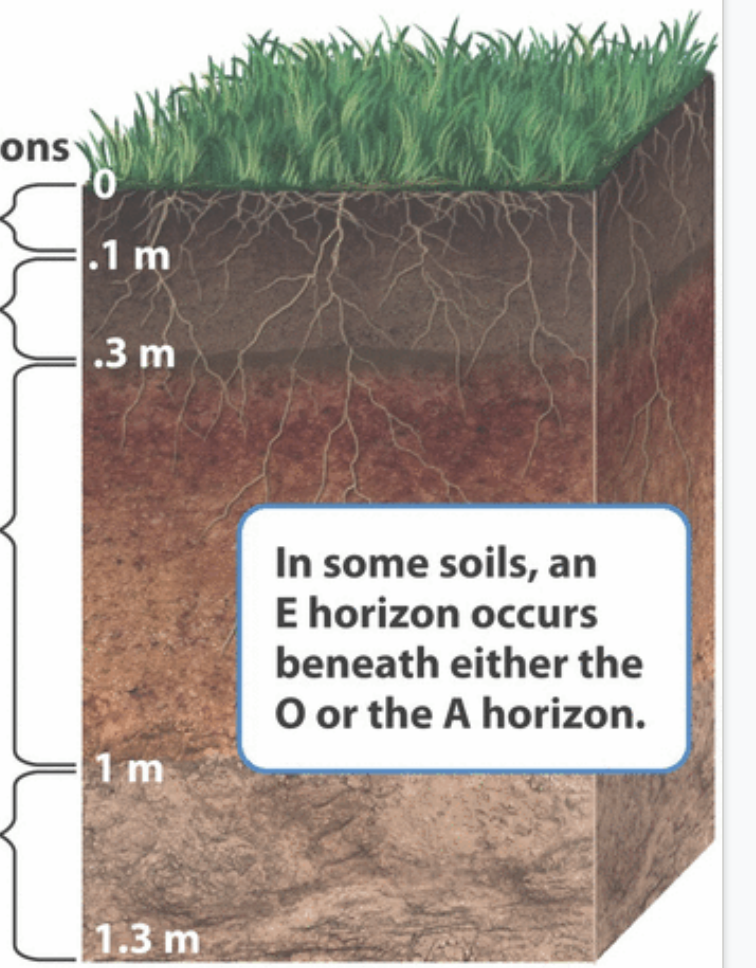
O-Horizon
layer of organic matter (plant roots, dead leaves, animal waste, etc) on top of soil and provides nutrients and limits H2O loss to evaportation
68
New cards
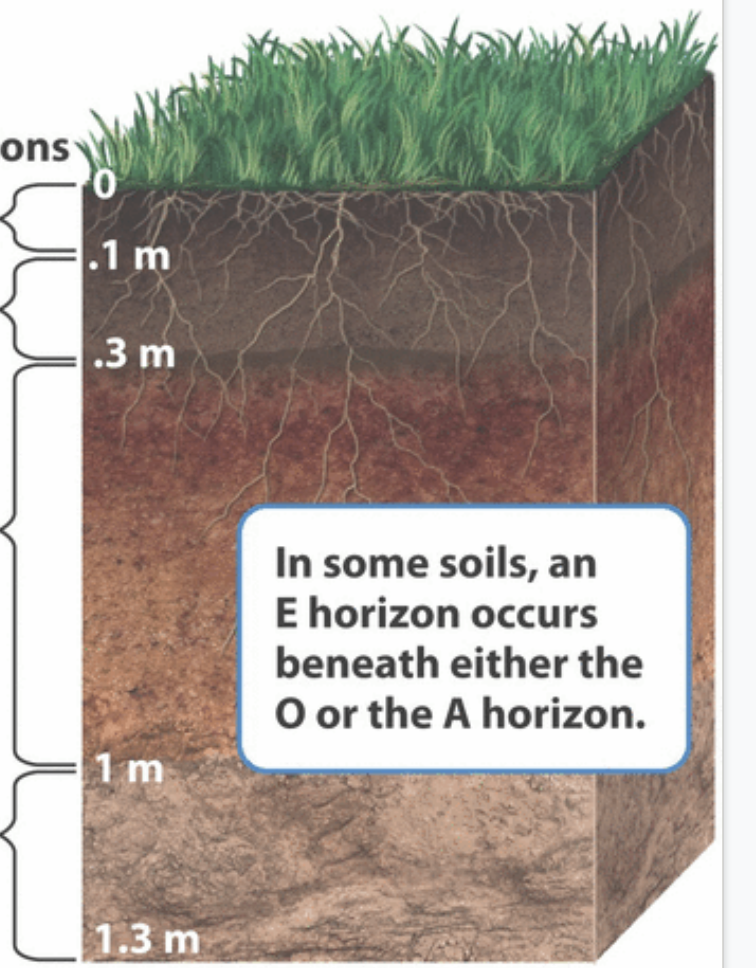
A-Horizon (topsoil)
A-Horizon has most biological activity (earthworms, soil microbes) breaking down organic matter to release nutrients
69
New cards
B-Horizon (subsoil)
lighter layer below topsoil, mostly made of minerals w/little to no org. matter and contains some nutrients
70
New cards
C-Horizon
least weathered soil that is closest to the parent material, sometimes called bedrock
71
New cards
Humus
The most fully decomposed organic matter in the lowest section of the O-Horizon
72
New cards
Where is humus typicially located
A-Horizon/ Topsoil
73
New cards
E-Horizon
Zone of leaching of metals and nutrients; occurs in some soils beneath either the O horizon or the A horizon (found in some acidic soils)
74
New cards
Effects on Soil Form:
Parent material, Topography, Climate, and Organisms
75
New cards
Topography:
steep slope = too much erosion; more level ground = deposition
76
New cards
Climate:
warmer = faster breakdown of org. matter;
more precip. = more weathering, erosion + deposition
more precip. = more weathering, erosion + deposition
77
New cards
Organisms:
Soil organisms like bacteria, fungi, worms breakdown organic matter
78
New cards
Where is O-Horizon?
Top
79
New cards
Where is A-Horizon?
Second
80
New cards
Where is E-Horizon?
Below A, third (sometimes)
81
New cards
Where is B-Horizon?
Third if under A/ fourth if under E
82
New cards
Where is C-Horizon?
bottom
83
New cards
Cation Exchange Capacity (CEC)
The ability of a particular soil to absorb and release cations (amount of clay in soil)
84
New cards
Base Saturation
The proportion of soil bases to soil acids, expressed as a percentage
85
New cards
Soil Permeability
Depends on the soil's texture (clay, sand and silt)
86
New cards
Porosity
The amount of pore space a soil has
87
New cards
Sand
Has the biggest particle size, more porous/higher porosity and low soil permeability
88
New cards
Silt
Mid particle size, mid level of porosity and mid soil permeability
89
New cards
Clay
smallest particle size, low porous/ lower porosity, and high soil permeability
90
New cards
H2O holding Capacity
how well water is retained, or held by a soil
91
New cards
Factors that increase H2O holding capacity
Aerated soil (biological activity)
Compost/humus/organic matter
Clay content
Root structure, especially natives
Compost/humus/organic matter
Clay content
Root structure, especially natives
92
New cards
Factors that decrease H2O holding capacity
Compacted soil (machines, cows)
Topsoil erosion
Sand
Root loss
Topsoil erosion
Sand
Root loss
93
New cards
Factors that increase soil nutrients
Organic matter (releases nutrients)
Humus (holds and releases nutrients)
Decomposer activity (recycles nut.)
Clay (neg. charge binds pos. nutrients)
Bases (Calcium carbonate - limestone)
Humus (holds and releases nutrients)
Decomposer activity (recycles nut.)
Clay (neg. charge binds pos. nutrients)
Bases (Calcium carbonate - limestone)
94
New cards
Factors that decrease soil nutrients
Acids leach pos. charge nutrients
Excessive rain/irr. leeches nutrients
Excessive farming depletes nut.
Topsoil erosion
Excessive rain/irr. leeches nutrients
Excessive farming depletes nut.
Topsoil erosion
95
New cards
How to test soil texture
Let soil settle in jar of water. Measure 3 layers that form (sand, silt, clay)
96
New cards
what soil texture tells about soil
% of sand, silt, and clay - how porous or permeable soil it
97
New cards
How to test soil permeability
Time for H2O to drain through column of soil
98
New cards
what soil permeability tells about soil
How easily water drains through soil. Too high, soil dries out. Too low, roots don’t get water or drown. Medium = optimal
99
New cards
How to test soil pH
pH strip - H+ ion concentration
100
New cards
What pH tells about soil
How acidic (low pH) or basic/alkaline (high pH) soil is. More acidic soil = less nutrient availability