Mammalogy Unit 1 - Biogeography
 Call Kai
 Learn
Learn Practice Test
 Spaced Repetition
 Match
Match Flashcards
 Knowt Play
1/38

There's no tags or description
Looks like no tags are added yet.
Name | Mastery | Learn | Test | Matching | Spaced | Call with Kai | Chat |
|---|
No analytics yet
Send a link to your students to track their progress
39 Terms
Biogeography
The study of causal processes and current distribution of species
Which of these factors do NOT determine the range of a species?
Geologic layers
Endemism
Restriction of a species range

Disjunction
A gap in the range of related species

How many faunal regions are there?
7

Paleartic
Largest Faunal region, Northern Old World (Europe, Asia, Northern Africa and the Middle East). 42 Families, 0 Endemic (Neartic + Paleartic + Holartic)

Neartic
Similar Biomes to Paleartic (North America, Canada, Greenland), 37 families, 2 endemic

Neotropical
Rainforests, Savanna, and Tropical Scrubland (South America), 50 families, 19 endemic. Historically isolated and better climate

Ethiopian
Sahara Desert, Savanna, Scrubland, Tropical Island (Africa, Madagascar) Shares 70% of families with Oriental. 52 families, 18 endemic

Oriental
Consistent climate of Tropical rainforest (India, Middle east, Maylasia) 50 families, 5 endemic. Not isolated
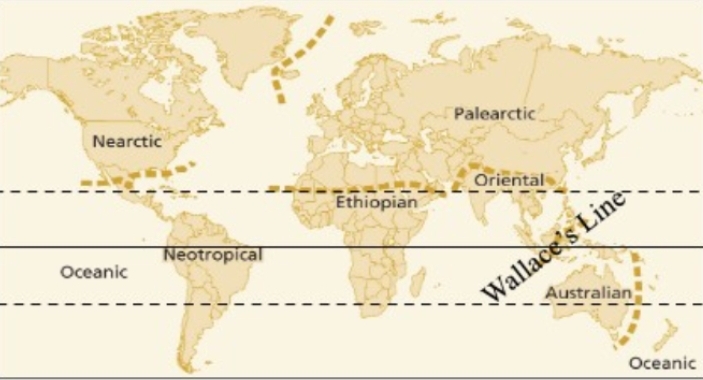
Australian
28 families, 17 endemic. Most isolated for longest time

Oceanic
Includes remote islands, Few native mammals on islands.

Historical Biogeography
Study of changes in species ranges that have taken place over evolutionary time
Evolutionary processes
Speciation, Extinction, Dispersal
Geological processes
Continental drift, climate change
Vicariance
The geographical separation of a population, typically by a physical barrier such as a mountain range or river, resulting in a pair of closely related species.
Continental Drift
Movement of land masses over geologic time
Supercontinent Pangea
Where first synapsids emerged

Laurasia
North America, Europe, Greenland, part of Asia
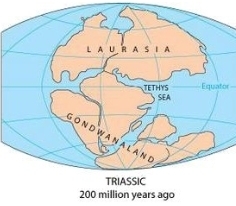
Gondwanaland
Southern continents (South America, Australia, Africa, Antarctica, parts of Asia)

When was the last glacial maximum?
~20,000 years ago
Refugia
Preserve biodiversity during periods of environmental change
Species Dispersal
Extension of species range, not necessarily over a single lifetime
Passive Dispersal
Not under the control of the animal, Human involvement or rafting
Active Dispersal
Under the control of the animal, Accumulation of ecological dispersal events
Corridor routes
Path of least resistance

Filter routes
Adapted species expand distribution, Bering land Bridge (cold), Panamanian land bridge (warm)
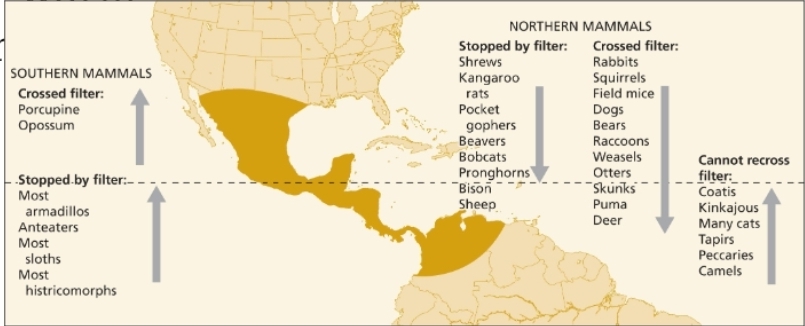
Sweepstakes routes
Most restrictive pathway: Rafting, Hurricanes
Ecological Biogeography focuses on…
How species ranges are influenced by certain factors

Species Richness
The number of species in an area
Insular Gigantism
Smaller mammals on islands tend to be larger than close relatives or ancestors on mainland
Insular dwarfism
Large mammals on islands tend to be smaller than close relatives or ancestors on mainland
Bergmann’s Rule
Body sizes of mammals tend to increase with increasing latitude (Bergmann Body size “BB”)
Large mammals have lower surface to volume raitios
True
Allen’s Rule
Mammals in colder climates have shorter appendages, mammals in warmer climates have longer appendages (Allen Appendages “AA”)
Gloger’s Rule
Pelage and Humidity- Polar bears in the arctic and Grizzlies in the humid tundra/boreal habitats
Rapoport’s rule
Species range increases from equator to poles, increasing climate variability at the poles (Polar species adapt to broader range of environments than tropical) (Rapoport Range “RR”)
Latitudinal gradient
Species diversity decreases from the equator towards the poles
Elevational & Peninsular gradient
The number of species declines towards the terminal end of a peninsula
