Learn: Evolution and Natural Selection: Key Concepts and Darwin's Contributions | Quizlet
 Call Kai
 Learn
Learn Practice Test
 Spaced Repetition
 Match
Match Flashcards
 Knowt Play
1/53

There's no tags or description
Looks like no tags are added yet.
Name | Mastery | Learn | Test | Matching | Spaced | Call with Kai | Chat |
|---|
No analytics yet
Send a link to your students to track their progress
54 Terms
Who is known as the father of evolution?
Charles Darwin
What voyage did Charles Darwin undertake to study natural history?
He sailed on the H.M.S. Beagle from 1831 to 1836.

What is artificial selection?
The process by which humans select traits in organisms, as opposed to natural selection.
What theory did Charles Lyell propose?
Uniformitarianism, which states that current geological processes occur at the same rates as in the past.
What does catastrophism refer to?
The theory that the Earth's surface has been shaped by catastrophic natural disasters.
What is gradualism in geology?
The theory that geological changes occur slowly over time.
What significant observations did Darwin make on the Galapagos Islands?
He observed variations in finch beaks and tortoise shells that corresponded to different food sources and ecosystems.

What was the title of Darwin's book published in 1859?
The Origin of Species
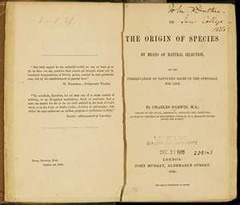
What is the theory of evolution?
The gradual change of a population over time to better suit their environment.
What is natural selection?
A process where individuals with favorable inherited traits are more likely to survive and reproduce.
What are the four requirements for natural selection to occur?
Variation, Adaptation, Heritability, and Competition.
What does 'survival of the fittest' mean?
It refers to the idea that individuals best adapted to their environment are more likely to survive and reproduce.
What is an adaptation?
An inherited characteristic that develops over time in response to environmental factors.
How can environmental pressures affect a population?
They can increase or decrease reproduction by creating competition and changing reproductive advantages.
What happens if a population cannot respond to environmental pressures?
It may become extinct.
What is descent with modification?
The process by which natural selection results in changes in inherited characteristics of a population over time.
Who proposed the theory of use and disuse?
Jean Baptiste Lamarck.
What is the significance of Thomas Malthus's ideas to Darwin?
Malthus proposed that populations outgrow their environments, influencing Darwin's thoughts on competition and survival.
What did Alfred Russel Wallace contribute to evolutionary theory?
He proposed that organisms evolve from common ancestors and almost published his ideas before Darwin.
What is the role of genetic variation in evolution?
It provides the raw material for natural selection to act upon.
What can happen to a population over many generations under natural selection?
It can evolve into a new species if significant changes occur.
What is the fossil record's role in evolution?
It provides evidence for the classification of organisms and their evolutionary history.
What is the relationship between natural selection and fitness?
Natural selection increases the fitness of a population by favoring traits that enhance survival and reproduction.
How does competition affect natural selection?
It creates pressure that can lead to the survival of individuals with advantageous traits.
What is the impact of reproductive strategies on population survival?
Different reproductive strategies can affect the number of offspring and their survival rates in varying environments.
What is the significance of heritability in natural selection?
Only traits that are heritable can be passed on to the next generation, influencing future populations.
What is biological fitness?
The ability to survive to reproductive age, find a mate, and produce offspring.
What does 'descent with modification' imply?
Each species has descended, with changes, from other species over time, suggesting all organisms descended from a common ancestor.
What are the main factors that drive evolution?
Sufficient resources for reproduction, variation in the population, competition for resources, and survival of the fittest.
What is microevolution?
The change in allele frequencies in a population over many generations.
What is an allele frequency?
The ratio of a particular version of a gene to the total of all other versions in the population.
What is a gene pool?
The set of all the alleles within a population.
What are the '5 Fingers' of Evolution?
Mutations, Gene Flow, Sexual Selection, Genetic Drift, Natural Selection.
What is genetic drift?
The change in allele frequencies in a population due to random chance, not natural selection.
What is the founder effect?
Occurs when a few individuals become isolated from a larger population and start a new population, leading to different allele frequencies.
What is the bottleneck effect?
A drastic reduction in population size due to an environmental change, leading to a loss of genetic variation.
What is gene flow?
The movement of alleles into and out of populations through immigration and emigration.
What is sexual selection?
When certain adaptations increase an individual's ability to secure a mate, often leading to sexual dimorphism.
What role do mutations play in evolution?
Mutations introduce new alleles into a population, which are the only source of truly new variation.
What is the Hardy-Weinberg principle?
Allele frequencies in a population remain constant unless influenced by external factors.
What are the five conditions required for Hardy-Weinberg equilibrium?
No mutations, no immigration/emigration, no natural selection, random mating, and a large population.
What does the Hardy-Weinberg equation p + q = 1 represent?
The frequency of the dominant allele (p) plus the frequency of the recessive allele (q) equals 100%.
What does the Hardy-Weinberg equation p² + 2pq + q² = 1 represent?
The frequencies of the three genotypes in a population should equal 100%.
What is heterozygote advantage?
Occurs when heterozygotes have higher fitness than homozygotes, maintaining multiple alleles at a locus.
How does natural selection act on a population?
It favors beneficial alleles, leading to adaptive evolution and increased fitness.
What are the three modes of natural selection?
Directional selection, disruptive selection, and stabilizing selection.
What is directional selection?
Occurs when conditions favor individuals at one end of the phenotypic range.
What is disruptive selection?
Occurs when conditions favor individuals at both extremes of the phenotypic range.
What is stabilizing selection?
Occurs when conditions favor intermediate variants and act against extreme phenotypes.
What is an example of natural selection in action?
The development of DDT resistance in mosquitoes after it was used as an insecticide.
What happens to allele frequencies during genetic drift?
They can change at random, leading to a loss of genetic variation.
Why is genetic drift more significant in small populations?
Smaller populations are more likely to experience random changes in allele frequencies.
What is the significance of mutations in evolution?
They are the only source of truly new genetic variation, essential for evolution.
How does sexual selection lead to sexual dimorphism?
Males and females develop different traits due to competition and mate choice.