GOV 1: Electoral Systems
 Call Kai
 Learn
Learn Practice Test
 Spaced Repetition
 Match
Match Flashcards
 Knowt Play
1/52

There's no tags or description
Looks like no tags are added yet.
Name | Mastery | Learn | Test | Matching | Spaced | Call with Kai | Chat |
|---|
No analytics yet
Send a link to your students to track their progress
53 Terms
What is FPTP?
A plurality electoral system:
The country is divided into single‑member constituencies, and the candidate with the most votes (not always a majority) wins the seat. It is a majoritarian, non‑proportional system.
How does FPTP work?
Voters cast one vote for one candidate
The candidate with the largest share of votes wins
No requirement for 50%+
Produces single‑party governments due to seat bonuses e.g 2024 Labour won 34% of vote share but got 63% of seat share
What are the pros of FPTP?
Single-party majorities: This reduces coalition instability & allows more decisive policy making e.g 2024 Labour 34% VS 63%
Clear constituency link: Each MP should embody their constituents’ needs e.g 2024 Leicester South elected Bhupen Dave as their new MP after local campaigning focused on NHS access
Simplicity: Voters understand FPTP = ballot spoilage is low e.g 2019 GE had 0.4% of spoiled ballots (Electoral Commission) and 2024 GE had 0.5%
Excludes extremist parties: Plurality systems disadvantage small, extreme parties e.g 2024 Reform won 14% of vote share VS 0.8% seat share
What are the cons of FPTP?
Disproportional outcomes: Seats rarely match the vote share e.g 2026 local elections gave Tories 21% vote share VS 16% seat share & Labour 18% vote share VS 21% seat share
Wasted votes: These are votes cast for losing candidates or surplus votes for winners that DONT affect the result e.g Electoral Reform Society estimated 22 million wasted votes in 2019 GE
Safe seats & voter apathy: Many constituencies rarely change sides, reducing competitiveness e.g Liverpool Walton produced a 70% Labour majority (voted for Labour since 1964) & a 2023 YouGov polling found 41% of voters feel their vote “does not matter” due to safe seats.
Tactical voting: Voters choose “least bad” option e.g 2024 tactical voting surged in Canterbury, Wimbledon, Finchley & Golders Green to block Conservatives
What is AMS?
Hybrid electoral system
Combines FPTP constituency seats & regional list seats
Allocated proportionally (D’Hondt formula)
Used in Scotland, Wales and London Assembly
How does AMS work?
Two votes:
Constituency vote (a person) & uses FPTP system
Regional list vote (political party) & is proportional to votes
List seats compensate parties under‑represented in constituencies
Produces more proportional outcomes than FPTP
What are the pros of AMS?
More proportional: List seats correct distortions e.g 2021 Scotland had the Greens win 8 list seats despite 0 constituency seats
Maintains constituency link: The majority of MSPs are have a “local link” e.g 2026 SGE = out of 129 seats in Scottish Parliament, 73 seats were won directly through the local constituency ballot
Better representation of smaller parties: Greens + Plaid gain seats via lists & sometimes through constituencies e.g 2026 SGE = Scottish Greens won their first-ever constituency seats, including high-profile co-leader Lorna Slater winning Edinburgh Central
Limits dominance: Prevents overwhelming majorities e.g SNP only achieved outright majority once e.g 2021 Scottish Parliament = SNP dominated local areas & won 62 out of the 73 available constituency seats but AMS gave them 64 seats total—exactly 1 seat short of an absolute majority. Because AMS stopped the SNP at 64 seats, they could not pass laws or budgets completely on their own. They were forced to cooperate with the Scottish Greens to form a majority coalition = must work with other parties
What are the cons of AMS?
Two types of representatives: Creates tension between constituency MSPs + list MSPs → list MSPs seen as less accountable e.g 2021 Lothian region clash when constituency MSPs (SNP) criticised list MSPs (Conservatives & Greens) for: intervening in local issues they were “not elected to represent”
More complex: Two votes + D’Hondt → higher spoilage e.g 2022 Scottish local elections had 5.64% of ballots rejected in the Glasgow Canal ward
Coalition/minority govts common: Less decisive policymaking e.g The Royal Society of Edinburgh’s 2026 report Policy in practice: How Scotland can get it right states “Ambition is not in short supply, but Scotland must improve how decisions are made and how trade‑offs are handled.”
Tactical list voting: Voters split ballots strategically e.g 2026 “SNP constituency, Green list” trend in Scotland
What is STV?
Proportional preferential voting system
Voters rank candidates
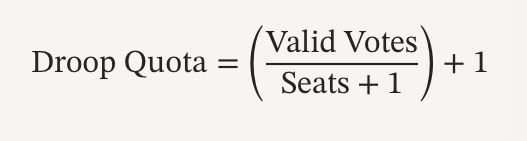
Seats are allocated using Droop quota + vote transfers
This reflects voter preferences more accurately
How does STV work?
Voters rank candidates (1, 2, 3…)
Candidates must reach the Droop quota =
Surplus votes transferred to next preferences
Lowest candidates eliminated → votes redistributed
Continues until all seats filled
What are the pros of STV?
Highly proportional:Seat share closely matches vote share e.g 2022 NI Assembly → Sinn Féin 29% vote VS 27 seats; DUP 21% VS 25 seats
Maximises voter choice: Voters choose between candidates within parties e.g 2022 NI voters often rank SDLP → Alliance → Greens. So SDLP voters often give their lower‑preference transfers to parties with similar moderate, non‑sectarian values.
Reduces wasted votes: Transfers ensure most votes help elect someone e.g Electoral Office for Northern Ireland (EONI) found only around 1.8% of ballots became exhausted (failed to help elect someone) in 2022 NI Assembly election
Encourages moderation: Candidates cant win by just getting first preference votes they need to get 2nd, 3rd and 4th preferences to reach Droop quota = centrist & non sectarian parties gain lots of transfer votes e.g Alliance gained many transfers in 2022 (13.5% vote → 17 seats)
What are the cons of STV?
Complex counting: Results take longer e.g NI 2022 count lasted two days (5th - 7th May 2022)
Weak constituency link: STV uses 3 - 5 member wards with multiple councillors = cannot easily identify “their” representative e.g 2024–2026 Scottish Local Governance Review states that multi‑member wards creates “confusion over who represents whom”
Intra‑party competition: Candidates from same party compete for preferences e.g 2024 study in Social Choice and Welfare found STV promotes strategic behaviour among candidates from the same party
Coalition govts inevitable: NI Executive always power‑sharing due to proportionality + Good Friday Agreement between unionists and nationalists e.g Since 1998 implementation
What is SV?
A majoritarian preferential system
Voters cast a 1st and 2nd choice
How does SV work?
Voters mark 1st + 2nd preference
If no candidate gets 50%+ → only top two remain
Second preferences for those two are added up
Winner usually ends with a majority after transfers
What are the pros of SV?
Ensures broad support: Winner usually gets 50%+ after transfers e.g 2021 London Mayor → Sadiq Khan won with 55.2%
Reduces extremist success: Extremist candidates rarely reach top two
Simple preferential system: Easier than STV
What are the cons of SV?
Many votes don’t count: If 2nd preference isn’t for top two = they’re discarded e.g London 2021 had 5% wasted second preferences
Still disproportional: Only elects one winner → not proportional
Tactical voting: Voters choose “safe” second preferences
Abolished in 2024: Govt replaced SV with FPTP for mayors due to voter confusion
How does FPTP compare to AMS (5 points)?
Representation:
FPTP → highly disproportional e.g 2024 GE: Reform UK won 14% vote VS 0.8% seat share (5 seats)
AMS → more proportional e.g 2021 Scotland: Greens won 8 seats via list vote despite limited constituency wins
Government formation:
FPTP → majority govt common e.g 2024 GE: Labour formed a majority with 34% vote share
AMS → minority/coalition govts common e.g 2016–2021 Scotland: SNP governed as a minority; 2021 Wales: Labour relied on Plaid cooperation agreement
Voter choice:
FPTP → one vote, limited choice e.g YouGov 2023: 41% of voters felt their vote “does not matter” in safe seats
AMS → two votes, more nuanced e.g 2021 Scotland: widespread split‑ticket voting (SNP constituency + Green list)
Party system:
FPTP → two‑party dominance e.g 2024 GE: Labour + Conservatives won ~75% of all seats combined
AMS → multi‑party representation e.g 2021 Scotland: Greens + Alba + Lib Dems all gained representation through list seats
Accountability:
FPTP → strong constituency link e.g 2024 Leicester South: MP replaced due to NHS‑focused local campaigning
AMS → dual accountability e.g 2021 Scotland: voters represented by 1 constituency MSP + multiple regional MSPs
1997 Scotland Devolution
Turnout: 60%
Q1: Should Scotland have a Parliament?
Yes: 74%
No: 26%
Q2: Should it have tax‑varying powers?
Yes: 64%
No: 37%
Unique constitutional significance:
Created the Scottish Parliament (opened 1999).
Gave Scotland primary legislative powers.
1997 Wales Devolution
“Do you agree that there should be a Welsh Assembly as proposed by the Government?”
Turnout: 50.1%
Result:
Yes: 50.3%
No: 49.7%
Unique constitutional significance:
Created the Welsh Assembly (now Senedd Cymru).
Extremely narrow result → weaker initial mandate.
2025 YouGov polling: 58% support further devolution
1998 Good Friday Agreement
Turnout: 81%
Result:
Yes: 71%
No: 29%
Unique constitutional significance:
Created the Northern Ireland Assembly using STV.
Established mandatory power‑sharing between unionists and nationalists.
1998 London Mayor & Assembly
Turnout: 34%
Result:
Yes: 72%
No: 28%
Unique constitutional significance:
Created the Greater London Authority, London Assembly, and Mayor of London.
First major elected executive position outside Westminster.
Introduced the Supplementary Vote (SV) system for mayoral elections.
Sir Sadiq Khan took office as mayor on 9 May 2016, and was re-elected in 2021 and 2024
2004 North East Regional Assembly
Should there be an elected assembly for the North East region?
Turnout: 48%
Result:
Yes: 22%
No: 78%
Unique constitutional significance:
Rejected plans for English regional devolution.
Ended Labour’s attempt to create elected regional assemblies in England.
Contemporary relevance:
Influences current debates on English devolution and mayoral combined authorities (2020–2026)
2011 AV Electoral Reform
Turnout: 42%
Result:
Yes: 32%
No: 68%
Unique constitutional significance:
Rejected replacing First‑Past‑the‑Post with Alternative Vote.
Showed low public understanding of electoral systems (YouGov 2011: only 15% understood AV well).
Contemporary relevance:
Electoral reform remains a major issue (2020–2026).
2024 YouGov: 52% support PR for Westminster.
2014 Scottish Independence
Turnout: 84.6% (highest in UK modern history)
Result:
Yes (Independence): 44.7%
No (Remain in UK): 55.3%
Unique constitutional significance:
Confirmed Scotland’s place in the UK (at the time).
Triggered further devolution (Smith Commission).
Established precedent for independence referendums.
Demonstrated extremely high public engagement.
Contemporary relevance:
2024–2026 polling shows support fluctuating around 48–52%.
Central to Scottish politics and UK territorial debates.
2016 EU Membership (Brexit)
Turnout: 72.2%
Result:
Remain: 48.1%
Leave: 51.9%
Unique constitutional significance:
Largest democratic event in UK history (33.5 million votes).
UK left the EU in January 2020.
Triggered major constitutional, economic, and political change.
Redefined UK trade, borders, immigration, and foreign policy.
Created long‑term political realignment (e.g Red Wall).
Contemporary relevance:
2023–2026 ONS data shows ongoing economic impacts.
2024 YouGov: 57% say Brexit “has not delivered expected benefits.”
Continues to shape party politics and NI constitutional debates.
How have referendums been used in the UK since 1997?
Referendums have been used to decide major constitutional questions that governments consider too significant or politically divisive to resolve through Parliament alone. Since 1997, the UK has used referendums for:
Devolution (Scotland, Wales, Northern Ireland)
Electoral reform
Independence
European Union membership
Local governance structures
London-wide institutions
How have referendums changed the UK constitution?
Referendums have driven territorial and constitutional transformation:
Scotland, Wales, and Northern Ireland gained devolved institutions.
London gained a directly elected mayor.
Brexit fundamentally altered the UK’s constitutional relationship with Europe.
Contemporary evidence:
2024 YouGov poll: 61% of Scots believe devolution has made Scotland “more politically distinct.”
2025 ONS trade data shows continued post‑Brexit divergence in trade flows (fall behind trade with countries)
How have referendums affected public participation?
Referendums have increased public engagement in major decisions:
2014 Scottish Independence turnout: 84.6% (highest in modern UK history).
2016 EU referendum turnout: 72.2% (Electoral Commission).
Contemporary evidence:
2023 YouGov survey: 58% of UK adults say referendums make them feel “more involved” in politics.
2025 Electoral Commission report: younger voters (18–24) show higher turnout in referendums than general elections
How have referendums influenced party politics?
Referendums have exposed and deepened party divisions:
Labour split on devolution (1997–2004).
Conservatives split on Europe & Brexit (1997–2016 and beyond).
SNP’s identity shaped by independence referendums.
NI parties shaped by Good Friday Agreement consent mechanisms.
Contemporary evidence:
2024 Conservative leadership contest centred on post‑Brexit strategy.
2026 Scottish Parliament polling shows independence remains a defining cleavage
How have referendums affected government stability?
Referendums have produced long‑term political consequences:
Brexit led to four changes of Prime Minister (2016–2022) = instability.
Scottish independence remains a live constitutional issue.
NI governance remains tied to referendum‑based consent.
Contemporary evidence:
2023 Windsor Framework reaffirmed NI’s consent mechanism (possible future border poll).
2026 Institute for Government report: referendums create “long‑tail constitutional consequences.”
Case FOR referendums in a representative democracy:
Legitimacy
They provide direct public approval for major constitutional changes.
Contemporary evidence:
2024 YouGov poll: 67% say constitutional changes should require a referendum.
2021 Bristol referendum legitimised abolition of the mayoral system.
Case FOR referendums in a representative democracy:
Party issues
They settle disputes Parliament cannot resolve internally.
Examples:
Labour split on devolution = 1997 referendums.
Coalition split on electoral reform = 2011 AV referendum.
Conservative split on Europe = 2016 EU referendum.
Case FOR referendums in a representative democracy:
Political participation
They produce higher turnout and engagement due to high media coverage and national debates.
Contemporary stats:
2014 Scotland: 84.6% turnout
2016 EU: 72.2% turnout
2023 YouGov: 58% feel referendums increase involvement
Case FOR referendums in a representative democracy:
Educating
Campaigns increase public awareness of constitutional issues.
Contemporary evidence:
2024 Electoral Commission survey: 71% felt “well informed” during the Scottish independence debate.
Case AGAINST referendums in a representative democracy:
Simplicity
They reduce complex questions to binary choices.
Contemporary evidence:
2020–2026 Brexit negotiations showed long‑term complexity not captured by a Yes/No vote.
2024 Institute for Government report: referendums “oversimplify multi‑layered constitutional issues.”
Case AGAINST referendums in a representative democracy:
Parliamentary sovereignty
They constrain Parliament’s ability to revise or interpret outcomes. Although referendums are not legally binding, the resulting public pressure makes it politically difficult for lawmakers to ignore the result.
Contemporary evidence:
2020–2026 Brexit legislation repeatedly cited the “will of the people” to override parliamentary objections.
Case AGAINST referendums in a representative democracy:
Emotional voting
Campaigns can become polarised or misleading, creating fear, anger or an “us VS them” agenda to influence the electorate’s feelings = vote based on their emotional reaction to candidates rather than considering the intricate politics of the matter
Contemporary evidence:
2023 Electoral Commission report criticised misinformation in online referendum debates.
2026 YouGov poll: 49% believe referendums “encourage emotional rather than informed voting.”
Case AGAINST referendums in a representative democracy:
Instability
Outcomes can trigger years of long-term political conflict.
Contemporary evidence:
Brexit’s long‑tail effects (trade, borders, NI Protocol).
Ongoing Scottish independence debate (2020–2026).
NI border poll discussions.
What system does Westminister use and why?
FPTP
Historical continuity — used since 1885; familiar and simple.
Produces clear single‑party governments → seen as promoting strong, stable executive power.
Clear constituency link → one MP per area.
Favours large parties → supports two‑party competition.
2024 GE gave Labour a large majority on 33.7% of the vote (Electoral Commission)
What system does the Senedd use and why?
AMS
Designed to produce proportional representation while retaining local constituency MSPs/MSs.
Prevents dominance by one party → encourages consensus politics.
Balances local accountability with fairer seat distribution.
2021 Scotland → SNP won 40% of votes but only 47.7% of seats, preventing a majority = prevents single-party dictatorship
What system does the NI Assembly use and why?
STV
STV is required by the Good Friday Agreement to ensure cross‑community representation.
Votes can transfer from eliminated candidates or surplus votes, rather than simply becoming wasted.
Highly proportional → ensures unionist, nationalist, and “other” parties gain fair representation.
Encourages moderation through lower‑preference transfers.
2022 NI → Alliance gained 17 seats on 13.5% of first‑preferences due to transfers = shows voters’ lower preferences matter
What systems have mayors and PCCs used and why?
SV (pre‑2024) ensured mayors had broad support via second preferences.
FPTP (post‑2024) adopted to simplify counting and reduce cost.
2024 London mayoral election used FPTP for the first time but Sir Sadiq Khan still won
What type of government does FPTP appoint?
Produces single-party majority governments even on modest vote shares.
Encourages decisive policymaking but can distort representation.
2024 GE → Labour majority on 33.7% vote share
What type of government does AMS appoint?
More proportional → harder for one party to win outright.
Encourages coalitions or minority governments (confidence‑and‑supply agreements).
2021 Scotland → SNP minority government
What type of government does STV appoint?
Creates mandatory coalition governments (Northern Ireland)
Good Friday Agreement requires power‑sharing between largest unionist & nationalist parties.
Highly proportional → no single party can dominate.
1998–2026 → every NI Executive has been a coalition.
2024 NI restoration → Sinn Féin's Michelle O'Neill became First Minister & DUP's Emma Little-Pengelly became deputy First Minister = STV's multi-party representation = coalitions between nationalist and unionist parties.
How representational is FPTP?
Disproportionate outcomes
Over‑represents large parties; under‑represents smaller ones.
Creates two‑party dominance.
2024 GE → Reform UK won 14% of vote but only 5 seats. Greens won 7% but only 4 seats.
How representational is AMS?
More proportional representation
List seats correct constituency distortions.
Smaller parties gain representation (Greens, Lib Dems)
2021 Scotland → Greens gained 8 seats on 8% vote.
How representational is STV?
Highly proportional representation, multi‑party representation
Better for smaller and cross‑community parties.
Helps moderate, centrist parties through transfers
2022 NI → Alliance gained 17 seats on 13.5% vote.
How representational is SV/FPTP for mayors?
Not proportional
Winner‑takes‑all → only one party represented.
SV allowed broader support; FPTP may reduce representativeness.
2024 London → single executive despite multi‑party vote.
How does FPTP impact voter choice?
Limited voter choice
Encourages tactical voting.
Many votes are wasted (Electoral Commission: millions wasted in 2024 GE).
2024 YouGov → 41% voted tactically
Electoral Commission: millions wasted in 2024 GE
How does AMS impact voter choice?
Mixed voter choice
Voters cast two votes: one for constituency, one for party list.
Reduces tactical voting but still limits choice in constituency ballot.
2021 Scotland → 32% of voters chose different parties on their two ballots (YouGov).
How does STV impact voter choice?
Voters rank candidates → reduces wasted votes.
Encourages voting for smaller parties without fear of “splitting the vote” (accidentally & unintentionally benefitting a larger party you don’t like by voting for a smaller party = wasted votes)
2022 NI → only 1.8% of ballots exhausted (EONI).
How does SV/FPTP for mayors impact voter choice?
SV allowed voters to express two preferences.
FPTP reduces choice to one vote, increasing tactical voting.
2024 London → This was the first time FPTP was used & resulted i. Sadiq Kahn only needing 43% of the vote to win = concerns about legitimacy under FPTP.