Week 3 NRS 504: Medication Rights, Routes, Urinary Elimination, Bowl Elimination
 Call Kai
 Learn
Learn Practice Test
 Spaced Repetition
 Match
Match Flashcards
 Knowt Play
1/170

Earn XP
Description and Tags
Medication administration & routes Medication safety/errors Urinary elimination UTIs & CAUTIs Urinalysis Bowel elimination Bowel diversions/ostomies
Name | Mastery | Learn | Test | Matching | Spaced | Call with Kai | Chat |
|---|
No analytics yet
Send a link to your students to track their progress
171 Terms
What are the 7 rights of medication safety?
Right patient
Right drug
Right dose
Right route
Right time
Right documentation
Right indication
What are the main enteral routes?
PO (by mouth), NG, and GT
What does “enteral”mean?
Medication passes through the GI tract
What are the major contraindications to enteral medications administration?
NPO, difficulty swallowing, decreased level of consciousness, gastric suction, risk of aspiration, severe vomiting, bowel obstruction, and lack of bowel function.
Why would you not give an enteral medication to someone who has gastric suctioning?
Gastric suctions may destroy some medications
Why do enteral medications generally have a slower onset?
They must pass through the GI tract before being absorbed: Mouth → esophagus → stomach → small intestine (mainly absorbed)
What should the nurse assess before giving an oral pill?
Can the patient swallow, whether the pill should be given with food or on an empty stomach, and whether it is safe for patient to swallow without aspirating
What position should a patient generally be in when taking oral medications
Sitting upright (45 degrees)
Why should you monitor a patient while they take oral medications?
To monitor for choking and aspirations
What type of medication should NOT be chewed?
Extended-release medications
How should pills generally be given?
One pill at a time
What is a Nasogastric tube (NG)?
A tube inserted down the nare (nose) → esophagus → stomach
What are two purposes of an NG tube?
Supplement feeding/full feeds
Draining of stomach contents → gastric suction to relieve pressure or remove posions
Where does an NJ tube terminate?
In the jejunum of the small intestine
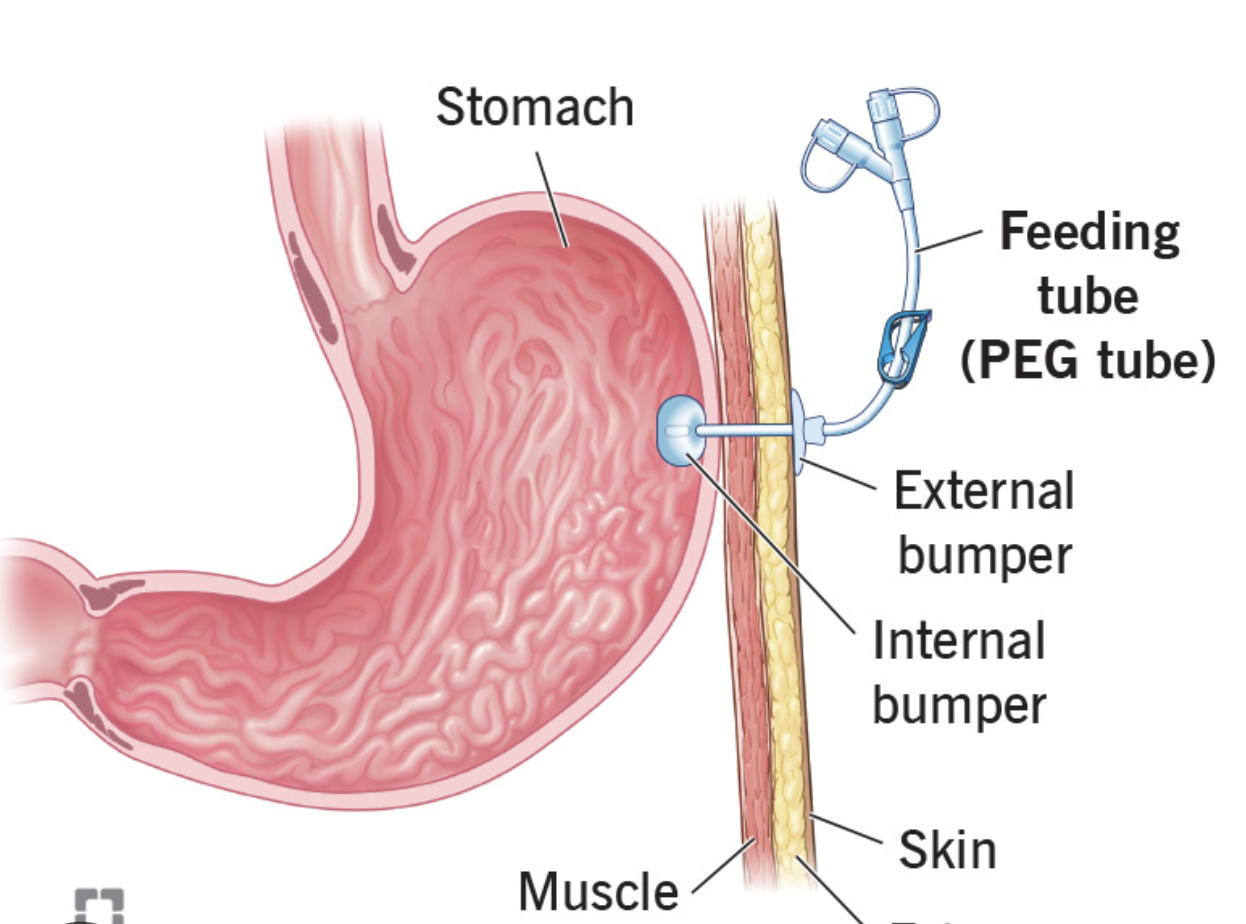
What is a gastrostomy tube (G)?
A tube inserted into a surgical opening (stoma) into the stomach; primarily used for long-term
How are NG tubes inserted?
Identify the patient, hand hygiene, and clean gloves
Position patient in Fowlers position
Measure tubing from the bridge of the nose to the earlobe then to the xiphoid process
Flex head and insert tube via nose → esophagus → stomach
How does a nurse ensure that a NG tube is inserted into the stomach?
Aspirate the stomach contents
Check pH of aspirate (< 5pH)
What is a PEG tube?
A specific method used to insert a G-tube, requiring a shorter tube and placed with an endoscope
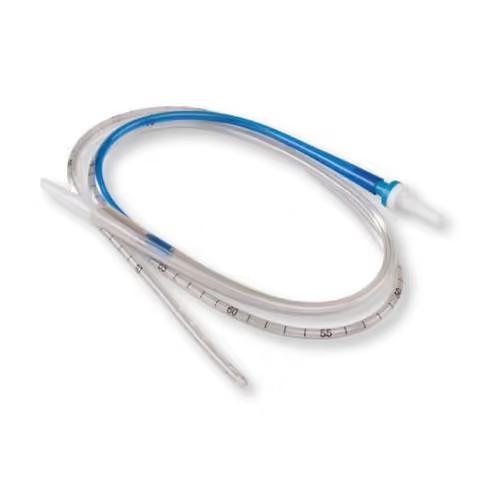
What is a Salem sump tube?
A specialized double lumen NG tube that helps to remove fluid and gas; measures output replacement
What does parenteral mean?
Administration of medication by injection into bodily tissue
What are common parenteral routes?
IV, IM, SQ, ID
Which medication route provides fastest delievery?
IV
Why is IV administration the fastest route?
Medication delivered directly into the bloodstream
What is an IV bolus?
A large amount of fluid is given over a short period, usually about 1 hour
Why would a nurse use an IV bolus?
Rehydration and to give concentrated medications
What is an Intermittent IV?
Delivers medications at scheduled times; IV push or piggyback IV or Saline/Heparin lock
What are continuous infusion?
Delivers medications over a long-period (24 hours); used for maintenance fluids
What are important considerations with handling needles?
Use safety needles
Minimize distractions
Put needles in a needle container
Never recap
As a nurse, you want to treat everyone as if they have an infectious disease to ensure your safety and the safety of others
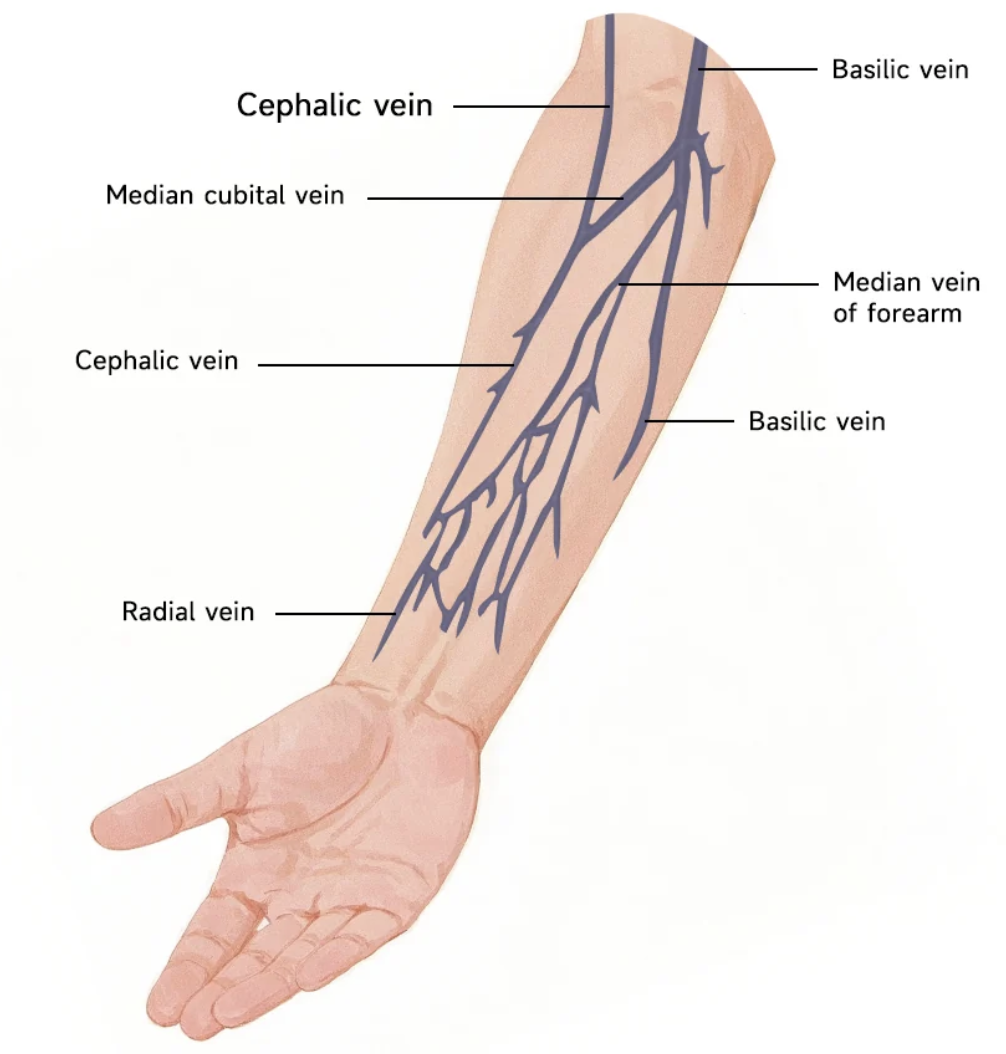
What are common IV sites in adults?
Cephalic vein
Median cubital vein
Median vein of forearm
Radial vein
Basilic vein
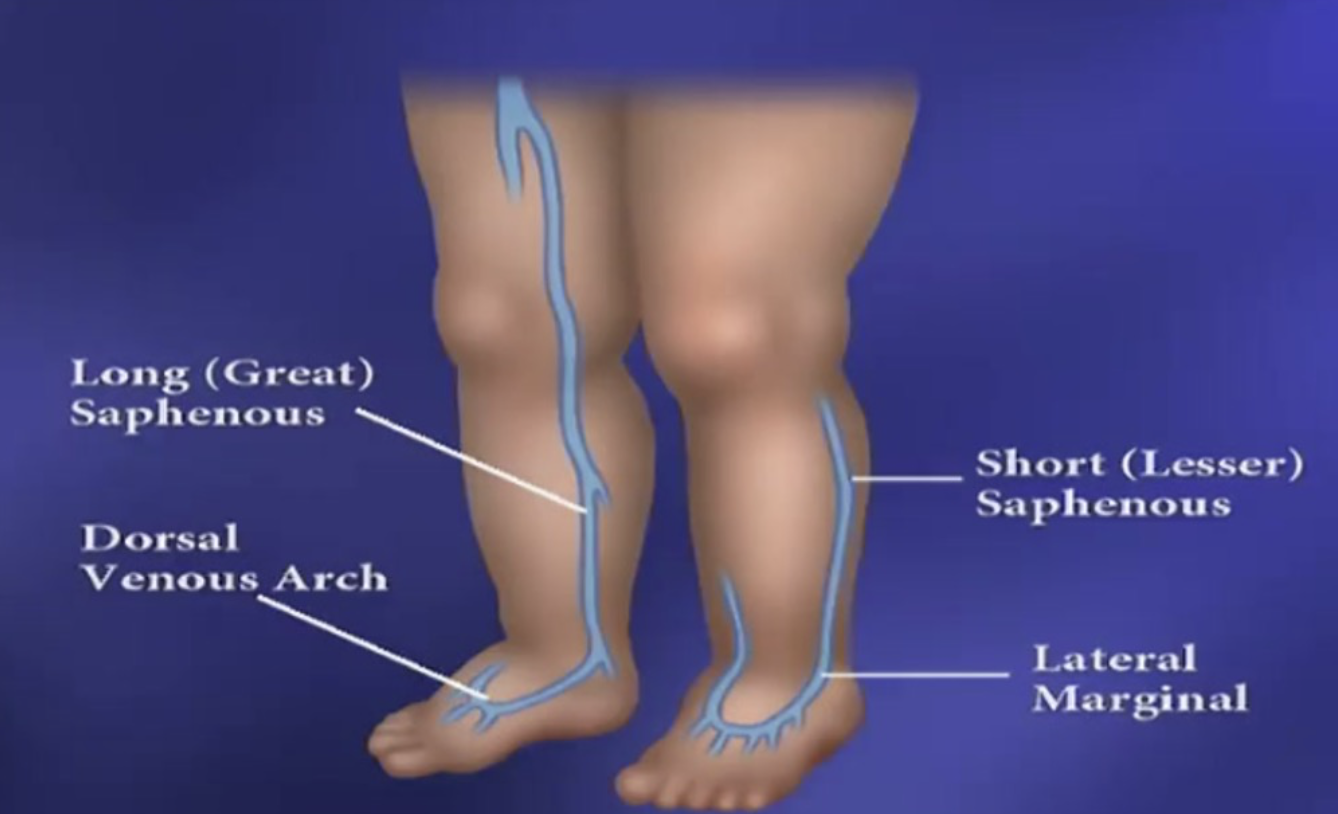
What is a common IV site for pediatrics?
Long (great) Saphenous
What are contraindications for IV?
Risk of introducing infection
Patients may experience pain with repeated needle sticks
Risk of tissue damage
May cause anxiety in many patients, especially children
How does IM absorption compare with IV?
IM is slower than IV
What are the risks associated with IM injections?
Risks for hematoma, infection, nerve injury, and vessel injury
Define intramuscular route
Delivery of medication into muscle tissue; absorbs into the bloodstream
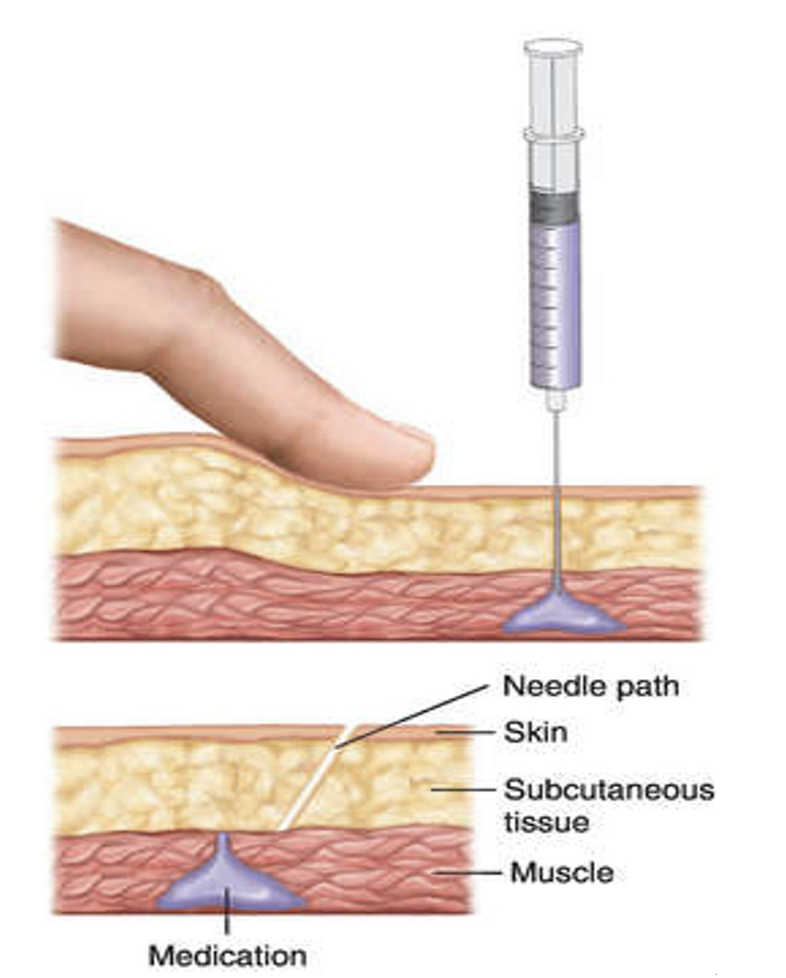
What is the purpose of the Z-track method?
To prevent medication from leaking into tissue and keep the medication sealed in the muscle for better absorption
At what angle is an IM injection administered using the Z-track method?
90°
What is the safest IM injection site?
Ventrogluteal; ideal for all ages and large volumes of medications
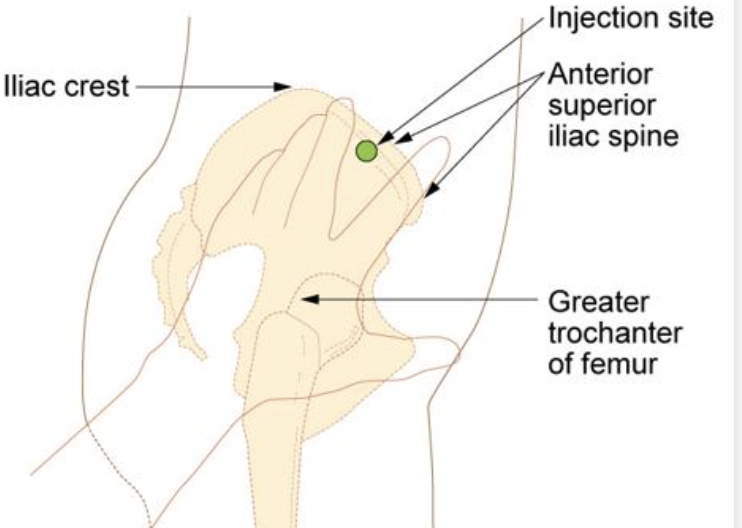
Why is the Ventrogluteal site ideal?
Away from major nerves and arteries
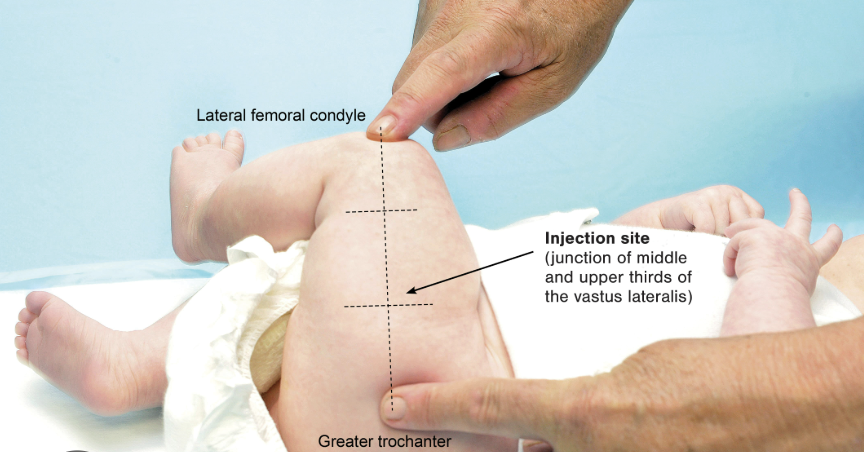
Which IM site is commonly used in children?
Vastus Lateralis: Well developed and thick
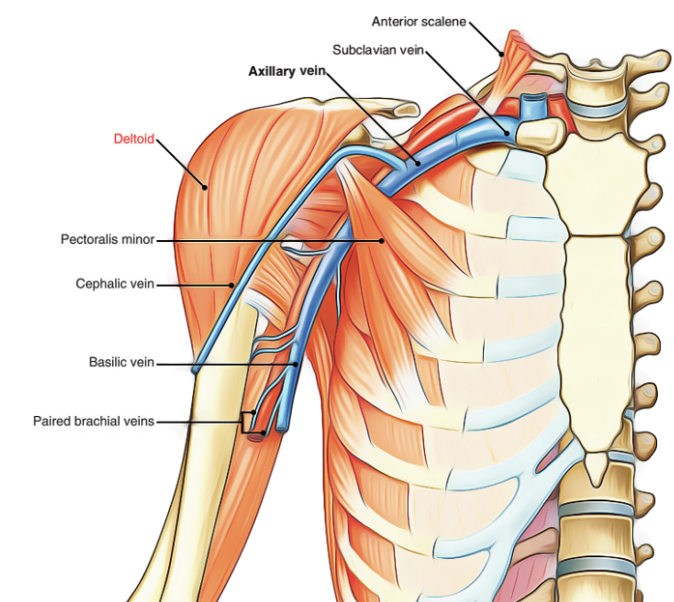
Why are smaller volumes used in the deltoid?
The deltoid is less developed and has multiple nerves and arteries.
Is the dorsogluteal site recommended?
No. It is no longer recommended.
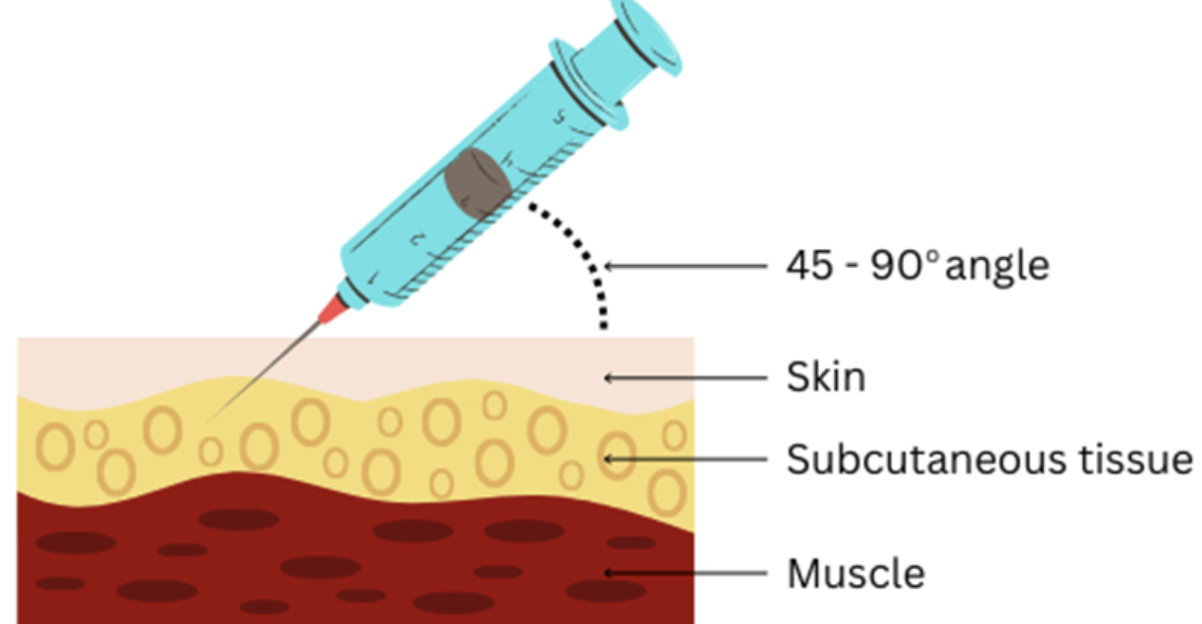
Where is subcutaneous tissue located?
Beneath the dermis but above muscle.
How does SQ absorption compare with IM?
SQ absorbs more slowly than IM.
What medications are commonly administered SQ?
Anticoagulants and insulin
At what angles can SQ medications be administered?
45° or 90°.
What is the intradermal route primarily used for?
TB skin testing and allergy testing.
Where is an intradermal medication delivered?
Just beneath the epidermis.
At what angle is an intradermal injection administered?
5–15°.
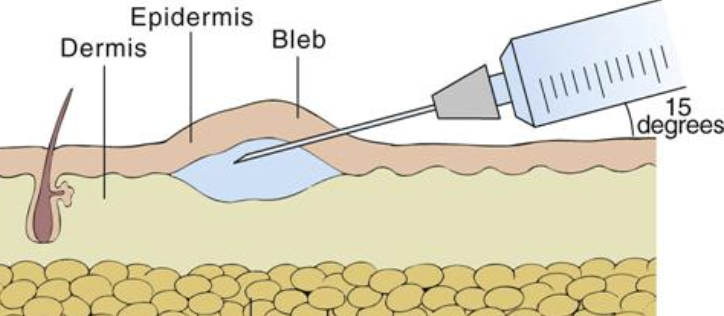
What characteristic does an intradermal injection create?
A bleb.
How quickly are intradermal medications absorbed?
Slowly
Where are topical medications applied according to the slides?
To intact skin
What should you use when handling topical medications?
Gloves because it prevents the medication being absorbed in the nurses skin
What should you do before applying a new medication patch?
Remove the old patch because medication can remain in the old patch even after the intended duration, increasing the risk for overdose (e.g., Fentanyl patch)
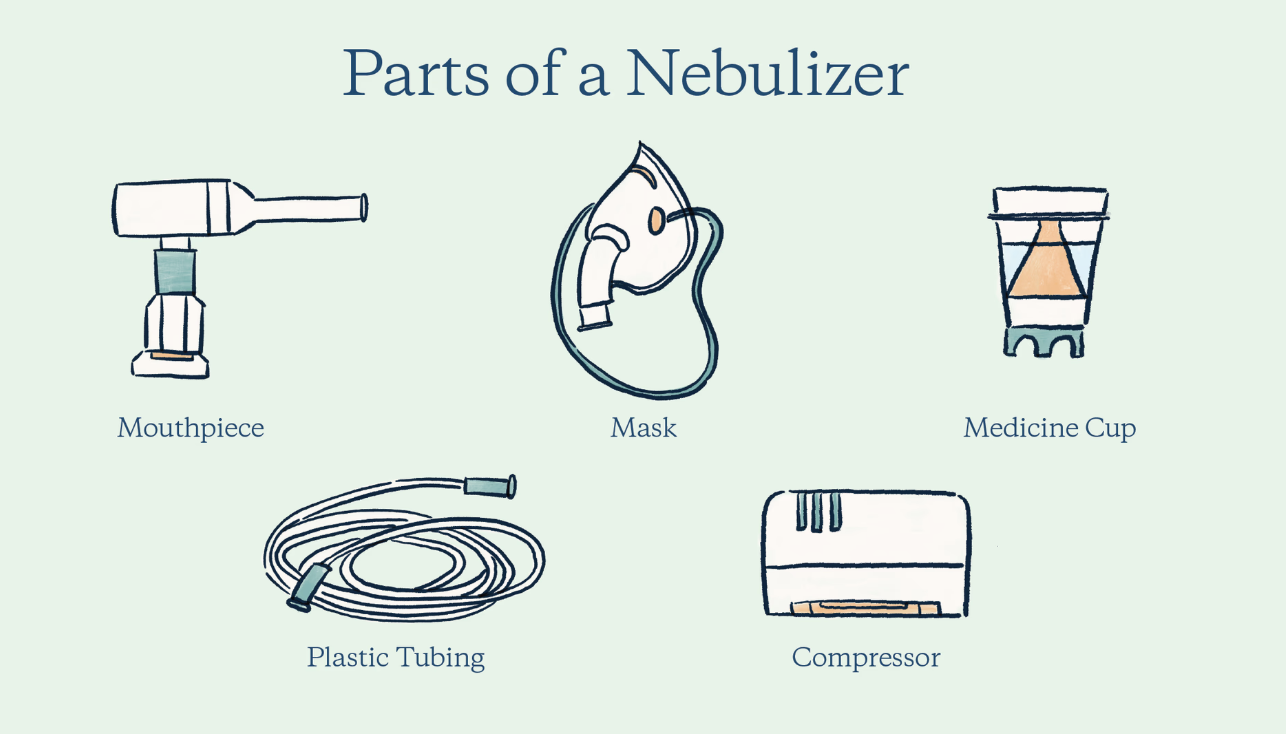
What does a nebulizer do?
Converts liquid medication into a fine mist that can be inhaled.
Where do nebulized medications travel?
Directly into the lungs
What can be used to deliver nebulized medication?
A mouthpiece or mask.
How quickly are inhaled medications absorbed?
Absorbed rapidly because of the rich vascular alveolar capillary network in the pulmonary tissue

What is an Metered Dose Inhalar (MDI)?
A small pressurized device that delivers a prescribed amount of medication for inhalation.
What makes an MDI more effective?
Using a spacer; important to educate patient on how to use a spacer to receive full effect
What is one advantage of an MDI?
It is pocket-sized, discreet, and convenient for travel.
What are some causes of medication errors listed in the slides?
Prescribing errors, communication/handwriting problems, wrong drug selected from a dropdown menu, similarly named drugs, similar packaging, weight/dosage errors, and human error.
Why can similarly named medications be dangerous?
They can be mistaken for one another, resulting in the wrong medication being administered.
Why can similar medication packaging contribute to errors?
The nurse may select the wrong medication because the packages look alike.
What is the purpose of urination?
To eliminate waste products of metabolism.
What is normal adult urine output according to the slides?
30 mL/hr.
What are urination, voiding, and micturition?
Terms that are often used interchangeably to describe a person peeing
What system is involved in micturition?
The central nervous system sends signals involved in bladder and urinary sphincter contraction/relaxation.
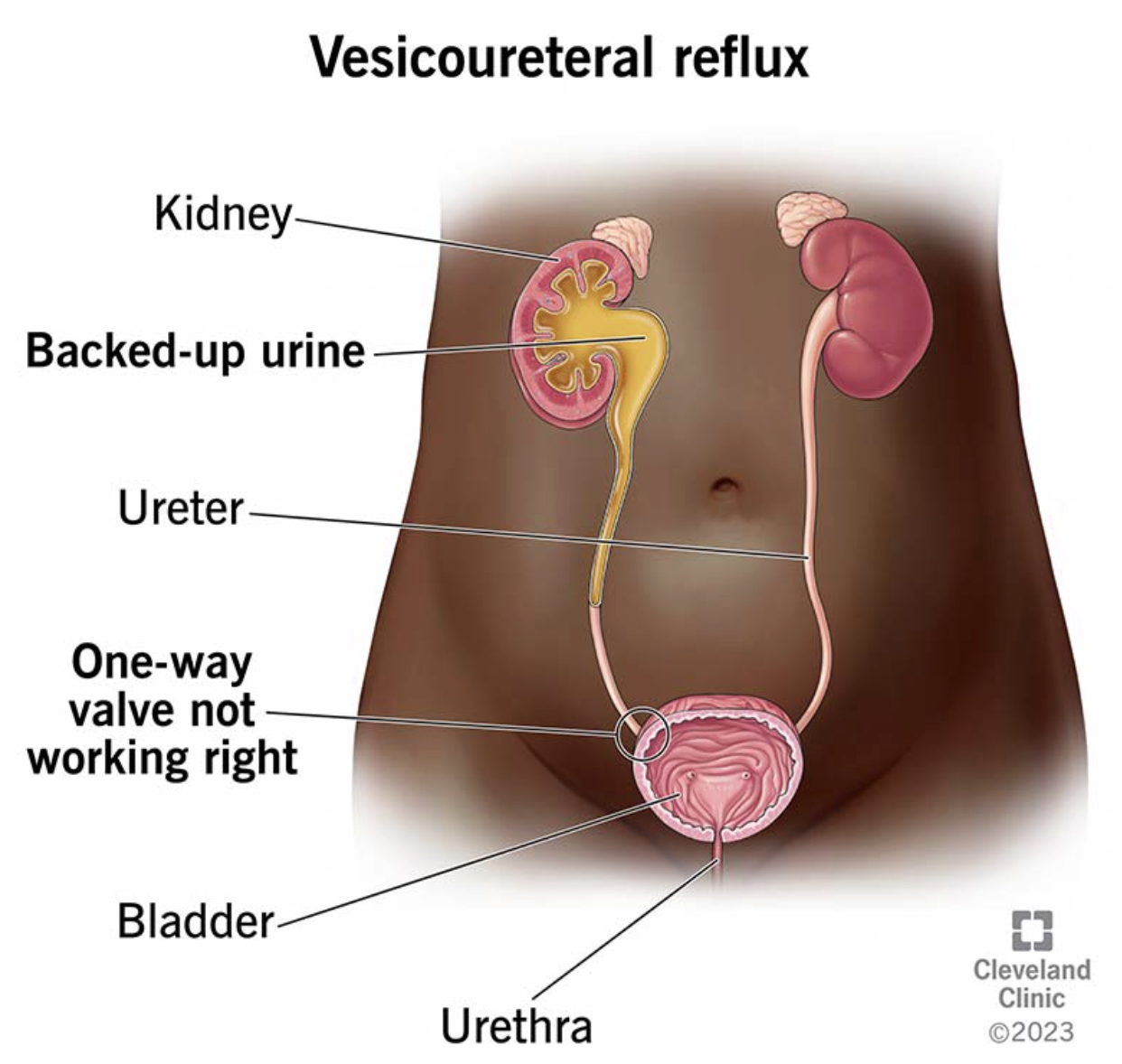
What stops the urine from backing up into the kidneys?
A specialized one-way flap valve mechanism where each ureter enters the bladder wall, preventing urine from backing up into the kidneys
What happens to urgency as bladder volume increases?
Urgency increases.
Which kidney sits higher?
The right kidney sits higher because of the liver.
Is urine normally sterile?
Yes, urine in the urinary tract is normally sterile.
What substances should not be present in the urine?
Blood (Hematuria)
Bacteria
Bilirubin (Urobilinogen)
Glucose
WBCs
Protein
Ketones
Nitrites
What is urinary incontinence?
Involuntary release of urine.
What is transient incontinence?
Reversible incontinence caused by issues such as medications, UTI, or overhydration.
What triggers stress incontinence?
Increased abdominal pressure such as with sneezing or coughing.
What is a major underlying problem in stress incontinence?
Pelvic floor incompetence.
What is urge incontinence associated with?
Overactive bladder, bladder inflammation, or obstruction.
What is reflex incontinence?
Urine is released when the bladder becomes full, often associated with spinal cord injury.
What is functional incontinence?
Incontinence caused by factors outside the urinary tract.
What can cause functional incontinence?
Lack of access to a bathroom, cognitive impairment, or altered mobility
What is a UTI?
Entry of microorganisms into the urinary tract causing symptoms of infection.
What organism is the most common cause of UTIs?
E.coli
Why are UTIs common?
The urethra is close to the rectum, facilitating bacterial entry.
What are risk factors for UTIs?
Poor toileting habits, urinary retention, sexual activity, and invasive procedures.
What is bacteriuria?
Bacteria in the urine.
Does bacteriuria always mean infection?
No. Asymptomatic bacteriuria does not necessarily represent infection.
Does asymptomatic bacteriuria automatically require antibiotics?
No; usually self-limiting in that body clears it out on its own
What is cystitis?
A lower UTI involving the bladder; inflammation of the bladder.

What is pyelonephritis?
An upper UTI involving the kidneys; where bacterial travel up the bladder to your kidneys
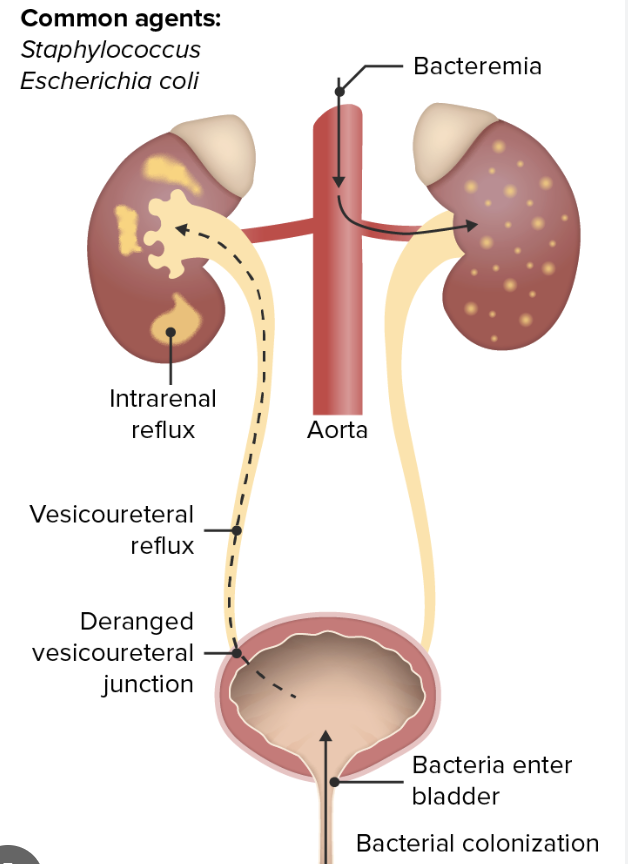
Why is pyelonephritis more concerning?
It can progress to a more serious infection such as urosepsis.
What does dysuria mean?
Burning or pain with urination.
What urinary symptoms are associated with a UTI?
Dysuria, foul-smelling urine, urgency, frequency, hematuria, and incontinence, fever, vomiting, CVA tenderness
What symptom may suggest pyelonephritis rather than a lower UTI?
Fever
What other findings can occur with pyelonephritis?
Vomiting and CVA tenderness.
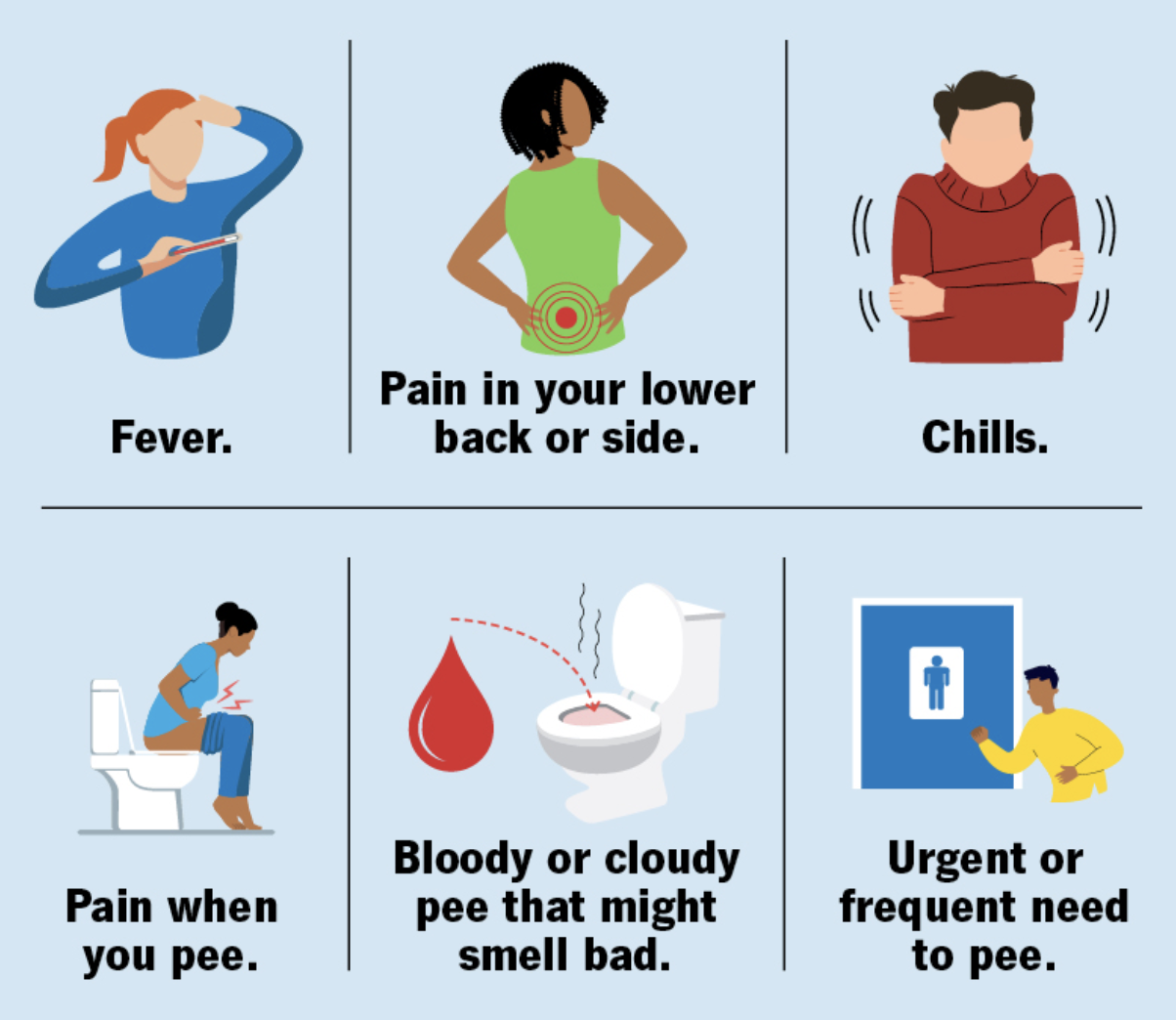
What does CVA tenderness suggest?
Possible kidney involvement, such as pyelonephritis
What does CAUTI stand for?
Catheter-associated urinary tract infection
What is a CAUTI?
A UTI associated with use of a urinary catheter.
How do the slides describe CAUTI in relation to healthcare-acquired infections?
It is identified as the most common healthcare-acquired infection
Why is CAUTI considered iatrogenic?
It can result from a healthcare intervention, specifically urinary catheterization.
What should nurses do daily regarding urinary catheters?
Review whether the catheter is still necessary.