TEAS TEST
 Call Kai
 Learn
Learn Practice Test
 Spaced Repetition
 Match
Match Flashcards
 Knowt Play
1/162

There's no tags or description
Looks like no tags are added yet.
Name | Mastery | Learn | Test | Matching | Spaced | Call with Kai | Chat |
|---|
No analytics yet
Send a link to your students to track their progress
163 Terms
Which of the following structures changes the volume of the lungs?
a. alveoli
b. heart
c. trachea
d. diaphragm
D. diaphragm
What is the respiratory systems main function
transporting oxygen from the atmosphere into the body's cells and moving carbon dioxide from the body's cells
How many lobes does the right lung have?
3 (superior, middle, inferior)
How many lobes does the left lung have? Why?
2 because of the heart
How does gas exchange occur in the lungs?
diffusion which is passive transport mechanism
Where is the heart located
mediastinum
Aveoli
sacs of the lungs where oxygen and carbon dioxide are exchanged by diffusion between the air and the blood
tidal volume
the amount of air breathed in and out of the lungs during a normal breath
Where is breathing controlled?
medulla oblongata of the brain - monitors carbon dioxide levels and blood ph.
cardiovascular system
responsible for the movement of blood around the body. This system allows for the nutrient distribution and waste removal.
What type of muscle is the heart?
cardiac muscle - inbolunysty mudvlr
What are the upper chambers of the heart called?
atria
What are the lower chambers of the heart called?
ventricles
Arteries
carry blood away from the heart
Veins
Blood vessels that carry blood back to the heart
Capillaries
single layer of endothelium that form a network that connect arteries to veins in tissues
Pulmonary loop
carries deoxygenated blood from the right ventricle to the lungs and returns oxygenated blood to the left atrium
Systemic loop
carries oxygenated blood from the left ventricle to the body, returning deoxygenated blood to the right atrium
Systole
Contraction of the heart
Diastole
Relaxation of the heart
What makes the "lub" sound?
atrioventricular valves closing (mitral and tricuspid valves)
What makes the dub sound?
closing of semilunar valves
What controls heart contractions?
Pacemaker - called the sinoatrial node
Plasma
clear pale yellow component of blood that carries red blood cells, white blood cells and platelets throughout the body.
Hemoglobin
The protein in red blood cells that carries oxygen from the lungs to the rest of the body
Lymphocytes
The two types of white blood cells that are part of the body's immune system: B lymphocytes form in the bone marrow and release antibodies that fight bacterial infections; T lymphocytes form in the thymus and other lymphatic tissue and attack cancer cells, viruses, and foreign substances.
white blood cells
granulocytes (basophils, eosinophils and neutrophils) agranulocytes (monocytes and lymphocytes)
macrophage
a large white blood cell that ingests foreign material
Leukocytes
white blood cells, which protect the body again disease
Which heart chamber pumps blood toward the lungs
right ventricle
Blood flow through the heart
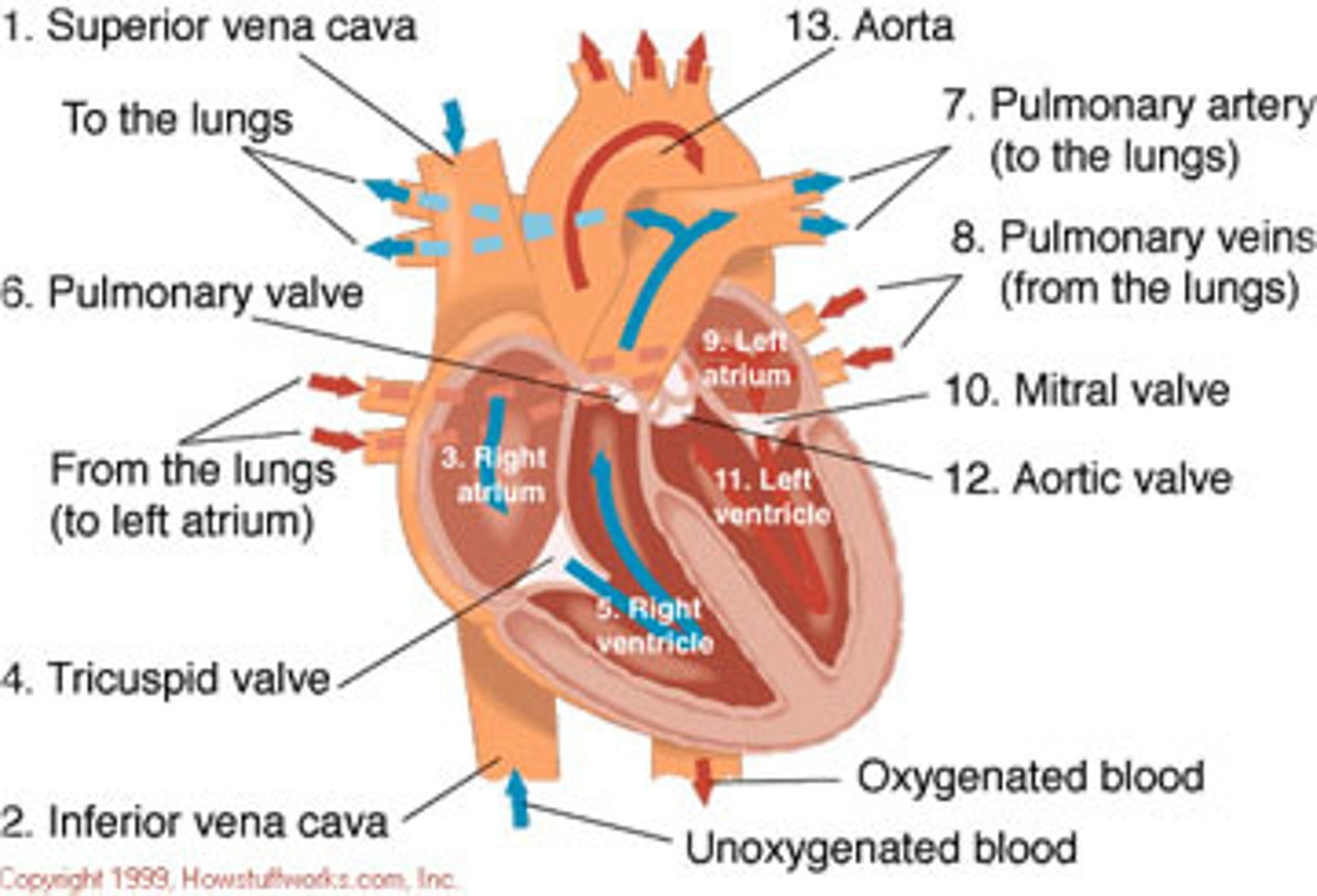
What two chambers of the heart have thicker walls? Why?
Ventricles use a large amount of pressure to push blood to different parts of the body. This puts quite a bit of force on these chambers, require them to be thicker.
Function of the digestive system
break down food for absorption and distribution of nutrients to the rest of the body
What controls the mechanical digestion and movement of food through the digestive system
the parasympathetic nervous system
What absorbs the nutrients in the digestive system?
Blood vessels located along the stomach and small and large intestines absorb digestive nutrients
What is mechanical digestion?
Physical breakdown of large pieces of food into smaller pieces
Peristalsis
Involuntary waves of muscle contraction keep food moving along in one direction through the digestive system.
Chyme
the semifluid mass of partly digested food that moves from the stomach to the small intestine.
Pepsin
Enzyme that breaks down proteins in the stomach
small intestine
The part of the GI Tract between the stomach and large intestine that includes the duodenum, jejunum, and ileum, where digestion and absorption of food occurs
Hydrophilic
water loving
large intestine
The last section of the digestive system, where water and salt is absorbed from food and the remaining material is eliminated from the body. Vitamin K is absorbed in the large intestine.
Ghrelin
A hunger-arousing hormone secreted by an empty stomach
Leptin
A hormone produced by adipose (fat) cells that acts as a satiety factor in regulating appetite.
Insulin
a hormone that triggers the influx of glucose into cells, thus lowering blood glucose levels.
Glucagon
a hormone secreted by the pancreas that stimulates its target cells in the liver to convert hepatic glycogen stores into glucose and releases that glucose into the blood
Enzymes in digestion
amylase, protease, lipase
Enzymes are proteins produced by the body that catalyze and speed up the breakdown of food so that nutrients are available for the body.
In the digestive system, where does the breakdown of proteins begin?
The stomach by the action of the enzyme pepsin, which is activated by hydrochloric acid.
What absorbs nutrients in the small intestine?
villi and microvilli
Describe the mechanical and chemical digestion of a starch
Mechanical: chewing, swallowing
Chemical: amylase and lipase
Muscle contractions in the stomach break down food particles in the chyme. Then, in the small intestines, more enzymes released by the pancreas break down the starches into simple sugars.
Central Nervous System (CNS)
brain and spinal cord and acts as the central command for all communication and actions of the body
Peripheral Nervous System (PNS)
includes all of the nerves that branch out to the rest of the body and the ganglia. It allows the signals sent by the brain to reach their target destination in the body.
A nerve cell
neuron
Axon
a nerve fiber that carries a nerve impulse away from the neuron cell body
dendrite
a nerve fiber that carries a nerve impulse toward the neuron cell body
synapes
the structure that allow neurons to pass signals to other neurons, muscles or glands
sensory nerons
Afferent - send messages to the CNS about sensory information, such as touch, small, and pain
motor neurons
efferent - send messages to muscle and can be subdivided into the autonomic (involuntary)and the somatic (voluntary) nervous system.
autonomic nervous system
A subdivision of the peripheral nervous system. Controls involuntary activity of visceral muscles and internal organs and glands. (heart rhythm, digestion and breathing)
somatic nervous system
A subdivision of the peripheral nervous system. Enables voluntary actions to be undertaken due to its control of skeletal muscles. (walking, throwing, typing)
What type of nerves send messages to the brain?
sensory
What is the role of the CNS?
The CNS acts as the central command for all communication and actions of the body.
Describe the difference between the CNS and PNS
The CNS is comprised of the brain and spinal cord and it controls the regulation of body systems.
The PNS is made up of all of the neurons that connect the CNS to the rest of the body. it is responsible for sending messages to the brain or from the brain to designated targets.
Types of muscle
skeletal, cardiac, smooth
Skeletal muscle
attaches to bones and is involved in the movement of bones. It is striated and very strong
Cardiac muscle
Involuntary muscle tissue found only in the heart.
smooth muscle
Involuntary muscle is found inside many internal organs of the body
Tendons
Connect muscle to bone
Ligaments
Connect bone to bone
Myosin
thick filament
Actin
thin filaments
Sarcomere
contacting unit of a muscle
What role does estrogen play?
Estrogen is a hormone that plays a role in egg maturation.
integumentary system
Consists of the skin, mucous membranes, hair, and nail.
vital to protecting the body and regulating temperature
Layers of skin from top to bottom
epidermis, dermis, hypodermis (subcutaneous)
Where are melanocytes found?
epidermis
What are melanocytes?
Cells that produce skin pigment granules in the basal layer
What's in the dermis?
nerves, blood vessels, sweat glands, hair, oil glands
functions of integumentary system
1. Protection
2. Body Temperature Regulation
3. Cutaneous Sensation
4. Metabolic Functions
5. Blood Reservoir
6. Excretion
apocrine glands
Sweat glands in the pubic and underarm areas that secrete thicker sweat, that produce odor when come in contact with bacteria on the skin
eccrine glands
These glands produce sweat. Mostly for temperature regulation
How does the integumentary system regulate body temperature?
if the body gets too hot, the integumentary system uses homeostatic strategies to cool it off. sweat is secreted by the sweat glads. as the water in sweat evaporates, the skin is cooled. blood vessels also dilate and move closer to the ski surface to try and cool it.
B cells
Cells manufactured in the bone marrow that create antibodies for isolating and destroying invading bacteria and viruses.
T cells
White blood cells that mature in the thymus and participate in an immune response
innate immunity
Immunity that is present before exposure and effective from birth. Responds to a broad range of pathogens.
adaptive immunity
A kind of passive or active immunity in which antibodies to a particular antigen are present in the body
Interferons
proteins (cytokines) secreted by leukocytes and other cells to aid and regulate the immune respons
antigen presenting cells
A cell that displays foreign antigens with major histocompatibility complexes on their surfaces
Helper T cells
A type of lymphocyte that secretes interleukids a preying that triggers the action of other cells including the attack of foreign cells by the cytotoxic T cell
Cytotoxic T cells
A type of lymphocyte that kills infected body cells and cancer cells
Cytokines
Cell signaling molecules release primarily by helper T cells and macrophages. Certain cytokines activate cytotoxic T cells
Which cells produce antibodies?
What is considered a short bone?
carpals and tarsals
What breaks down bone material?
osteoclasts
What builds bone?
osteoblasts
4 types of tissues found in the body
epithelial, connective, muscle, nervous
Macromolecules
carbohydrates, lipids, proteins, nucleic acids
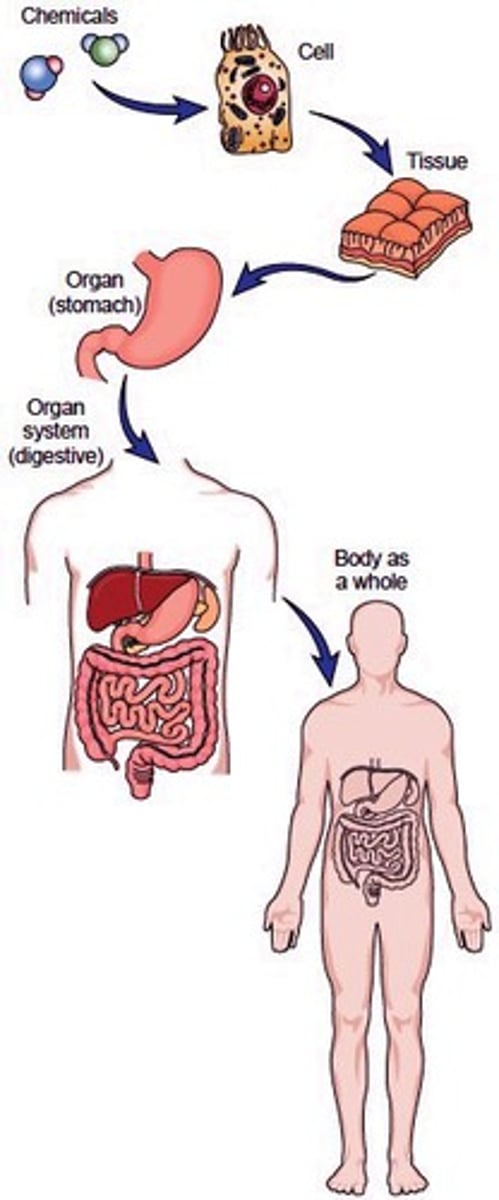
Levels of organization
chemical, cellular, tissue, organ, organ system, organism
Mitosis vs. Meiosis
Mitosis: one division forming 2 identical cells (clones); Meiosis: two divisions forming 4 genetically different cells
Mitosis
cell division in eukaryotes that produce two daughter cells, each with the same chromosome number as the parent cell