ICORE Marketing
 Call Kai
 Learn
Learn Practice Test
 Spaced Repetition
 Match
Match Flashcards
 Knowt Play
1/57

There's no tags or description
Looks like no tags are added yet.
Name | Mastery | Learn | Test | Matching | Spaced | Call with Kai | Chat |
|---|
No analytics yet
Send a link to your students to track their progress
58 Terms
Marketing
An organizational function and a set of processes for creating, communicating, and delivering value to customers and for managing customer relationships in ways that benefit the organization and its stakeholders
Marketing... (5 things)
-benefits various stakeholders
-is about satisfying customer needs and wants
-entails an exchange (global)
-creates value through four P's
-can be performed by individuals and organizations (entrepreneurial)
Value
the ratio of what is given up for what is obtained
What constitutes an exchange?
both parties must believe they are getting value during the exchange
How is value created?
through the marketing mix
Marketing Mix
Product, Price, Place, Promotion
Product
creating value that satisfies customer needs
Price
-capturing value
-everything a buyer gives up in exchange for product
-must be amount they are willing to pay and which given profit
Place
-delivering value
-supply chain management
-all activities needed to get product to customer when they want it
Promotions
-communicating value
-communication that informs, persuades, or reminds buyers
-to influence opinions/ responses
Timeline of Marketing
production, sales, marketing, value-based marketing, tech-augmented marketing
How do you create value?
-build relationships with customers
-gather + analyze information
-balance benefits + costs
-connect customers on social + mobile media
Where does value stem from?
-adding value
-social + mobile marketing
-marketing analytics
-ethical + societal dilemma
Marketing Strategy includes...
-target markets
-marketing mix
-provides sustainable competitive advantage
-developed through marketing planning
Macro strategies for delivering value
-customer excellence (rewards)
-operational excellence (efficiency)
-product excellence
-location excellence
What do macro strategies for delivering value allow for?
sustained competitive advantage
Phases of Marketing Plan
1) Planning
- business mission + objectives
-SWOT
2) Implementation
- identify opportunities/ target markets (segmentation, targeting, positioning)
- implement marketing mix (4 P's)
-marketing strategy
3) Control
-evalue performance

SWOT
internal strengths, internal weaknesses, external opportunities, external threats
How to identify and evaluate opportunities?
-segmentation (identifying distinct groups)
-targeting (selecting certain groups)
-positioning (making strategy to differentiate and align product with group)
Marketing Metrics
used to explain why things happen and project future
Portfolio Analysis
method to classify current business units/products and helps determine how to allocate resources
Boston Consulting Group Growth Matrix
-star (invest and grow)
-cash cow (maintain and milk)
-question mark (watch and hold)
-dog (drop/ consolidate)
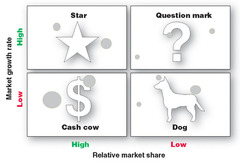
Growth Strategies for Markets and Products

Conscious Marketing
-recognition of marketing's greater purpose
-consideration of stakeholders and their interdependence
-presence of conscious leadership, creating a corporate culture
-understanding that decisions are ethically based
-creating positive social and environmental impact
Corporate Social Responsibility
-economic, social, environmental impacts
-triple bottom line
How does CSR differ from conscious marketing?
CSR is baseline, conscious marketing goes one step further with higher purpose of businesses
Stakeholders of Conscious Marketing
employees, customers, marketplace (competitors), society
Marketing Ethics
-important part of conscious marketing
-implementation of programs that are socially responsible and employees are ethical
Ethics vs Social Responsibility in Marketing
-ethical and socially responsible is conscious marketing

Framework for ethical decision making
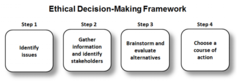
Marketing Environment
uncontrollable elements outside of any organization that may affects its performance
Environmental Scanning
systematic analysis of marketing environment
What is at the center of the environment?
consumers
Immediate Environment
company, competition, corporate partners, physical environment
Macroenvironment
culture, demographics, social, technology, economic, political/legal
Culture
-shared meanings, beliefs, morals, values, and customs of a group of people transmitted by words, literature, and institutions
-influences consumer behavior
Hofstede's Cultural Dimensions
power distance, individualism, masculinity, uncertainty avoidance, time orientation, indulgence
Demographics
-the characteristics of a population with respect to age, race, and gender
-used to identify consumer markets
Generational Cohorts
gen alpha, gen z, gen y, gen x, baby boomers
What is purchasing power related to?
education > income > spending power
How do companies respond to the environment?
-implement strategies that respond to multiple forces
-to succeed have to respond quickly, accurately, and sensitively
Types of involvement in the purchasing decisons
high and low involvement
Low Involvement Decisions
-low cost, standardized, low risk
-routine purchases
-in store promotion, linked to high involvement issue
High Involvement Decisions
-important, risky, more effort + expensive
-substantial differences between alternatives
Consumer Decision Process
need recognition, information search, alternative evaluation, purchase, post purchase
Need Recognition
-influenced by internal and external stimuli
-present state vs preferred state
Search for Information
-internal search (what you know)
-external search (getting info from others)
Factors Impacting Search Process
-perceived costs and benefits
-locus of control (internal: more search activities because you control outcome) (external: fate and external factors control outcome)
Perceived Risks
-performance: how the product performs
-financial: monetary risk
-social: how your status will be impacted
-physiological: safety/health risks
-psychological: is the purchase morally right
Sets considered when consumer is evaluating alternatives
-universal: everything that possibly exists
-retrieval: what consumer can actually think of to buy
-evoked: what consumer would actually consider buying
Components of Post-Purchase Outcomes
-customer satisfaction
-post purchase cognitive dissonance (when beliefs contradict actions)
-customer loyalty (customer relationship management)
Factors that affect the consumer decision process
marketing mix, psychological factors, social factors, situational factors
Psychological factors that impact consumer decision process
motives, attitudes, perceptions, learning and memory, lifestyle
Motives of Psychological Factors
physiological, safety, love, esteem, self-actualization

Attitudes of Psychological Factors
-cognitive: thinking
-affective: feeling
-behavioral: doing
Types of Reference Groups
-membership: group you belong to
-aspirational: group you want to belong to
-dissociative: group you want to avoid
Situational Factors
-purchase situation: reason for purchase
-sensory situation: physical surroundings
-temporal state: time of day related constraints
Segmentation Methods
-geographic: where you live
-demographic: most common, age, gender, income
-physiographic: lifestyle, self-concept, self-values
-benefits: convenience, economy, prestige
-behavioral: occasion, loyalty