Classification and Kingdoms Vocabulary

0.0(1)
Studied by 33 people
call kaiCall Kai
Locked
learnLearn
examPractice Test
spaced repetitionSpaced Repetition
heart puzzleMatch
flashcardsFlashcards
Card Sorting

1/20

flashcard set

Earn XP

Description and Tags

Prepare for your quiz/test on this unit.

Last updated 6:44 PM on 9/3/26
Name
Mastery
Learn
Test
Matching
Spaced
Call with Kai
Chat

No analytics yet

Send a link to your students to track their progress

21 Terms

1
New cards

Dichotomous key

A key or series of questions for the identification of new organisms based on physical traits

<p>A key or series of questions for the identification of new organisms based on <strong>physical traits</strong></p>
2
New cards

Taxonomy

The science of classifying organisms and assigning each organism a universally accepted name

<p>The <strong>science </strong>of classifying organisms and assigning each organism a universally accepted name</p>
3
New cards

Carolus Linnaeus

Created modern classification system based on physical traits

<p>Created <strong>modern classification system </strong>based on physical traits</p>
4
New cards

Prokaryote

Single-celled microorganism that lacks (does NOT have) a nucleus

<p>Single-celled microorganism that<strong> lacks </strong>(does NOT have) <strong>a nucleus</strong></p>
5
New cards

Eukaryote

Organism that contains a nucleus

<p>Organism that contains a<strong> nucleus</strong></p>
6
New cards

Heterotroph

An organism that consumes other organisms in a food chain; consumer (examples: animals)

<p>An organism that<strong> consumes other organisms</strong> in a food chain; consumer (examples: animals)</p>
7
New cards

Autotrophic

An organism that is able to make its own food/energy; producer (examples: plants)

<p>An organism that is able to <strong>make its own food/energy</strong>; producer (examples: plants)</p>
8
New cards

Kingdom

The second broadest taxonomic rank between Domain and Phyla (consists of 6 groups)

<p>The<strong> second broadest</strong> taxonomic rank between Domain and Phyla (consists of <strong>6 groups</strong>)</p>
9
New cards

Eubacteria

Kingdom of unicellular prokaryotes whose cell walls are made up of peptidoglycan - common bacteria

<p>Kingdom of <strong>unicellular prokaryotes</strong> whose cell walls are made up of peptidoglycan - <strong>common</strong> bacteria</p>
10
New cards

Archaeabacteria

kingdom of unicellular prokaryotes whose cell walls do not contain peptidoglycan - extremephiles

<p>kingdom of <strong>unicellular prokaryotes</strong> whose cell walls do not contain peptidoglycan - <strong>extremephiles</strong></p>
11
New cards

Protista

Kingdom that includes mostly unicellular organisms that do not fit into the other eukaryotic kingdoms

<p>Kingdom that includes mostly unicellular organisms that do not fit into the other eukaryotic kingdoms</p>
12
New cards

Fungi

Kingdom of organisms that obtain their food from decomposition in the soil - eukaryote - cell walls made of chitin

<p>Kingdom of organisms that obtain their food from <strong>decomposition </strong>in the soil - eukaryote - cell walls made of <strong>chitin</strong></p>
13
New cards

Plantae

Kingdom of multicellulalr photosynthetic authtrophs that have cell walls containing cellulose

<p>Kingdom of <strong>multicellulalr </strong>photosynthetic authtrophs that have cell walls containing cellulose</p>
14
New cards

Animalia

Kingdom of organisms that consist of many complex cells, are heterotrophs and have NO cell wall

<p>Kingdom of organisms that consist of many <strong>complex </strong>cells, are <strong>heterotrophs </strong>and have <strong>NO cell wall</strong></p>
15
New cards

Unicellular

Consists of only one cell

<p>Consists of <strong>only one cell</strong></p>
16
New cards

Multicellular

Consists of many cells

<p>Consists of<strong> many cells</strong></p>
17
New cards

Domain

Most inclusive taxonomic category; larger than a kingdom (consists of 3 groups)

<p>Most inclusive taxonomic category; larger than a kingdom (consists of <strong>3 groups</strong>)</p>
18
New cards

Bacteria

Domain of unicellular prokaryotes that have cell walls containing peptidoglycans - common bacteria

19
New cards

Eukarya

Domain of all organisms whose cells have nuclei (nucleus), including protists, plants, fungi, and animals
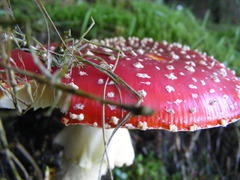
<p><strong>Domain </strong>of all organisms whose cells have <strong>nuclei (nucleus)</strong>, including protists, plants, fungi, and animals</p>
20
New cards

Archaea

Domain of unicellular prokaryotes that have cell walls that do not contain peptidoglycan and live in extreme environments.

<p><strong>Domain </strong>of unicellular prokaryotes that have cell walls that do not contain peptidoglycan and live in <strong>extreme environments.</strong></p>
21
New cards

Binomial Nomenclature

Two name naming system: consists of genus name and species name (example: Homo sapien)



