Cell Bio Chapter 11 The Central Dogma: From DNA to Protein
 Call Kai
 Learn
Learn Practice Test
 Spaced Repetition
 Match
Match Flashcards
 Knowt Play
1/90

There's no tags or description
Looks like no tags are added yet.
Name | Mastery | Learn | Test | Matching | Spaced | Call with Kai | Chat |
|---|
No analytics yet
Send a link to your students to track their progress
91 Terms
Gene
Stores information to make polypeptides.
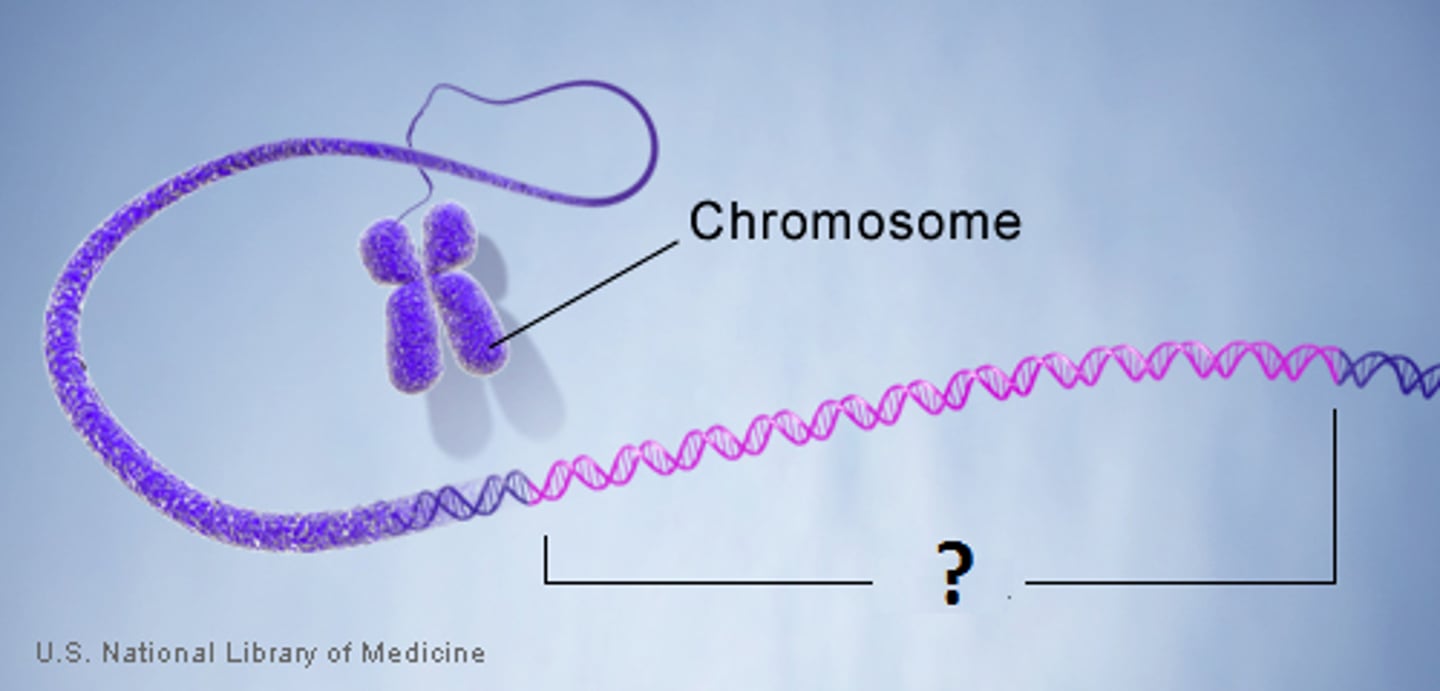
Gene expression
A procedure to produce a functional protein using the information stored in the correlated gene.
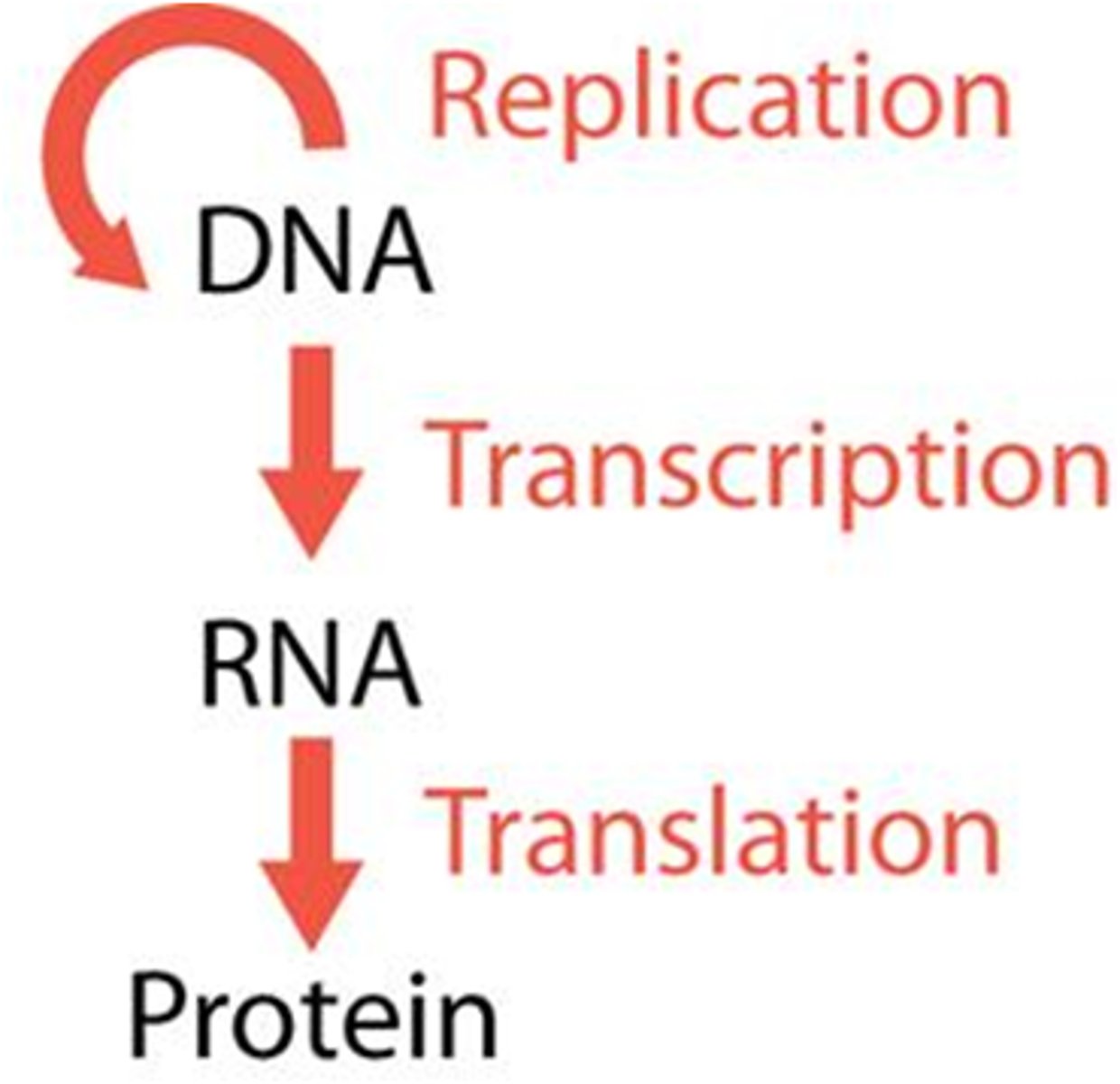
Central Dogma
A DNA-based gene encoding an RNA based message that is then translated into a protein
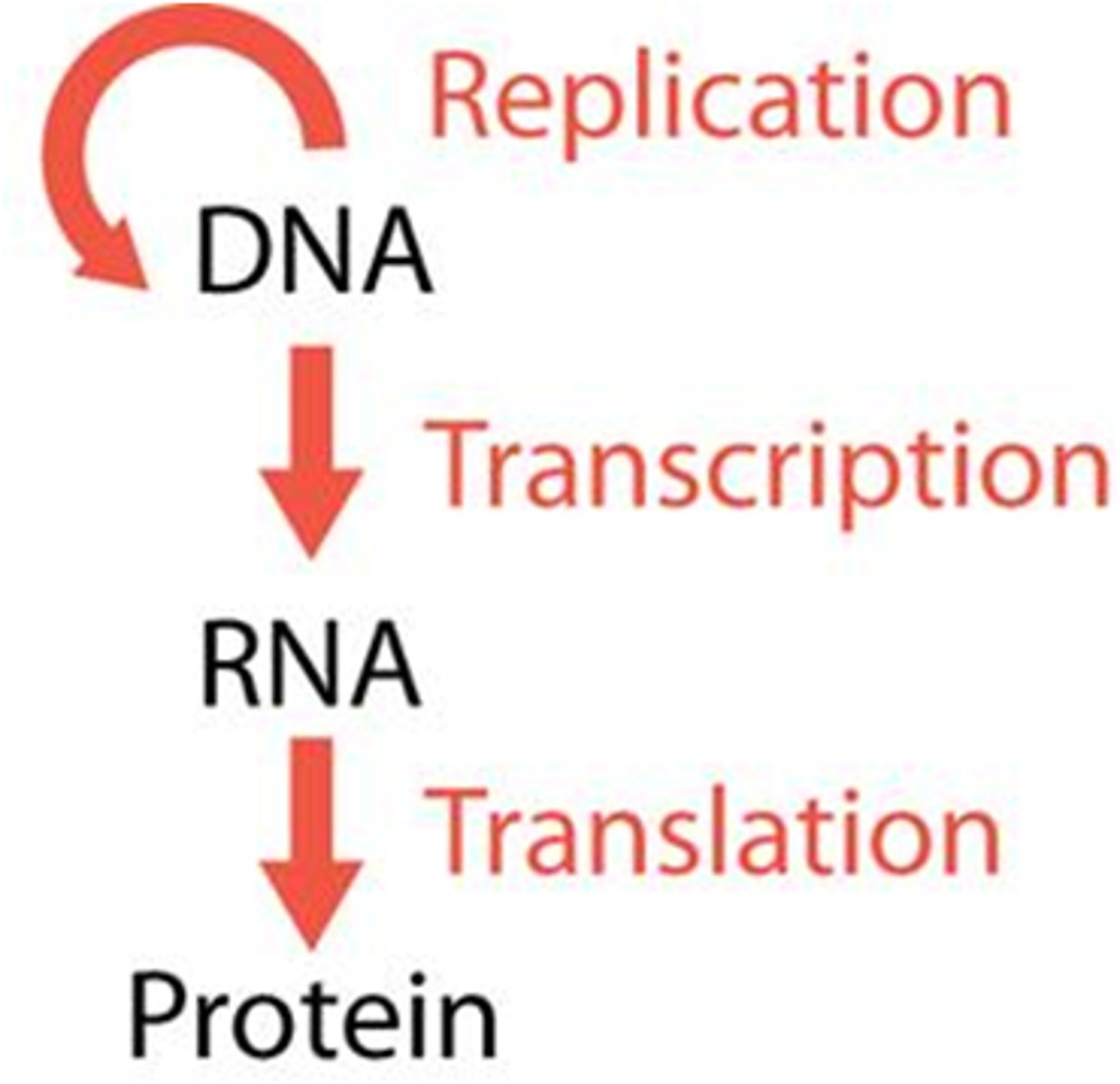
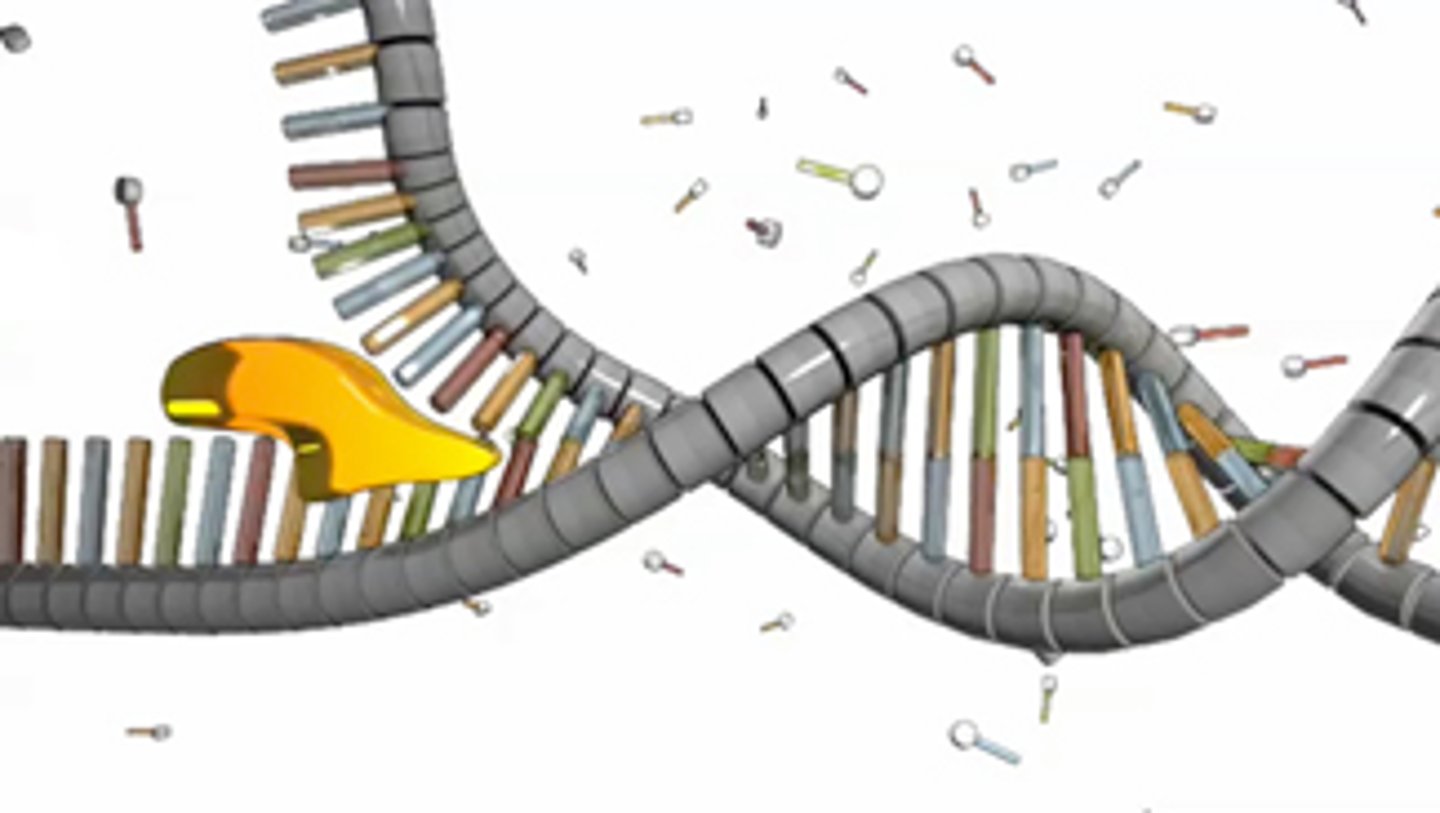
Transcription
process by which an RNA is synthesized from a DNA template in the nucleus
Translation
process by which proteins are synthesized from an mRNA template in the cytoplasm
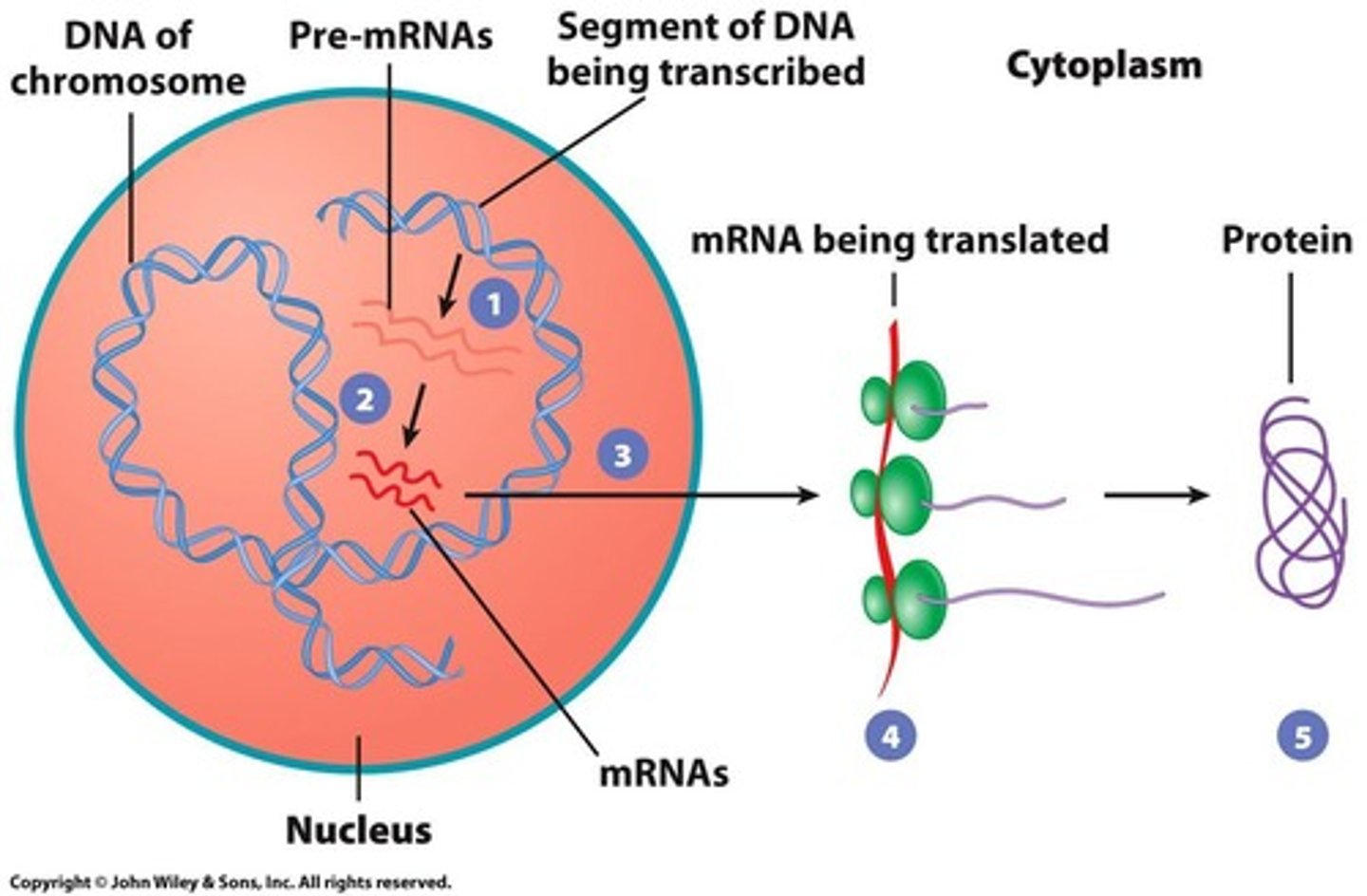
Messenger RNA (mRNA)
An intermediate between a gene (DNA) and a polypeptide (Protein).
Function of mRNA
Allows the cell to separate information storage from information utilization and greatly amplify its synthetic output
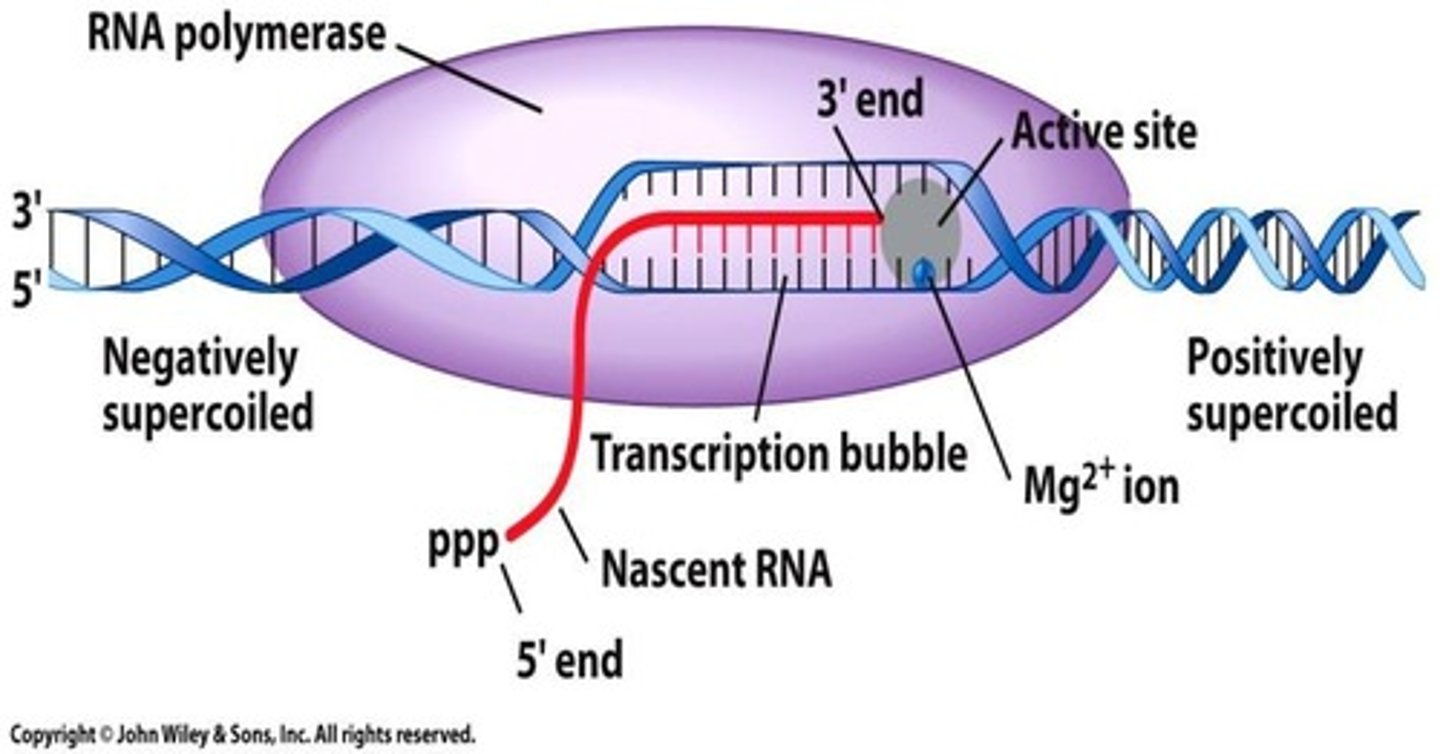
RNA polymerase
Enzyme synthesizing RNA from DNA template.
Promoter
DNA region where RNA polymerase binds.
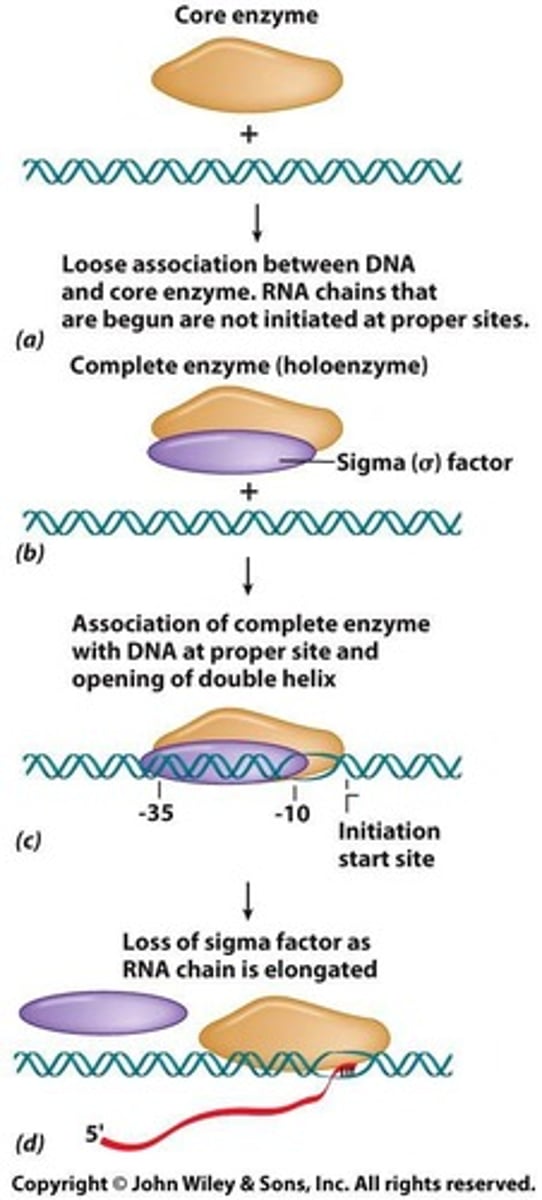
Promoter function
Determines which of the two DNA strands will be used as the template and where transcription will begin and Facilitates initiation of transcription.
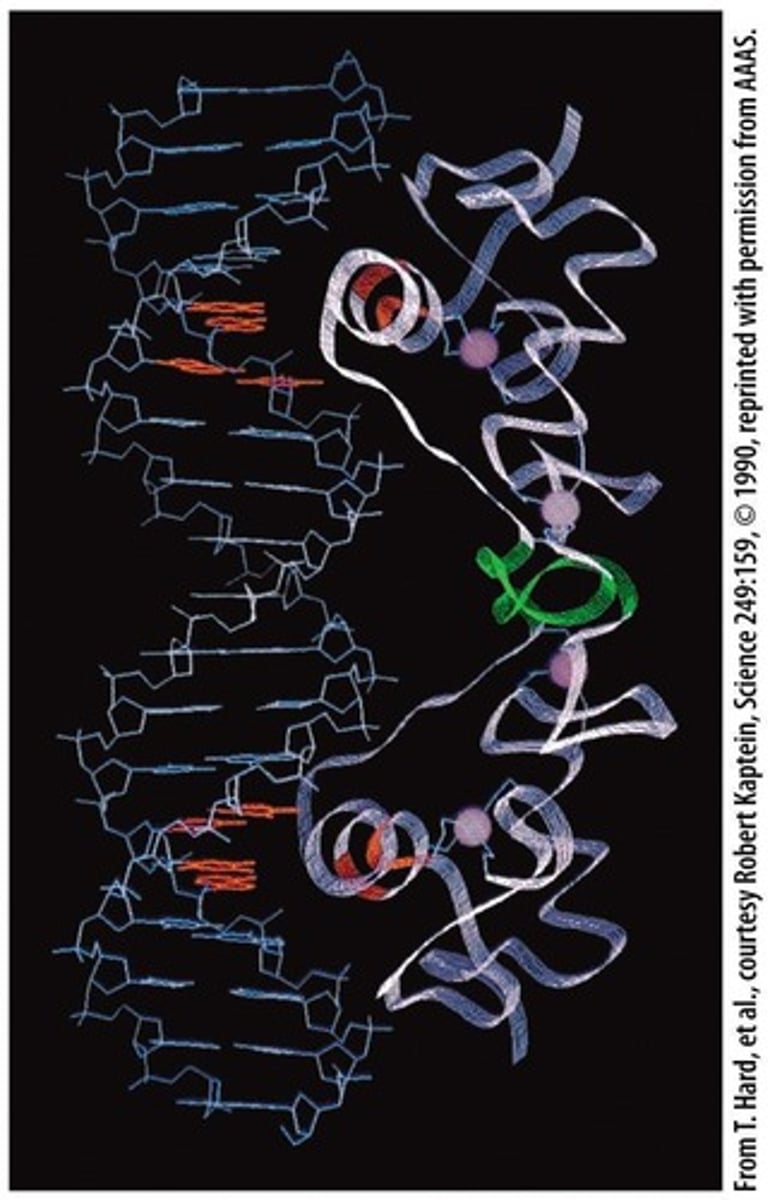
Transcription factors
A group of proteins that control the rate of transcription of genetic information from DNA to messenger RNA, by binding to promoter region
primary transcript (pre-mRNA)
Initial RNA product, precursor to mature mRNA.
Ribonucleoside triphosphates substrates (NTPs)
are cleaved to nucleoside monophosphates as they are polymerized into RNA chain
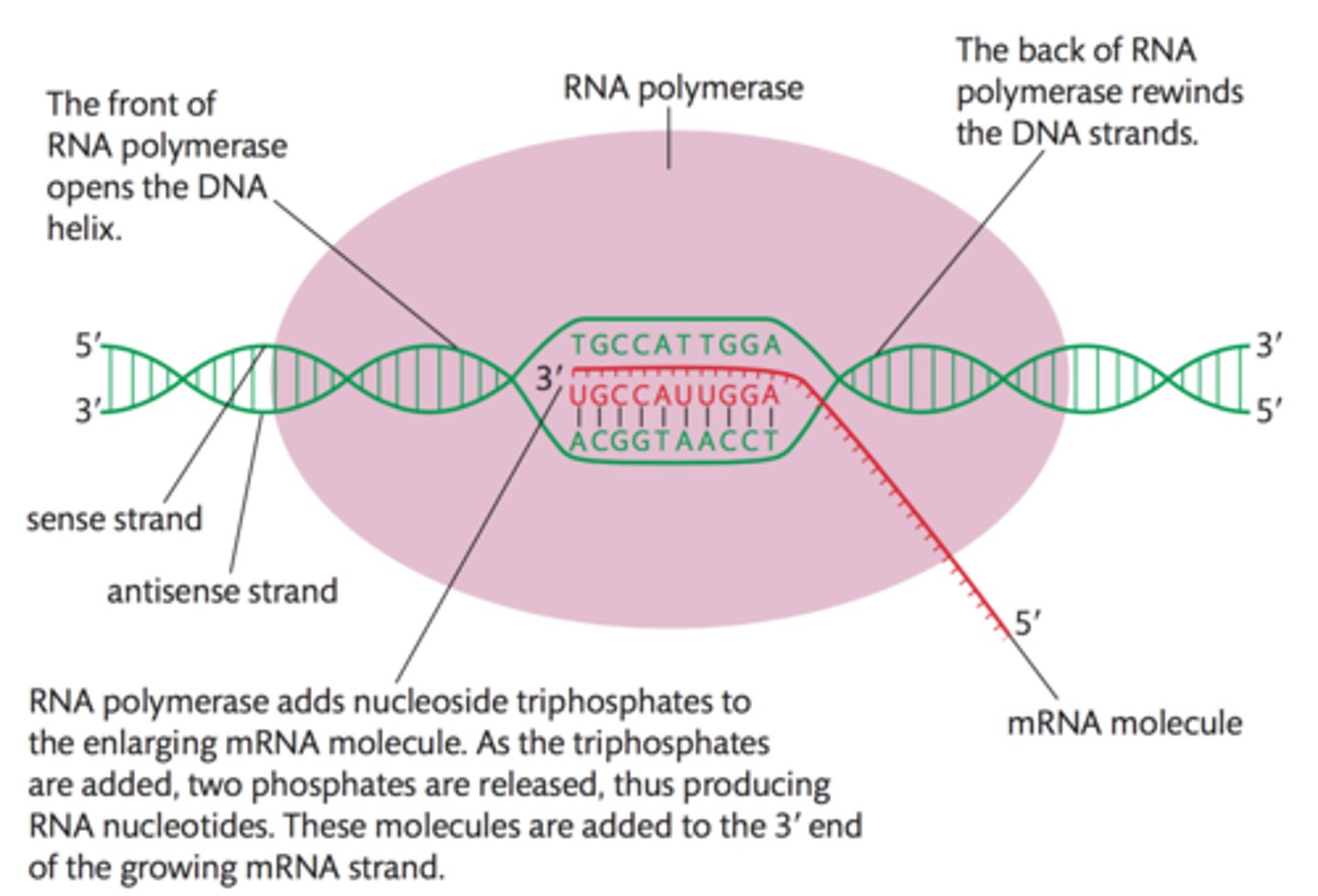
Direction of RNA chain
5' to 3' direction antiparallel to the DNA template
DNA-RNA Hybrid
Temporary structure during transcription, about 9 base pairs.
Transcription bubble
Region where DNA unwinds during transcription.
Processive
RNA polymerase remains attached to DNA during synthesis.
Number of RNA polymerases in prokaryotes
one
Core Enzyme
Five subunits forming prokaryotic RNA polymerase.
Sigma Factor
Protein aiding RNA polymerase binding to specific promoter sites.
Transcription unit
DNA segment corresponding to a primary transcript.
mRNA
Messenger RNA coding for specific polypeptides.
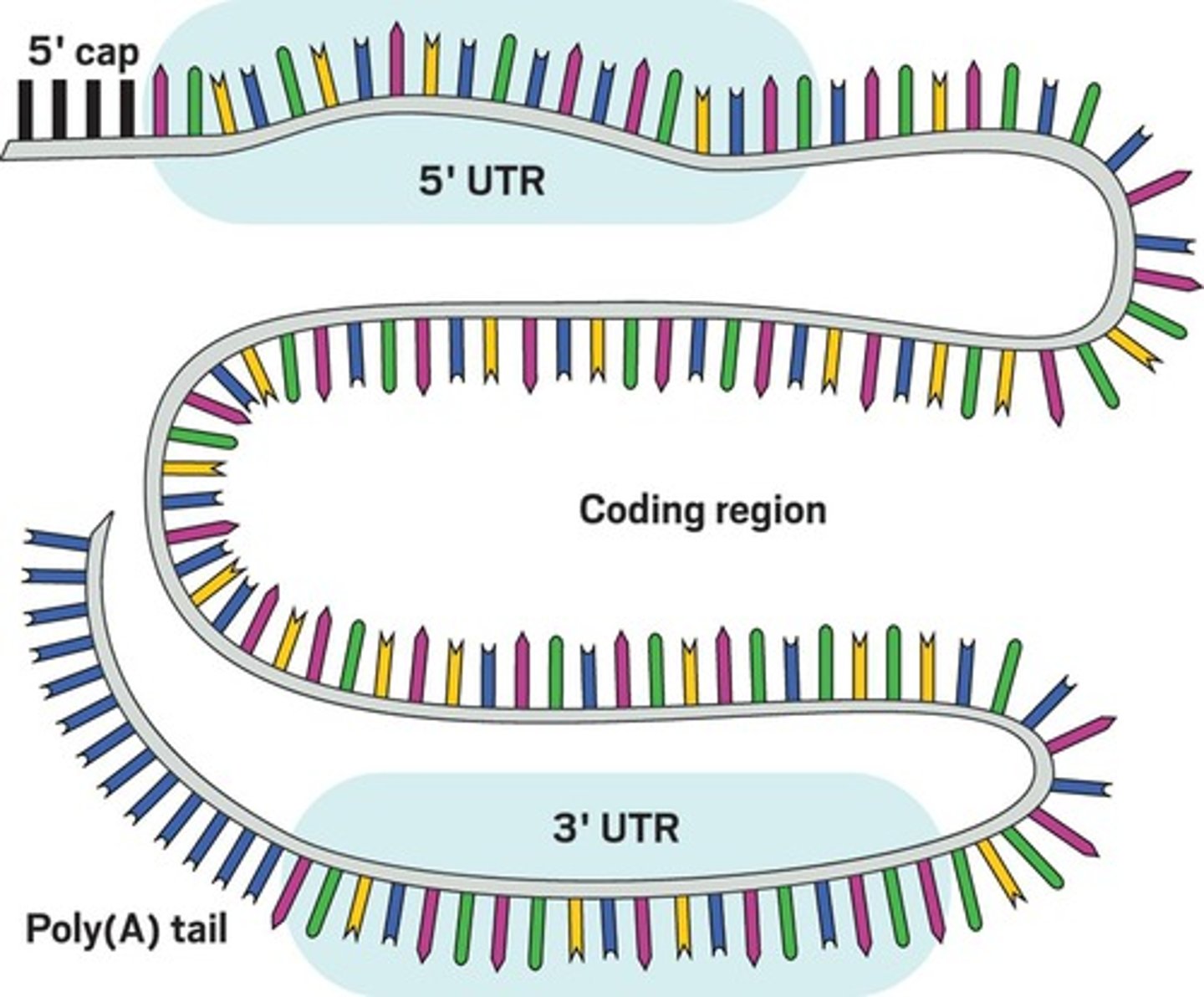
Eukaryotic mRNA
Contains specific modifications at both ends.
5' cap of eukaryotic mRNA
Methylated guanosine cap on mRNA's.
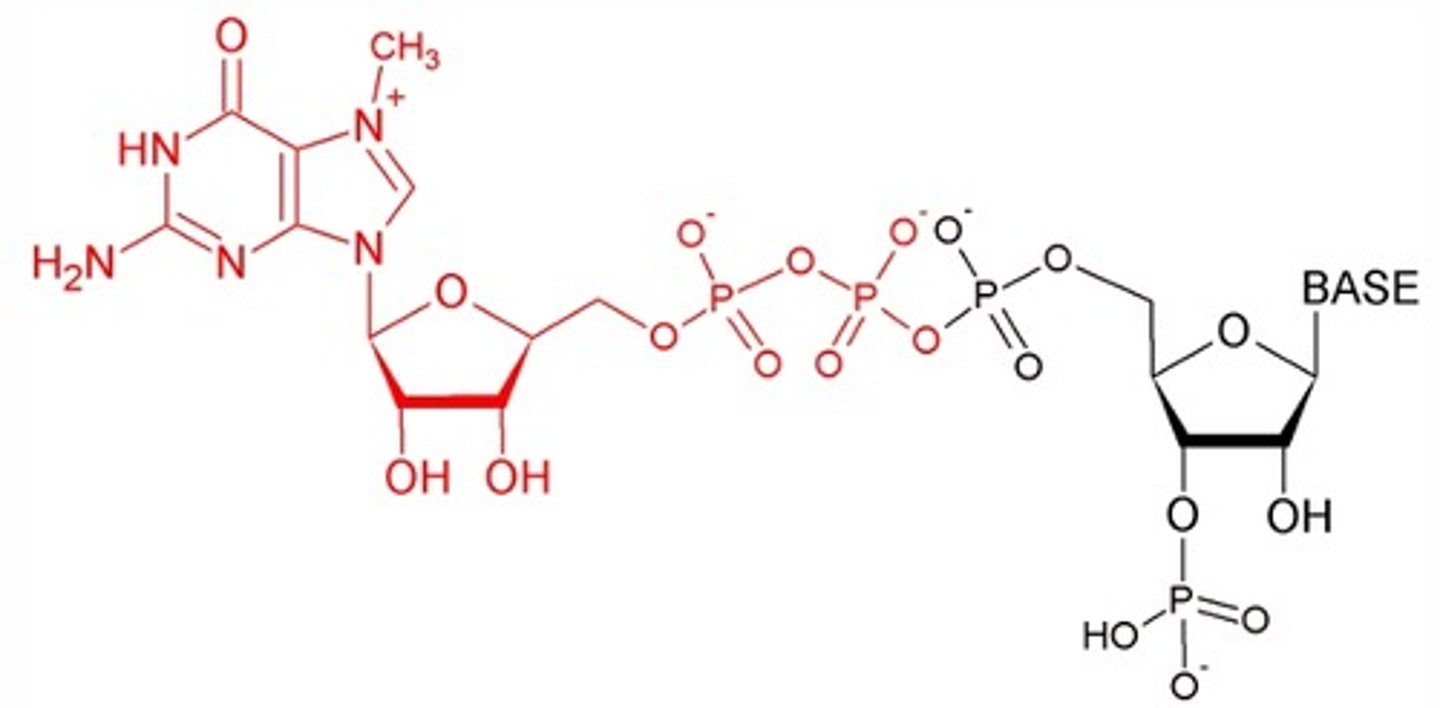
Function of the 5'-cap of eukaryotic mRNA
Prevents the 5’-end of mRNA from being digested by enzymes, Aids in transport of the mRNA out of the nucleus and plays an important role in the initiation of translation.
3' cap of eukaryotic mRNA
poly(A) tail, composed of 50-250 adenosine residues
Function of 3' cap of eukaryotic mRNA
Protect the mRNA from premature degradation by enzymes
RNA polymerase II
makes all eukaryotic mRNA precursors in nucleus
General Transcription Factors (GTFs)
Proteins forming preinitiation complex( PIC) with RNA polymerase II.
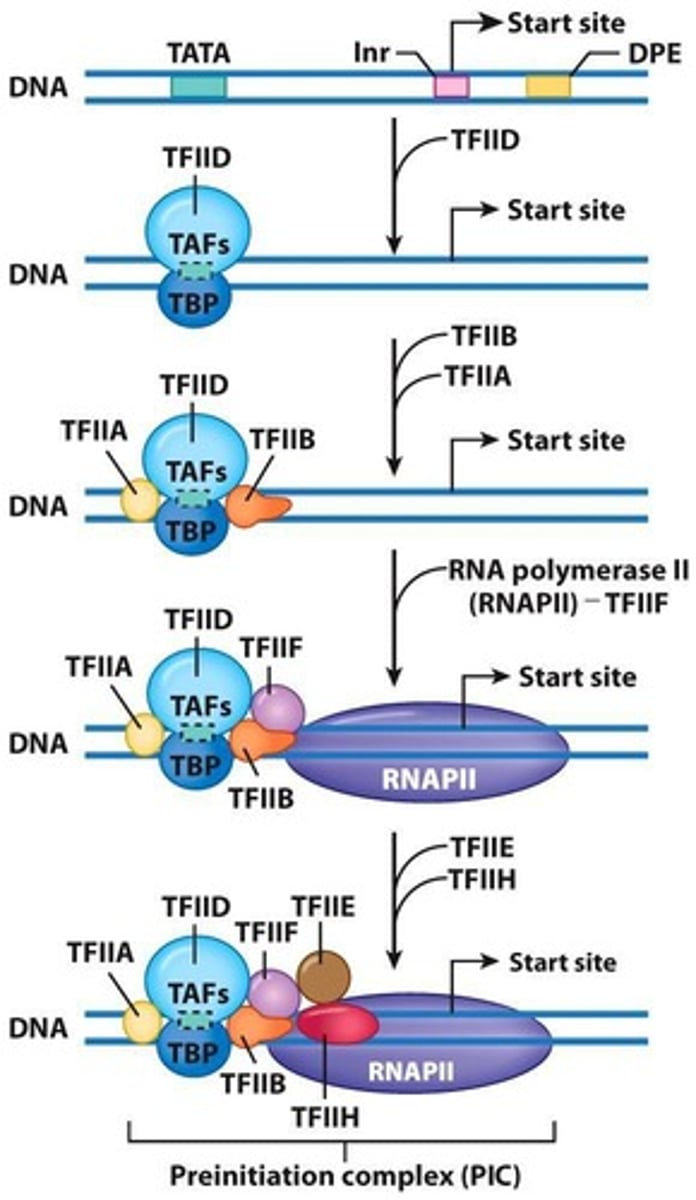
Preinitiation Complex (PIC)
Assembly of GTFs at promoter for transcription initiation.
TATA Box
Consensus sequence critical for eukaryotic transcription initiation.
TFIIH
Complex with kinase and helicase activities for transcription.
Protein kinase
The enzyme that transfers phosphate groups from ATP to protein. (phosphorylate RNA polymerase II)
Helicase
The enzyme that unwinds DNA double helix to generate the transcription bubble
Exon
Parts that contribute to the mature RNA, including coding sequence
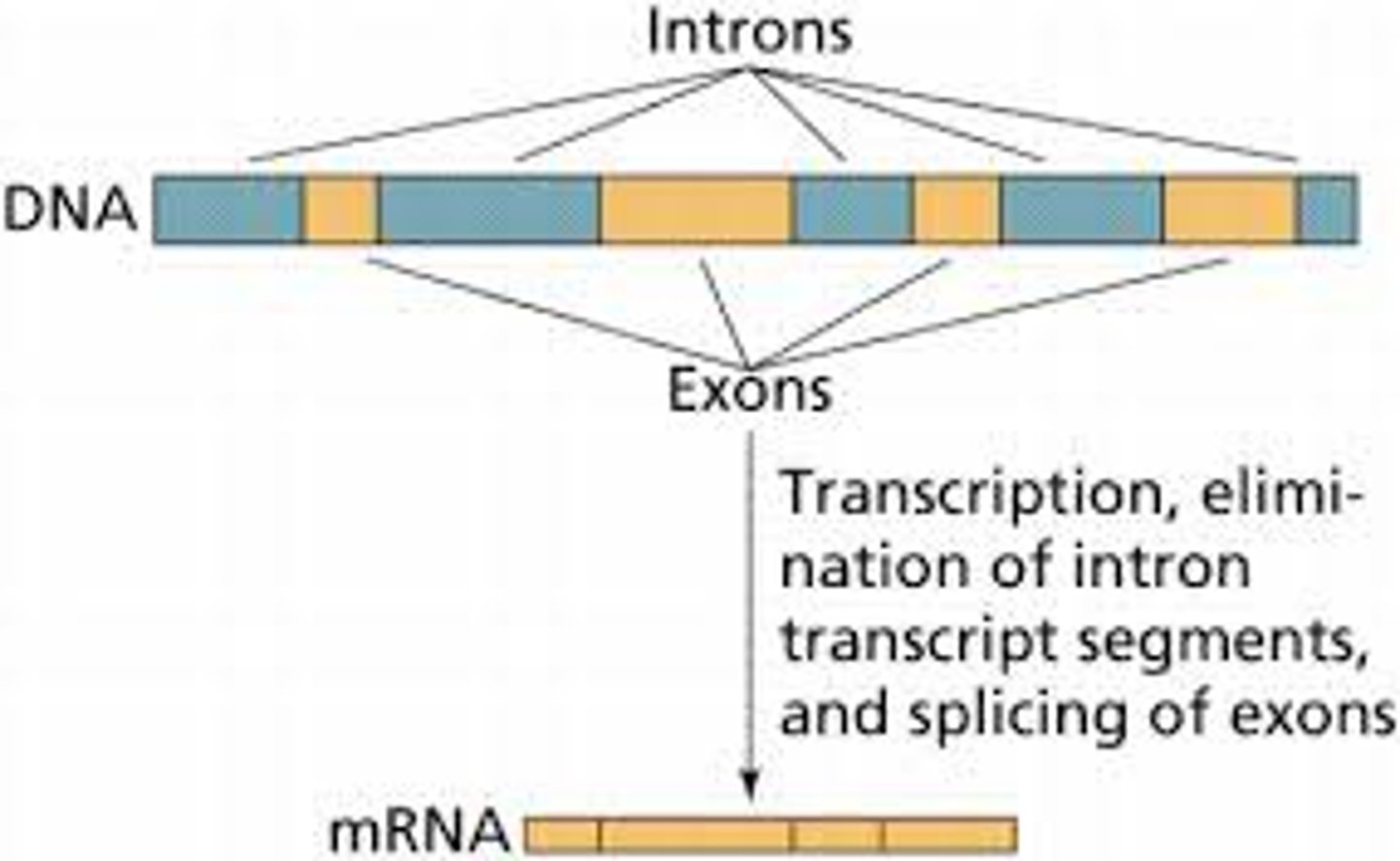
Intron
Noncoding sequence removed from pre-mRNA.
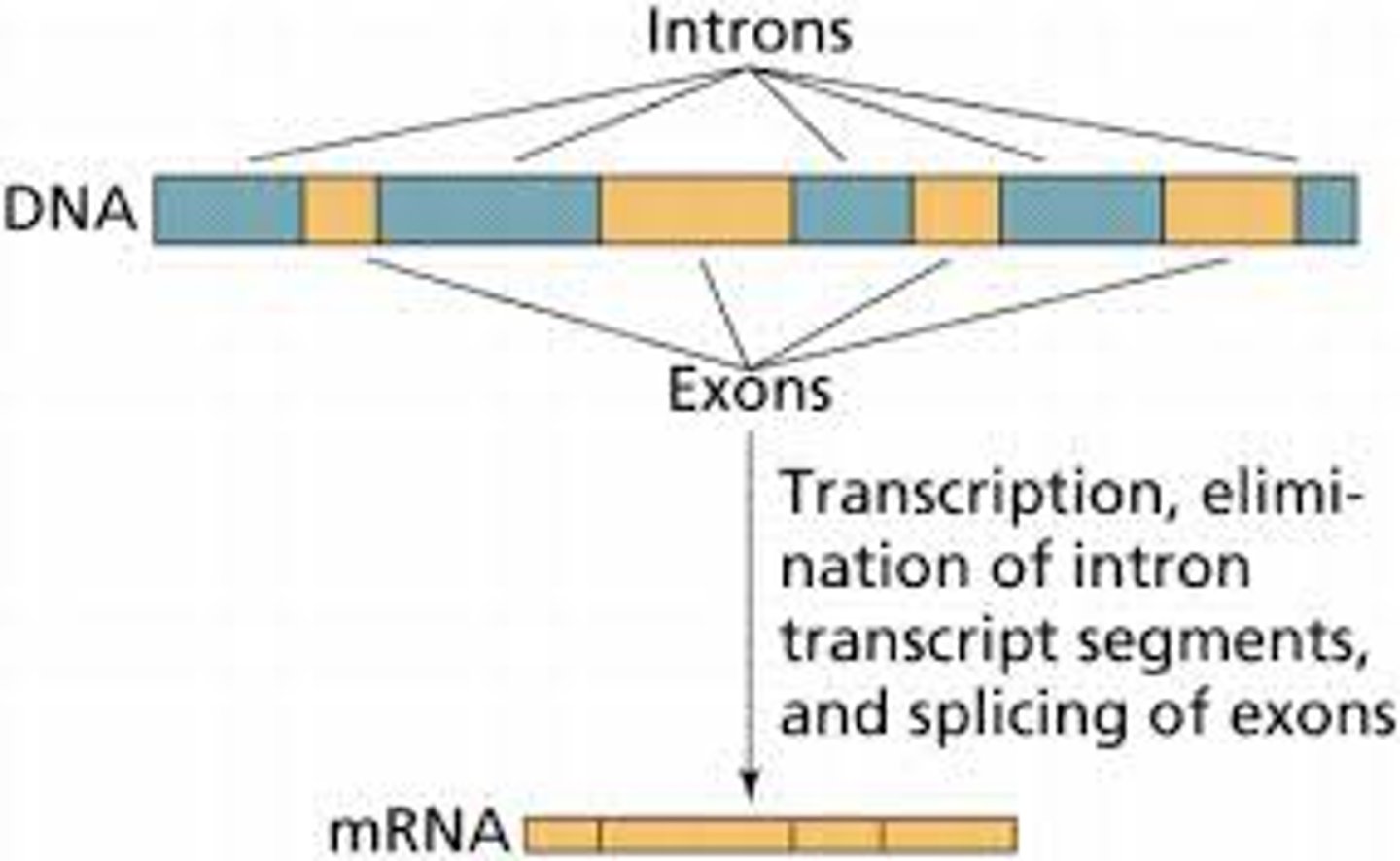
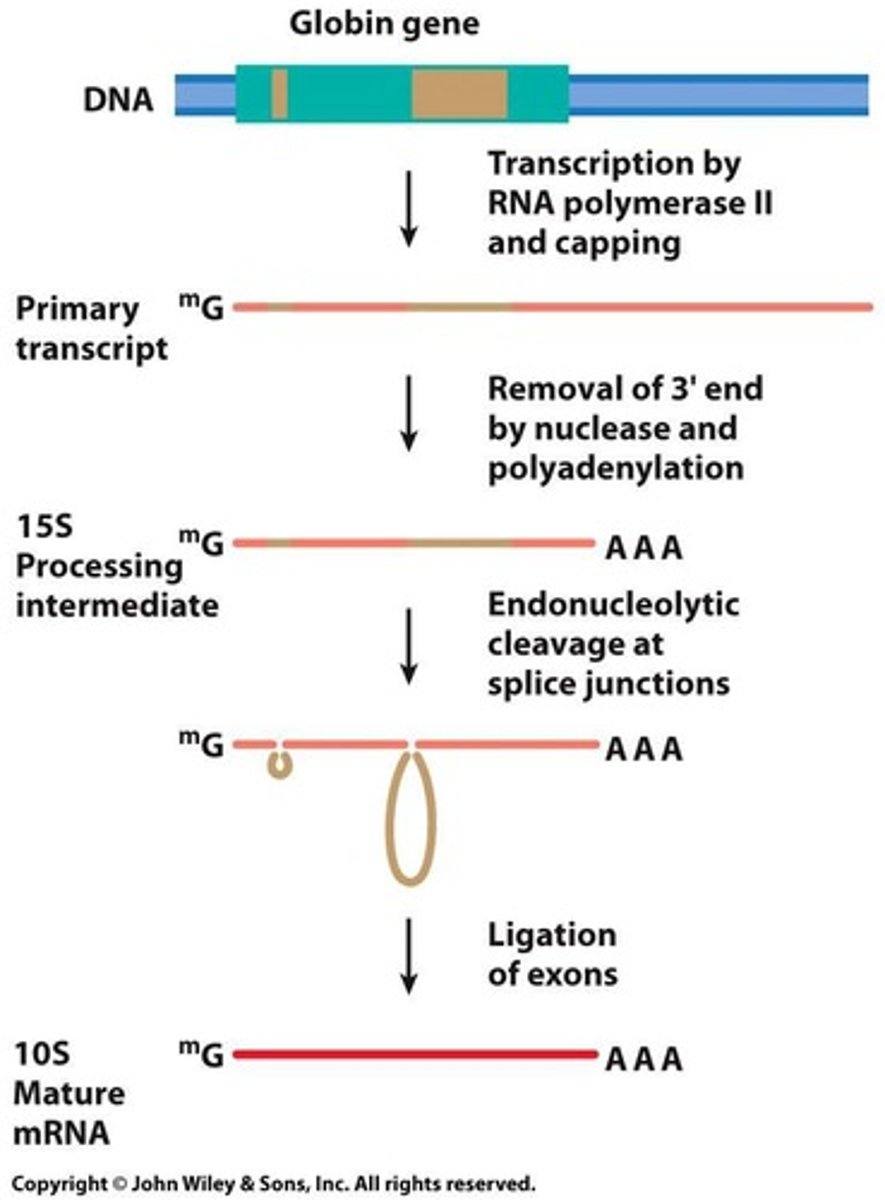
RNA Splicing
Process of removing introns and joining exons to produce the mRNA.
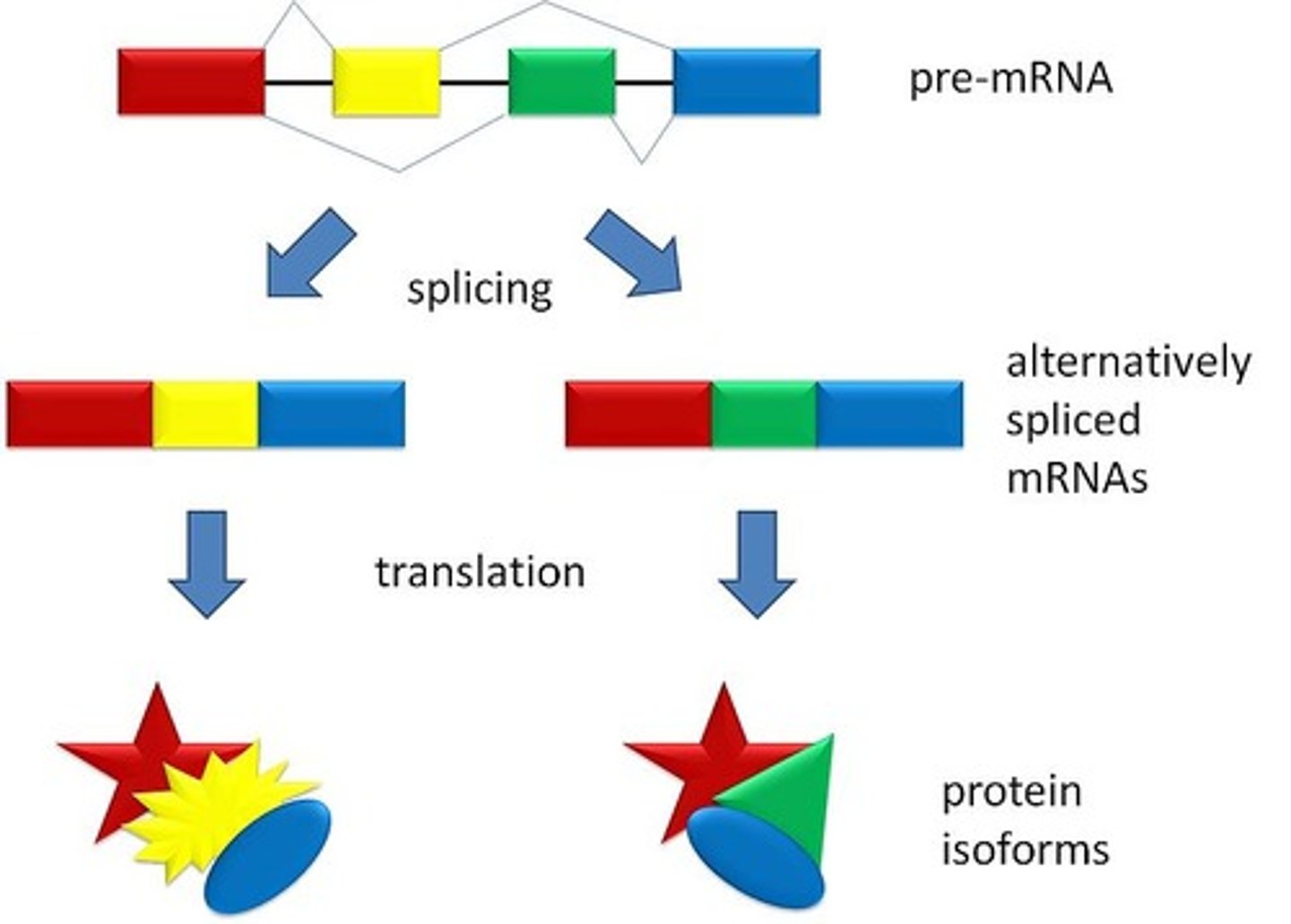
Alternative Splicing
A regulated process during gene expression that results in a single gene coding for multiple proteins
Transcription in prokaryotes
Single RNA polymerase binds randomly to DNA.
Cotranscriptional Processing
Simultaneous processing of RNA during transcription.
Cytoplasm
Location where mRNA is translated into proteins.
Template Strand
DNA strand used for RNA synthesis during transcription.
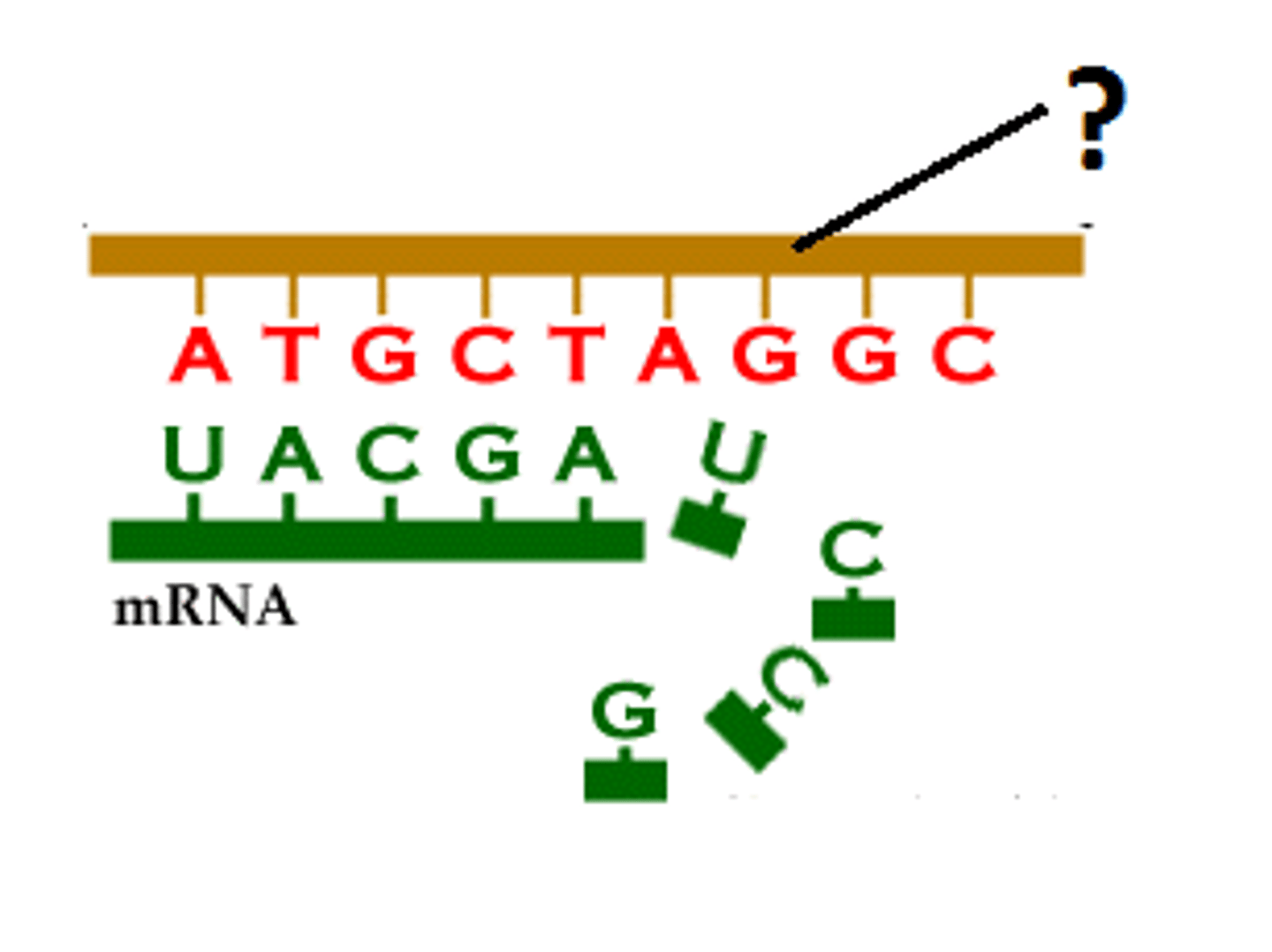
Codons
Information stored in a gene is present as a genetic code.
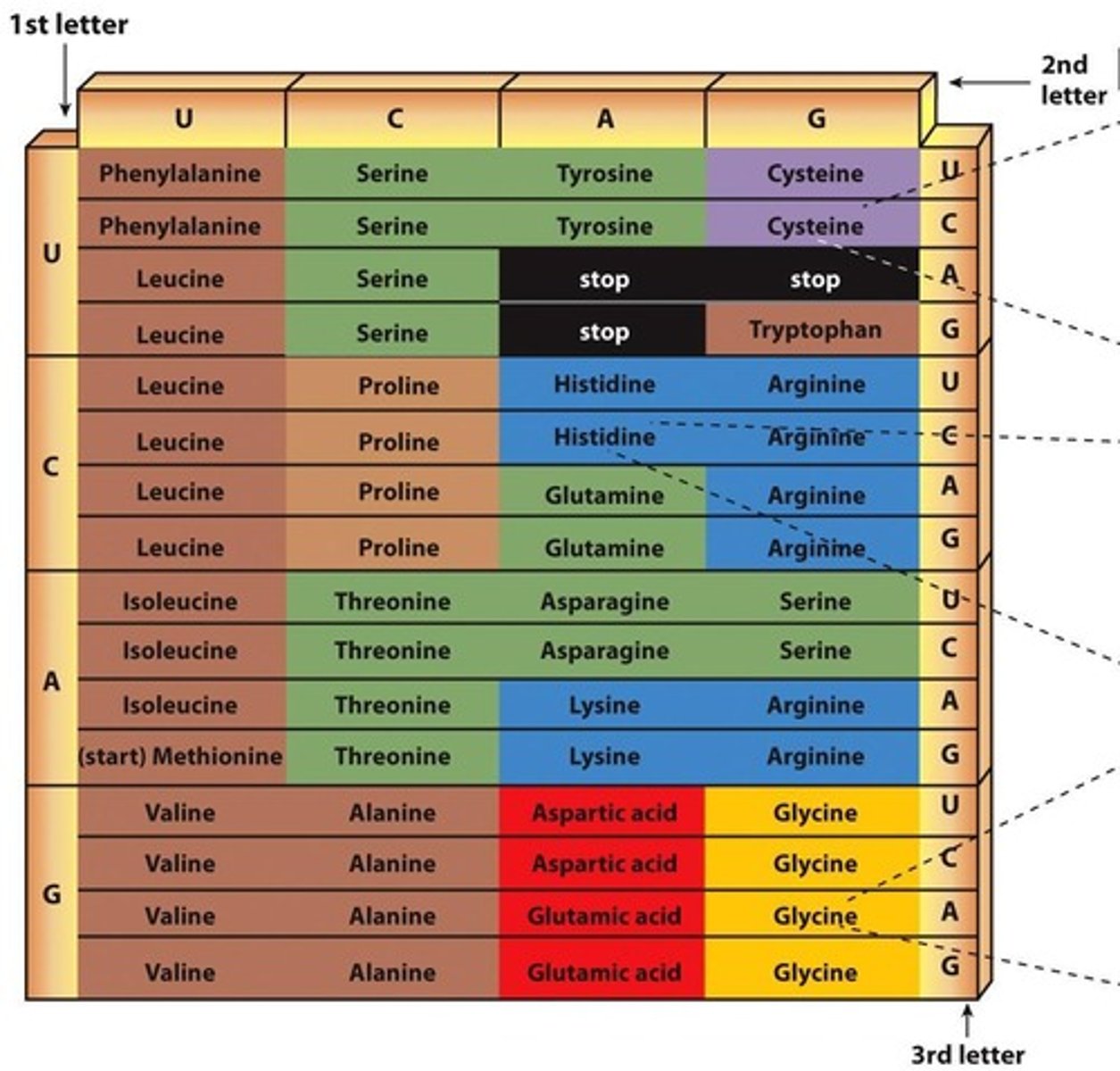
Properties of Codons
Triplets of nucleotides, Non-overlapping, and Degenerate
The first two codon bases for a particular amino acid are _________, whereas the third base may vary.
invariant(never changing)
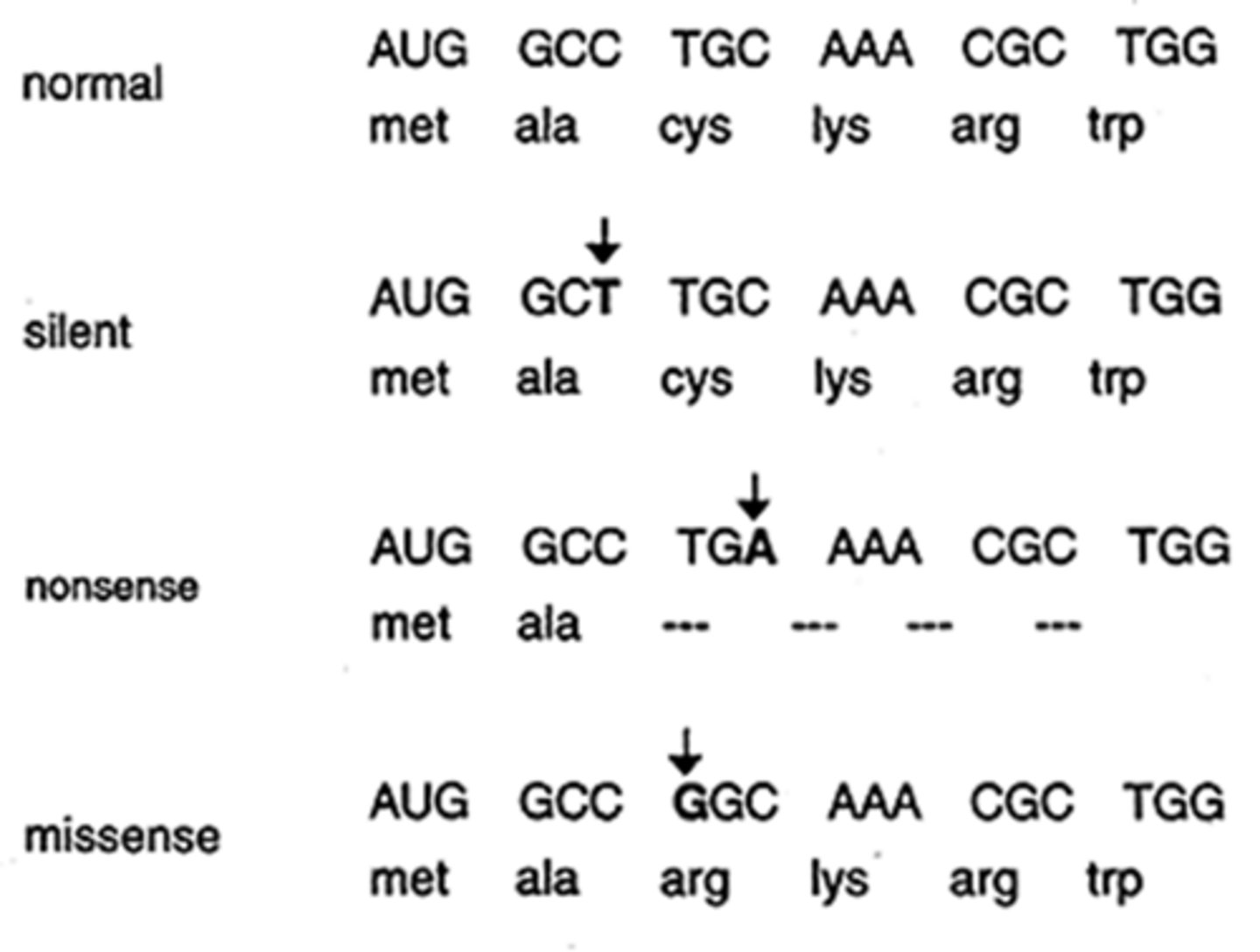
Synonymous Mutation
Mutation that does not change the amino acid sequence.
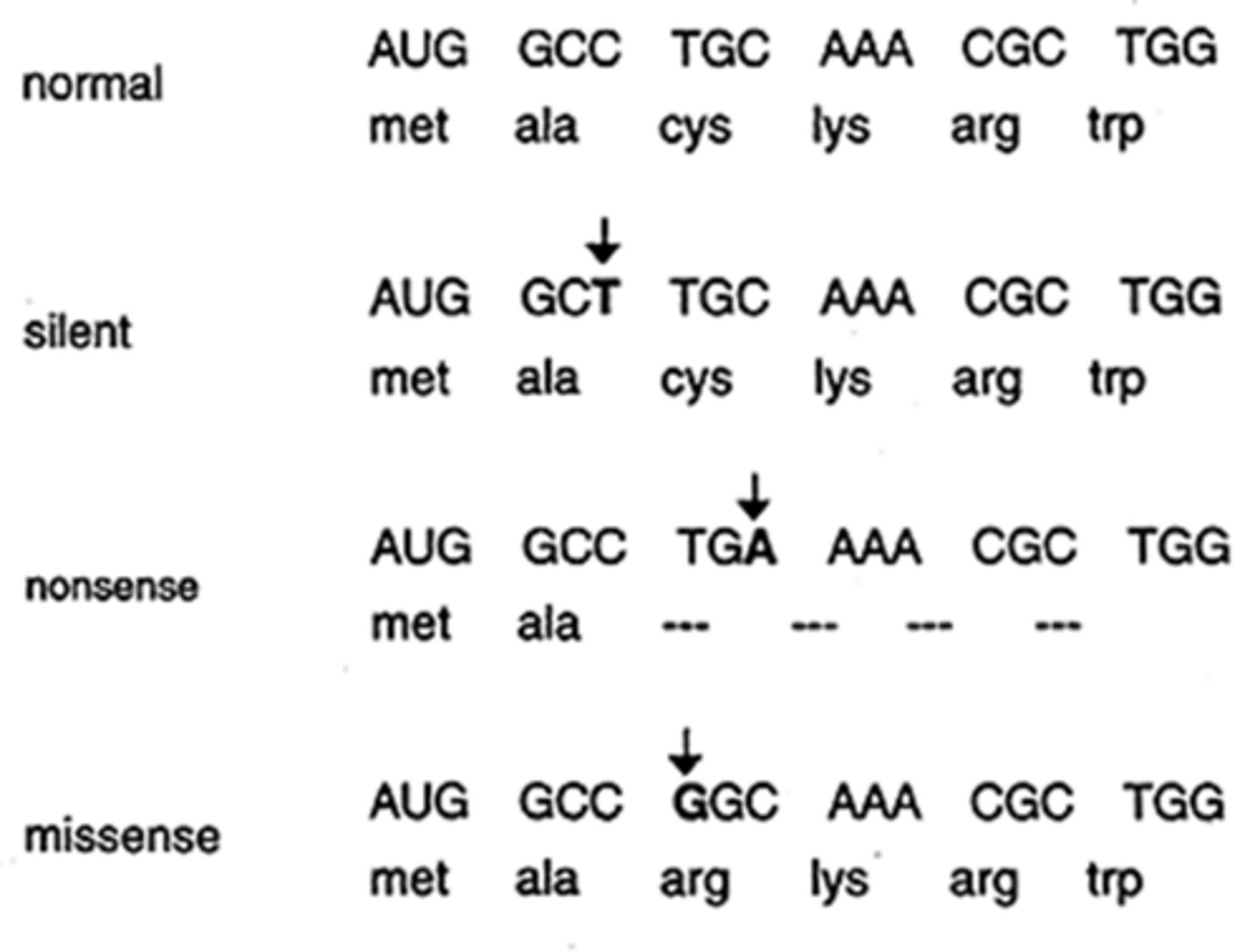
Non-synonymous Mutation
Mutation that results in an amino acid change.
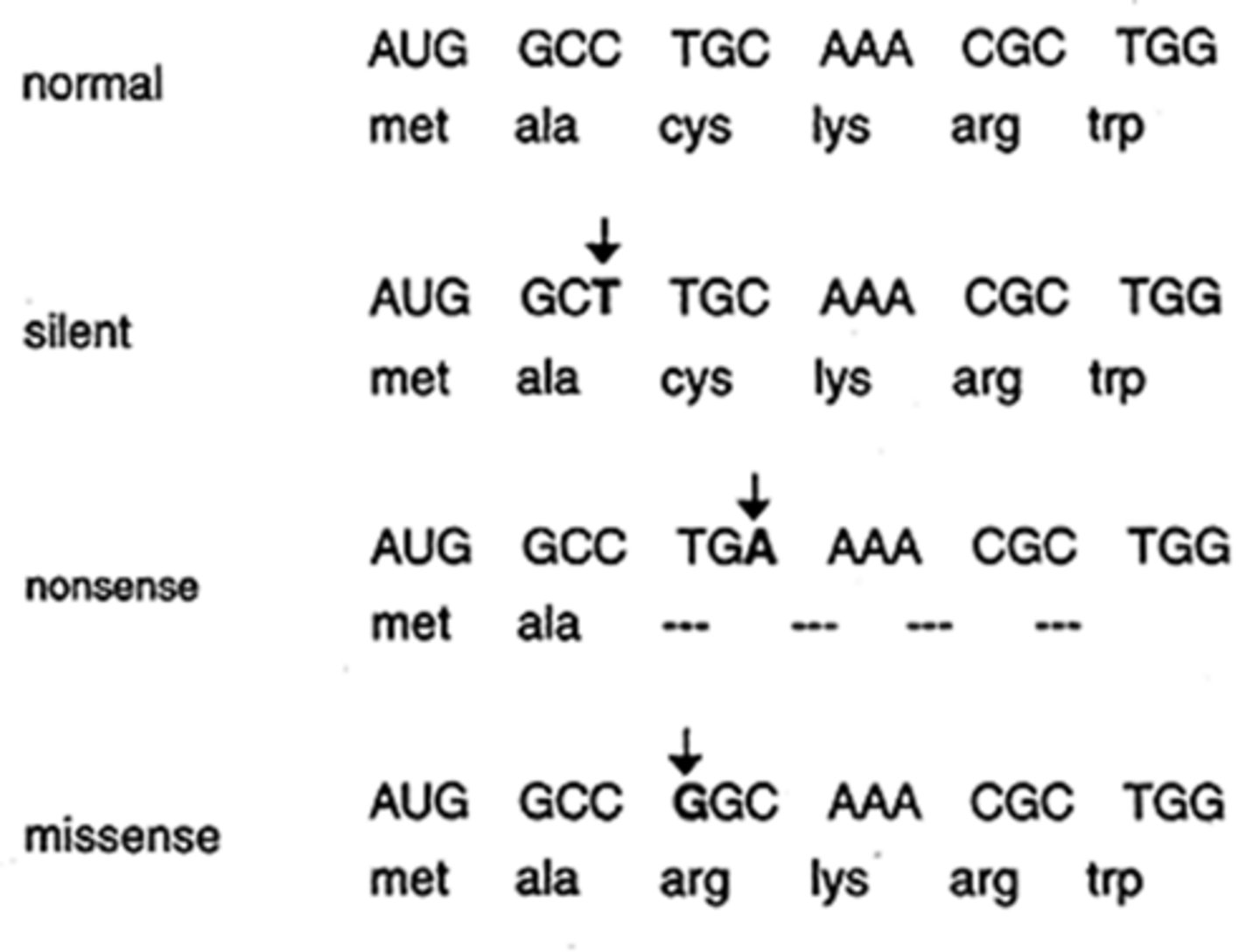
Nonsense Mutation
Mutation creating a premature termination codon.
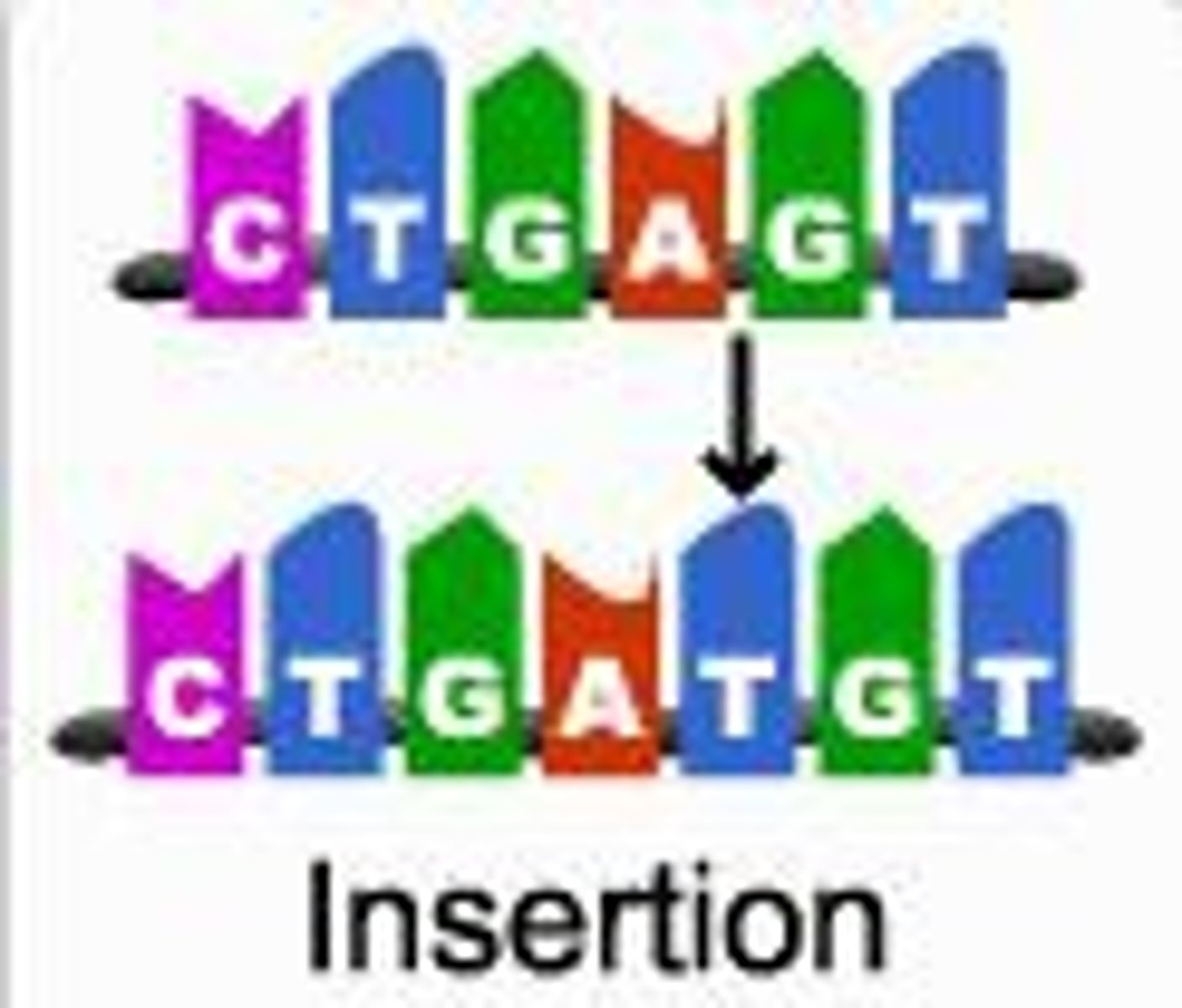
Frameshift Mutation
Insertion or deletion altering the reading frame of mRNA.
tRNA
Translate a sequence of mRNA codons into a sequence of amino acid residues: decoding
tRNA transfer appropriate amino acid to specific __________.
Codons
tRNA structure
73 to 93 nucleotides with cloverleaf shape.
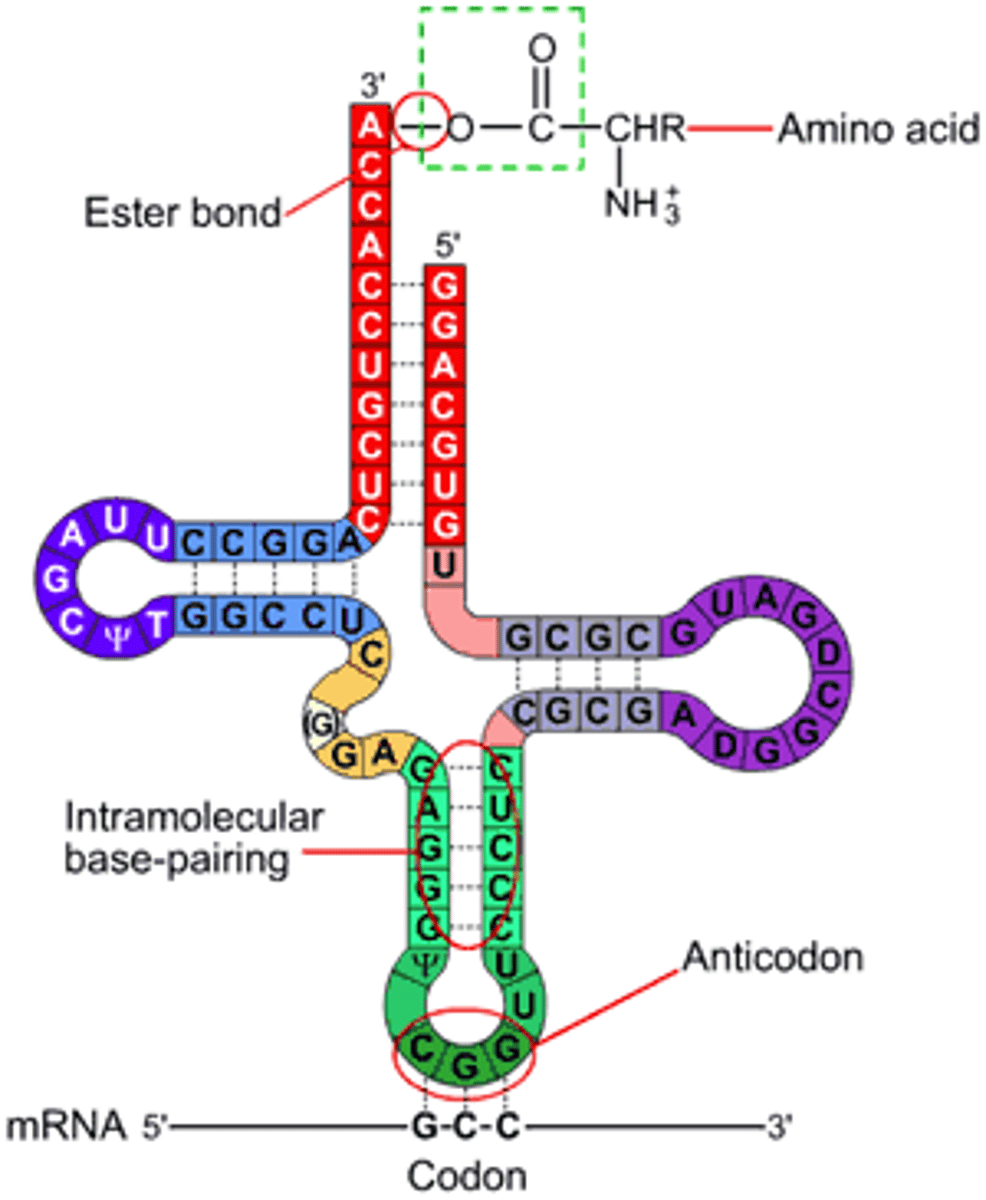
Anticodon
A stretch of three sequential nucleotides resides in tRNA, which decodes codon information by forming complementary base pairs between codons on the mRNA transcript.

Wobble hypothesis
tRNA can recognize variable third codon bases.
3rd position of U
with A or G (codon)
3rd position of G
with U or C (codon)
3rd position of I
with U, C, or A (codon)
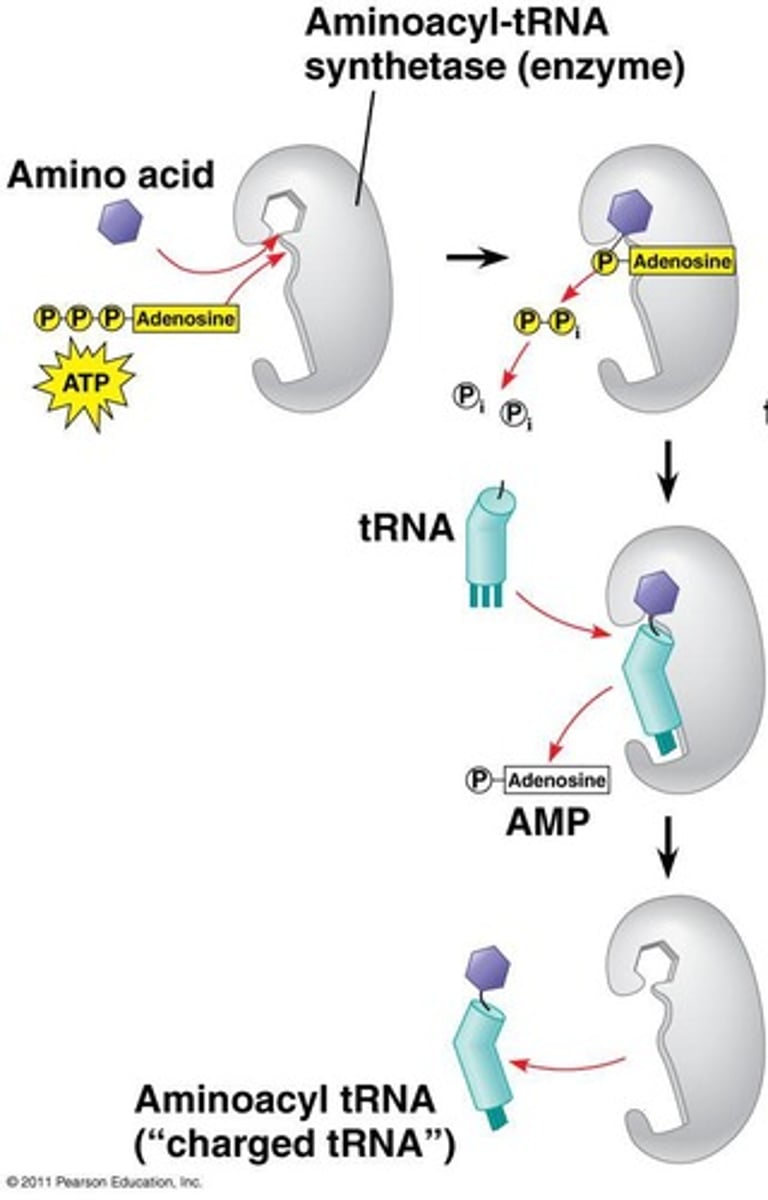
Aminoacyl-tRNA synthetases
Enzymes linking amino acids to tRNAs.
Ribosomes
Cellular structures where translation occurs. (Complex translating mRNA into proteins.)
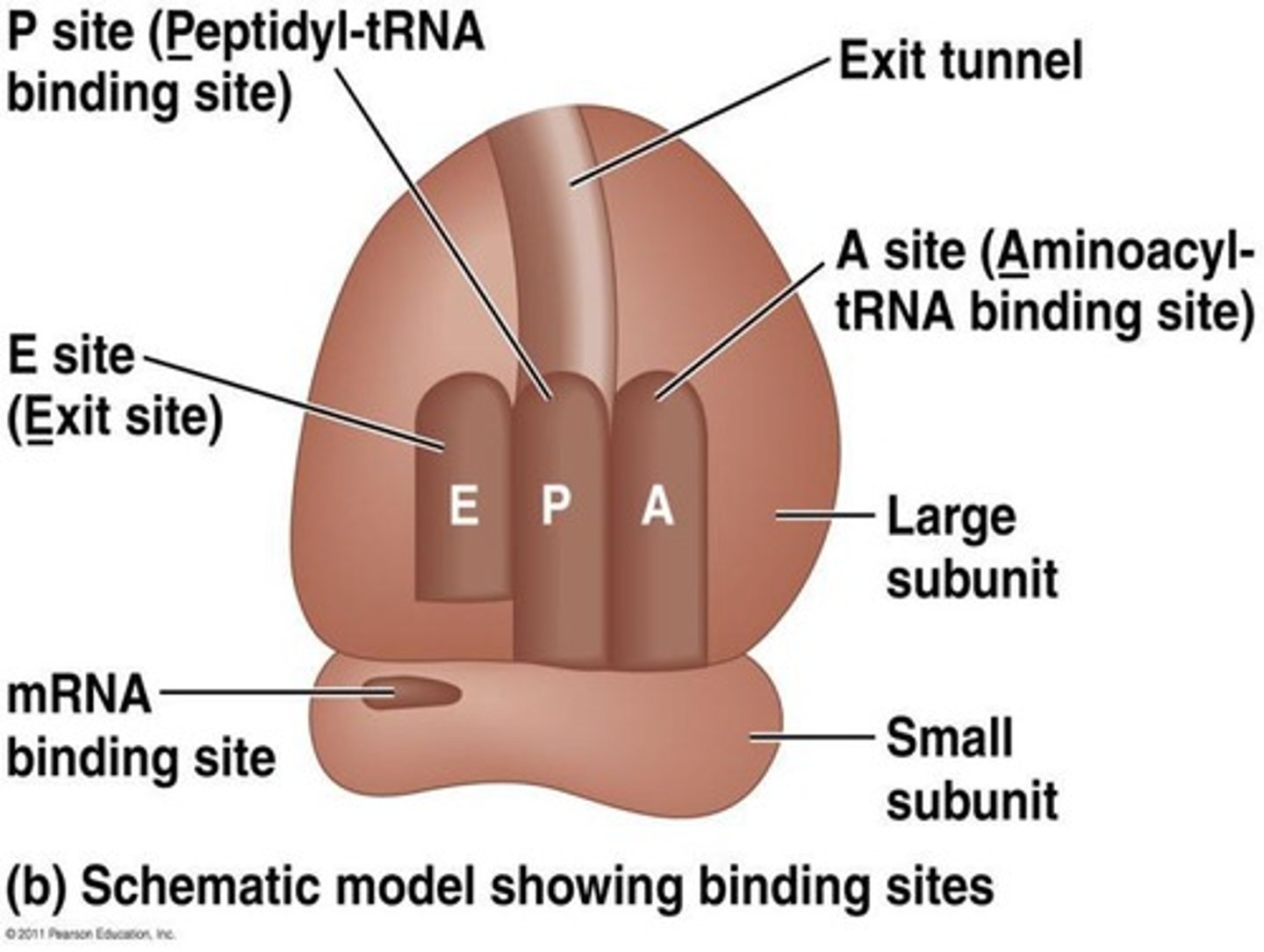
Ribosome complex
Consist of protein subunits(large or small), Ribosomal RNAs, and Transfer RNAs
Eukaryotic ribosome protein subunits
Small (40S) and large (60S) subunits.
Ribosomal RNAs
Act as structural support for ribosome complex and catalyze the chemical reaction in which amino acids are covalently linked to one another.
Transfer RNAs
Required to translate the information in the mRNA nucleotide code into the amino acid
tRNA binding sites
A(aminoacyl), P(peptidyl), and E(exit) sites in ribosome.
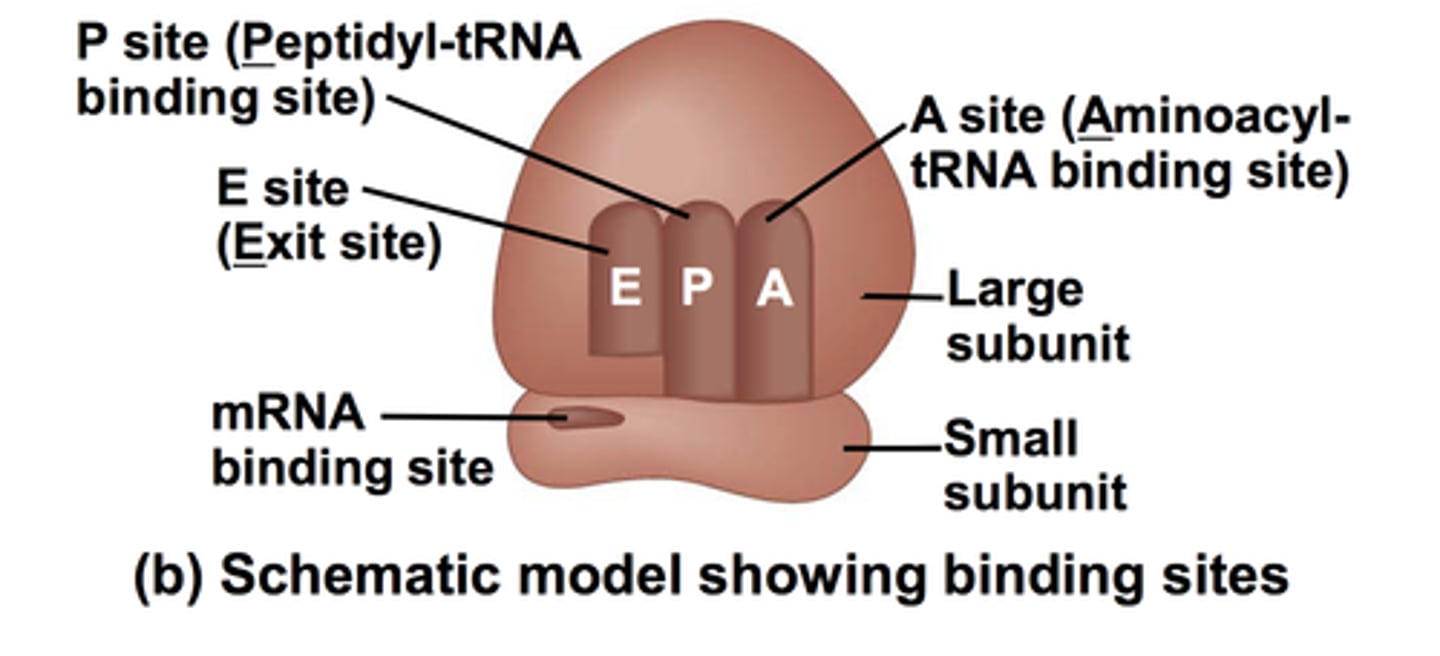
Translation process is _________ between prokaryotes and eukaryotes
similar
Components required for translation
Various tRNAs with their attached AA, Ribosomes, A messenger RNA, Numerous proteins with different functions, GTP, Cations, and rRNA
3 steps of translation
initiation, elongation, termination
what is required for initiation of protein synthesis?
Initiation factors (eIFs)
Initiation codon
AUG (methionine)
Step 1 (Initiation) of Translation
43S complex binds to the 5' end of mRNA complex and scan for the AUG start codon
Step 2 (Initiation) of Translation
Large subunit (60S) joins the complex after 43S complex reaches the appropriate AUG codon
Components of 43S complex
Ribosomal 40S subunit, Initiator tRNA linked to a methionine (AUG), eIFs: eIF2-GTP
Components of mRNA complex
mRNA, eIF4E, eIF4A, and eIF4G
eIF4E function
binds to 5'-cap
eIF4A function
remove double stranded structure
eIF4G function
links 5' and 3' end
Kozak sequence
Defines the AUG start codon.

Elongation Cycle of Protein Synthesis
process of adding each subsequent amino acid to the growing polypeptide chain.
Elongation factors (eEFs)
Proteins required during the elongation phase (also 2 GTP).
Major Steps in Elongation of Translation
Aminoacyl-tRNA selection, Peptide bond formation, Translocation and Releasing the deacylated tRNA
With the charged amino acid in the P site, the next aminoacyl-tRNA binds to the vacant _________ is the first step for elongation.
A-site
Any aminoacyl-tRNA can enter the A site, but ONLY the one with a ______________________ can trigger the ribosome's conformational change.
complementary anticodon
peptidyl transferase
Enzyme responsible for catalyzing peptide bond formation
_____________ of the amino acid bound to the A site tRNA links to ____________ of the amino acid bound to the P site tRNA to form a peptide bond.
Amine nitrogen, carboxyl carbon
Translocation
procedure by which the ribosome moves three nucleotides (one codon) in the 5’ to 3’ direction on the mRNA molecule
Releasing the deacylated tRNA
The deacylated tRNA leaves the ribosome and empty the E site of the ribosome
Stop codons
UAA, UAG, or UGA signal termination.
Release factors
Proteins that recognize stop codons.
eRF1
Release factor for Eukaryotic cells, which recognize all the stop codons
Polyribosome (polysome)
A complex of multiple ribosomes on mRNA, allowing simultaneous translation.
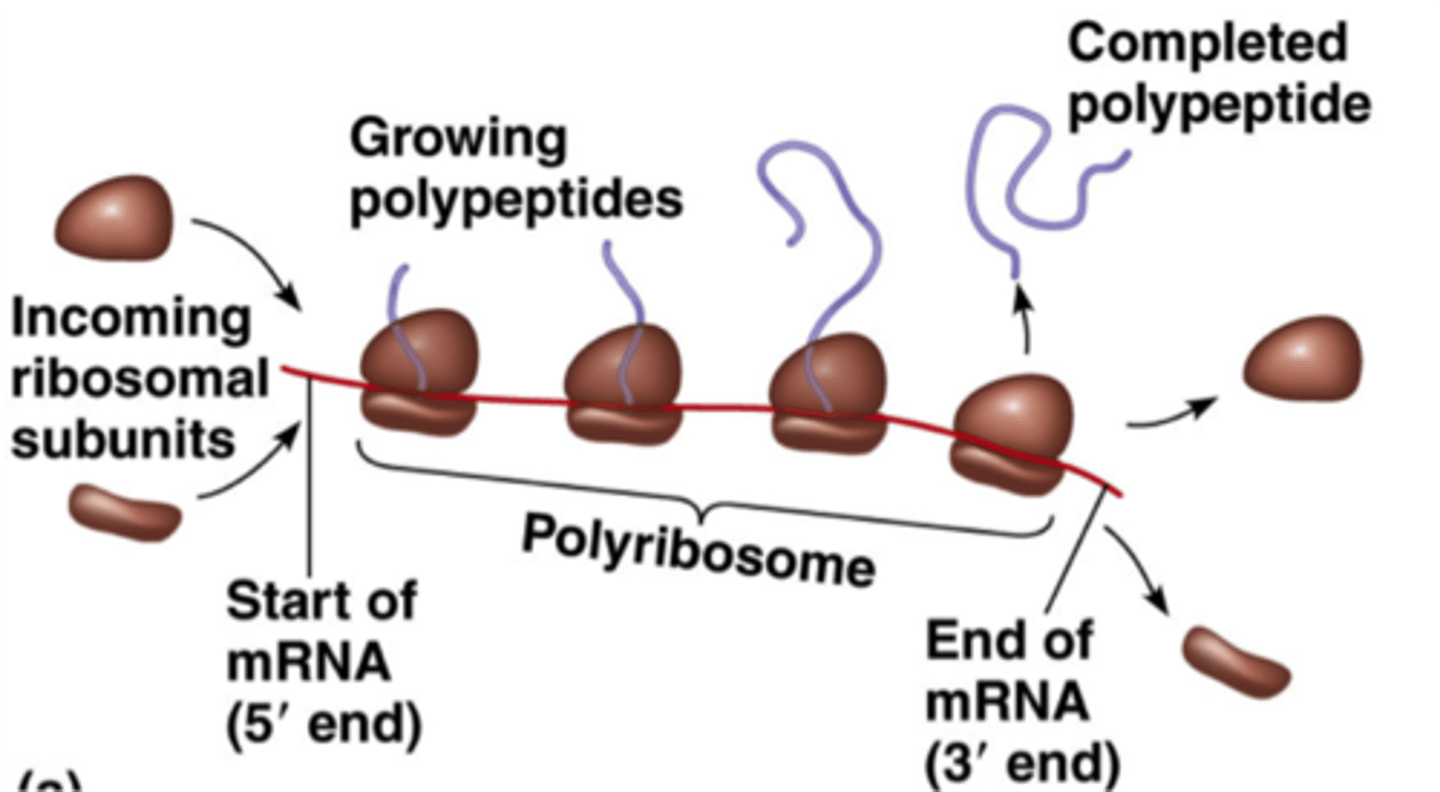
polyribosomes function
increase the rate of protein synthesis