Classical Methods of Analysis
 Call Kai
 Learn
Learn Practice Test
 Spaced Repetition
 Match
Match Flashcards
 Knowt Play
1/133

There's no tags or description
Looks like no tags are added yet.
Name | Mastery | Learn | Test | Matching | Spaced | Call with Kai | Chat |
|---|
No analytics yet
Send a link to your students to track their progress
134 Terms
Example of volumetric analysis
Titration
What does titration involve?/Definition of titration
It involved the determination of the amount of substance by measuring volumes upon reaction with a second substance necessary to react completely with the substance being analyzed
What year was Bronsted Lowry acid-base theory given?
1923
Definition of acid (according to Bronsted-Lowrry)
An acid is a chemical species that can donate a proton
Definition of base (according to Bronsted-Lowry)
A base is a chemical species that can accept a proton
Whar us conjugate acid-base pair?
An acid base pair related by this equation is known as conjugate acid-base pair

Conjugate acid-base pair definition
A conjugate acid-base pair is two chemical species that differ from each other by exactly one hydrogen ion
Conjugate Acid: The species that donates the proton.
Conjugate Base: The species that accepts
What will the stronger of two acids do?
• The stronger of two acids will displace the weaker from its salt. For example, if HCl is added to a solution of sodium acetate, acetic acid is generated.
• Strong acids have large dissociation constants, ka. The greater the degree of dissociation, the more protons are produced.
What does weak acid do?
Weak acids dissociate to a small extent
Relationshiop of pKa value and acid
Stronger an acid, smaller its pKa value
pH of aqueous solution of 0.1M HCl
1
pKa of HCl
-6.0
pH of aqueous solution of 0.1M acetic acid
2.88
pKa of acetic acid
4.75
Ionisation of strong and weak bases
Strong bases are completely ionised in water. Weak bases are not completely ionised in water
Relationship of strong base and pKb
The stronger the base, the greater the dissociation, the larger the value of dissociation constant, Kb and smaller the pKb
pKb of ammonia
4.75
pKb of pyridine
8.77
What is the pKa of pyridine and what does it mean?
The pKa of pyridine is 5.23. This means that the pKa of the conjugate acid of pyridine is 5.23
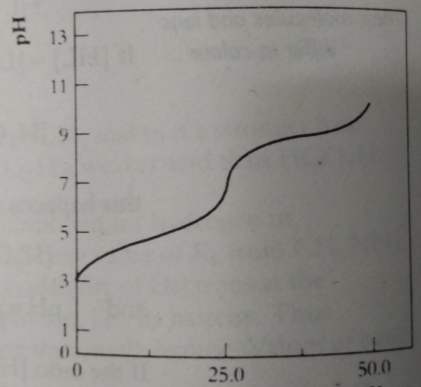
What does the titration curve show and what does it depend on?
Titration curves show the changes in pH during the course of a titration
Titration curves depend on the strength of rhe reacting acids and bases
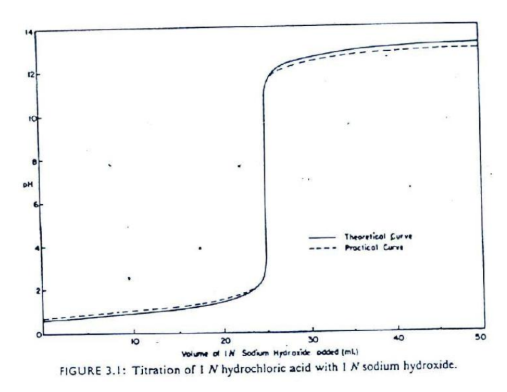
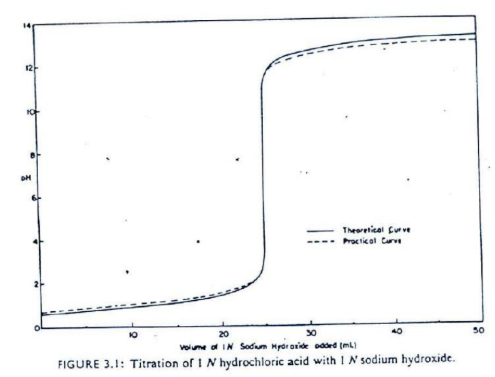
Titration of strong acid using a strong base
• Conical flask contains: Strong acid
• Burette contains: Strong base
• Initial pH of solution in conical flask: 0 – 2
• When base is added, pH increases.
• The stoichiometric point occurs at pH 4.3-9.8.
• The slope is steepest for this type of titration.
• The final pH of the solution in the conical flask is that of the strong base: 12 – 14.
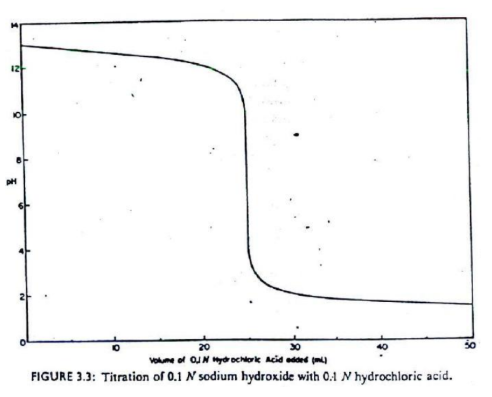
Ttiration of a strong base using a strong acid
• Conical flask contains: Strong base
• Burette contains: Strong acid • Initial pH of solution in conical flask: 12 - 14
• When acid is added, pH decreases.
• The stoichiometric point occurs at pH 4.3-9.8.
• The slope is steepest for this type of titration.
• The final pH of the solution in the conical flask is that of the strong acid: 0 - 2
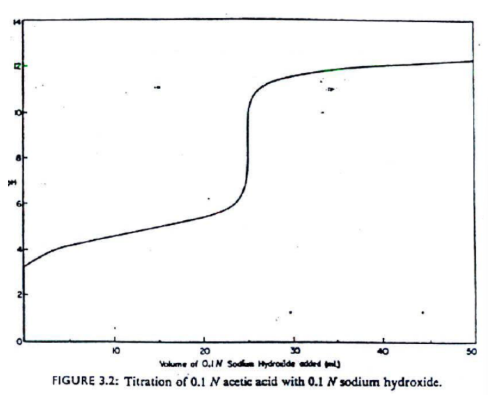
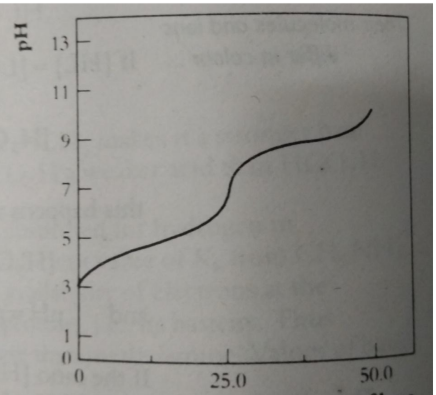
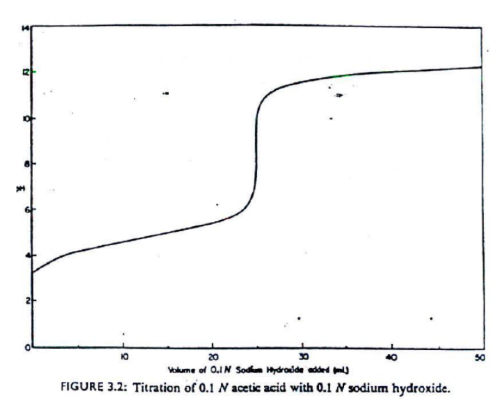
Titration of weak acid using a strong base
• Conical flask contains: Weak acid
• Burette contains: Strong base
• Initial pH of solution in conical flask: 2 - 7
• When base is added, pH increases.
• The stoichiometric point occurs at pH 7.5-10.
• Since the weak acid is in equilibrium with water, there is gradual change in pH. So the slope is not very steep before the equivalence point.
• The final pH of the solution in the conical flask is that of the strong base: 12 – 14
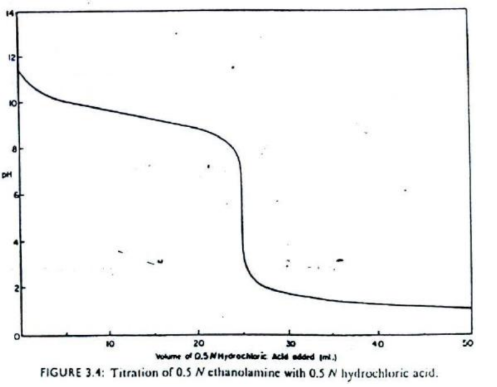
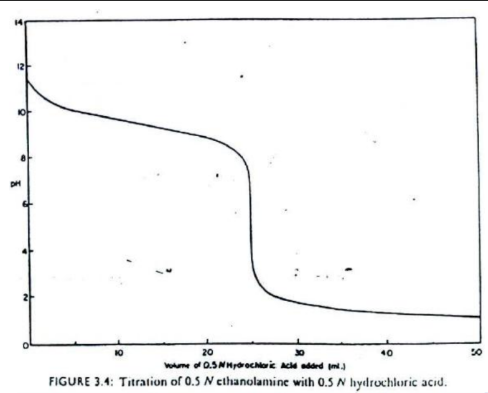
Titration of weak base using a strong acid
• Conical flask contains: Weak base
• Burette contains: Strong acid
• Initial pH of solution in conical flask: 7-12
• When base is added, pH decreases.
• The stoichiometric point occurs at pH 6.5-4.
• Since the weak base is in equilibrium with water, there is gradual change in pH. So the slope is not very steep before the equivalence point.
• The final pH of the solution in the conical flask is that of the strong acid: 0-2.
Titration of weak acid using a weak base
• Conical flask contains: Weak acid
• Burette contains: Weak base
• Initial pH of solution in conical flask: 2 - 7
• When base is added, pH increases.
• The equivalence point occurs at approximately pH 7.
• Since the weak acid is in equilibrium with water, there is gradual change in pH. So the slope is not very steep before the equivalence point.
• Since the weak base is in equilibrium with water, there is gradual change in pH. So the slope is not very steep after the equivalence point.
• The final pH of the solution in the conical flask is that of the weak base: 9 – 12.
Equivalence point
• In a titration, a solution of known concentration (ie. titrant) is added to a known volume of a solution (ie. analyte) whose concentration is to be determined.
• Titrant is added to the analyte until the amount of titrant added is chemically equivalent to the amount of analyte (ie. number of moles of titrant is equal to the number of moles of analyte, or some multiple).
• The equivalence point or the stoichiometric point is the theoretical point at which the reaction is complete or when exactly equivalent amounts of the two reactants have been mixed.
End point
• The experimental estimate of the equivalence point is called the end point of the titration.
• The end point occurs when sufficient titrant has been added to effect a physical change in the solution which signals the completion of the reaction.
• The end point in an acid/ base titration curve may be detected potentiometrically or by a colour indicator method.
• Potentiometric determination is more precise than colour indicators.
• However, all the strong acid/ strong base, weak acid/ strong base and weak base/ strong acid titrations give excellent indicator end points.
Colour indicator
• A colour indicator is a compound which shows a well defined change in colour over a definite pH range.
• Most indicators are mainly weak organic acids but few are weak bases.
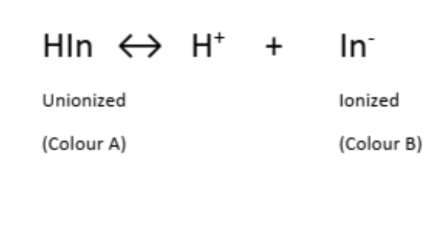
• The colour change is associated with a change from unionized to ionized forms (or vice versa) of the weak acid or base.
Colour indicator mechanism
• In solution, these indicators will exist as an equilibrium mixture of the two forms according to the usual reversible reaction.
• If a solution of an indicator is added to a titration mixture, its pH will cause the indicator equilibrium to reach a new value which might be represented by a percentage ionization.
• As titrant is added to the titration mixture, change in pH will occur, and the indicator equilibrium will be displaced to a new value, represented by a new percentage ionization.
• As more titrant is added, a point will eventually be reached when the solution will show a definite colour change associated with the change in percentage ionization of the indicator (10% colour A; 90% colour B).
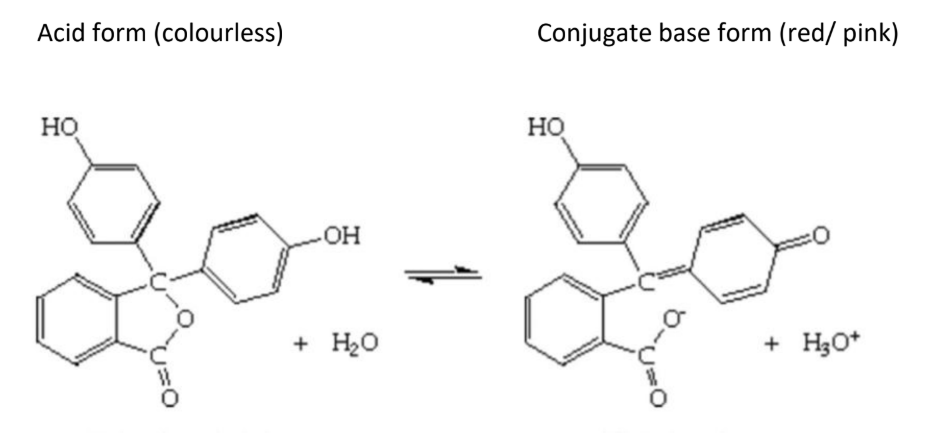
Phenolphthalein
acid form (colourless) ↔ conjugate base form (red/pink)
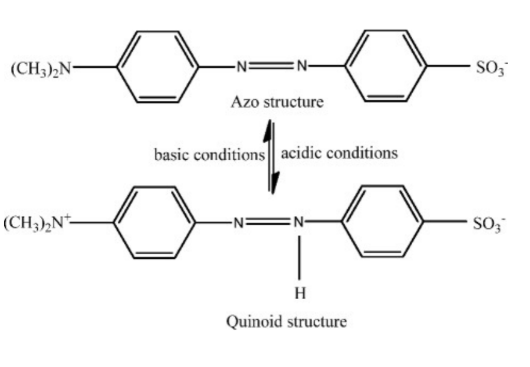
methyl orange
base form (yellow) ↔ comjugate acid form (red)
For titration of strong base with strong acid, or strong acid with strong base-
all indicator can be used
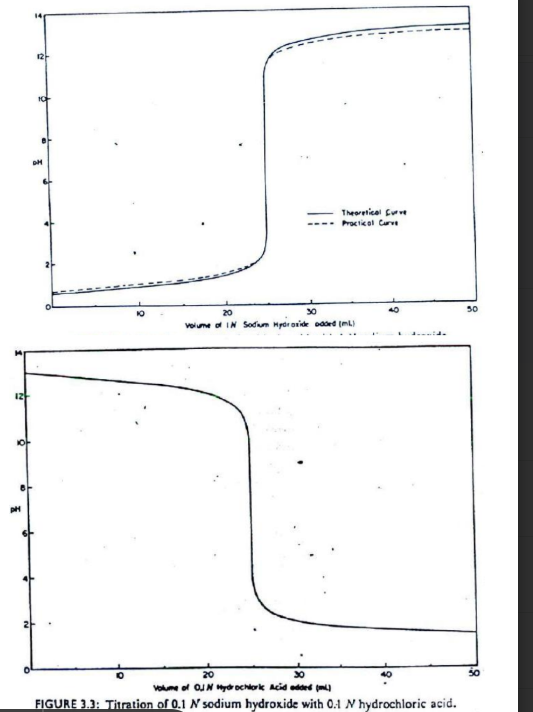
For titration of strong acid
• Rapid change in pH occurs over pH range under 7 (6.5-4).
• Indicator that can be used: Methyl orange
• Effective range of indicator: 2.9 – 4.0
• Below 2.9: red
• Above 4.0: yellow
For titration of weak acid with strong base
• Rapid change in pH for decinormal solutions occurs over pH range 8 to 9.5 (7.5-10).
• Indicator that can be used: Phenolphthalein
• Effective range of indicator: 8.3 - 10
• Below 8.3: Colourless
• Above 10: Pink/ red
For titration of weak base
• Rapid change in pH occurs over pH range under 7 (6.5-4).
• Indicator that can be used: Methyl red
• Effective range of indicator: 4.4 – 6.0
• Below 4.4: red
• Above 6.0: yellow
For titration of weak acid with weak base
the change in pH at the equivalence point is gradual. No indicator will give a sharp end point.
To overcome this,
• Weak acids are titrated using strong bases
• Weak bases are titrated using strong acids
• Potentiometry is used
What is analyte?
Solution of unknown concentration
What is titrant?
Solution of known concentration
What is standard solution?
A titrant which contains a known amount of reactant in each unit of volume is a standard solution
What is acidimetry?
Acidimetry involves the determination of acidic substances by titration with a standard base solution
What is alkalimetry?
Alkalimetry is the measurement of basic substances by titration with a standard acid
Concentration of solutions, M
• The molarity of a solution is the number of moles of solute in each liter of solution.
• For example, 0.1 M HCl solution contains 0.1 mole or 3.65 g of HCl per liter.
• The molarity of a solution is independent of the reaction in which the solution is involved.
Concentrations of solutions, N
• In volumetric analysis, it is important to be able to express the concentration of a solution in terms of its ability to neutralise the opposite species.
• The equivalent weight (equiv. wt.) of a substance is based upon the reaction in which it is involved.
• In neutralization reactions, the equivalent weight is defined as that quantity of acid or base which will furnish or react with 1 gram atomic weight of hydrogen ion.
Concentration of solutions, N, for acids
• For acids, equivalent weight is the molecular weight divided by the number of hydrogens which are replaced or neutralized.
• The equivalent weight of HCl is the same as the molecular weight.
• The equivalent weight of H2SO4 is its molecular weight divided by 2.
Concentration of solutions, N, for bases
• For bases, equivalent weight is the molecular weight divided by the number of hydrogen atoms it is capable of neutralizing.
• The equivalent weight of NaOH is the same as the molecular weight.
• The equivalent weight of Na2CO3 is its molecular weight divided by 2.
What is meant by the normality of a solution? Explain the concept of titer value using suitable examples.
• The normality of a solution is the number of equiv. wt of solute in each liter of solution.
• For example, 0.1 N HCl solution contains 3.65 g of HCl per liter.
• In the official compendia, it is the practice to express the equivalency of a standard solution with the amount of substance under assay.
• This is known as the titer value (number of mg of substance equivalent to 1 mL of the standard
solution).
• For example, the USP states “Each mL of 1 N sodium hydroxide is equivalent to 60.06 mg of acetic acid.”
Standardization of solutions
• The process of determining the exact strength of a standard solution is known as standardization.
• Standard solutions used in volumetric analysis can be prepared by weighing an exact amount of reagent to give a desired normality or molarity.
• The accurately weighed amount of chemical is then transferred to a volumetric flask and diluted to the mark with solvent.
• The solution is then standardised using a primary standard.
• In standardizing a solution, the primary standard should be selected which closely resembles the type of substance for which the solution is to be used for analysis.
• For example, if a base is to used for the analysis of a weak acid, the primary stndard should be potassium acid pthalate.
Properties of ideal primary standard
• It is a white crystalline solid.
• It is not hygroscopic.
• It is a substance of extremely high purity.
• It is of known composition.
• It is stable to air and light.
• It can be dried at 1100 C without decomposition.
• It should readily dissolve in water.
• It should react quantitatively with the solute in the titrant being standardized.
• It should have high molecular weight.
properties of primary standard potassium acid pthalate (KHC8H4O4)
Equivalent weight- 204.22
● white crystalline solid
● available in highly pure state
● water soluble
● stable up to a temperature 110°C
● Recommended as a primary standard for solutions of strong bases
properties of primary standard sodium carbonate (Na2CO3)
Equivalent weight- 53
● white crystalline solid
● available in highly pure state
● water soluble
● stable up to a temperature 270°C
● Recommended as a primary standard for solutions of acids
Properties of ideal titrants
• The acid or base should be strong so that weak acid and bases can be titrated visually with readily detectable end point.
• It should be sufficiently soluble in water.
• Solutions should be stable under usually laboratory conditions to avoid frequent restandardizations.
• Oxidizing and reducing agents are not desirable as acid-base titrants.
• Volatile compounds are not desirable.
• Their salts should be soluble in water.
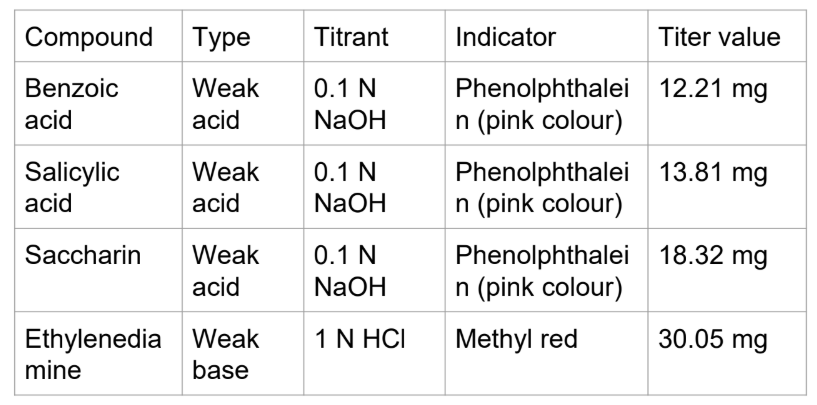
Direct titration
• A direct titration involves the addition of a standard solution into the solution being analysed until the end point is reached.
• The end point is readily discernible by the change in colour of the indicator or from the inflection in the titration curve obtained by a potentiometric titration.
Applications from USP
Residual titration
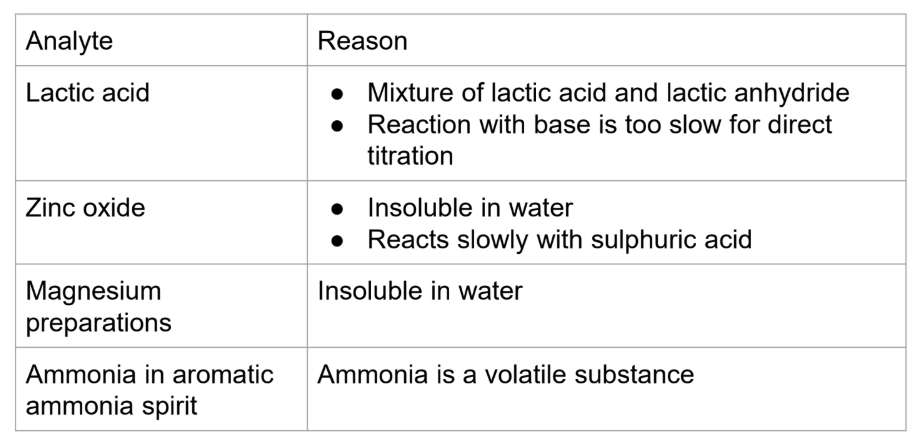
• Residual titration or back titration is successful when direct titration is not feasible.
• In this procedure, a known excess of acid or base titrant, more than is sufficient to react completely with the compound being analysed, is added to the sample. After reaction is complete, the excess reagent is determined by titration with a standard solution of the opposite species.
Applications from pharmacopoeia
Advantages of titration
• Capable of a higher degree of precision and accuracy than instrumental methods of analysis, with precisions of ca ± 0.1% being achievable.
• The methods are generally robust.
• Analyses can be automated.
• Cheap to perform and do not require specialised apparatus.
• They are absolute methods and are not dependent on the calibration of an instrument
Disadvantages of titration
• Non-selective.
• Time-consuming if not automated and require a greater level of operator skill than routine instrumental methods.
• Require large amounts of sample and reagents.
• Reactions of standard solutions with the analyte should be rapid and complete.
What is oxidation
• Combination of a substance with oxygen
• Loss of electrons
What is reduction
• Removal of oxygen from a substance
• Gain of electrons
Oxidation–reduction reaction or Redox reaction
• Oxidation and reduction occur simultaneously.
• If there is one species undergoing oxidation, then another species undergoes reduction at the same time.
• In a redox reaction, two half-reactions are involved.
• Each half reaction involves a redox conjugate pair.
• The net process of the overall reaction is transfer of one or more electron from one pair to the other.
• In a redox reaction, one species is required to donate electrons and another species is required to accept electrons.
Oxidizing agent
• The reactant that gains electron in a redox reaction.
• It is reduced in the process.
• Reduction half-reaction:

Reducing agent
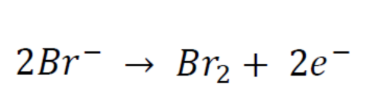
• The reactant that loses electrons in a redox reaction.
• It is oxidized in the process.
• Oxidation half-reaction:
What is reduction potential and how does it relate to the strength of oxidizing agents?
• Reduction potential is a measure of how thermodynamically favorable it is for a compound to gain electrons.
• High positive values of reduction potential indicate that the compound is readily reduced.
• If a compound is readily reduced, it is a strong oxidizing agent.
• It should easily remove electrons from a compound with lower reduction potential.
Define titrant and analyte and explain acidimetry, alkalimetry, and redox titrations with suitable examples
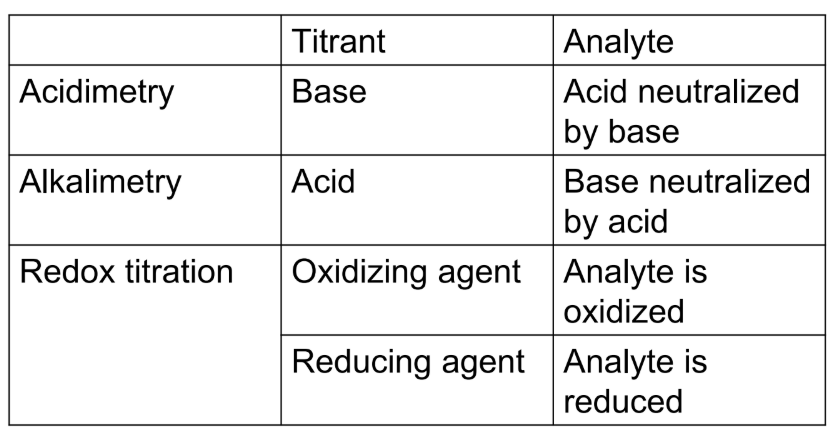
Types of oxidation-reduction titrations
1. Potassium bromate; Potassium bromate- Bromine (0.1N Bromine)
2. Potassium Iodate
3. Iodimetric, iodometric determinations
4. Ceric sulphate
5. Potassium permanaganate
6. Potassium dichromate
Iodimetric titration
• Iodine has reduction potential +0.536 V.
• Substances with reduction potential less than that of iodine can undergo oxidation with iodine.
• Iodine solutions of desired concentration may be prepared by dissolving and then diluting to volume a known weight of iodine.
• Iodine is volatile. Therefore, KI is added to the solution. The triiodide ion formed is water soluble and has greater stability.
• The iodine solution should be stored in light protected container not above room temperature.
Starch as indicator
• The hydrolysis products of starch beta amylose and amylopectin, form a blue- purple and a red -purple colour with iodine, respectively.
• In an iodimetric reaction, iodine (deep brown) is reduced to iodide ions (colourless). When all the analyte is oxidized, addition of another drop of iodine turns the solution pale yellow in colour (unstable).
• Addition of starch at this point, gives a more accurate end-point because the starch-iodine complex is more stable. However, starch may also be added at the beginning.

Applications of iodimetric titrations in pharmacopoeia
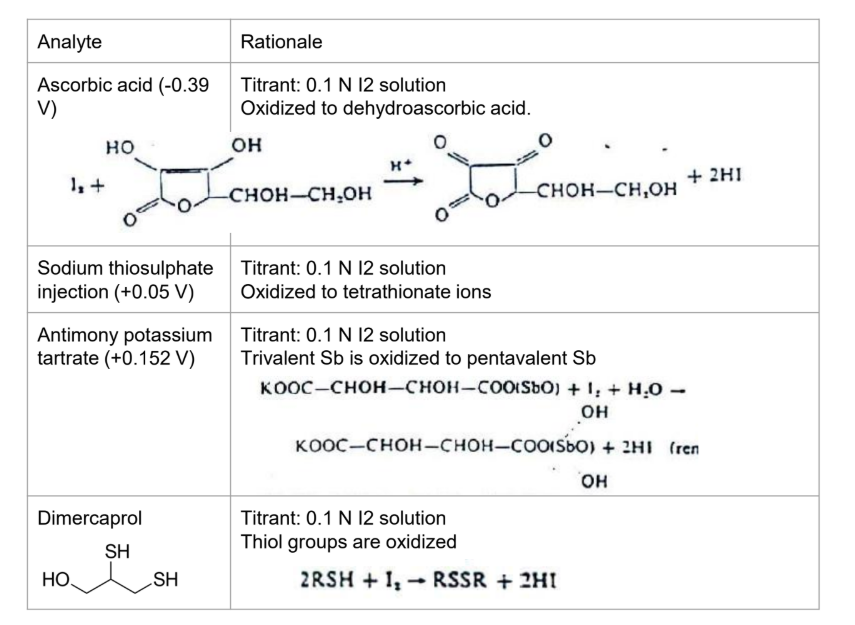
Standardisation of iodine solution
• Due to its volatility, iodine solution is not a primary standard solution.
• Iodine solutions can be standardised with sodium thiosulphate solution.
• Iodine oxidizes sodium thiosulphate to sodium tetrathionate (+0.17V).
• Iodine is reduced to iodide.

Standardisation of sodium thiosulphate solution: Dichromate titration
• Sodium thiosulphate solution is not a primary standard solution because of probability of contamination with sulphur bacteria.
• Standardisation depends upon the release of iodine from potassium iodide by an oxidizing agent.
• The USP recommends potassium dichromate (+1.33 V) as oxidizing agent and starch as indicator.

Potassium permanganate titration
• Under acidic conditions, potassium permanganate is a strong oxidizing agent.
• Titrations with potassium permanganate are self indicating, not requiring extra indicators.
• Potassium permanganate solution is unstable in presence of direct sunlight and upon contamination with organic matter.
• Solutions are standardised with oxalic acid solution.

Applications of permanganate titrations in pharmacopoeia
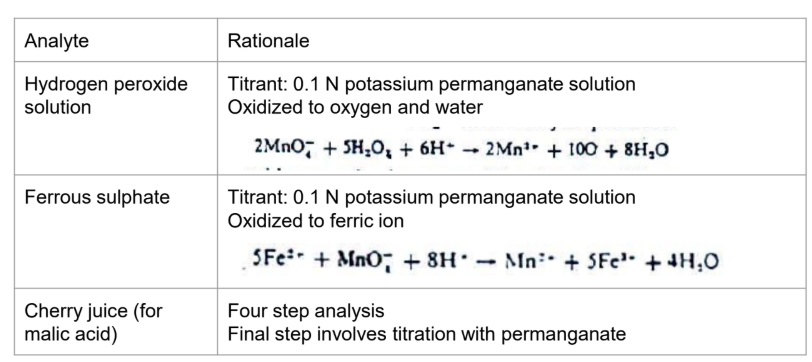
Ceric sulphate
• Cerium salts are used as oxidizing agents.
• Ce (IV) ion has a reduction potential +1.61 V, making it the strongest oxidizing agent among the commonly used oxidizing agents.
• Solutions may degrade when exposed to light and so require standardisation with sodium oxalate.
• End point is detected with an indicator such as ferroin.
Ferroin indicator
• Indicators for redox titrations include complexes of heterocyclic compounds with metals such as Fe, Cu, Zn.
• The most common indicator used is ferroin.
• When the Fe in the complex is in ferrous form, the complex is red in colour.
• At the end point, the ferrous ion is oxidized to ferric ion (reduction potential +0.771 V), which gives the complex a faint blue colour.
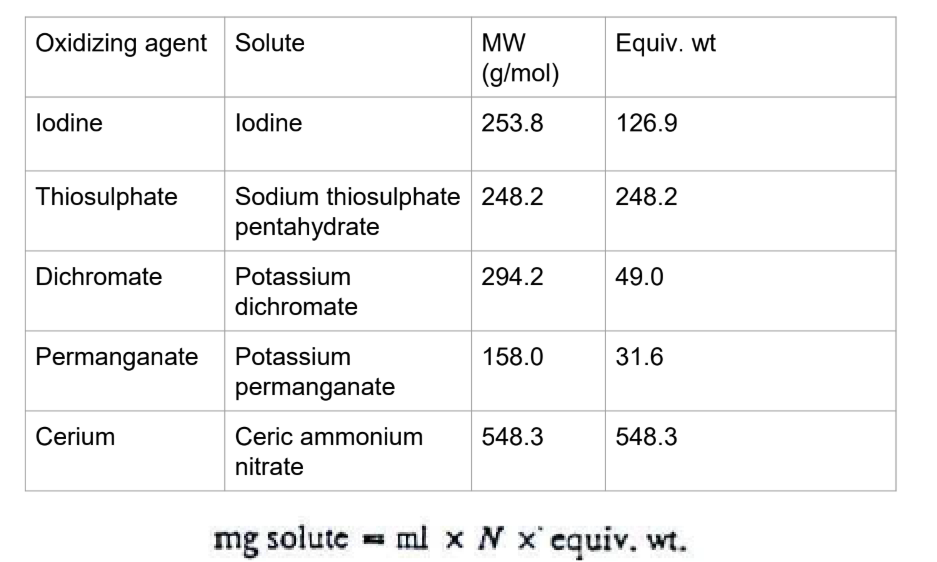
Preparation of reagents, half reactions
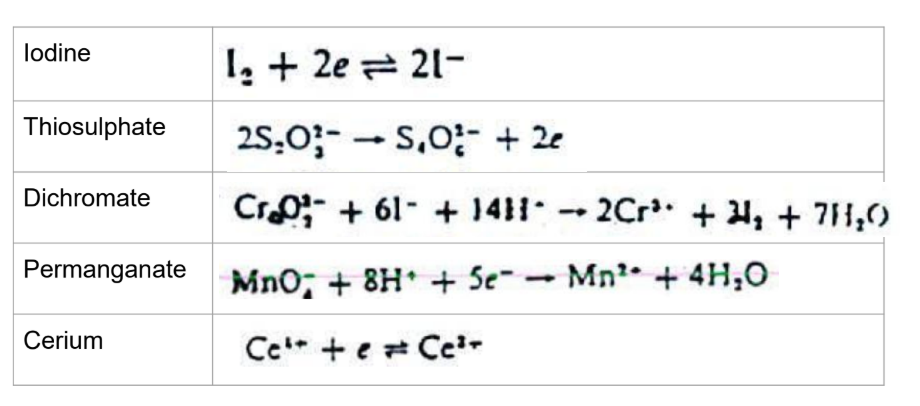
Preparation of reagents
Complexation reaction
• Definition: Complexation is an acid-base reaction between the ligand, a Lewis base or electron donor, and the metal ion, a Lewis acid or electron acceptor.
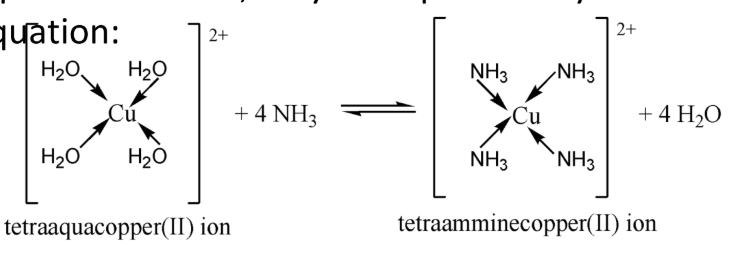
• An example of a complexation reaction, between copper (II) ion and four ammonia molecule in an aqueous solution, may be expressed by the equation:
Ligand
• Definition: Ligands or complexing agents can be any electron-donating entity which has the ability to bind a metal ion producing complex ion.
• These compound contain atoms that are strongly nonmetallic elements such as N, O and S.
Types of ligand
Unidentate
Multidentate
Unidentate
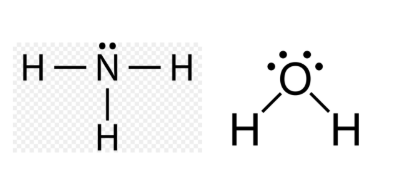
When a single site on the ligand is involved in the formation of the complex, the ligand is called unidentate.
Multidentate
Molecules or ions that contain two or more donor groups that attach to a metallic ion are called multidentate ligands.
Chelates
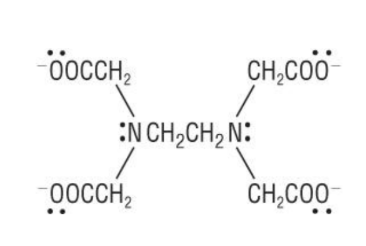
• When a polydentate ligand attaches to a metal at more than one site, a ring structure is formed.
• These ring compounds are called chelates.
What does the law of mass action define?
The law of mass action defines the concentrations of all species in equilibrium processes
Stability of chelates
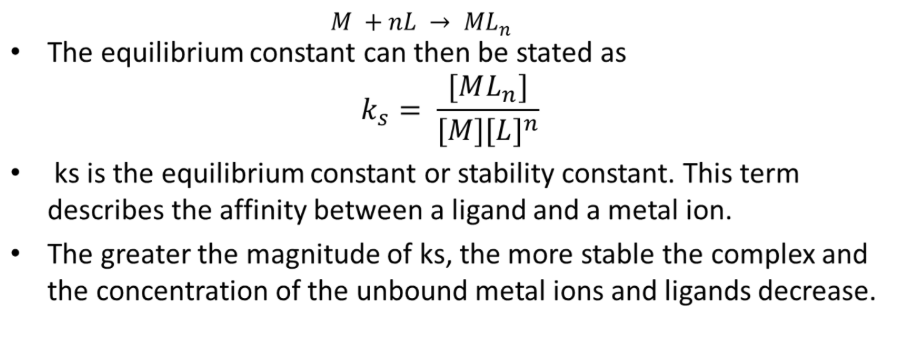
Acid base titration
• When acid is titrated, base is added
• Proton is disappearing
• Salt is formed
• At end point, pH (-ve log of H ion concentration) increases
Complexometric titration
• EDTA is added
• Free metal ion is disappearing
• M-EDTA complex is formed
• At end point, pM (-ve log of M ion concentration) increases
Factors affecting titration curve
Stability of the complex formed
Number of steps involved
Stability of the complex formed
Greater the stability constant for the complex formed, the larger the change in the free metal ion concentration (pM) at the equivalence point and more easy to see the end point.
Number of steps involved
Fewer the number of steps required in the formation of a complex, the greater the break in the titration curve at the equivalence point.
EDTA
• Ethylenediamine tetraacetic acid (EDTA) is a lewis acid.
• It has six binding sites.
• EDTA forms stable chelates with nearly all metal ions.
• The complex formation takes place at once (single step).
• Thus EDTA is the most preferred chelating agent in complexomteric titrations.
• Free EDTA has poor water solubility.
• The water soluble disodium (dihydrate) salt is used instead (MW. 372.9 g/mol).
Significance of maintaining pH
• During complexometric titration, the pH must be kept constant by the use of a buffer solution.
• Most ligands are bases and can bind to protons.
• Some of these protons are displaced from the ligand by the metal during chelate formation.
• The stability of the complex is therefore pH dependent.
• The lower the pH of the solution, the more protons are available to compete with the metal ion for the ligand, decreasing the stability of the complex.
• Usually buffers are used to maintain the pH at 8-10.

Metallochromic indicator
• At the onset of the titration, the reaction medium contains the metal-indicator complex (MI) and excess of metal ion.
• When EDTA titrant is added to the system, a competitive reaction takes place between the free metal ions and EDTA.
• Since the metal-indicator complex (MI) is weaker than the metal- EDTA chelate, the EDTA which is being added during the course of the titration is chelating the free metal ions in solution.
• Finally, at the end point, EDTA removes the last traces of the metal from the indicator and the indicator changes from its complex colour to its metal free colour.
• The overall reaction is given by:

Standardization of EDTA
• EDTA is not a primary standard.
• EDTA solution should be standardized against the metal ion for which it is to be used as titrant.
• For example, for the determination of zinc sulphate in a solution, the EDTA solution should be standardized against a solution of pure zinc.
• Solutions of EDTA are stable when stored in clean PET containers. The concentration slowly changes when solutions are stored in glass containers. This is caused by the leaching of metal ions from the surface of the glass container.
Applications
Direct complexometric titration
Residual complexometric titration
Direct complexometric titration
• Determination of calcium in Ringer’s solution
• Assay of zinc sulphate syrup
• Determination of total hardness in water
• Determination of magnesium stearate
Residual complexometric titration
• Assay of calcium carbonate tablets
• Determination of manganese salts
In what year was Bronsted Lowry acid-base theory given
1923
Bronsted Lowry acid definition
An acid is a species that can donate a proton.
Bronsted Lowry base definition
A base is a species that can accept a proton
Strengths of acids and bases
• An acid can only exhibit its acidic properties in the presence of a base; a base can only function as a base in the presence of an acid.
• When water is the solvent, HCl is a strong acid because it gives up proton readily but acetic acid is a weak acid because it gives up only a small amount of the protons.
• When liquid ammonia is the solvent, acetic acid is a strong acid because it gives up proton readily.
• The strength of an acid depends on both its inherent ability to donate proton AND the ability of the solvent to accept the proton from the acid