CAMS - Midterm Review
 Call Kai
 Learn
Learn Practice Test
 Spaced Repetition
 Match
Match Flashcards
 Knowt Play
1/104

Earn XP
Description and Tags
Sessions 1-8
Name | Mastery | Learn | Test | Matching | Spaced | Call with Kai | Chat |
|---|
No analytics yet
Send a link to your students to track their progress
105 Terms
Importance of Study of Child/Adolescent Psychopathology
½ of all lifetime cases of mental illness begin by 14 (3/4 by 24)
Rapid cognitive and emotional dev
Brain still developing (prefrontal cortex)
Melatonin peaks later at night, drops later in morning
Psychosocial transitions (education, employment, relationships/sexuality, sense of self, beliefs)
Traumatic childhood experiences affect > 50% children
Suicide among top 10 causes of death in adolescents; depression, self-harm, anxiety disorders among top 10 causes of illness/disability
Sigmund Freud
Psychoanalysis
Gave meaning to adult psychopathology by linking it to childhood experiences
→ Course of mental disorders finally not seen as inevitable
Drive Theory (Freud)
Aggressive and sexual “drives” primary motivating forces in our quest for pleasure. end goal of development: sexual maturity
Oral Phase (birth-18mo): infant interaction through the mouth
Anal Phase (18-36mo): primary focus on controlling bladder + bowel movements
Phallic-Odeipal Phase (3-6yr): children discover differences b/w males and females
Latency Phase (6-11yr): development of social skills, values, and relationships
Genital Stage (11+; ends at adulthood): puberty → strong interest in opposite sex
Psychosocial Theory (Erikson)
Basic Trust vs. Mistrust (Birth-1yr) - trust/mistrust that basic needs will be met
Autonomy vs. Shame and Doubt (1-3yr) - develop sense of independence
Initiative vs. Guilt (3-5yr) - take initiative on some activities; may develop guilt if unsuccessful
Industry vs. Inferiority (6-11yr) - develop self-confidence in activities when competent; inferiority when not
Identity vs. Role Diffusion (11 yr-end of adolescence) - develop identity & roles
Intimacy vs. Isolation (21-40yr) - establish relationships w/ others
Generativity vs. Stagnation (40-65yr) - contribute to society + be part of family
Integrity vs. Despair (65+) - make sense of life & meaning of contributions
Stages of Cognitive Development (Piaget)
Sensorimotor Stage (birth-2yr): learn senses and body movement
Preoperational Stage (2-7yr): learn language, symbols, and pretend play
Concrete Operational Stage (7-adolescence): start thinking logically
Formal Operational Stage (adolescence): can think about abstract ideas
Object Relations (Mahler)
More modern adaptation of psychoanalytic theory that places less emphasis on drives of aggression and sexuality as motivational forces
More emphasis on human relationships as primary motivational force in life
Separation-Individuation (Mahler)
Six stages of development lead to normal object relations, predicated upon a recognition of “separateness”
Normal Autism (birth-2mo): unaware of outside world
Symbiosis (2-5mo): baby is a single unit w/ primary caregiver
Differentiation (5-10mo): show interest in world beyond caregiver
Practicing Sub-Phase (10-18mo): crawling and active exploration
Rapprochement (2-5yr): separate identities from caregiver
Risk Factor
A variable that precedes a negative outcome and increases the chance of that outcome occurring
Situational risk factors: poverty, death of a loved one, homelessness, community disasters
Inconsistent/deficient caregiving in early childhood
Family history of mental illness
Neonatal complications
Resilience/Protective Factor
A variable that increases one’s ability to avoid or cope w/ negative outcomes despite a risk for psychopathology
Self-confidence
Flexibility in problem solving
Intelligence
Coping skills
Social and emotional support
Gender and Psychology
Girls have more internalising sx → increased anxiety, depression, somatisation, eating disorders, emotional withdrawal
Boys have more externalising sx → more difficulties w/ aggression, hyperactivity, delinquency
Gender diverse/trans youth have higher rates of mental health struggles than cis peers
Race + Ethnicity and Psychology
Minorities overrepresented in encountering poverty, limited access to care, and poorer quality of care → more difficulties in many mental disorders
Racism, not race itself, is contributor to mental ill-health
Intersectional Therapeutic Framework
How overlapping social identities (e.g., gender, race, class, sexuality, etc.) create a unique system influencing a client’s mental health and wellbeing
Window of Tolerance
An optimal zone of emotional and physiological arousal
Stress, trauma, or overstimulation can push person outside of their zone into hyper-arousal (fight or flight) or hypo-arousal (withdrawal/dissociation)
Person needs to return to optimal zone through regulation/co-regulation
When person goes into hyper-/hypo- arousal, activity increases in brainstem and decreases in prefrontal cortex
During acute and chronic stress, brain flooded w/ adrenaline and cortisol
Key Stages of Neurodevelopment
Prenatal period
Postnatal - adolescence
Adolescence - adulthood
Early Brain Development
Child’s brain develops due to genes and env.
Genes provide initial map for brain dev
Significant wiring occurs during first years of a child’s life
Age 3: ~1000 trillion brain connections → Adolescence": ~500 trillion
Synaptic pruning heavily influenced by experience and env.
Synaptic Pruning
Infants born with ~2,500 synapses per neuron
By 3, ~15,000 synapses per neuron
Early adolescent brain loses as many as 30,000 synapses per sec
Frontal lobes are “closed for construction”
Adolescent Brain Development
Amygdala: fear, anxiety, aggression; less volume in youth = risk assessment not as developed; hypoactivity
Nucleus Accumbens: dopamine sensitivity, reward system; hyperactivity
Prefrontal Cortex: high-level executive function, inhibition, assessment of situations; “closed for construction” during youth; not interacting w/ other parts of brain
Adolescence - The Risky Brain
Darwinian Argument: need to become more of a risk taker and sensation seeker when you strike out on your own and leave safe home env. to survive
Neurological Argument: high activity in reward system and motivation; less refined activity in PFC
Peer Pressure: greater social sensitvity
Neuroplasticity
The brain’'s ability to change/adapt by forming new connections, strengthening old ones, and reorganising pathways in response to learning, env, or injury
Firing together: active nerve cells build stronger links
Pruning: unused connections fade away over time
Brain keeps changing and growing at any age, not just in childhood
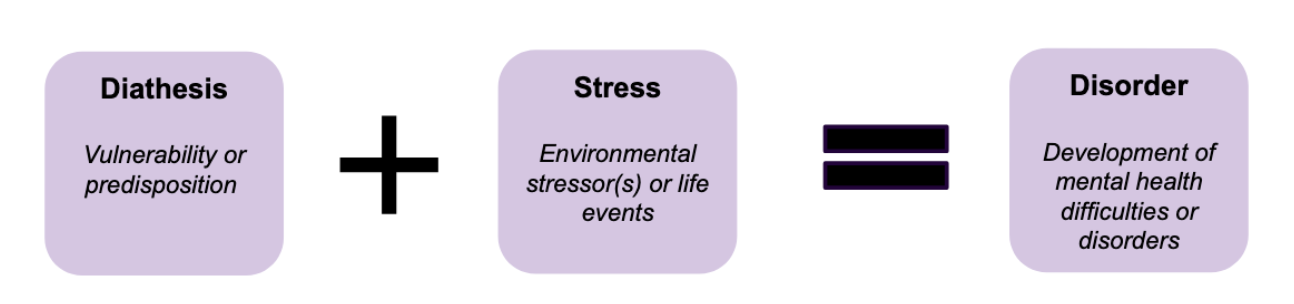
Diathesis-stress Model
Mental disorders develop from a combination of pre-existing vulnerability (diathesis) + environmental stress
an individual w/ a high predisposition to mental illness requires less stress to trigger the disorder
resilience factors reduce likelihood of disorder developing
Health Paradox of Adolescence
Adolescence physically healthiest time of life
Yet…
Depression increases from 4% prevalence in childhood to 17% in adolescence
Substance abuse, eating disorders, psychotic disorder, etc. all increase greatly during teen years → major increases in morbidity
Adolescence has high rates of risk-taking behaviour, sensation-seeking, emotionally-influenced behaviour
Mental Disorder
A clinically significant disturbance in cognition, emotion regulation, or behaviour reflecting dysfunction in psychological, biological, or developmental processes
Characteristic must include:
Distress or impairment in functioning
Not merely a normal response to stress/loss
Not simply social deviance
Risk of further suffering/harm
Nosology: classification of disorders
Diagnostic and Statistical Manual of Mental Disorders of the American Psychiatric Association (DSM)
“Statistical” in sense that historically, its progenitor was an attempt to gather epidemiological info (“stats”) on the number of various types of mental illness in nation
Symptom-driven document that describes mental illness w/o etiological explanation
DSM (1952) and DSM-II (1968)
Provided brief descriptions of characteristic sign and sx of the disorders but no criteria
DSM-III (1980) and DSM-III-R (1987)
Diagnostic criteria for various disorders provided
Better inter-rater reliability and evidence of predictive reliability
Specified group of disorders as “usually first evident in infancy, childhood, or adolescence”: Reactive attachment disorder, separation anxiety disorder, overanxious disorder, and avoidant disorder
Anxiety diagnoses applicable to adults were available for diagnosing children
DSM-IV (1994) and DSM-IV-TR (2000)
Further clarified diagnoses and refined diagnostic criteria
Some new diagnoses added (Asperger, ADD became ADHD, etc.)
Intro of multi-axial system
TR was a Text Revision w/ increased background info regarding risk factors, epidemiology, and course, and development of disorders
Multiaxial System in DSM-IV
Axis I: Clinical mental disorders
Axis II: Personality disorder & mental retardation
Axis III: Major medical diagnoses
Axis IV: Psychosocial and environmental stressors
Axis V: Global Assessment of Functioning (GAF), a numeric scale (0-100) used to rate social, occupational, and psychological functioning
DSM-V (2013) and DSM-V-TR (2022)
Removal of multiaxial system and introduction of single axis diagnostic approach (single diagnostic list w/ each disorder using standardised codes and noting psychological, environmental stressors, and disability)
Reorganisation of diagnostic chapters based on shared underlying mechanisms and developmental patterns
Introduction of dimensional assessments (spectrum disorders)
DSM Changes - Removal of Multiaxial System
Multiaxial system complex and unreliable
Changed to a single diagnostic list → each disorder has standardised codes and notes psychosocial, env stressors, disability
DSM Changes - Removal of Some Disorders
DSM-I and II (1952)
Homosexuality: "s*xual deviation disorder”
DSM-II (1973)
Homosexuality removed → changed to “s*xual orientation disturbance”
DSM-III (1980)
Ego-dystonic homosexuality
DSM-III-R (1987)
All mention of homosexuality removed
DSM Changes - Dimensional Disorders
Categorical System: traditional system; DSM classifies disorders into distinct categories; artificial yes/no boundaries; comorbidity
Dimensional System: measures sx on continuums of severity; captures variations in sx
DSM 5 combines categorical diagnoses and dimensional severity measures
Pros of Mental Health Diagnosis
Provides clarity
Validates experiences
Provides opportunity for evidence-based treatment
Cons of Mental Health Diagnosis
Stigmatising psychiatric disorders → self-limiting beliefs or discrimination
Misdiagnosis
Overreliance of labels
Limitations of DSM
Artificial boundaries: disorders diagnosed as absent or present
High comorbidity
Heterogeneity: individuals w/ same disorder may have different sx
Sx overlap
Limited context: environmental and cultural factors may be underemphasised
Pros and Cons of DSM
+ standardisation, research, clinical guidance
- oversimplifies human behaviour, risk of misdiagnosis, over diagnosis, stigmatising labels
Future Diagnostic Models
Will continue to be framed partly by categorical mental disorder concepts
Will include a dimensional scale (disorders on spectrum of severity)
Cross-cutting dimensional model: measures how certain sx are across multiple areas of mental health, regardless of specific disorder being considered (anxiety cross-cutting sx for GAD and panic disorder)
Diagnosis vs. Differential Diagnosis
Diagnosis: identification of a disorder based on a person’s sx and other clinical features (do this person’s sx satisfy the recognized criteria for a particular disorder?)
Differential diagnosis: distinguishing a condition from others with similar sx and other clinical features (based on current sx, what other disorder could this be?)
Clinical Evaluation
What are the diagnostic features
Hypothesis (initial hunches)
Testing
what specific sx do these hypotheses include?
what would discount them?
are there any sx that differentiate one condition from another?
Consult DSM
Clinical Evaluation Conducted with Child & Family
1) Identify problem and formulate theory
2) Identify history of child and family
3) Test theory with assessments and interviews
4) Conduct Mental Status Examination
5) Provide diagnosis (if necessary)
Formulation
A summary of main clinical problems and the factors that may have contributed to development of those problems
Biopsychosocial formulation (biological factors, psychological factors, social factors)
Strengths Based vs. Problem-focused Formulation
Strength based formulation: identifying and utilising an individual’s existing strengths to facilitate change, rather than concentrating solely on deficits
Problem-focused/diagnosis-focused formulation: identify and address a client’s specific, current difficulties. focuses on identifying triggers and underlying mechanisms of problem
Clinical History
1) History of presenting problem
2) Child history
3) Family history
History of Presenting Problem
Evaluating present problem (sx, duration, frequency, severity)
Past psychiatric history
Environmental and cultural context
Child History
Developmental history
Education history
Medical history
Relationships
Physical history
Strengths
Family History
Family history: enquire about each parent’s family of origin, mental health history, and relationships
Family conflict, parenting styles
How do the parents manage difficulties in child?
Are there any cultural/religious considerations? Divorce/separation?
Mental Status Examination (MSE)
1) Appearance (grooming, hygiene, clothing, physical signs of neglect)
2) Behaviour and psychomotor activity (eye contact, cooperation, activity lvl)
3) Speech (rate, volume, fluency, vocab)
4) Mood and affect (mood = internal emotional experience; affect = observable expressions of emotion)
5) Thoughts (thought process = how thoughts organised - ex: coherent; thought content = what they’re thinking about - ex: excessive worries)
6) Perception (hallucinations, illusions, distorted perceptions?)
7) Cognition (orientation, attention/concentration, memory, intellectual functioning)
8) Insight and Judgement (insight = awareness of difficulties; judgement: make appropriate decisions and understand consequences)
Engaging with Adolescents
Establish rapport
Define confidentiality
Non-judgmental w/o condoning risky behaviour
Address parents’ concerns and involve them; decide with adolescent which issues to discuss w/ parents
Beware of splitting/countertransference (over-identifying w/ adolescent or parents)
Autism Spectrum Disorder (ASD) in DSM
A) Persistent deficits in social communication and social interaction across multiple contexts:
deficits in social-emotional reciprocity
deficits in nonverbal communicative behaviours used for social interaction
deficits in developing, maintaining, and understanding relationships
B) Restricted, repetitive patterns of behaviour, interests, or activities, at least 2:
stereotyped/repetitive motor movements, use of objects, or speech
insistence on sameness, inflexible adherence to routines, or ritualized patterns or verbal speech
Highly restricted, fixated interests that are abnormal in intensity or focus
Hyper or hypoactivity to sensory input or unusual interests in sensory aspects of the env.
C) Sx must be present in early developmental period
D) Sx cause clinically significant impairment in social, occupational, or other important areas of current functioning
E) These disturbances are not better explained by intellectual disability or global developmental delay
ASD - DSM Specifiers
Specify Severity Level
Requiring support
Requiring substantial support
Requiring very substantial support
Specify if:
With or w/o accompanying intellectual impairment
With or w/o accompanying language impairment
Specify if:
Associated with a known genetic or other medical condition or environmental factor
Associated with a neurodevelopmental, mental, or behavioural problem
Specify if
With catatonia
Communication Impairment Examples (ASD)
Using communication for social purposes
Difficulty changing communication to match context or needs of listener
Difficulty following rules for conversation or storytelling
Difficulties understanding what is not explicitly stated and non-literal meanings
Language Impairment Examples (ASD)
Developmental language delay
Echolalia (repetition of words/phrases/sounds)—immediate or delayed
Pronoun reversal (e.g., mixing “you” and “i”)
Idiosyncratic word use and jargon (talking like “little professors”)
Course of ASD
12-24 mos: first sx recognised
2-4 yrs: developmental plateaus or regression
4+ yrs: restricted/repetitive behaviours clear
Adolescence: sx may be less obvious
*ASD can be reliably diagnosed by age 2
Prevalence of ASD
ASD occurs all over world, affecting 1-2% of pop.
Boys : Girls → 3 : 1
Girls who are diagnosed are more likely to have an ID
Masking Impairments
Conscious or unconscious effort to hide, compensate for, or minimise behaviours associated w/ autism
suppressing self-soothing behaviours, forcing eye contact, rehearsing convos beforehand, learning scripts

Interoceptive Awareness
Ability to listen to our body and understand its messages
Genetic Factors of ASD (Aetiology)
High heritability - associated with more than 100 genomic variants
Fragile X gene, FXR1, Chromosome 15 variant
10-30% of children w/ fragile X syndrome have autistic sx
Much higher concordance in monozygotic twins than dizygotic twins
*Having ASD gene variant alone often not enough to result in ASD manifestation
Environmental Factors of ASD
Advanced maternal (> 40 yrs) and paternal (> 50 yrs) age
Short interpregnancy intervals (< 2 yrs)
Maternal stressors (maternal stress, maternal hypertension, maternal metabolic difficulties)
Premature birth (< 32 weeks)
Low birth weight (< 1500 grams)
Diet

Neurobiological Factors of ASD
ASD also has neurobiological factors

Visual Tracking
Individuals with ASD do not follow the most salient features when viewing faces or watching other people
A person w/o ASD would typically watch eyes to gather social info
Person with ASD more likely to look at mouth (helps them process what’s being said)
Assessment of ASD
Autism Diagnostic Interview-Revised (ADI-R)/Autism Diagnostic Observation Schedule (ADOS)
Checklist for Autism in Toddlers Screening Tool (CHAT)
The Childhood Autism Rating Scale (CARS)
The Profile-Revised (PEP-R)
Social Responsiveness Scale
ADOS
4 modules for different developmental ability
Semi-structured assessment that presents various activites that elicit behaviours directly related to an ASD diagnosis
ADI-R
Structured interview used for diagnosing autism
Clinical interview for parents or guardian
Treatment for ASD
Psychoeducation for parents
Applied Behavioral Analysis (ABA)
Social skills training
Neuro-affirming care
Psychoeducation for Parents
Therapeutic approach that teaches individuals and their families about mental health conditions, sx, and treatment options
Applied Behavioural Analysis (ABA)
ABA Therapy: focuses on improving specific behaviours, communication, and learning, through positive reinforcement techniques
Principles:
Correct response = reward + reinforcement
Incorrect response = no reward
Reward every time → reward once every X times
Helps develop skills they may not acquire naturally + reduce dangerous behaviours (EX: self harm)
Focus: skill development and redirection of problem behaviours, not trying to take away neurodiversity
Social Skills Training
Improve social interaction, including conversational skills, non-verbal cues, relationship building
Often group-based
Neuro-affirming Care
Views autism as natural variation of human brain, not something to be “fixed”
Learning neuro-affirming regulation strategies
Focus on sensory processing, body awareness, and finding regulatory needs
Functional communication and self-advocacy, not just speech reproduction
Specific Learning Disorder in DSM
A) Difficulties learning and using academic skills, at least 1 sx for min 6 months (despite interventions that target those difficulties)
B) Affected academic skills substantially below expected for age + interference w/ academic/occupational/daily living as shown by standardized assessment. (if 17+, documented history of learning difficulties sub assessment)
C) Learning difficulties begin during school-age but may not fully manifest until demands for affected academic skills exceed person’s limited capacities
D) Learning difficulties not better accounted for by intellectual disabilities, uncorrected visual/auditory acuity, other mental/neurological disorders, psychosocial adversity, lack of proficiency in lang of academics, or inadequate educational instruction
Specific Learning Disorder Specifiers (DSM)
Specify if
With Impairment in Reading (Dyslexia - word reading accuracy, reading rate/fluency, reading comprehension)
With Impairment in Written Expression (Dysgraphia - spelling accuracy, grammar & punctuation, organisation of written expression)
With Impairment in Mathematics (Dyscalculia - number sense, memorisation of arithmetic facts, accurate calculation, accurate math reasoning)
Specify current severity
Mild, moderate, severe
Course of Specific Learning Disorder
Preschool yrs: sx manifest as subtle lang and motor delays
Early elementary school: gap b/w child’s intellectual potential and academic performance becomes visible
Adolescence: decoding can be mastered, but reading/maths/written word remains effortful and challenging
*Recognition and diagnosis usually occurs during elementary school
SLD - Dyslexia
Phonological decoding impaired, but meaning retained
Distortions, substitutions, or omissions in reading (“aminals” for “animal”)
Automaticity doesn’t develop: 50ms (control group) vs. 400 ms (dyslexia) to identify words
→ increased school refusal
→ difficulties w/ esteem, anxiety sx, depressed mood
→ children w/ learning disorders 2x more likely to drop out of school
Aetiology of SLD
1) Genetic Factors: strong heritability of SLDs
2) Perinatal and Prenatal Factors: premature birth, low birth weight, maternal stressors
3) Environmental Factors: low SES or limited access to early education can exacerbate severity
4) Neurobiological Factors
Assessment of SLD
Wechsler Preschool and Primary Scale of Intelligence (WPPSI): 2.5 - 7.5 yrs
Wechsler Intelligence Scale for Children (WISC): 6 - 16 yrs
Wechsler Adult Intelligence Scale (WAIS): 16+
Wechsler Individual Achievement Test (WIAT)
WISC
Assesses a full-scale Intelligence Quotient (IQ) and provides rankings for
verbal comprehension
visual spatial
fluid reasoning
working memory
processing speed
WISC for SLD
In SLD, IQ within avg range
WISC helps differentiate SLD from an ID
WIAT
Consists of 20 activities
WIAT identifies impairment and severity in reading, written expression, and mathematics
Diagnosing SLD
SLD typically diagnosed if their scoring in a WIAT domain (reading, written expression, mathematics) is 2 SDs lower than predicted lvl from WISC
General IQ for most people: mean IQ: 100 and SD: 15
With no SLD, IQ of 100 means predicted reading ability of 100 (WIAT score)
→ Nelly scores 100 on IQ test so her expected reading ability score ~100. She scores 65 on the WIAT reading index = diagnosis of a reading disorder
Treatment Plans for SLD
Phonological Awareness Training
Phonemic awareness: critical phonological skill for reading and spelling
Auditory-based, crucial early literacy intervention focusing on identifying and manipulating sound structure of spoken lang
School-based Supports and Accommodations
Individual Education Plan (IEP): legal protection for students w/ SLDs to receive free and appropriate education
Customised educational env that has specific goals, adjustments, and support strats
Psychological Support
Help address additional mental health sx (low self-esteem, anxiety, school avoidance)
Intellectual Developmental Disorder (Intellectual Disability) in DSM
A) Deficits in intellectual functions confirmed by clinical assessment and individualized, standardized IQ testing (IQ below 70)
B) Deficits in adaptive functioning that result in failure to meet developmental and sociocultural standards for personal independence and social responsibility
C) Onset of intellectual and adaptive deficits during developmental period
Severity (determined by adaptive functioning)
Mild (85%)
Moderate (10%)
Severe (5%)
Profound (1%)
Course of ID
12-24 mos: delayed motor, lang, and social milestones
Preschool: mild impairments
Adolescence: skill gap b/w peers widens
Adulthood: focus on building autonomy, vocational readiness, and community inclusion
ID - Associated Difficulties
Increased rates of accidental injury
Lack of communication skills → predispose aggressive behaviours
Exploitation
Common comorbidities w/ epilepsy, cerebral palsy, medical complications, other psychiatric conditions
Aetiology of ID
No clear aetiology can be found in 30-40% of cases
Specific aetiologies often found in those w/ severe/profound ID
Most common causes:
Down Syndrome
Fragile X Syndrome
Foetal Alcohol Syndrome Disorder
Down Syndrome
Extra copy of chromosome 21
Caused by an error in division of sperm or egg cells, risk increases in prenatal age at conception
Most have mild to moderate ID
Fragile X Syndrome
Most common inherited cause of ID
Occurs in 1/4000 males and 1/8000 females
Full mutation of FMR-1 gene on the X chromosome
This gene produces the FMR-1 protein which is essential for normal brain function
Foetal Alcohol Spectrum Disorder (FASD)
Caused by consuming alc during pregnancy
Characteristic physical features
Behavioural Sx: impulsivity, poor memory, short attention span
ID: ADHD, learning disabilities, anxiety, depression, lang disorders
Assessment of ID
Often known since birth
Instruments same as SLD
WISC - assesses IQ
WIAT - assesses cognitive ability
→ if ID is typically classified by an IQ < 70, then expect WISC and WIAT scores to be < 70
Treatment Plan for ID
Focus on building life skills, autonomy, and managing co-occurring sx
Psychoeducation
ABA
School-based Supports and Accommodations
Therapy for Psychological Challenges Related to ID
Attention-deficit/Hyperactivity Disorder in DSM
A) Persistent pattern of inattention and/or hyperactivity-impulsivity that interferes with functioning or development
B) Several of these sx present before age 12
C) Several of these sx present in 2 or more settings (at home, school, work; with friends or relatives; in other activities)
D) Clear evidence that sx interfere w/ or reduce quality of social, academic, or occupational functioning
E) sx do not occur exclusively during course of schizophrenia or another psychotic disorder and are not better explained by another mental disorder
Inattention and Hyperactivity Sx
1) Inattention (> 6)
poor attention to detail
difficulty sustaining attention in tasks/play
doesn’t seem to listen when spoken to
difficulty following instructions
difficulty organizing tasks
Avoids tasks requiring sustained mental effort
loses items necessary for tasks
easily distracted
forgetful in daily activities
2) Hyperactivity (> 6)
fidgets
leaves seat
runs/climbs excessively
difficulty engaging in leisure activities quietly
“on the go”
talks excessively
blurts out answers early
difficulty waiting turn
interrupts others
ADHD Specifiers
Type
Predominantly inattentive
Predominantly hyperactive
Combined
Severity
Mild
Moderate
Severe
*Sx persist into adulthood but can decrease over time
ADHD - Associated Problems
Early maladaptive schema/core beliefs
School dropout rate 2x
More likely to repeat grades and face disciplinary action
May have neuro-cognitive deficits (working memory, reaction time variability, response inhibition)
Course of ADHD
Sx difficult to distinguish from normal behaviors < 4 yrs old
Preschool: signs of hyperactivity and excessive movement
Elementary school: often when ADHD identified, inattention becomes more prominent and hyperactivity confined or internalised
Later school years: increased risk-taking, challenges w/ planning and org, emotional dysregulation, high comorbidity
Adulthood: hyperactive sx less common, inattention and comorbidities can persist
Prevalence of ADHD
Most commonly diagnosed behavioural disorder of childhood
Combined presentation most common subtype
High comorbidity w/ oppositional defiant disorder, ASD, personality & substance use disorders
ADHD Sex Paradox
Male : Female → 2 : 1 (girls typically less hyperactive, fewer conduct problems, less externalising behaviours)
girls w/ condition experience higher sx severity, greater functional impairment, and greater distress
ADHD - Genetic Factors
Heritability of ADHD ~75%
Among individuals w/ ADHD, heritability closer to 90%
Polygenic risk: multiple genes associated (EX: genetic variants involved in dopamine regulation)
ADHD - Environmental Factors
Early development: premature birth, low birth weight, perinatal stress
Social factors: low SES, high family dysfunction, social isolation, education difficulties
Trauma: childhood trauma (abuse, neglect, household dysfunction) impacts brain development and stress response
ADHD - Neurobiological Factors
Lower levels of neurotransmitters: dopamine and noradrenaline
Dopamine (DA): dopamine impacts reward and motivation pathways (DA deficiency in ADHD increases impulsivity and reward seeking)
Norepinephrine/noradrenaline (NE): norepinephrine (derivative of dopamine) affects arousal and cognitive control (NE deficiencies in ADHD decreases alertness and focus)
ADHD Hypothesis: Weak Dopamine & Norepinephrine (NE) Signals
Reduced DA released in brain signaling = hypo-dopaminergic
Affects PFC (exec function), nucleus accumbens (reward), and motor control brain regions (striatum)
Hypodopaminergic state = difficulties in: impulsivity, reward-seeking, physical activity
NE levels lower in ADHD
NE affects widespread brain regions to regulate arousal, attention, and stress
Deficiencies contribute to difficulties in alertness and focus
*DOPAMINE LEVELS IMPACT NA LEVELS; NA LEVELS DON’T IMPACT DOPAMINE; THIS IS WHY COMBINED TYPE MOST COMMON THEN INATTENTIVE TYPE SECOND MOST COMMON
The ADHD Brain
PFC responsible for executive functioning → ADHD = executive dysfunction
Strengths of ADHD brain
hyperfocus
creativity
high energy and drive
resilience and adaptability
sensory sensitivity
quick thinking and intuition
Assessment of ADHD
Common validated instruments:
Conners’ Rating Scales
Child Behaviour Checklist (CBCL)
Vanderbilt ADHD Diagnostic Rating Scale (VADRS)
Functional assessments (stroop task, trail making test)
VADRS
55 items, for 5-12 yr olds
Rates sx by severity across inattention, hyperactivity and impulsivity, co-occurring conditions, and performance (academic and social)
Parent and teacher report versions
Clinical cut off requires score of at least 6/9 items for each subscale to be rated as “often” or “very often”