Nervous Tissue Histology
 Call Kai
 Learn
Learn Practice Test
 Spaced Repetition
 Match
Match Flashcards
 Knowt Play
1/48

There's no tags or description
Looks like no tags are added yet.
Name | Mastery | Learn | Test | Matching | Spaced | Call with Kai | Chat |
|---|
No analytics yet
Send a link to your students to track their progress
49 Terms
The Nervous System
- The body's speedy, electrochemical communication network, consisting of all the nerve cells of the peripheral and central nervous systems
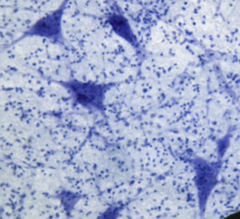
Glial Cells
- Cells in the nervous system that support, nourish, and protect neurons
*Smaller dots among neurons
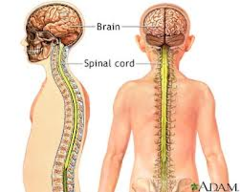
Central Nervous System
- Consists of the brain and spinal cord
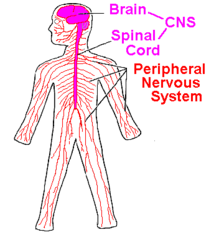
Peripheral Nervous System
- The sensory and motor neurons that connect the central nervous system to the rest of the body
Ganglia
- Clusters of cell bodies in the PNS
Dendrites
- Branchlike parts of a neuron that are specialized to receive information.
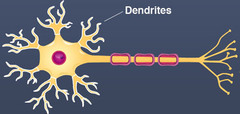
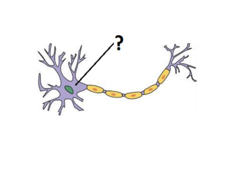
Soma
- Cell body, contains the nucleus and other parts of the cell needed to sustain its life
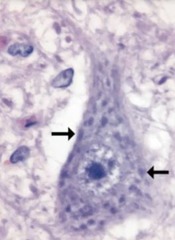
Nissl bodies
- Rough endoplasmic reticulum in neuron
*Darker dots in cytoplasm of neuron
Axon Hillock
- The cone-shaped area on the cell body from which the axon originates
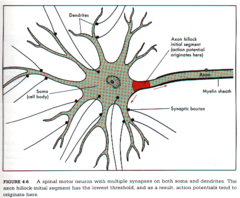
Initial Segment
- Short section of nerve fiber between the axon hillock and the first glial cell
Oligodendrocyte
- A type of glial cell that forms myelin in the central nervous system
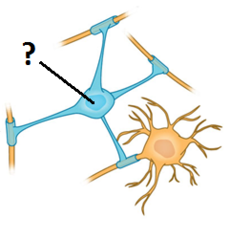
How many neurons can the Oligodendrocyte associate with?
- 40-50 neurons
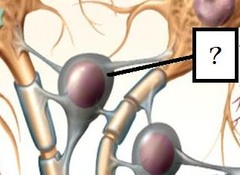
Myelin
- A layer of fatty tissue segmentally encasing the fibers of many neurons; enables vastly greater transmission speed of neural impulses as the impulse hops from one node to the next.
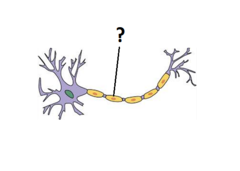
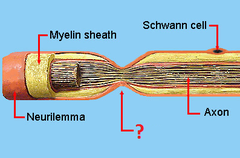
Nodes of Ranvier
- Gaps in the myelin sheath to which voltage-gated sodium channels are confined.
- Allow rapid, efficient, and amplified conduction of nerve impulses through saltatory conduction
Schwann Cell
- Supporting cells of the peripheral nervous system responsible for the formation of myelin.
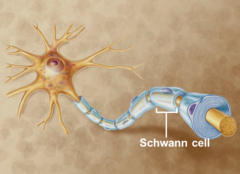
How many neurons can the Schwann Cell associate with?
- 1
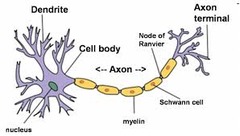
Multipolar Neuron
- A neuron with a single axon and multiple dendrites; the most common type of neuron in the nervous system.
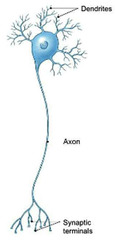
Bipolar Neuron
- A neuron with one axon and one dendrite attached to its soma

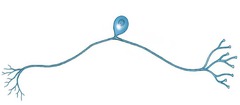
Unipolar Neuron
A neuron with one axon attached to its soma; the axon divides, with one branch receiving sensory information and the other sending the information into the central nervous system.
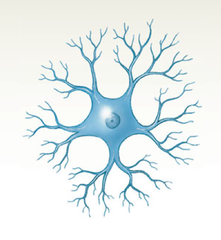
Anaxonic Neuron
- Many dendrites but no axon, help in visual processes
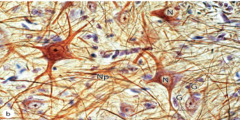
Neurophil
- Dense network of nerve fibers and their branches/synapses, together with glial processes
Nerve impulses: Uni or Multidirectional?
- Unidirectional: Neuron → target cell
Nerve impulses are converted to what?
- Electrical signals from presynaptic cell are converted to a chemical signal via chemical synapses → chemical signal affects postsynaptic cell
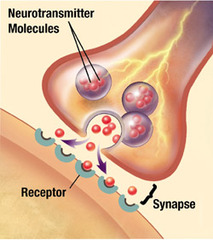
What is released by presynaptic cell?
- Neurotransmitters, can be excitatory or inhibitory
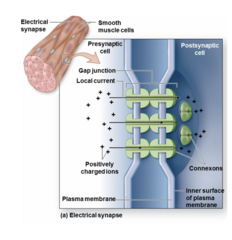
Electrical Synapses
- Synapses that transmit information via the direct flow of electrical current at gap junctions.
- Contain connexin
Glial Cells: Abundance
- 10x more abundant than neurons
The CNS lacks what? How do glial cells help?
- Lacks CT, instead glial cells support neurons and create microenviornments that optimize neuronal function
Four major glial cells in CNS
- Oligodendrocytes
- Astrocytes
- Ependymal Cells
- Microglial Cells
Astrocytes
- Provide structural and metabolic support for neurons.
- Form blood brain barrier
*Star Shaped*
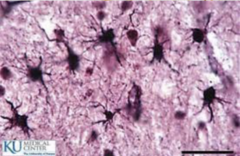
Fibrous vs Protoplasmic Astrocytes
- Fibrous: Abundant in white matter, has long/delicate processes
- Protoplasmic: Abundant in grey matter, numerous/shorter processes
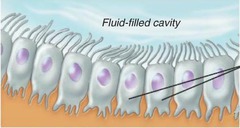
Ependymal Cells
- Line cavities of the brain and spinal cord, circulates/produces cerebrospinal fluid
Microglia
- Act as phagocytes, eating damaged cells and bacteria, act as immune system in CNS
*Spiders*
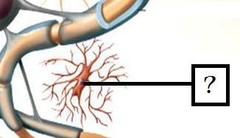
Microglia originate from what?
- Monocytes
Oligodendrocytes
- Type of glial cell in the CNS that wrap axons in a myelin sheath.
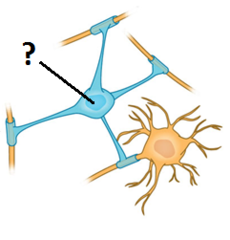
Myelin: Composition and Function
- Composition: Large lipoprotein complex → deposited around neurons
- Function: Increases conduction speed of chemical synapses
Neurolemmocytes
- Schwann cells: Form myelin sheath of peripheral nerves
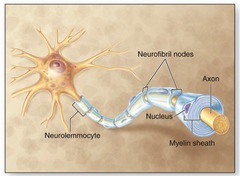
Neurolemmocytes are derived from what?
- Neural crest
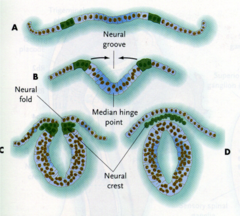
Neural Crest
- A band of cells along the border where the neural tube pinches off from the ectoderm; the cells migrate to various parts of the embryo and form the pigment cells in the skin, bones of the skull, the teeth, the adrenal glands, and parts of the peripheral nervous system.
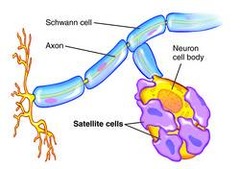
Satellite Cells
- Surround neuron cell bodies in PNS
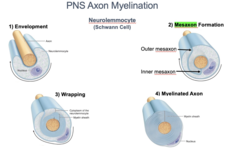
Steps of Myelination in PNS
1. Schwann cell becomes aligned along a portion of the axon and extends a wide cytoplasmic process to encircle it
2. The growing process completely encloses the axonal portion, continuing to extend spirally around it
3. Continues to spiral and become compacted layers of cell membrane, cytoplasm leaves the growing process
4. Mature Schwann cell myelin sheath has up to 100 lamellae, with most cytoplasm in the outermost layer with the cell body
Internodal Segment
- Length of an axon ensheathed by one neurolemmocyte
Unmyelinated Small-Diameter PNS Axons
- A single Schwann cell surrounds multiple small axons but does not wrap them in a myelin sheath. Without myelin, nerve impulses travel more slowly.
*Slower conduction but saves energy and space*
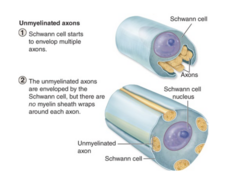
Where are Unmyelinated Small-Diameter PNS Axons found?
- In autonomic nervous system and pain/temp pathways
Endoneurium: What is it, and its composition?
- Innermost connective tissue layer that surrounds each individual axon (and its Schwann cell)
- Composition: Reticular fibers, fibroblasts, capillaries
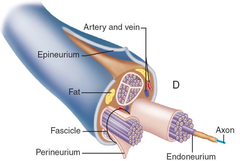
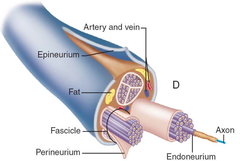
Perineurium
- Coarse connective tissue that bundles nerve fibers into fascicles
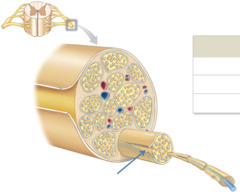
Epineurium
- Dense connective tissue that surrounds entire nerve including fascicles and blood vessels.
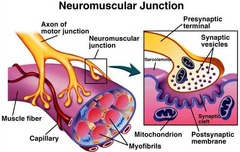
Neuromuscular Junction
- Point of contact between a motor neuron and a skeletal muscle cell
- Schwann cells cover and fuse to sarcolemma
Motor Unit
- A motor neuron and all of the muscle fibers it innervates
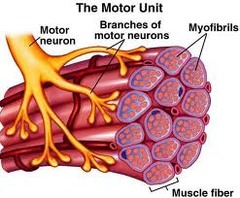
How many muscle fibers can be innervated by a single neuron?
- 100+