ITSS 3300.007 Timothy Stephens final review fall 2021
 Call Kai
 Learn
Learn Practice Test
 Spaced Repetition
 Match
Match Flashcards
 Knowt Play
1/98

There's no tags or description
Looks like no tags are added yet.
Name | Mastery | Learn | Test | Matching | Spaced | Call with Kai | Chat |
|---|
No analytics yet
Send a link to your students to track their progress
99 Terms
Computer Hardware and Processing Basics
· CPU, Memory, Storage (volatile and non-volatile), IOT, Digital Reality, BYOD
•CPU (Processor)
•Speed measured in cycles - Example 3 GHz (Giga Hertz)
•Multi-Processor Platforms
•Memory
•Main Memory
•Cache - Temporary Holding Area
•Other - Video, Communications, etc
•Storage
•Non-Volatile - Magnetic Hard Disk Drive (HDD), Solid State Drive (SSD), Thumb Drives, Optical Drive (CD/DVD)
•Volatile - Cache and Main Memory
Software
Client/Server, Operating System, Virtual (machine, network, etc.), User Interface
•Operating Systems
•- Program(s) to "Direct" the Hardware what to do
•User Interface
•Program which manages presentation, input, and output with the user of the computer
•Virtual Machine
•Program(s) which simulate 1 or more additional physical computers in a single machine
•Licensing
•- You do not ever own a program, you own a license to use it: License types are Individual, Site License, Open Source.
Network and Communications
Definitions (including LAN, WAN), How do they work? (client/server, packets, TCP/IP), Analog vs Digital, Cellular, Wireless LAN
What Is a Network?
•Two or more connected computers
•Major components in simple network
•Client and server computers
•Network interfaces (NICs)
•Connection medium
•Network operating system (NOS)
•Hubs, switches, routers
•Client/Server
•Distributed computing model through Network and Web Applications (Thin/Thick Client)
•Software-defined networking (SDN)
•Functions of switches and routers managed by central program
LANS
Local area networks
Wans
Wide area networks
Networking Technologies
-Client/server computing
•Distributed computing model
•Clients linked through network controlled by network server computer
•Server sets rules of communication for network and provides every client with an address so others can find it on the network
-Packet switching
•Method of slicing digital messages into parcels (packets), sending packets along different communication paths as they become available, and then reassembling packets at destination.
-TCP/IP and connectivity
•Protocols: rules that govern transmission of information between two points
•Transmission Control Protocol/Internet Protocol (TCP/IP)
•Analog vs Digital
A modem is a device that translates digital signals into analog form (and vice versa) so that computers can transmit data over analog networks such as telephone and cable networks.
Notice the differences between digital and analog signals, and shows how digital signals can be sent to other computers over analog cables such as telephone and cable lines which are analog. Note that digital signals are representations of the two binary digits, 0 and 1, and are represented logically as on and off electrical pulses (in reality as different voltages).
Note that many of the telephone systems in buildings had twisted wires installed for analog communication, but they can be used for digital communication as well. Also, today, telecommunications companies are starting to bring fiber optic cable into the home for high-speed Internet access.
Note that the transmission capacity of a medium (bps) is dependent on its frequency, which is measured in hertz, or cycles per second. Ask students to define bandwidth (it is the difference between the highest and lowest frequencies that can be accommodated on a single channel).
Cellular Systems
•Competing standards
•CDMA: United States only
•GSM: Rest of world, AT&T, T-Mobile
•Third-generation (3G) networks
•144 Kbps
•Suitable for e-mail access, web browsing
•Fourth-generation (4G) networks
•Up to 100 Mbps
•Suitable for Internet video
•LTE and WiMax
What's New- 5G networks
Download speeds up 10-20 times faster
Better use of radio spectrum
Enables more devices to access Internet
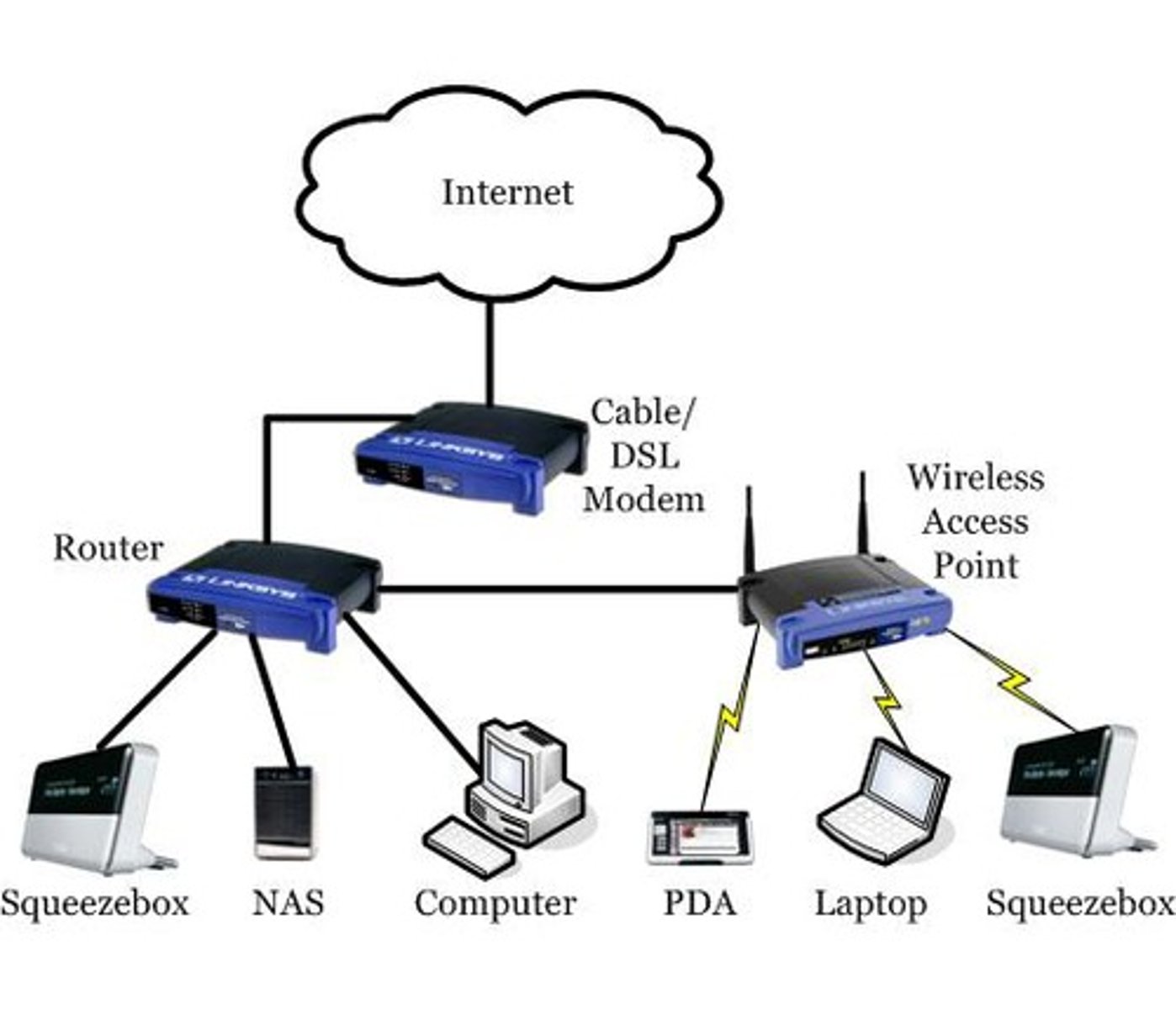
A Wireless LAN
•Wi-Fi (802.11)
•Used for wireless LAN and wireless Internet access
•Use access points: device with radio receiver/transmitter for connecting wireless devices to a wired LAN
•Hotspots: one or more access points in public place to provide maximum wireless coverage for a specific area
•Weak security features
Internet and Cloud
URL, World Wide Web, VPN, Cloud Service Offerings
URL
Web page addresses (______) are composed of the domain name of the website and the file location of the individual web page.
The World Wide Web
The most popular service on the Internet is the web, and the main protocols enabling the web. The web is an interlinked connection of websites, which are collections of web pages linked to a home page. These pages are created using a text markup language call HTML, and transmitted to user's web browsers by HTTP
VPN (Virtual Private Network)
•VPN client software encrypts messages so their contents are protected from snooping.
•Then the VPN client appends the Internet address of the VPN server to the message and sends that package over the Internet to the VPN server.
When the VPN gateway receives the message, it strips its address off the front of the message, decrypts the coded message, and sends the plain text message to the original address inside the LAN
•The Cloud
•Commoditizing" key infrastructure in order to lower overall costs
•Enabled by improved communication speeds and security
Data
Stream of raw facts
Information
Data shaped into meaningful form
Databases
Group of related tables (files
Key terms
•Database - Group of related tables (files)
•Table (File) - Group of related rows (records)
•Row (Record) - Group of related columns (fields)
•Column (Field) - Group of characters, words, numbers, etc.
•Entity - Person, place, thing on which we store information
•Attribute (Metadata) - Each characteristic, or quality, describing the entity
DBMS
•Program to create, process, and administer a database
•Database serves many applications by centralizing data and controlling redundant data.
•
Relational DBMS represents data as two-dimensional tables
•Key Field - Field used to uniquely identify each record (row)
•Primary Key - Field in table used for key fields
•Foreign Key - Primary key used in second table as look-up field to identify records from original table
Capabilities of DBMS
•Data definition capability
•Data dictionary
•Querying and reporting
•Many DBMS have report generation capabilities for creating polished reports (Microsoft Access)
Components of a Database
Tables or files + Relationships among rows in tables + Metadata
•Main Operations Within DBMS
•Read
•Insert
•Modify
•Delete data
•Structured Query Language - SQL
•International Standard used by most DBMS
Data Integrity Problems
•Files maintained separately by different users
•Data redundancy
•Data inconsistency
•Program-Data dependence
•Poor Security
•Lack of data sharing and availability
•Referential integrity
•Rules used by RDBMS to ensure relationships between tables remain consistent
•Normalization
•Streamlining complex groupings of data to minimize redundant data elements and awkward many-to-many relationships
-Represent entity each entity with a table
-entity identifier becomes a table key
-entity attributes become table columns
- normalize tables as necessary
-represent relationships
-use foreign keyes
-add additional tables for N:M relationships
Big Data
•Massive sets of unstructured/semi-structured data from web traffic, social media, sensors, and so on
•Volumes too great for typical DBMS
•Petabytes, exabytes of data
•Can reveal more patterns, relationships and anomalies
•Requires new tools and technologies to manage and analyze
•Enables more robust Business Intelligence
Data warehouse
-Stores current and historical data from many core operational transaction systems
-Consolidates and standardizes information for use across enterprise, but data cannot be altered
-Provides analysis and reporting tools
•Data marts
-Subset of data warehouse
-Typically focus on single subject or line of business
•Hadoop
•Enables distributed parallel processing of big data across inexpensive computers
•In-memory computing
•Used in big data analysis, requiring optimized hardware, reducing hours/days of processing to seconds
•Uses computers main memory (RAM) for data storage to avoid delays in retrieving data from disk storage
•Analytic platforms
•High-speed platforms using both relational and non-relational tools optimized for large datasets
Business Intelligence Analytical Tools
•Multidimensional data analysis (OLAP)
•Rapid, Online Answers
•Insulated from Main Line Operational Processing
•Data mining - Find hidden patterns, relationships in datasets
•Text mining - Extracts key elements from unstructured data
Web mining - Discovery and analysis from web (content, structure, usage)
Project
•a planned undertaking that has a beginning and end and that produces some definite result
•Used to develop an information system
•Requires knowledge of systems analysis and systems design tools and techniques
Program
Interrelated collection of projects
•Triple Constraint
•If you change one variable, you MUST change one or both of the remaining two.
•Scope - Includes Quality and Risk
•Time - Available timeframe until deadline
•Resources - Includes funding, human resources
Project Management Structure
Corporate strategic planning group
Responsible for firm's strategic plan
Information systems steering committee
Reviews and approves plans for systems in all divisions
Project management group
Responsible for overseeing specific projects
Project team
Responsible for individual systems project
Organizational Change
-Change management
•Required for successful system building
•New information systems have powerful behavioral and organizational impact
-Implementation
•All organizational activities working toward adoption, management, and routinization of an innovation
-Role of end users
•With high levels of user involvement,
•System more likely to conform to requirements
•Users more likely to accept system
-User-designer communication gap
•Users and information systems specialists
-Management support and commitment
•Effects positive perception by both users and technical staff
•Ensures sufficient funding and resources
•Helps enforce required organizational changes
•Critical Path
•The series of tasks, given their dependency relationship, that determines the total length (time) of project completion
Failure and Runaway IT Projects
•Runaway projects: 30-40 percent IT projects
•Exceed schedule, budget
•Fail to perform as specified
•Types of system failure
•Fail to capture essential business requirements
•Fail to provide organizational benefits
•Complicated, poorly organized user interface
•Inaccurate or inconsistent data
•Stakeholder Management
•Identify all the relevant stakeholders and understand their interest or role
•Understand and manage the expectations, involvement, and communication of stakeholders
•Risk Management
•Determine the potential areas of high risk for the project
•Develop strategies and plans of actions to reduce the identified risks
•Carry out the plans of action to monitor and control the project risks
•Communications
•Necessary information is gathered in a timely manner and is complete and accurate
•Project information is disseminated frequently and is an accurate representation of the project
•Members of the project team have current information
•Capture and record important project information in a central information repository
•Change Management
•Formal processes to ensure quality control and management buy-in
•Changes in business process, scope, budget, resources, timeframes, etc.
•Work Breakdown Structure
•Outline of all tasks, resources, and effort involved in the project. (Hint: do not list more detail than you can manage.)
•Early start time
•the earliest time that a task can begin due to predecessor durations
•Late start time
•the latest time that a task can start to maintain the schedule
•Slack time
•the amount of time a task or leg of sequential tasks can be delayed without impacting the project schedule
The primary purpose of Business Intelligence is to support
•Timely
•Data-driven
•Objective
Business Decisions
Business Decision Approaches
-Objective
•Data-Driven
•Quantitative
•Measurable
•Keywords: Numbers, Structured, Analytical
-Subjective
•Qualitative
•Perception
•Intuition
•Keywords: Unstructured, Opinion, Exploratory
Types of Business Decisions
-Strategic decisions: Typically Unstructured
•Involve higher-level issues concerned with the overall direction of the organization.
•These decisions define the organization's overall goals and aspirations for the future.
•
-Tactical decisions: Typically Semi-Structured
•Concern how the organization should achieve the goals and objectives set by its strategy.
•They are usually the responsibility of midlevel management.
•
-Operational decisions: Typically Structured
•Affect how the firm is run from day to day.
•They are the domain of operations managers, who are the closest to the customer.
Business Analytics
-Descriptive
•Describe performance, based on established data
•Examples: Financial Reports, Statistics
-Prescriptive
•Analysis of current data and situations
•Examples: Optimization, Simulation
-Predictive
•Predict future trends and behavior based on past performance
•Examples: Credit Scoring, Sales Projections
Data visualization
•This is the heart of Tableau. You can iterate through the countless ways of visualizing the data to ask and answer questions, raise new questions, and gain new insights.
Reporting Applications
•Create meaningful information from disparate data sources.
•Deliver information to user on time.
•Basic operations:
1.Sorting
2.Filtering
3.Grouping
4.Calculating
5.Formatting
REMEMBER: To maintain data warehouse integrity, NEVER use Transform function in ETL for manipulating report data.
Big Data Analytics
•Massive datasets collected from social media, online and in-store customer data, and so on
•Help create real-time, personalized shopping experiences for major online retailers
•Smart cities
•Public records
•Sensors, location data from smartphones
•Ability to evaluate effect of one service change on system
Operational Intelligence and Analytics
•Descriptive and/or Prescriptive in Nature
•Operational intelligence: Business activity monitoring
•Collection and use of data generated by sensors
•Internet of Things
•Creating huge streams of data from web activities, sensors, and other monitoring devices
•Software for operational intelligence and analytics enable companies to analyze their big data
Intelligent Techniques
Artificial Intelligence emulates human behavior
•Expert Systems - Capture tacit knowledge as set of rules, using knowledge base and inference engine
•Case Based Reasoning - Past experience stored in knowledge base.
•Fuzzy Logic - Process imprecision like linguistics
•Machine Learning - Absence of explicit programming
•Neural Networks - Learn by example
•Genetic Algorithms - Examine extremely large number of possible solutions, using DNA-like approach.
•Intelligent Agents - Search external sources for solutions, such as Siri and Priceline.com.
Data storytelling
•Tableau allows you to build fully interactive dashboards and stories with your visualizations and insights so that you can share the data story with others
Data Warehouse Components ETL
•EXTRACT
•Obtain data from operational, internal and external databases.
•TRANSFORM
•Cleanse and translate data
•Normalize
•LOAD
•Organize and relate data.
•Catalog data using metadata.
Support for Semistructured Decisions
•Decision-support systems
•Support for semistructured decisions
•Use mathematical or analytical models
•Allow varied types of analysis
•"What-if" analysis
•Sensitivity analysis
•Backward sensitivity analysis
•Multidimensional analysis / OLAP
For example: pivot tables
Decision Support for Senior Management
ESS, BPM, Balanced scorecard
•ESS: decision support for senior management
•Help executives focus on important performance information
•Data Sources
•Internal data from enterprise applications
•External data such as financial market databases
•Drill-down capabilities
•Business Performance Management (BPM)
•Translates firm's strategies (e.g., differentiation, low-cost producer, scope of operation) into operational targets
•KPIs developed to measure progress toward targets
•Balanced Scorecard Method
•Measures outcomes on multiple dimensions
•Financial
•Business process
•Customer
•Learning and growth
•Key performance indicators (KPIs) measure each dimension
•communities
•Mutual interests
•Transcend familial, geographic, and organizational boundaries
•Crowdsourcing (from Wikipedia)
•"Simply defined, crowdsourcing represents the act of a company or institution taking a function once performed by employees and outsourcing it to an undefined (and generally large) network of people in the form of an open call."
•Providers' Functions
•Develop and operate custom, proprietary, social networking application software.
•Procedures for creating content, managing user responses, removing obsolete or objectionable content, and extracting value from content
•Users
•Individuals and organizations.
•Content data
•data and responses to data contributed by users and sponsors.
•Connection data
•data about relationships
•Social capital
•Social relations with expectation of marketplace returns.
•Number of relationships, strength of relationships, resources controlled
•Strength of Relationships
•Likelihood of other entity will do something that benefits you or your organization
•Resources
•Must be relevant - huge network with few resources less valuable than smaller network with substantial resources.
•Feedback - Frequent interactions strengthen relationships.
•Dangers (excessive positive or negative reviews)
•Social Media Providers
•Facebook, YouTube, LinkedIn, Twitter, Instagram, and TikTok.
•Attracting, targeting demographic groups.
•Popularity constantly changing
•Providers' Functions
•Develop and operate custom, proprietary, social networking application software.
•Procedures for creating content, managing user responses, removing obsolete or objectionable content, and extracting value from content.
Dangers / Risks / Security
•Synthetic "Friends"
-Army of bots for company social media inflates follower count.
•"Click Farms
-Form of click fraud.
-Large group of low-paid workers hired to click on paid advertising links for the click fraudster.
•Problems from external sources
-Junk and crackpot contributions
-Inappropriate content
-Unfavorable reviews
•False Identities
•Attracts annoying spam accounts.
How is Social Media used in Business?
•Sales and Marketing
-Customers craft their own relationship, able to search content, contribute reviews and commentary, ask questions, create user groups, etc.
•Customer Service
-Relationships emerge from joint activity, customers have as much control as companies.
•Product users freely help each other solve problems.
•Manufacturing and Operations
-Business to Consumer communications.
-Crowdsourcing
•Human Resources
-Recruiting
-Knowledge Management
Earning Money from Social Media
-Advertising
•Pay-per-click
•Use increases value
•Conversion rate -Frequency someone clicks on ad makes a purchase, "likes" a site, or takes some other action desired by advertiser.
-Freemium
•Offers users a basic service for free, and then charges a premium for upgrades or advanced features.
-Influence / Following (Blogs and Posts)
•Focus on returning visitors
•Free 'stuff' and cash for promoting goods and services. ($$ for followers)
•Affiliate commissions, sponsored content, etc.
•Steps to remove or mask digital footprints, to protect yourself.
•Clearing cookies,
•Encrypting email,
•Avoid using real name
Why should we care about security
to protect you and others from cyber crime
Incident response
you know how to respond to a security issue
passwords
first line of defense
Malware
is any software intentionally designed to cause damage to a computer, server, client, or computer network
Social engineering
90% of attacks are done this way. EX: dumpster diving, pretending to be someone else over the phone.
Phishing
sending fake emails with bad links. 90% of attacks are this.
Backup
In information technology, a _____, or data backup is a copy of computer data taken and stored elsewhere so that it may be used to restore the original after a data loss event
safe surfing
surf the internet safely by controlling what sites and links we open.
Cloud computing
is the on-demand availability of computer system resources, especially data storage and computing power, without direct active management by the user
Ransomware
is a type of malware from cryptovirology that threatens to publish the victim's personal data or perpetually block access to it unless a ransom is paid.
Keystroke logging
is the action of recording the keys struck on a keyboard, typically covertly, so that a person using the keyboard is unaware that their actions are being monitored
Spoofing attack
in the context of information security, and especially network security, a spoofing attack is a situation in which a person or program successfully identifies as another by falsifying data, to gain an illegitimate advantage
Trojan Horse
a type of malware that downloads onto a computer disguised as a legitimate program