Geography coasts
 Call Kai
 Learn
Learn Practice Test
 Spaced Repetition
 Match
Match Flashcards
 Knowt Play
1/69

There's no tags or description
Looks like no tags are added yet.
Name | Mastery | Learn | Test | Matching | Spaced | Call with Kai | Chat |
|---|
No analytics yet
Send a link to your students to track their progress
70 Terms
definition of erosion
the wearing away of rocks by a force, like wind or waves
definition of corrasion
the process of mechanical erosion where rock and soil are worn away by the scraping of rocks carried by a force
abrasion
the wearing away of cliffs by sediment rubbing against rocks and waves picking up and hurling stones at the cliff face
hydraulic action
breaking waves compress into pockets of air in cliffs, and the pressure may cause the crack to widen, breaking off rock
solution
soluble particles are dissolved at sea
attrition
Erosion caused when rocks and boulders transported by waves bump into each other and break up into smaller pieces
Freeze- thaw weathering
When water gets into cracks in rock and freeze, expanding. This widens the crack. The water melts and goes deeper into the rock, where the process repeats until the rock is broken off.
onion- skin weathering
repeated heating and cooling of the rock causes the layers to peel overtime, breaking the rock into concentric layers
weathering
the weakening or the decay of rocks in their original place, on/ close to the ground. mostly caused by weather factors such as rainfall and changes in temperature
sub- aerial processes
occur above the water line, and include biological, mechanical and chemical weathering
coastline
transition zone between land and sea
marine processes
natural physical actions of the sea (erosion, deposition, and transportation) which shape/ change coastlines through the movement of waves, tides and currents
terrestrial processes
land- based natural processes like weathering, mass movement and river sediment input, that influence the shape and development of coastlines
how are waves formed?
formed by the wind breaking over the sea. the ripples caused by friction at the surface of the water develop into waves. Can also be formed dramatically when earthquakes or volcanic eruptions shake the seabed (tsunamis)
backwash
the movement of the wave back down the beach perpendicular to the coast
swash
the wave breaking and moving up the beach (angle depends on wind direction)
destructive waves
-occur when wave energy is high and wave has travelled over long fetch
-created in strong conditions- erode coasts
-shorter wavelength+ steep
-stronger backwash than swash
mass movement
downward movement of material under the influence of gravity
rockfall
weathering weakens rock, fractures develop, breaks rock, rocks tumble down slope
landslide
fast movement of debris down a slope
mudflow
waterlogged soil flowing downhill like a thick fluid
rotational slip
saturated soil flowing downhill in one block
geology influencing coastal environments
Hard rock resists erosion, forming steep cliffs and headlands, and soft rock erodes faster, creating bays and gentler coastlines
Vegetation influencing coastal environments
Plant roots bind soil and cliffs, reducing erosion, and vegetation absorbs wave energy and traps sediment
People influencing coastal environments
Coastal defences alter erosion and deposition patterns, human activities like building and tourism increase erosion
Sea levels influencing coastal environments
Rising sea levels increase coastal erosion and flooding, sea-level change can create landforms
Concordant Coastlines
same rock along the coastline’s length
Discordant coastlines
alternating bands of soft and hard rock along the coastline
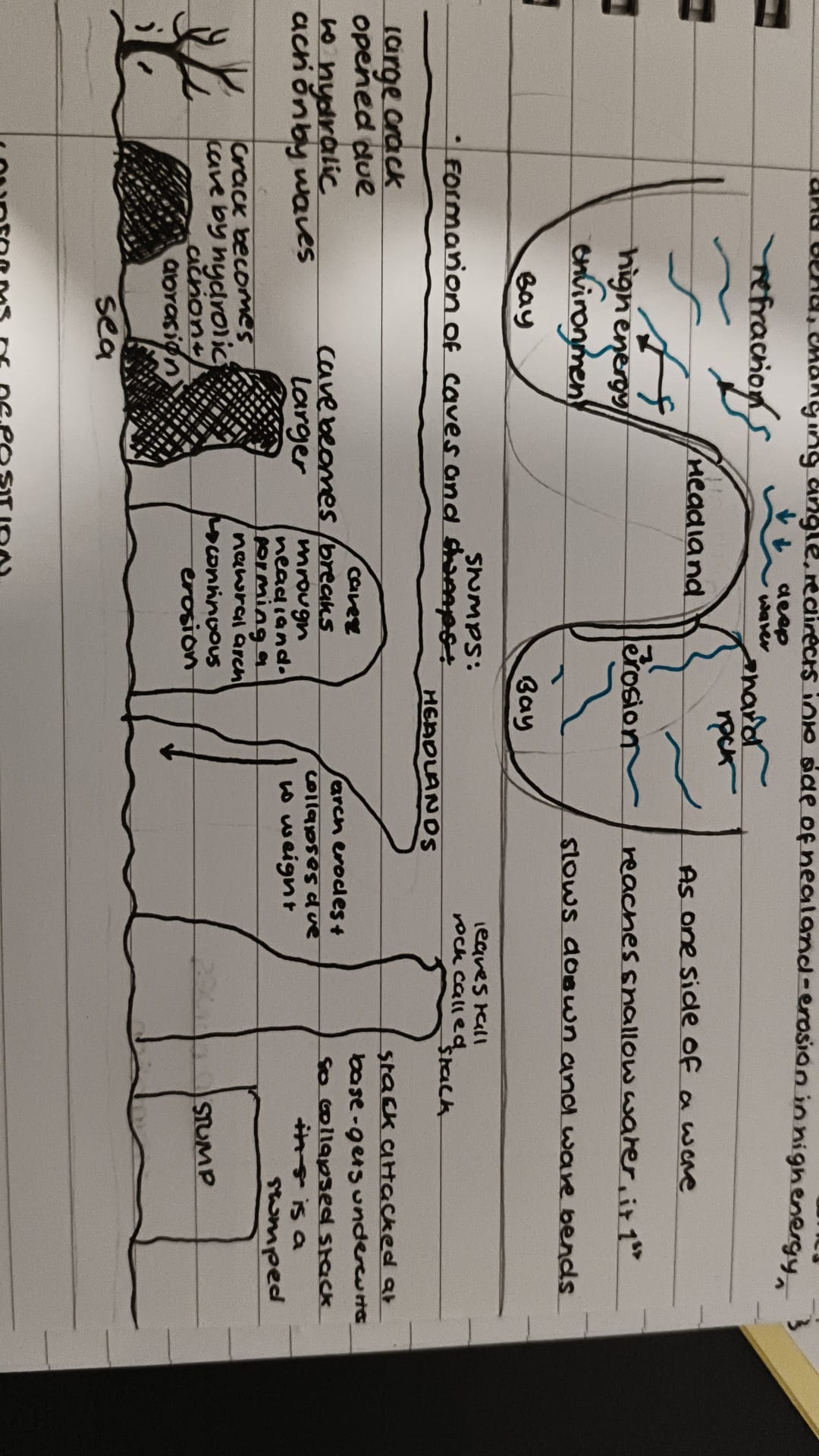
Wave refraction
waves break in shallow water at the base of headlands and bend, changing its angle, redirecting it onto the side of the headland, causing erosion in high energy zones
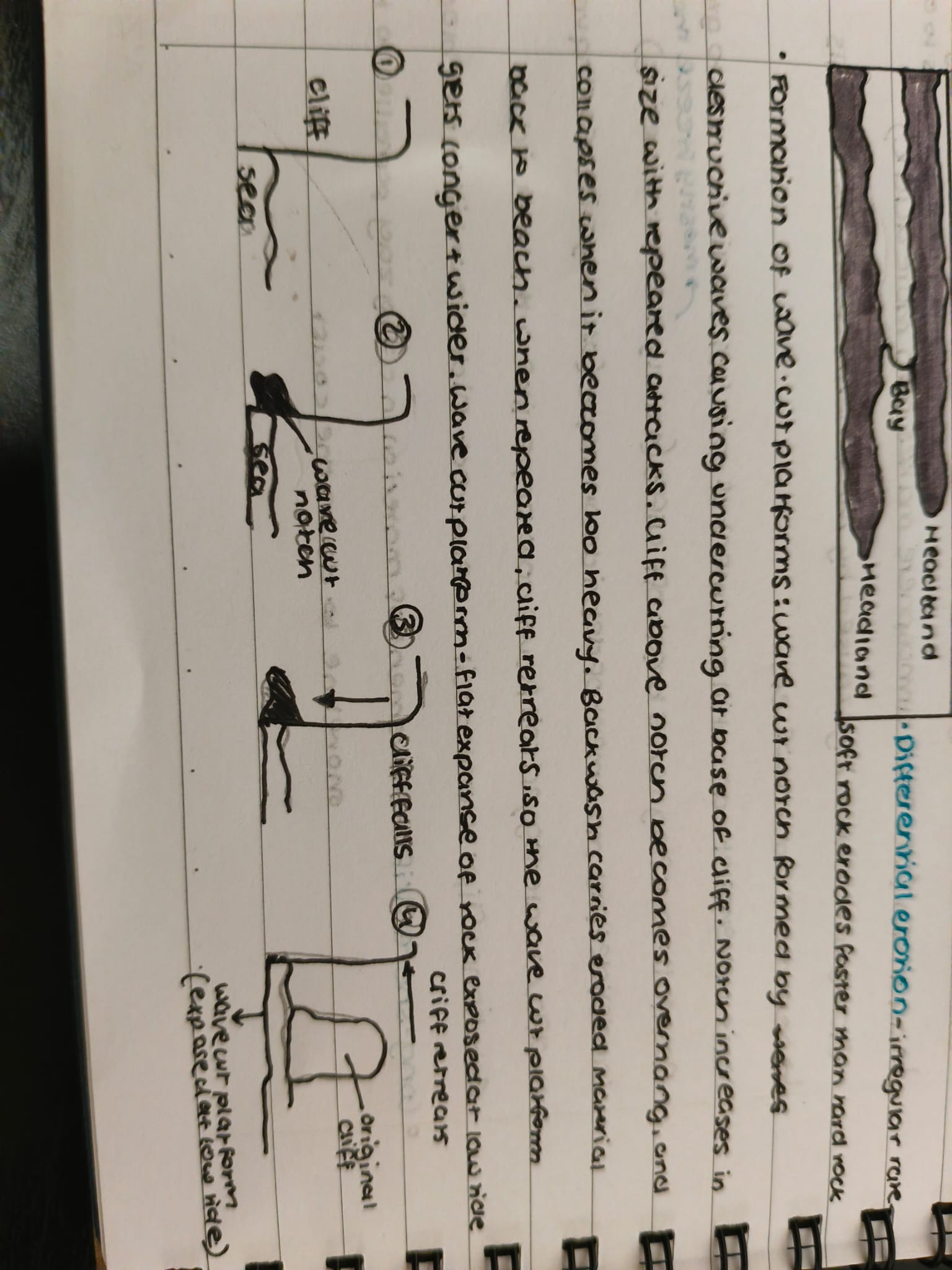
Formation of wave cut platforms
see image
Formation of caves and stumps
see image
Formation of a spit
A spit forms when longshore drift transports sediment along the coast and deposits it where the coastline changes direction or at a river mouth. As wave energy decreases, material is dropped, building a narrow ridge of sand or shingle out into the sea. Over time, the spit grows longer, often with a curved end due to changing wind and wave direction, and salt marshes may develop in the sheltered water behind it.
Formation of a bar
A bar is formed when longshore drift moves sediment along the coastline and deposits it across a bay. Over time, the spit continues to grow until it extends fully across the bay, joining two headlands. This cuts off the bay from the sea, and the trapped water behind the bar forms a lagoon.
Formation of a beach
A beach is formed when constructive waves deposit sand and shingle along the coast. These waves have a strong swash and weak backwash, so more material is deposited than removed. Over time, repeated deposition builds up a gentle sloping beach, with material often sorted by size due to wave action.
Sand dunes- formation
Sand dunes form when wind blows dry sand from the beach inland. The sand is trapped by obstacles such as driftwood or vegetation and is deposited. Over time, this builds up mounds of sand, which grow and move inland as more sand is added. Marram grass helps stabilise the dunes by trapping sand with its leaves and roots.
Sand dunes- features
Embryo dunes form first near the beach. Yellow dunes grow larger with some vegetation like Marram grass. Grey dunes are more stable with more plant life. Dune slacks are low, wet areas between dune
Sand dunes- threats
Sand dunes are threatened by tourism, as trampling by people damages vegetation that holds the sand together. Development and construction can remove dunes completely, increasing erosion. Vehicle use and strong storms can also destabilise dunes, causing them to be blown away more easily.
Sand dunes- distribution
areas of coastlines- East Coast of North America and Central America, West Africa etc
Coral reefs
Underwater ecosystems made of coral polyps that build hard limestone structures
Coral reefs- features
Animals made of calcium carbonate
Coral reefs- conditions required
Warm water (around 23–29°C)
Shallow water (less than 25 m) for sunlight to reach corals
Clear water with low sediment for photosynthesis
Salty water (marine conditions)
Stable coastlines with low wave action to prevent damage
Coral reefs- threats
-trampled by people
-Overfishing- imbalances ecosystem
Coral reefs- impacts
Economic
Provide fishing resources for local communities
Support tourism (snorkelling, diving) → income and jobs
Environmental
Protect coastlines by reducing wave energy and erosion
Support biodiversity, home to many marine species
Social
Provide food and livelihoods for coastal communities
Cultural and recreational value for local people and tourists
Coral reefs- distribution
shallow waters around the tropics and equator, like australia
Mangroves
Coastal forests of salt-tolerant trees growing in intertidal, muddy areas
Mangroves- distribution
-found between tropics
-one third found in asia
mangroves- adaptations
roots- stick out of mud- allows for gas exchange during high tide
leaves-salt glands excrete nearly all of the salt in the plant- makes them salt tolerant
seeds-grow roots attached to plant and float in water until they find shallow waters to grow in
mangroves- importance
-protect coastlines from erosion (wave action becomes gentle due to their roots/ absorb wave energy)
-attract tourism
-provide nurseries for fish (supports fishing industries)
mangroves- threats
-agricultural runoff- causes algal bloom (eutrophication)- imbalances ecosystem
Salt marshes
Low-lying coastal wetlands with salt-tolerant grasses
salt marshes- threats
Coastal development: Building on coastlines destroys salt marsh habitats.
Fishing: Overfishing and trawling damage the marsh ecosystem and disturb wildlife.
Invasive species: Non-native plants and animals outcompete native species and change the habitat.
Climate change: Rising sea levels flood salt marshes, reducing their area.
Sewage/fertilizer: Runoff causes pollution and eutrophication, harming plants and animals.
Abiotic
non-living factors of an ecosystem
biotic
living factors of an ecosystem
Threats of coastal ecosystems by humans
Coastal ecosystems are threatened by human activities in several ways. Industrialisation causes pollution and habitat loss, damaging reefs, mangroves, and salt marshes. Agricultural practices lead to runoff of fertilizers and pesticides, harming water quality and wildlife. Tourism damages habitats through trampling, waste, and construction, while deforestation removes protective vegetation like mangroves, increasing erosion and flooding.
coastal flooding
coastal area is inundated with water
coastal flooding- causes
thermal expansion- sea absorbs heat in the atmosphere- causes water molecules to expand- rises sea levels- leads to coastal flooding
melting ice- ice that was originally on land melts, adding water to sea, increasing sea levels.
Storm surge: Sudden rise in sea level from strong winds & low pressure
Tsunami: Large sea waves from underwater earthquakes/volcanoes
Climate change: Long-term sea level rise increasing flood risk
threats from coastal flooding-
less freshwater available
loss of tourism
loss of traditional way of life
loss of soil/ land area
erosion of beaches/ land
disrupted fishing
coral bleaching
Users/ uses of the coast
fishing, tourism, housing. indulstrialization, natural habitats
Prediction & Prevention of coastal flooding
Forecasting: Using tech/data to predict storms and floods
Building design: Raising or strengthening buildings to resist floods
Planning: Limiting building in flood-prone areas
Education: Teaching communities how to prepare and respond
Soft Engineering
when the natural environment is used to help reduce coastal erosion
Soft Engineering- Beach replenishment
-Adding sand/shingle to the beach to make it wider and to absorb wave energy
-Advantage: Protects coast by absorbing waves
-Disadvantage: Expensive, needs regular maintenance
Soft Engineering- Cliff regrading
Reducing cliff slope to prevent collapse
-Advantage: Reduces cliff collapse risk
-Disadvantage: Changes natural landscape
Soft Engineering-Ecosystem rehab & revegetation
Planting vegetation to stabilise coastlines
-Advantage: Stabilises coast, supports wildlife
-Disadvantage: Slow to work, vegetation can be invasive
Soft Engineering- Managed retreat
Allowing flooding to create natural barriers like salt marshes
-Advantage: Creates natural habitats, low maintenance
-Disadvantage: Loss of land or property
Hard engineering
involves the construction of man made structures to manage the coastline
Hard engineering- Groynes
Wooden or rock barriers built perpendicular to the coast to trap sediment
Advantage: Build up beaches, naturally protecting the coast
Disadvantage: Starves down-drift areas of sediment, causing erosion there
Hard engineering- Sea walls
Concrete or stone walls along the coast to reflect wave energy
Advantage: Very effective at preventing erosion and flooding
Disadvantage: Expensive, unnatural appearance, can increase erosion elsewhere
Hard engineering- Rip raps
Large boulders placed at the base of cliffs to absorb wave energy
Advantage: Relatively cheap, absorbs wave energy effectively
Disadvantage: Can look unnatural, dangerous to people
Hard engineering- Gabions
Wire cages filled with rocks to protect cliffs from erosion
Advantage: Cheap, flexible, absorbs wave energy
Disadvantage: Need maintenance, can look unattractive
Hard engineering- revetments
Sloped wooden, concrete, or rock structures along the shore to reduce wave impact
Advantage: Reduces wave energy and slows erosion
Disadvantage: Expensive, can look unnatural