PRCM 1000 Final Exam- Nixon
 Studied by 0 people
 Call Kai
 Learn
Learn Practice Test
 Spaced Repetition
 Match
Match Flashcards
 Knowt Play
 Podcast
1/128

There's no tags or description
Looks like no tags are added yet.
Name | Mastery | Learn | Test | Matching | Spaced |
|---|
No study sessions yet.
129 Terms
PR Metrics article
- PR can be a very effective sales tool
- create PR campaigns to track all of your results, even if unsavory
- Paid promotions on platforms like Facebook and LinkedIn to drive leads and conversions.
- A point-based system for measuring social media engagement, where likes, comments, shares, and retweets are assigned different values to evaluate campaign effectiveness.
- Includes unique URLs, landing pages, discount codes, or phone numbers used exclusively in social media to track effectiveness through analytics.
-Email marketing plays a crucial role in distributing content, and its effectiveness can be measured by downloads, shares, and audience engagement.
-track the effectiveness of your community through sales, speaking engagement recommendations, client referrals, or paid webinar attendees.
-include sales as a metric
PESO model
A PR strategy that integrates Paid, Earned, Shared, and Owned media to maximize effectiveness.
- PESO Model program teaches you how to measure the work you're doing to real results.
media pitching guide w examples article
to pitch an article, first read journalist's previous articles to understand their POV, understand their values, put a personal twist on a pitch, include context on who you are, make sure your email is correctly addressed, don't send mass emails, tailor to the medium that you're pitching to
media pitch, muck rack article
a short communication, typically an email or direct message, suggesting a news story to a journalist or editor at a publication, radio station or broadcast network. The goal of a pitch is to generate coverage and determine if your media contact is interested in creating a story around the content.
pitching for TV
When pitching TV, your story must be visual.
Plus, you should be familiar with the show you're pitching. Not only do TV news programs have different segments within a show, but the shows themselves might be different. For example, a news station's morning show may be lighter and allow for more fun feature segments than the station's 6 p.m. evening news.
pitching for radio
One of the biggest differences between radio and other broadcast media is airtime allotment. Some radio shows may feature guests on the air anywhere from 15 minutes to a full hour, compared to the short timespan you often get on TV.
Something important to think about here: When you're being interviewed live on the radio, there's a lot less time to think about your message. Your spokesperson needs to be prepared to deliver their message on the fly.
pitching for magazines
Magazines plan out much further in advance (think: at least three-four months) compared to other types of media, which are often more immediate. magazines also have a language of their own
contributed content
Unlike an article written by a reporter about a person or company, contributed content is written directly by the person or company and submitted to a publication. Contributed articles are meant to offer insight and first-person perspective on relevant topics, and can be a great way to position a brand as a thought leader in the industry.
6 media values, muck rack article
Timeliness- trending and relevant stories
Impact- does the story impact alot of ppl
Prominence- how widely known is the subject of ur story
Proximity- is smth localized
Conflict- does the story have a good conflict
Human interest- a human touch on who is affected
writing a media pitch
1. write a clear, short subject line
2. in the body, include who, what, where, when, why, content that resonates with the audience
3. the pitch should be under 3 sentences
4. email the journalist, don't cold call them
5. follow up once if they don't respond within a week
6. track the metrics of your pitch (click-thru rate, hit rate, open rate, etc)
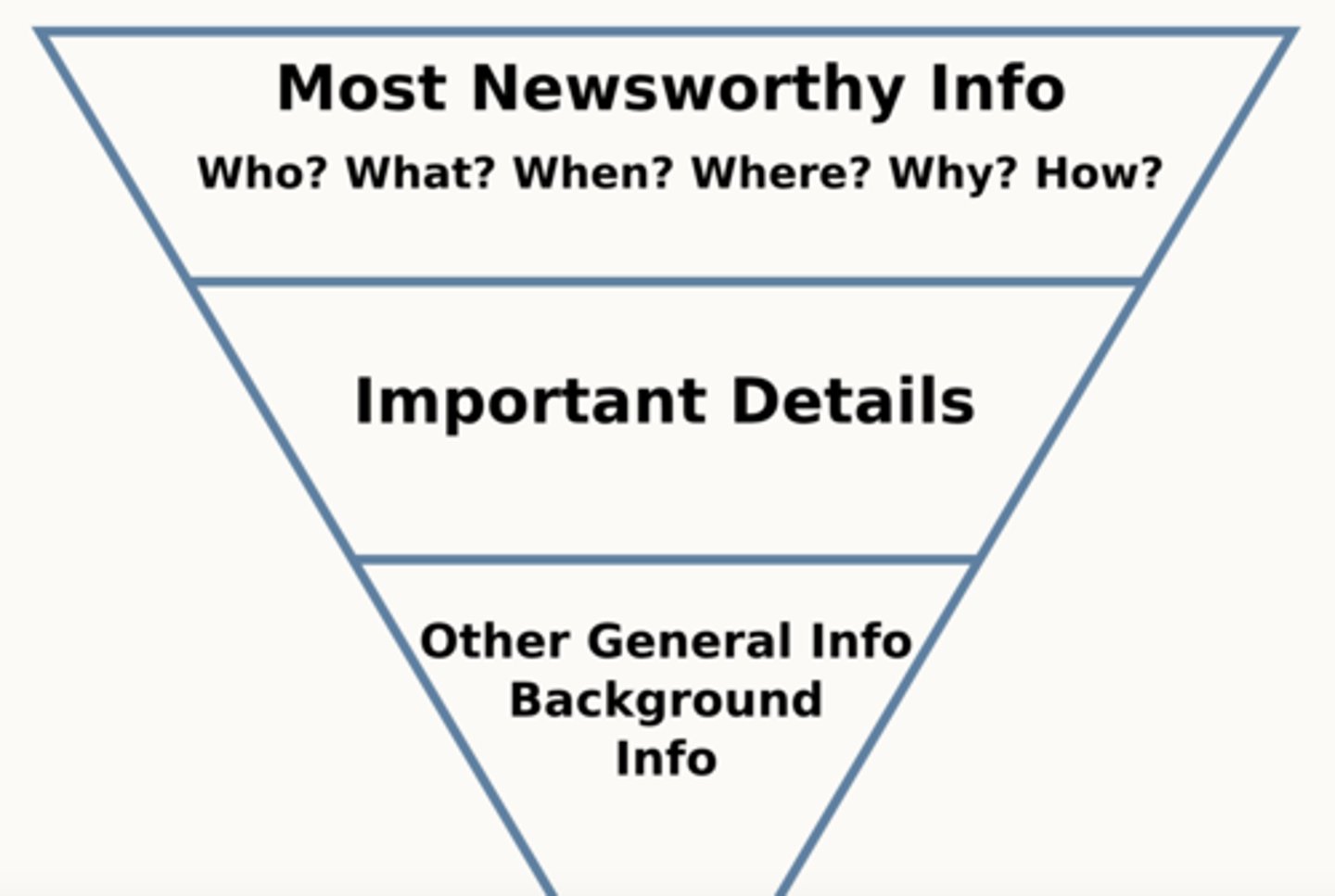
mass communication
the process whereby media organizations produce and transmit messages to large publics and the process by which those messages are sought, used, understood, and influenced by audience
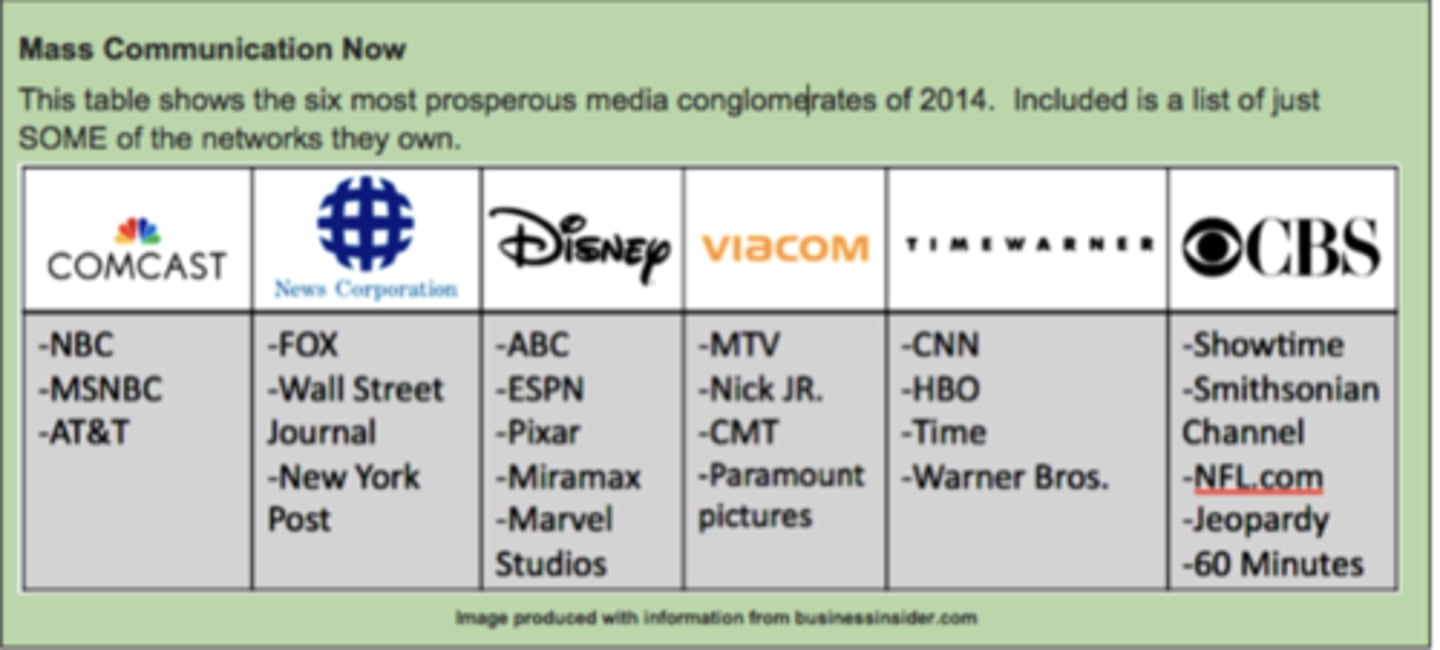
how mass communication differs from other forms of media
- mass communication often comes from large organizations that influence culture on a large scale
- dependence on media to deliver the news
- audience
- tends to be distant, diverse, and varies in size depending on
- most often profit driven, and feedback is limited.
- participants are not equally present during the process.
hot and cold media
Examples of hot media include photographs or radio because the message is mostly interpreted using one sense and requires little participation by participants. An audience
is more passive with hot media because there is less to filter. Television is considered a cold medium because of the large amount of multisensory information.
evolution of mass communication
Mass communication has evolved from oral traditions to written language, the printing press, and modern digital media. Each advancement, from newspapers and radio to television and the internet, has expanded how people share information. Today, social media and streaming services enable instant global communication, shaping culture and society.
sensationalization
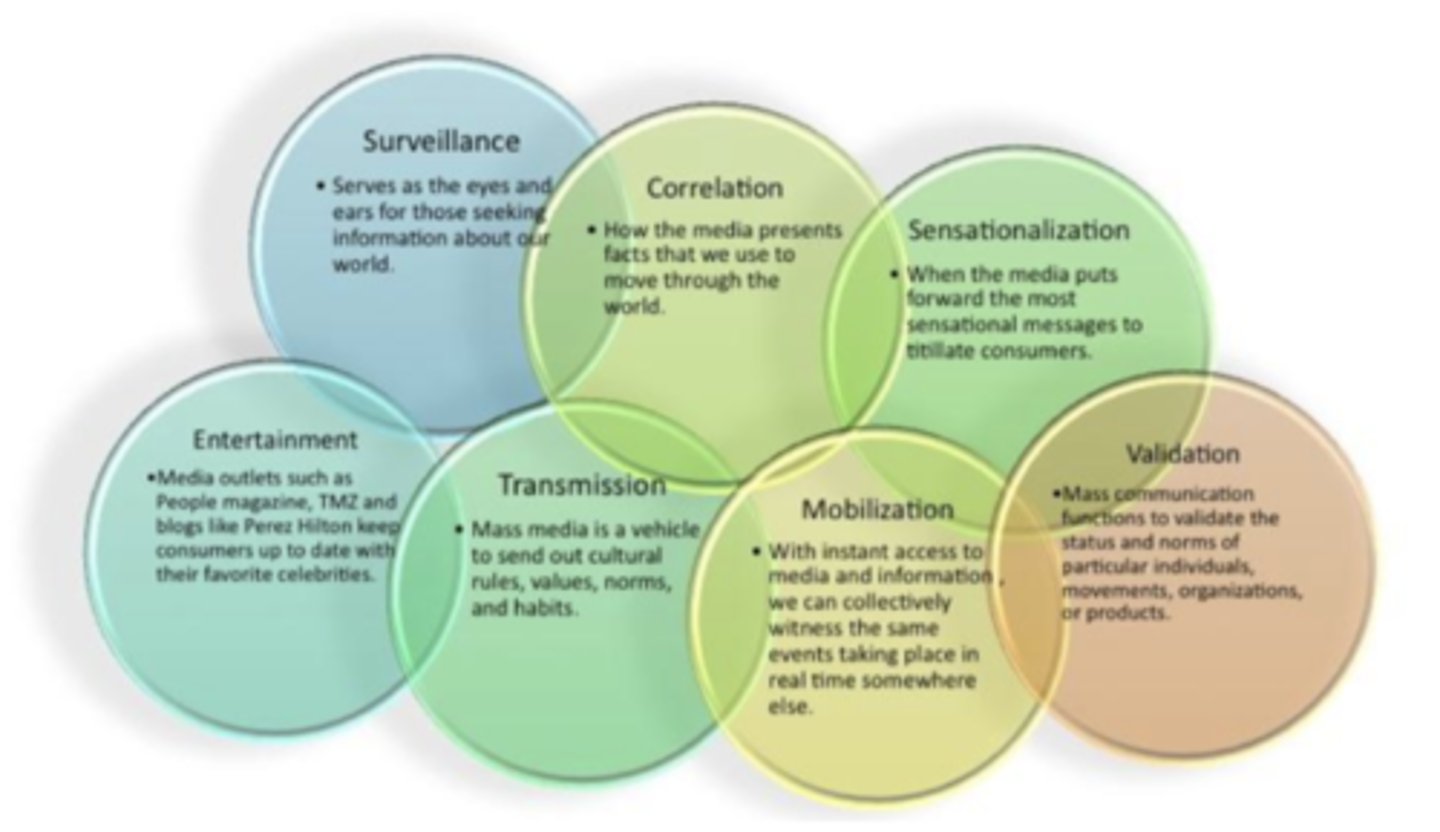
There is an old saying in the news industry "if it bleeds, it leads," which highlights the idea of Sensationalization. Sensationalization is when the media puts forward the most sensational messages to titillate consumers. Elliot observes, "Media managers think in terms of consumers rather than citizens. Good journalism sells, but unfortunately, bad journalism sells as well. And, bad journalism-stories that simply repeat government claims or that reinforce what the public wants to hear instead of offering independent reporting -is cheaper and easier to produce" (35).
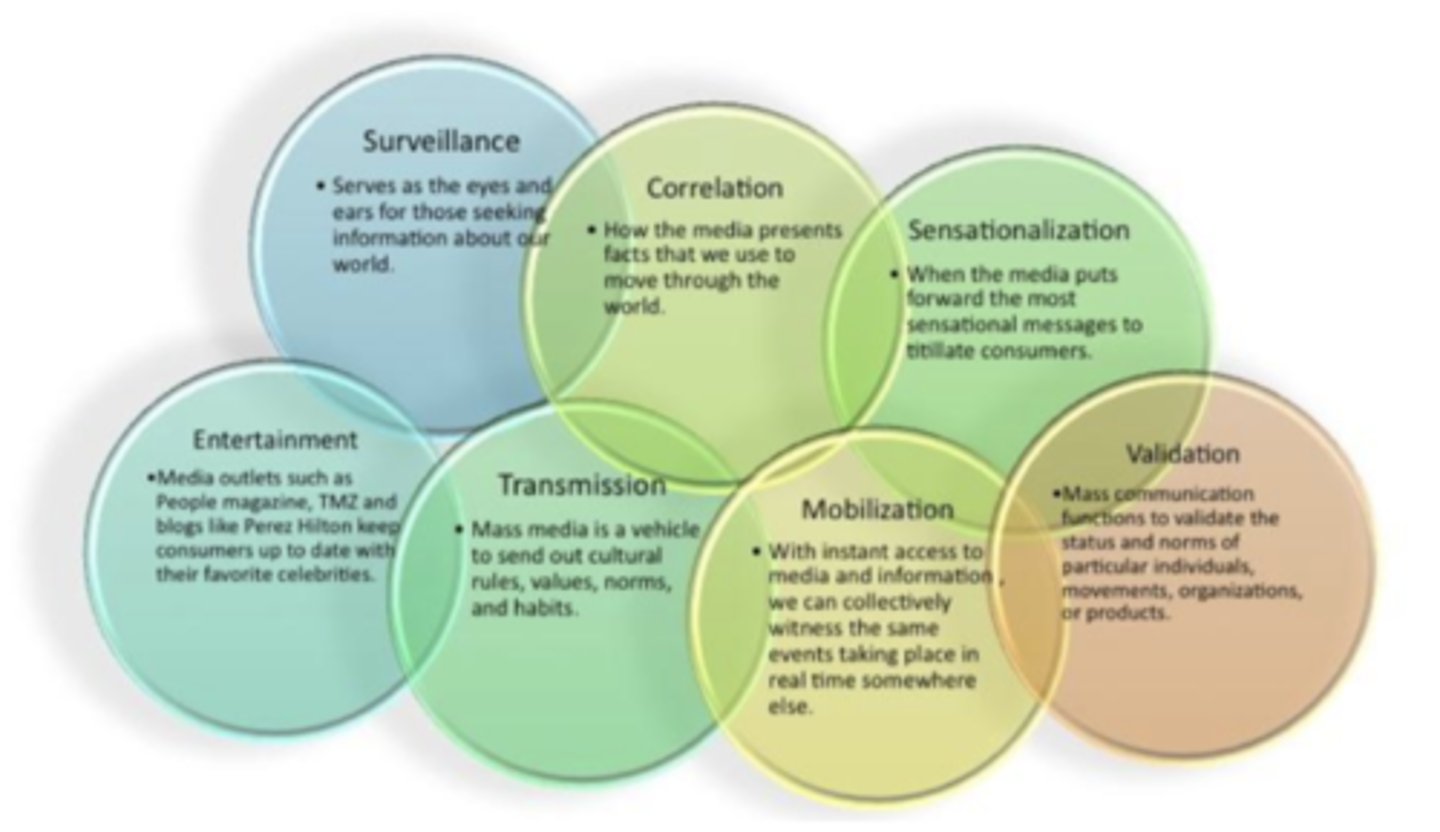
mobilization
With instant access to media and information, we can collectively witness the same events taking place in real time somewhere else, thus mobilizing a large population of people around a particular event.
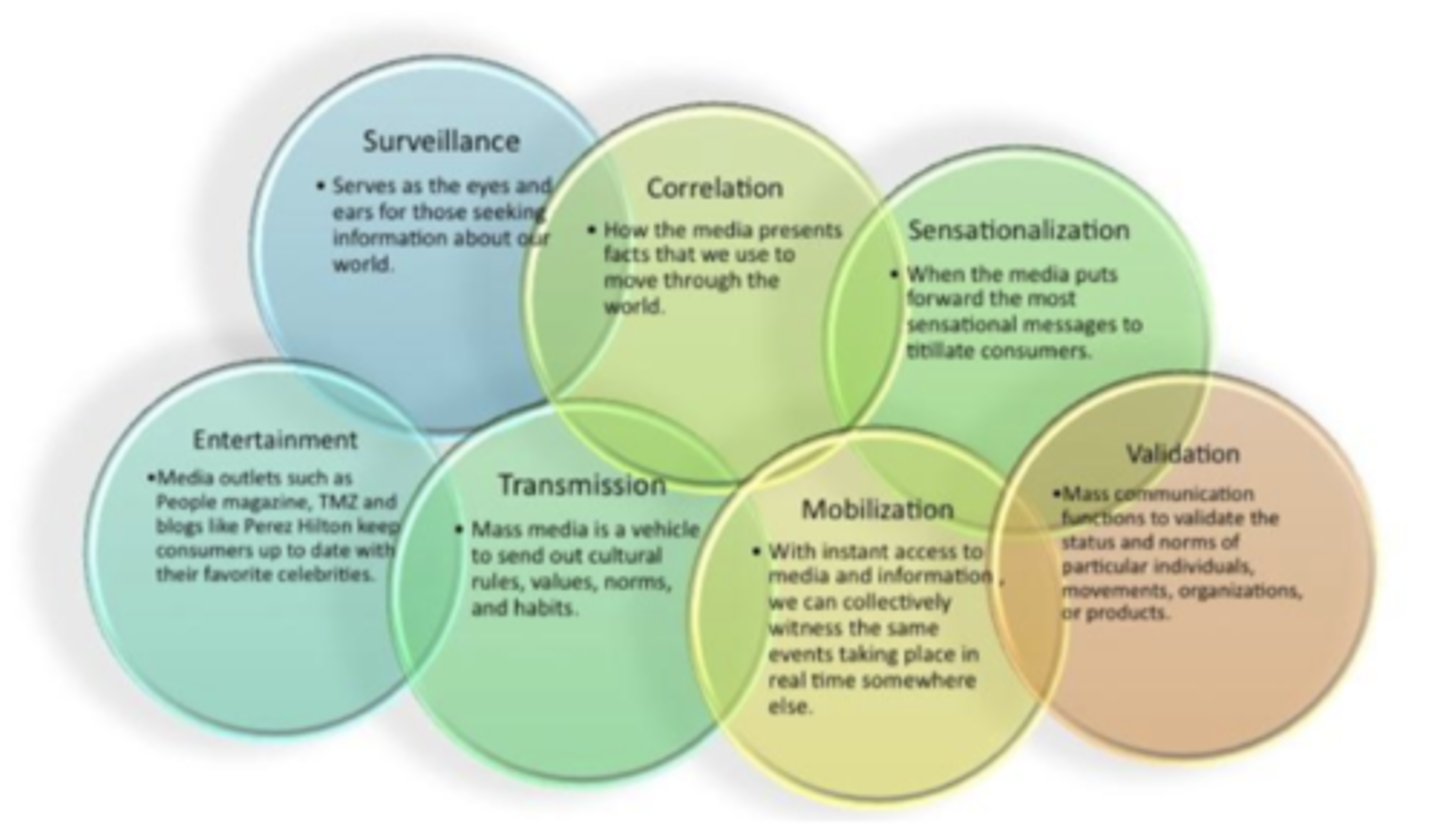
validation
The media validates particular cultural norms while diminishing differences and variations from those norms. A great deal of criticism focuses on how certain groups are promoted, and others marginalized by how they are portrayed in mass media.
magic bullet theory
Communication was seen as a magic bullet that transferred ideas or feelings or knowledge or motivations almost automatically from one mind to another
two-step theory
messages pass through opinion leaders, who interpret and share them with others. This is seen in political campaigns, where media and social leaders shape public opinion. Social media has amplified this effect, as seen with figures like Pope Francis and President Obama.
multi-step flow theory
information and influence flow back and forth between opinion leaders and followers. With social media, average people can now reach millions, reducing the dominance of traditional opinion leaders.
uses and gratification theory
people actively choose media based on their needs and preferences. Instead of being passive consumers, audiences select content that aligns with their values and interests.
cultivation theory
heavy media consumption shapes perceptions of reality. Frequent exposure to violence, stereotypes, and cultural messages can desensitize viewers and influence beliefs about the world.
media literacy
ability to responsibly comprehend, access, and use
mass communication in our personal and professional lives. Potter states that we should maintain cognitive, emotional, aesthetic, and moral awareness as we interact with media.

skills we need for media literacy
1. respect power of mass comm messages
2. understand content by paying attention and filtering out noise
3. understand emotional v reasoned reactions
4. develop expectations of mass comm content
5. understand if and why genres are being mixed
6. think critically about sources
7. understand internal language of mass comm
competition
PR managers should avoid deliberately threatening competitors and engaging in practices that harm the entire industry. Hiring should be based on an open and ethical set of rules.
free flow of content
Communications should be precise and truthful in order to create high-integrity relationships with the media and other stakeholders. Practices such as gift-giving must be handled with honest care.
disclosure of information
All content necessary for informed decision-makers should be disclosed to clients or employers. Sponsors and financial interests should be revealed to avoid deceit.
safeguarding confidences
Confidential, privileged, or otherwise private information should be kept safely. It is unethical to use such information for another job and use it to undermine a previous client or employer, or to steal it.
conflicts of interst
"Real, perceived and potential" conflicts of interests should be excluded. PR experts can better serve their clients and employers when their personal and business interests don't contradict their PR work.
enhancing the profession
It's important to build trust in the PR reputation among the public. When PR experts follow and self-enforce the PRSA code of conduct, they increase the overall credibility of the public relations industry.
ethical PR practices
1. provide truthful information
2. offer true context
3. advise company leaders (sway them away from making bad decisions)
4. mention fellow sponsors
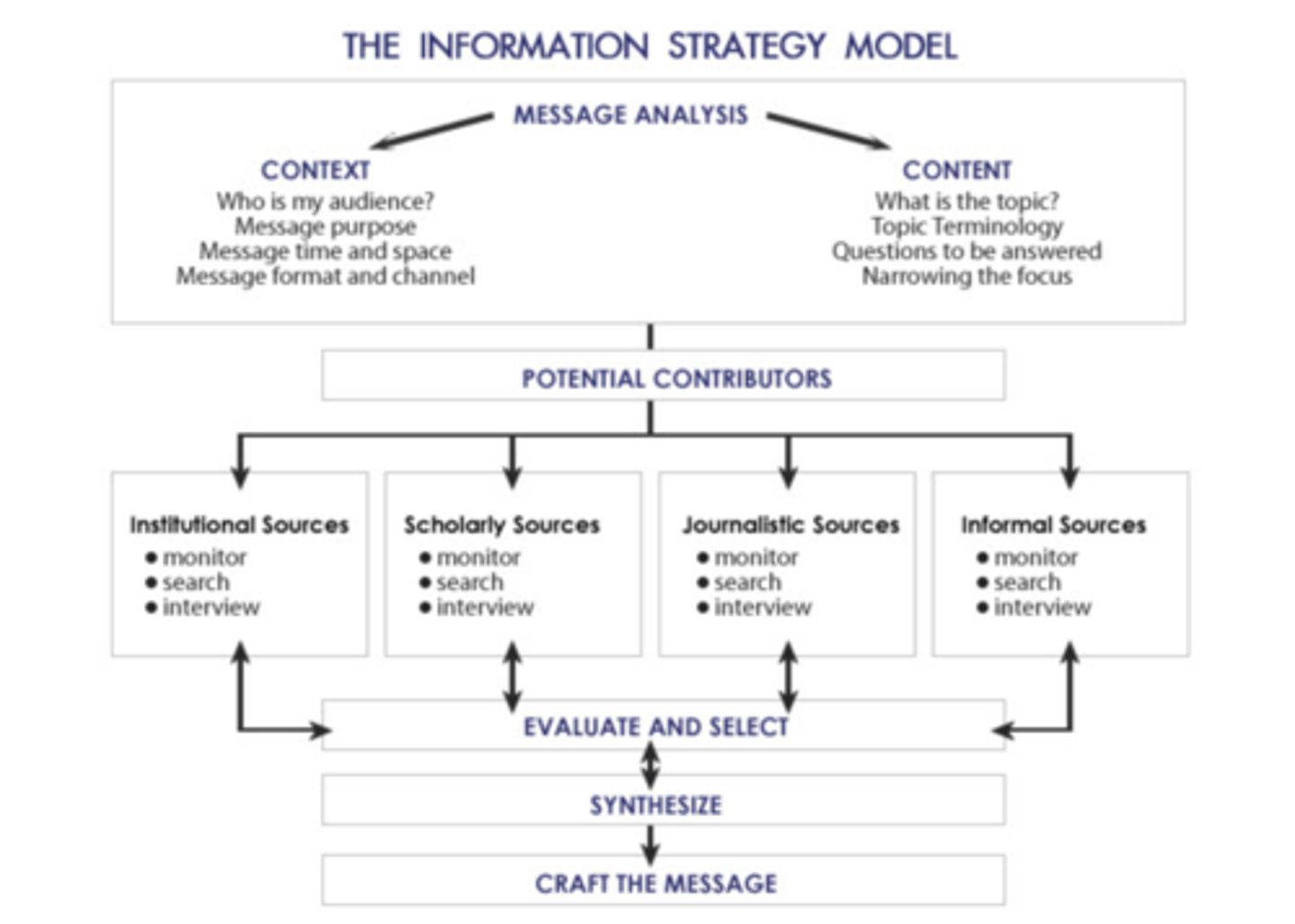
info strategy model
helps guide mass communicators through systematic steps for creating effective messages. It involves:
Message Analysis: Define the audience, purpose, time, space, format, and focus of the message.
Potential Contributors: Identify and evaluate information from institutional, scholarly, journalistic, and informal sources.
Synthesize: Combine relevant information and craft the message.
journalistic organizations
want to inform and engage the readers / viewers / listeners of their messages through publishing stories about current events, people, ideas, or useful tips. By providing compelling and interesting information they hope to draw an audience to the publications in which their messages appear.
advertising firms
create messages for their clients that inform or persuade potential customers to purchase a product or service or adopt an idea or perspective. Ads generally include a "call to action" that identifies the intended outcome of the message.
public relations firms
help their clients influence legislators, stakeholders (ie: regulators, business partners, media organizations and the general public) to think positively about the company or organization and manage the organization's information environment.
breaking news
hard news. Immediate coverage of ongoing events, focusing on key details like who, what, when, where, and why.
depth report
hard news. An in-depth follow-up story that explains the broader context and consequences of an event.
analysis/interpretive report
hard news. A report that analyzes and explains an issue or event, focusing on "why" something happened.
investigative report
hard news. A story that uncovers hidden or unreported information, often exposing problems or controversies.
feature
soft news. A story designed to entertain or engage, focusing more on style and interest than critical information.
personality sketch/profile
soft news. A story about an individual's life, accomplishments, and personality.
informative
soft news. A feature that provides detailed information about a topic, often accompanying a news story.
historical
soft news. A feature focused on the past, often tied to holidays or anniversaries.
descriptive
soft news. A feature about places or events, often used for tourism or promotion.
how-to
soft news. A practical guide that explains how to do something or improve a skill.
editorials
opinion. Signed or unsigned pieces reflecting the publication's or management's views on a subject, aiming to persuade, entertain, or comment on an issue. Requires credible information to support the position.
columns
opinion. Personal opinions written by columnists, offering a specific perspective on community or world events. Requires selective use of information and a consistent voice.
reviews
opinion. Informed judgments about the quality of content (books, films, art, etc.), offering both descriptive and evaluative insights. Requires deep knowledge of the subject being reviewed.
advertising
paid form of communication from an identified sponsor using mass media to persuade or influence an audience. Because there are so many diverse advertisers attempting to reach so many different types of audiences with persuasive messages, many forms of advertising have developed.
brand/natl consumer advertising
Focuses on promoting brand identity and generating demand for a product or service. It emphasizes building consumer preference for a specific brand over others.
retail advertising
Local ads that promote specific stores, focusing on product availability, prices, location, and special offers.
directory advertising
Provides information about where to buy products or services, commonly seen in yellow pages or sponsored search engine links.
direct response advertising
Encourages immediate consumer action, like purchasing products through phone, mail, or online, often seen in infomercials or direct mail.
business to business advertising
Targets professionals, retailers, or industrial buyers, often in specialized trade publications, offering products or services suited to specific industries.
institutional advertising
Focuses on promoting a company's image, corporate identity, or stance on a particular social issue, rather than specific products.
advertising features
Advertorials or native ads that blend advertising with editorial content, often appearing as feature stories but promoting a product or service.
public service advertising
Communicates a message for a social cause, typically created and aired for free by media outlets to encourage action or raise awareness.
internal pr
type of pr. Communications aimed at employees and officers within a company, including newsletters, crisis plans, and annual reports. These media require in-depth knowledge of company issues, finances, and concerns that employees or stockholders may be interested in.
news releases
type of pr. Written to generate media interest for a client, these announcements can be for new events, trends, or responses to current issues. The goal is to create content that resembles a news story, though PR specialists are not required to include all viewpoints.
broadcast news releases
type of pr. Similar to news releases but in broadcast form, including video and voice-overs for TV stations. B-roll footage, without a voice-over, can also be provided to enhance media stories.
media kits
type of pr. A collection of materials including fact sheets, bios, photographs, and video/audio segments that provide media professionals with background information. These kits are designed to generate story ideas or attract advertisers.
backgrounders/briefing sessions
type of pr. Provide in-depth information about a topic or event to reporters. These sessions involve handouts and presentations, and PR specialists anticipate reporters' questions and provide detailed follow-up materials.
news conferences
type of pr. Two types exist: informational (to announce or update on a specific event) and personality (to provide access to public figures). Information tasks include preparing statements, briefing papers, and anticipating questions.
media tours
type of pr. PR specialists organize in-depth, interactive tours with reporters. These tours offer more practical experiences, like product demos, and require knowledge of what will interest journalists and what can be shared.
special events
type of pr. PR specialists plan events for media attention around causes or issues. These must have news value and require generating information that aligns with journalistic standards for coverage.
responses to media inquiries
type of pr. PR specialists respond to media requests for comments, quotes, or information. Quick responses and background research are essential for maintaining good media relationships.
PR features
PR firms often create branded content or native ads, sometimes referred to as "owned media." This content must be well-informed and written in a journalistic style to be effective.
storytelling/information strategy
The way information is crafted into the final media message depends on two key factors:
how the message is being delivered
the audience for whom the message is intended
storytelling can: inform/enlighten, provide context, persuade
characteristics of good storytelling
1. understanding your audience
2. mastery of the subject matter
3. command of the mechanics of writing
4. media elements
5. ethical standards
6. meeting assignment parameters
gatekeepers
these are the people within the organization who not only hand out the assignments, they are also the ones with the power to decide:
which messages are produced
who produces the messages
where the messages will appear
what the messages will contain
7 functions of messages
they provide information about the availability of products and services: advertising and publicity
they entertain: special features, advertising
they inform: basic news, advertising, publicity
they provide a forum for ideas: editorials, interpretive stories, documentaries, commentaries
they educate: depth stories, self-help stories and columns, informative pieces, advertising with product features and characteristics
they serve as a watchdog on government: investigative pieces and straight coverage of trials and other public events
they persuade: advertising, publicity, editorials and commentaries
motives
psychographic variable. n internal force that stimulates someone to behave in a particular manner. A person has media consumption motives and buying motives. A motive for watching television may be to escape; a motive for choosing to watch a situation comedy rather than a police drama may be the audience member's need to laugh rather than feel suspense and anxiety.
attitudes
psychographic variable. a learned predisposition, a feeling held toward an object, person or idea that leads to a particular behavior. Attitudes are enduring; they are positive or negative, affecting likes and dislikes. A strong positive attitude can make someone very loyal to a brand (one person is committed to the Mazda brand so she will only consider Mazda models when it is time to buy a new car). A strong negative attitude can turn an audience member away from a message or product
personalities
psychographic variables. a collection of traits that make a person distinctive. Personalities influence how people look at the world, how they perceive and interpret what is happening around them, how they respond intellectually and emotionally, how they form opinions and attitudes.
lifestyles
psychographic variables. The model categorizes people according to their psychological characteristics and their resources. Advertisers use it to determine what kind of products and advertising appeals will best work with an anonymous audience member
participant observation
involves joining or living with a group and becoming a part of the action. Members of the group being observed — for instance, prison inmates — may or may not know the observer's true identity, but he or she is seen as being part of the group
unobstrusive observation
research method where the observer remains as inconspicuous as possible, ensuring their presence does not influence or alter the behavior of the subjects being observed.
conventional wisdom
The essential elements of conventional wisdom about any topic can usually be demonstrated in some sense. For example: conventional wisdom says that cats are difficult to train, Midwestern universities have good hockey teams, and women are good listeners.
special library
The Folger Shakespeare Library in Washington D.C. is a special library in the sense that it collects books and materials by and about Shakespeare. Insurance companies, law firms, churches, hospitals, oil companies, and banking institutions are other kinds of places where a special library might be located.
archive
An archive is responsible for keeping a permanent record of the history, transactions, and operations of whatever it is that is being archived and thus, the materials in an archive usually do not circulate.
it's v its
Error: Confusing “it’s” (it is) with “its” (possessive form of it).
Fix: Remember, “it’s” is a contraction for “it is.” If you can’t replace “it’s” with “it is,” then you should use “its.”
dangling modifiers
Error: Placing a modifier too far from the word it’s describing.
Fix: Keep modifiers close to the words they modify. Change “Walking into the room, the product caught everyone’s eye” to “As she walked into the room, the product caught everyone’s eye.”
that v which
Error: Using “that” and “which” interchangeably.
Fix: Use “that” for essential clauses and “which” for non-essential clauses. “The campaign that succeeded” vs. “The campaign, which succeeded.”
fake news
deliberate disinformation. It is "false, often sensational, information disseminated under the guise of news reporting" (Collins Dictionary). It's meant to confuse, scare, or trick someone into believing a fake event happened, and can be used to sway individuals to a political party line.
propoganda
fake news. intended to promote a specific agenda
disinformation
fake news. frequently spread to discredit a rival or increase confusion
conspiracy theory
fake news. usually attempts to explain an event or circumstances as part of a secret plot by those in power
clickbait
fake news. a sensational headline written to entice people to click and/or share
satire
fake news. an intentionally false story written for comedic purposes that may be shared by people who do not realize it is a work of fiction
bias challenging
fake news. a piece of news that a person wishes to discredit because it challenges his or her own beliefs
time line of PR/comm
1. Dawn of the ages: cave drawings- spain, france, indoneisa
2. Age of empires: Egyptian hieroglyphics- tombs, pottery, etc
3. Age of faith: Confucius & philosophy, started humanities program
4. Age of empire: greek philosophy influenced western cultures
5. Age of faith: st paul created religious writings, resonated w many, Han dynasty- During the Han dynasty, handwritten news sheets, called tipao, were disseminated among government officials, The Library of Alexandria, an extensive library that stored more than a half-million scrolls, was a meeting place for scholars and intellectuals.Saint Patrick, the patron saint of Ireland, began his journey in Britain, where he was kidnapped at 16 years old and taken to Ireland to be a child slave. Escaping six years later, he returned to Ireland to help spread Christianity. Genghis Khan, known for his violent conquests in Asia, united the Mongols, and with the help of his successors, created an empire. He implemented a system of way stations for horses and their messenger riders, helping the empire disseminate orders and receive news.
6. Age of print- gutenburg, martin luther, propaganda to crush reformation, boston tea party, abolitionists,
7. Age of invention- telegraph, railroads, telephone. women's rights. political campaigns,
8. Age of digital media- many different platforms, social media in politics, virtual reality
peer reivew article options
1. accept without revisions- 3%
2. minor revisions- 7%
3. major revisions- 10%
4. rejection- 80%
peer reviewed articles are the highest quality academic sources. you can often find them in a university online catalog. or u can use google scholar
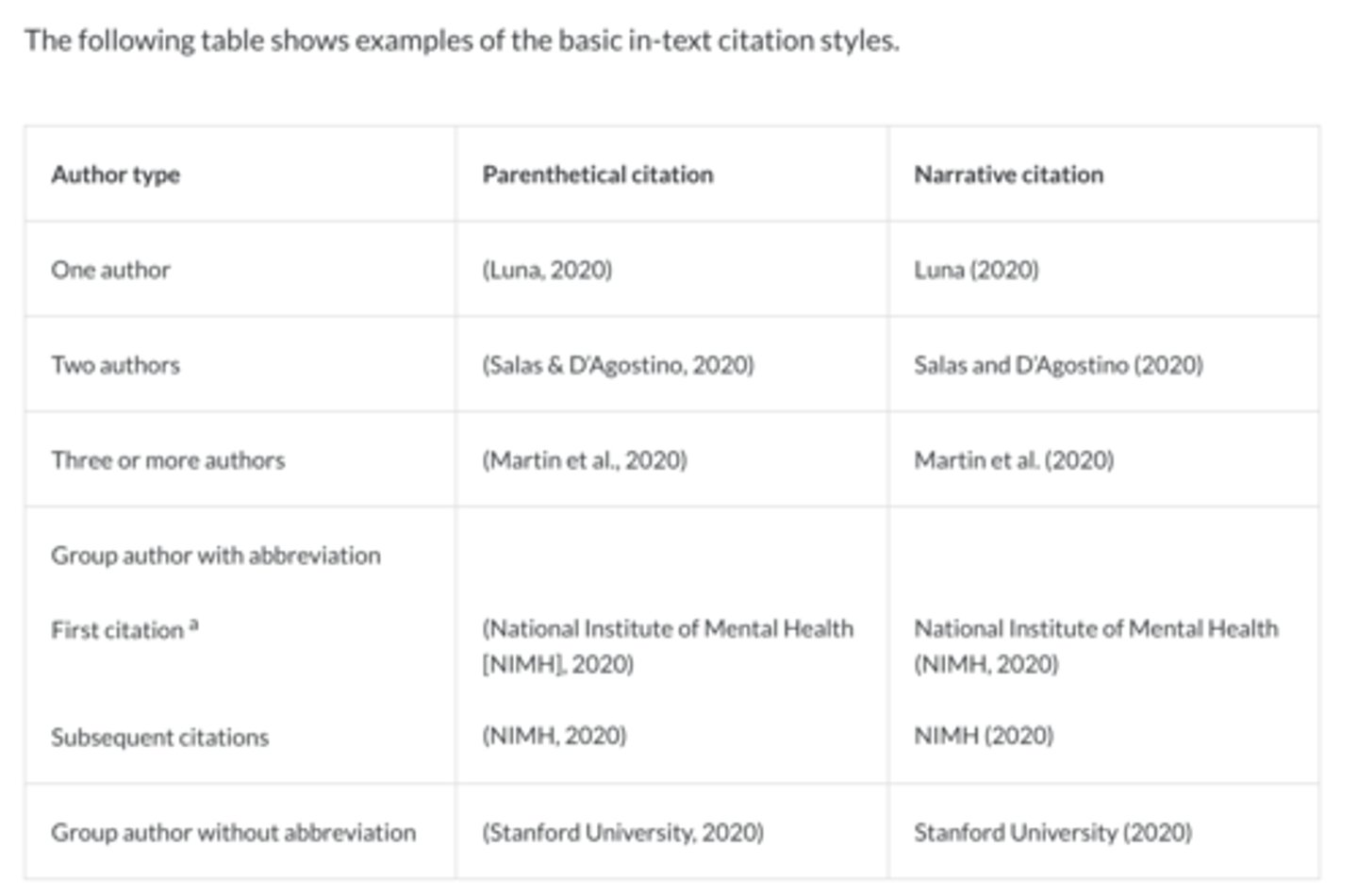
APA intext citations
Each work cited in the text is identified by its author and year of publication.
For each in-text citation, there is a corresponding reference entry in the reference list.
Define the abbreviation for a group author only once in the text, choosing either the parenthetical or the narrative format. Thereafter, use the abbreviation for all mentions of the group in the text.
In parenthetical citations, the author and year appear in parentheses. In narrative citations, the author appears as part of the sentence, followed by the year in parentheses.
For multiple works by the same authors, separate the publication years with commas. When citing works by different authors in one parenthesis, place the citations in alphabetical order, separating them with semicolons.
continuity
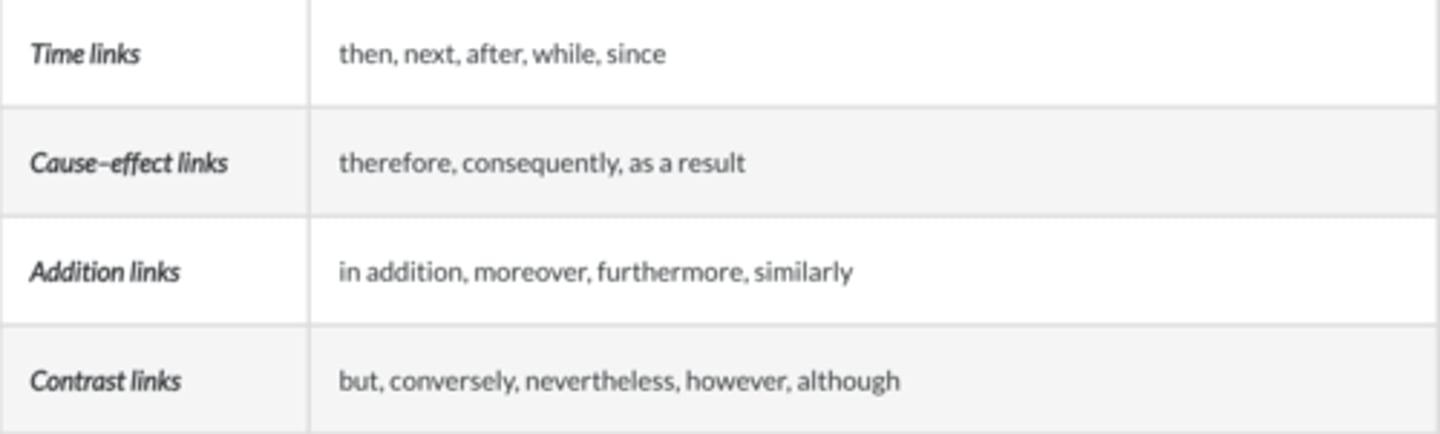
meaning a logical, orderly, and smooth flow of ideas. Readers will better understand your ideas if you have continuity in words, concepts, and themes throughout your paper.
To improve continuity in your writing and the flow of your paper, check transitions between sentences, paragraphs, and ideas.
anthropromorphism
Refrain from anthropomorphism, which means attributing human characteristics to animals or inanimate objects, and from making illogical comparisons, which often result from the omission of key words or from having nonparallel sentence structure.
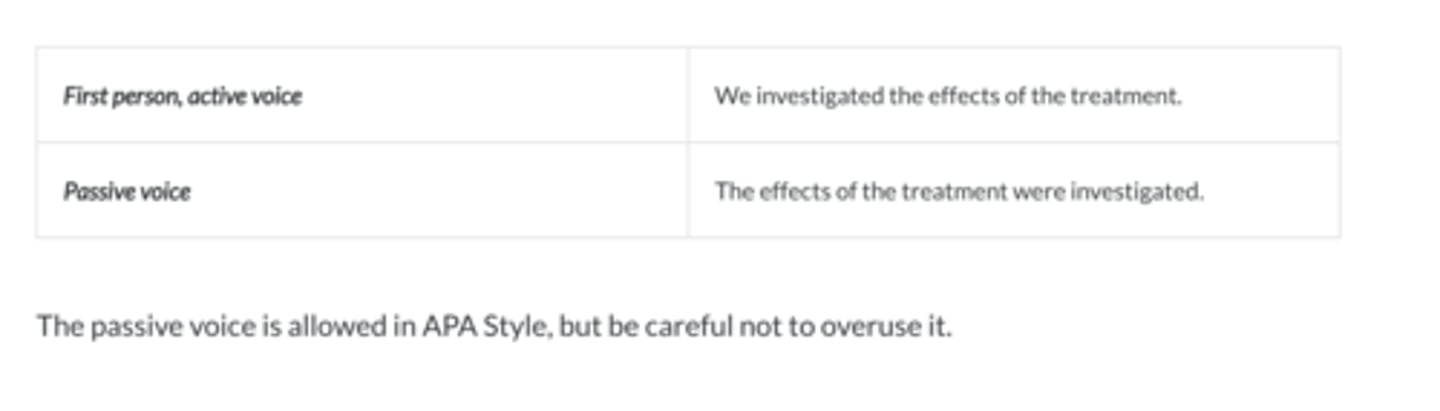
active and passive voice
When possible, use the active voice instead of the passive voice to create direct, clear, and concise sentences. For example, use the first person and the active voice to show your involvement in a project or to describe steps you personally took.
bias-free language
Write about all people with professionalism, respect, and sensitivity. Just as you have learned to check what you write for spelling, grammar, and wordiness, practice reading your work for bias.
Consult self-advocacy organizations for appropriate language to use when talking about specific groups. If you are working directly with participants, also ask the people about whom you are writing which designations they prefer and use the language those people use to describe themselves.
person first and identity first language
Person-first language puts the person before the disabling or chronic condition (e.g., “people with substance use disorders” rather than “substance abusers”).
Identity-first language allows people to reclaim what others may see as a disability and incorporate it into their personal identity on their own terms (e.g., “autistic people” instead of “people with autism” and “Deaf people” instead of “people who are deaf”).
Both person-first and identity-first language are good choices overall; it is appropriate to use either approach unless or until you know that a person or group prefers one approach over the other—in which case, use the person or group’s preferred approach.
Public relations
the management of communication between an organization and its publics
- maintaining indiviual/brand/message's perception
journalism
gathering, assesing, and presenting news and information. report wo favor.