L4-Fluid and Electrolytes
 Call Kai
 Learn
Learn Practice Test
 Spaced Repetition
 Match
Match Flashcards
 Knowt Play
1/67

There's no tags or description
Looks like no tags are added yet.
Name | Mastery | Learn | Test | Matching | Spaced | Call with Kai | Chat |
|---|
No analytics yet
Send a link to your students to track their progress
68 Terms
Why do infants become dehydrated much faster than adults?
greater fluid intake/output relative to their size
larger body surface area (more water lost through skin)
higher metabolic rate
immature kidneys
greater susceptibility to insensible fluid loss
Insensible water loss is water loss that isn’t easily measured, primarily through ___________ and ___________
skin and respiration
Where is total body water located?
TBW = ICF + ECF
What are the three major locations of ECF?
Intravascular, interstitial, transcellular
__________ is the primary determinant of ECF
Na+ (sodium)
What systems control water balance?
Thirst + ADH + Aldosterone + Renin-Angiotensin System
What does ADH do?
Retains water → decreases urine output
More ADH → kidneys retain water → less urine
Less ADH → kidneys release water → more water
What does aldosterone do?
retains sodium (in the kidneys)
water follows sodium
↑ Aldosterone → ↑ Na⁺ reabsorption → water follows sodium → ↑ blood volume/BP
It also causes ↑ K⁺ excretion.
______________ detects changes in plasma osmolality and regulates the release of ADH to control water balance.
Hypothalamus
↑ Osmolality = blood too concentrated
→ Hypothalamus detects it
→ ↑ ADH
→ Kidneys retain WATER
→ Urine becomes more concentrated
→ Blood becomes more diluted↓ Osmolality = blood too diluted
→ ↓ ADH
→ Kidneys release more water
→ More dilute urine
What is the key rule for osmolality?
water follows particles
If there are lots of particles outside the cell, water gets pulled out
If there are fewer particles outside, water moves into the cell
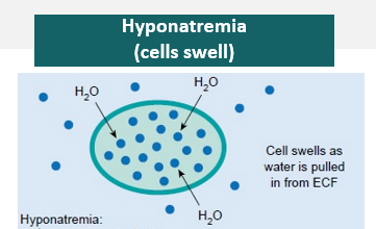
What happens to cells during hyponatremia?
water moves into cells → cells swell
What happens to cells during hypernatremia?
water moves out of cells → cells shrink

What are the S/S of hyponatremia?
S – Seizures
A – Abdominal cramping
L – Lethargy
T – Tendon reflexes diminished
L – Loss of appetite
O – Orthostatic hypotension
S – Shallow respirations
S – Spasms
Why can hyponatermia cause seizures?
↓Na⁺ → water enters brain cells → cerebral swelling → seizures
What are the S/S of hypernatremia?
fatigue
increased reflexes
extreme thirst
dry mouth/skin
What are the S/S of hypokalemia?
Lethargy
Leg cramps
Limp muscles
Low/shallow respirations
Lethal dysrhythmias
Lots of urine
Low BP
What ECG changes occur with hypokalemia?
Flattened T waves + U waves
What are the S/S of hyperkalemia?
Muscle weakness
Urine changes — oliguria/anuria
Respiratory distress
Decreased cardiac contractility
ECG changes
Reflex changes
What ECG changes occur with hyperkalemia?
Tall, peaked T waves + widened QRS
What labs should you check with suspected hyperkalemia?
K⁺ + BUN + creatinine
What are the S/S of hypocalcemia?
Confusion
Reflexes hyperactive
Arrhythmias
Muscle spasms
Positive hyperreflexia signs
Sensation of tingling/numbness
Does hypocalcemia increase or decrease neuromuscular activity?
INCREASES it → hyperreflexia + spasms
What are manifestations of hypercalcemia?
Profound weakness
ECG changes
Absent reflexes
Kidney stones
What causes hypermagnesemia?
Excess supplementation or decreased renal function
What are manifestations of severe hypermagnesemia?
Profound lethargy + ECG changes
What are the 3 types of dehydration?
Isotonic, hypertonic, hypotonic
What is the most common type of dehydration?
Isotonic
What labs increase with isotonic dehydration?
↑ Hct
↑ BUN
↑ urine specific gravity
What defines hypertonic dehydration?
Na⁺ >145
water loss > electrolyte loss
What is the major danger of hypertonic dehydration?
Neurologic compromise/seizures
What defines hypotonic dehydration?
Na⁺ <135
electrolyte loss > water loss
What is the major danger of hypotonic dehydration?
SHOCK
What happens as dehydration becomes more severe?
↓ urine
↓ BP
↑ cap refill
↑ dry mucous membranes
↓ skin turgor
↓ weight
What is the FIRST responsibility when a dehydrated child is admitted?
WEIGH THE CHILD
What % weight loss indicates mild dehydration?
3-5%
What % weight loss indicates moderate dehydration?
6-9%
What % weight loss indicates severe dehydration?
>10%
How is mild/moderate dehydration treated?
Oral rehydration: 50–100 mL/kg over 4 hr
How much additional ORS is given for each diarrheal stool?
10mL/kg
How is moderate/severe dehydration initially treated?
Isotonic IV fluid 20 mL/kg bolus → reassess
What electrolyte should NOT be given until kidney function is verified?
Potassium (K⁺)
Why must urine output/kidney function be verified before giving potassium?
Kidneys may not eliminate K⁺ → hyperkalemia → dangerous dysrhythmias
What is the pediatric daily maintenance fluid rule?
o First 10 kg → 100 mL/kg/day
o 11–20 kg → 1000 mL + 50 mL/kg for every kg >10
o >20 kg → 1500 mL + 20 mL/kg for every kg >20
What does an isotonic fluid do?
Expands intravascular volume without major cellular fluid shifts
Examples of isotonic fluids?
0.9% NS + Lactated Ringer's
When are isotonic fluids commonly used?
Dehydration and shock
What does hypotonic fluid do to cells?
Water moves INTO cells → SWELL
Example of hypotonic fluid?
0.45% NS
What does hypertonic fluid do to cells?
Water moves OUT of cells → SHRINK
Example of hypertonic fluid?
3% saline
When is intraosseous (IO) access used in children?
Critically ill/shocked child when IV access is unsuccessful
How quickly should blood be started after arrival?
Within 30 minutes
How long can a blood transfusion run?
Maximum 4 hours
When is the highest-risk monitoring period during a transfusion?
First 15–20 minutes
What should the nurse do during the first 15–20 min of blood administration?
Transfuse slowly + stay with child + monitor VS/response
FIRST action for suspected transfusion reaction?
STOP THE TRANSFUSION
What is the most severe transfusion reaction?
hemolytic
What suggests a febrile transfusion reaction?
Fever + chills
What suggests an allergic transfusion reaction?
Urticaria (hives) + pruritus (itchyness) + laryngeal edema
What can cause water intoxication in an infant?
Excess water or improperly diluted infant formula
What electrolyte problem occurs with water intoxication?
Hyponatremia
Why can water intoxication cause seizures?
Excess water → ↓Na⁺ → water enters brain cells → cell swelling → seizures
What are the 3 major types of burns?
Thermal, chemical, electrical
What are typical characteristics of 1st/2nd-degree burns?
Superficial/partial thickness
Pink/red
May blister
Painful
What are typical characteristics of 3rd/4th-degree burns?
Full thickness
Red/tan/brown/black
No blanching
Little/no pain
Severe scarring possible
Why can a 3rd-degree burn hurt LESS than a 2nd-degree burn?
Nerve endings are destroyed.
What is the priority treatment for moderate/major pediatric burns?
IV access ASAP + fluid replacement + monitor for shock
Which topical medications are listed for pediatric burns?
Bacitracin, mupirocin, Silvadene