Structure and Function of Nucleic Acids
 Call Kai
 Learn
Learn Practice Test
 Spaced Repetition
 Match
Match Flashcards
 Knowt Play
1/55

There's no tags or description
Looks like no tags are added yet.
Name | Mastery | Learn | Test | Matching | Spaced | Call with Kai | Chat |
|---|
No analytics yet
Send a link to your students to track their progress
56 Terms
nucleotides
monomer of nucleic acids
nucleotide
sugar + base + phosphate
nucleoside
sugar + base
ribose
A five-carbon sugar present in RNA
deoxyribose
A five-carbon sugar that is a component of DNA nucleotides
1'
carbon in DNA that forms the glycosidic bond with the base (purine or pyrimidine)
2'
carbon in DNA that differentiates it from RNA
3' and 5'
carbons in DNA that form phosphodiester bonds to link nucleotides, forming the backbone
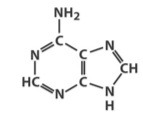
adenine
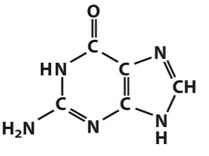
guanine
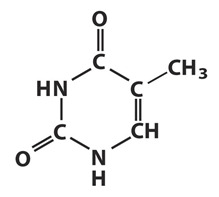
thymine
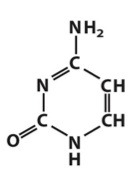
cytosine
uracil
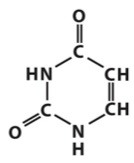
nucleotide triphosphate
starting material in polymerizing DNA - gets added onto polymer
dissociate
at intracellular pH, phosphates ______________ freeing hydrogen ions and leaving the phosphate group negatively charged on the backbone of DNA
positively
DNA is associated with ____________ charged proteins
Chargaff's Rule
[A]=[T] and [G]=[C]
antiparallel
DNA strands run _______________ of one another
3
number of hydrogen bonds between guanine and cytosine
2
number of hydrogen bonds between adenine and thymine
melting temperature
temperature at which 50% of the helical (ds) structure is lost
higher
the greater the GC%, the ________________ the Tm
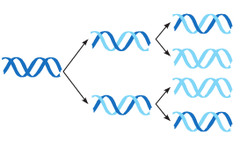
semiconservative replication
Method of DNA replication in which parental strands separate, act as templates, and produce molecules of DNA with one parental DNA strand and one new DNA strand
20 mcm
diameter of a human cell
6 ft
human cells contain ______ of DNA
6 mcm
all DNA in a human cell fits into a ______ diameter nucleus; allowing for enzymes and proteins that act on the DNA to be concentrated where needed and ensures compartment-specific enzyme activity
negative
______ charges on the phosphates repel eachother, keeping DNA extended
4 billion
number of nucleotides in the haploid human genome
chromatin
nucleoprotein complex of DNA in eukaryotic cells not undergoing division; dynamic
50%
histones make up about ______ of chromatin by mass
chromosome 1
largest chromosome in human genome
chromosome 2
only way to differentiate human and primate chromosomes on a karyotype
euchromatin
gene-rich, transcriptionally active chromatin that is less compact and has less proteins
heterochromatin
gene-poor, inactive, compact, protein-rich chromatin that maintains chromosome structure, provides genome stability with repetitive DNA sequences, and regulates gene expression. Ex: telomeres and centromeres
histones
arginine and lysine-rich small basic proteins that form ionic bonds with the phosphorous on DNA backbone; amino acid sequence is highly conserved between species
core particle
146 bp of DNA wound around 8 histones (four types, two of each)
nucleosome
core particle + linker DNA of 20-80 base pairs
repetitive sequences
two main kinds: satellite DNA and short interspersed elements (SINES); used in DNA paternity and forensic testing (unique genetic fingerprints); allow for hyper-compact DNA to easily be distorted
satellite DNA
short sequences of repeated nucleotides (tandem)
SINEs (short interspersed nuclear elements)
are approximately 300 base pairs long, are present in over 1 million copies scattered throughout the human genome (not tandem)
mitochondrial genome
multiple copies of circular genome containing 16.5 Kbp in the mitochondria, allowing them to function independently of the human genomic DNA; transmitted maternally only
RNA
single stranded nucleic acid that contains a ribose sugar and uracil in place of thymine; is more reactive and less stable than DNA; produced as needed and acts as deletable memory
2' OH
makes RNA less stable than DNA because it allows for intramolecular nucleophilic attack resulting in the hydrolysis of the RNA
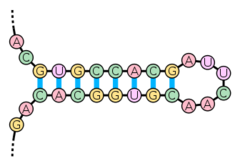
hairpin
secondary structure of RNA; forms when inverted palindrome sequences hybridize
RNA
two major classes of _________: protein coding and non-protein coding
mRNA
long molecule ranging from a few hundreds to many thousands of bases - length directly correlates with gene size
5' cap
The 5' end of a pre-mRNA molecule modified by the addition of a cap of guanine nucleotide; protects mRNA from degredation (increases stability), enhances translatability, transports mRNA out of the nucleus, and increases efficiency of splicing mRNA
poly-A tail
3' end of mRNA that is added post-transcriptionally; about 250 nucleotides long; the length correlates with half life of the mRNA
splicing
removal of introns from pre-mRNA to generate mature mRNA; five methods
normal
type of splicing that occurs 80% of the time
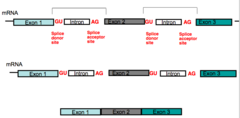
alternative
type of splicing that occurs 15% of the time
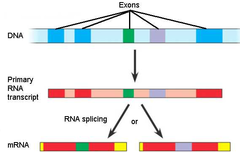
5
extended exon, skip exon, and intron retained methods of all together make up ___% of mRNA splicing methods
snRNA
small nuclear RNA; act as spliceosomes that cut mRNA in the splicing process; small sequences of RNA that can cut mRNA - multiple types exist in eukaryotes
rRNA
ribosomal RNA; provides platform for protein synthesis and is therefore very stable; consists of two subunits
tRNA
transfer RNA; short molecules of 25 KDa that translate message on mRNA into a polypeptide chain; have a specific amino acid attached to one end (first part of translation) and an anticodon on the other end (second part of translation) - can contain unusual nucleotides other than just the AUGC
61
number of different types of tRNA, each with a specific anticodon