CH 30 Using Sources Responsibly Quiz
 Call Kai
 Learn
Learn Practice Test
 Spaced Repetition
 Match
Match Flashcards
 Knowt Play
1/30

There's no tags or description
Looks like no tags are added yet.
Name | Mastery | Learn | Test | Matching | Spaced | Call with Kai | Chat |
|---|
No analytics yet
Send a link to your students to track their progress
31 Terms
What is plagiarism?
presenting someone’s ideas/work in your own work without crediting them
2 types of plagiarism
intentional + unintentional
examples of intentional plagiarism
claiming someone’s research paper/ideas as your own
self-plagiarism
asking someone else to write your paper for you
self-plagiarism
submitting a previously written class paper to another class
if planning to use your work, ask you instructor if this is allowed and use a proper citation (obviously don’t use the same exact paper)
proper citation for self-plagiarism
Author, (year written). Title [Unpublished manuscript]. Institution
examples of unintentional plagiarism
forgetting to cite sources when using someone else’s words or ideas
copying someone else’s words exactly, even if its a short phrase
using someone else’s exact words without quotation marks and a citation (direct quotes must include page #s)
giving credit to the wrong person for someone else’s words or ideas
t/f: copying someone else’s words exactly, even if its a short phrase, is okay as long as you cite them
false; it is still plagiarism even if you cite them
what must be included in a citation with a direct quote (something with quotation marks)
page numbers
what should be cited?
anything that is not common knowledge
what is common knowledge? — info that is found undocumented in at least 5 credible sources
main types of citation format
APA, MLA, Chicago style
t/f: always cite a source the first time you use it
true
what do you do if the entire paragraph comes from the same source?
cite it in the first sentence and again in the last sentence
3 types of citations for a typical peer reviewed article
paranthetical, narrative, and bibliographic
t/f: parenthetical citations can come at the end of a sentence or in a sentence
true
how to format parenthetical citations
(Author, Year)
According to purdue owl when do you use et. al?
3+ authors
for 2 authors write “and” if in the sentence and & if in the parentheses
where does the bibliographic citation go in a paper?
at the end in your reference list
“According to Tendulkar et al. (2022)...” is a type of narrative citation that is also called
leading phrase citation
how to format narrative citations
if you mention the author in the sentence, just put a parentheses around the year: Tendulkar (2022) mentions…
you can also just say In 2022, Tendulkar mentions…
how to cite content from systematic reviews
If you are summarizing conclusions of the review, cite the review. If you are summarizing findings of a study used in the review, cite THAT study
t/f: direct quotations are common in scientific writing
true
Human immunodeficiency virus (HIV) is a retrovirus that attacks the body’s immune system, targeting CD4+ T cells, which trigger the immune system to attack pathogens that cause infections (Deeks et al., 2015). According to Deeks et al. (2015), this gradually weakens immune responses and increases susceptibility to opportunistic infections and cancers. After initial transmission—often through unprotected sexual contact, needle sharing, or perinatal exposure—HIV can establish itself in mucosal tissues and spread through the lymphoid system (Smith et al., 2020). If left untreated, HIV can progress to acquired immune deficiency syndrome (AIDS), a severe stage of infection associated with renal disease, cardiovascular disease, and various cancers (Smith et al., 2020).
Identify citation types in this paragraph.
Narrative and parenthetical. For parenthetical, it is specifically an end-of-sentence citation.
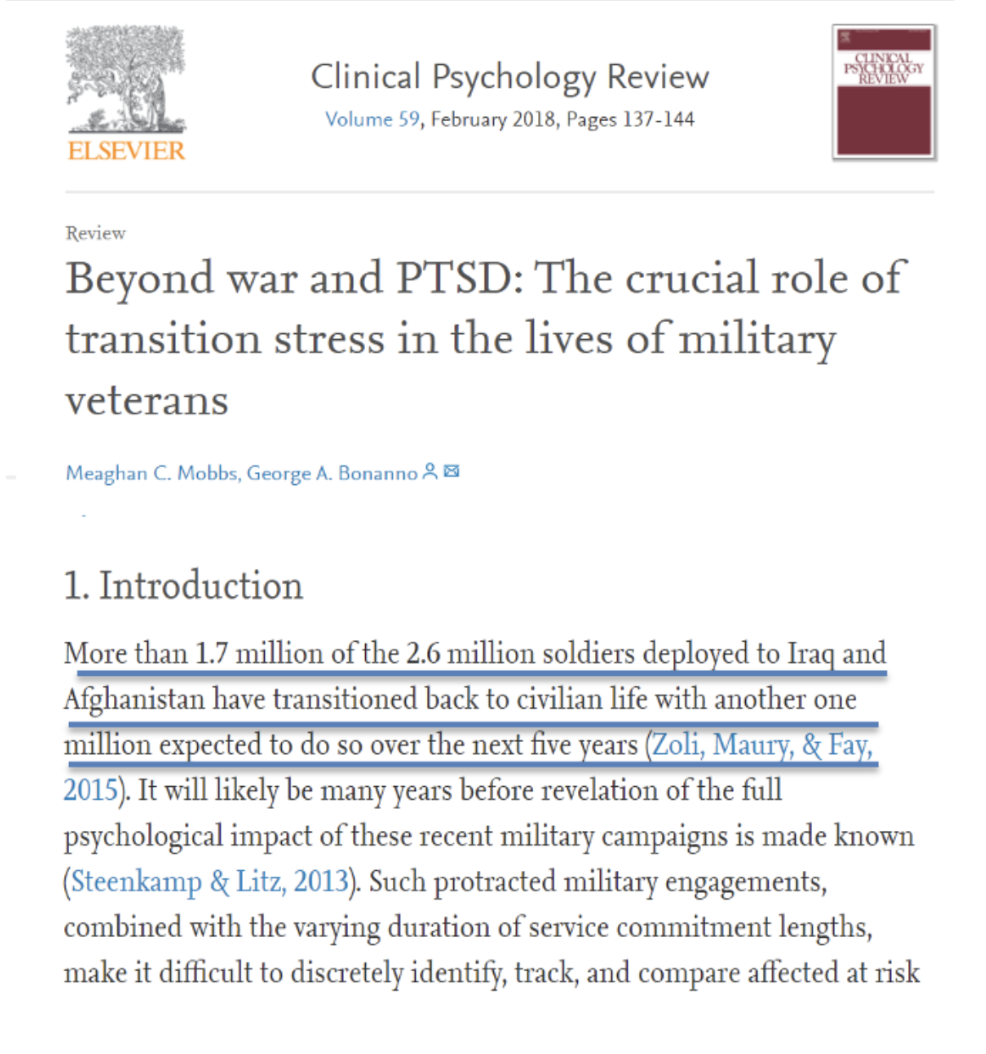
The underlined statement is in an article written by Mobbz & Bonanno (2018). You paraphrase this sentence from their introduction and include it in your paper. Who would you cite and credit for the ideas in that sentence?
Zoli et. al, 2015
Paragraph #1: Alzheimer’s Disease (AD), discovered by Dr. Alois Alzheimer, is a cognitive disability that destroys the memory and interpretation part of the brain and mostly impacts middle-aged to elderly people. It is a type of dementia that causes personality changes, trouble with daily functioning, and language deterioration. It is an especially painful experience for the families of those suffering from the disease as they watch their loved ones gradually forget about them. AD isn’t just a memory issue—it is a devastating sickness that robs people of their independence, identity, and ultimately, their life. Despite medications that slow progression, it leads to death, making it one of the most daunting diseases out there (National Institute on Aging, 2021)
Which citation ISSUES do you notice?
There should be an end-of-centence citation at the end of the first sentence as well as it seems like this entire paragraph is based on content pulled from the National Institute on Aging.
Paragraph #2: Ovarian cancer concerns the ovaries, which can be found near the uterus. It is characterized as abnormal cells also growing at an uncontrollable rate driven by the estrogen and progesterone hormones, specifically in the ovaries. Breast cancer is also influenced by estrogen and progesterone production, but in lobules of the breast.
Which citation ISSUES do you notice?
There are no citations at all and none of the paragraph’s contents seem like common knowledge
Paragraph #3: Various studies also reported high DV/IPV victimization in their population sample. Gilbert et al. (2023), a quantitative study, explored rates of DV/IPV victimization in indigenous communities. Their sample consisted of 27 participants, both men and women from a tribal community in western United States. 85.2% of those surveyed reported sexual abuse, and 88.9% reported some type of violence, resulting in high rates of injury (Gilbert et al., 2023). Similarly,
McKinley (2022) reported high levels of victimization in both its quantitative and qualitative data. “Many participants reported witnessing DV/IPV growing up, and 61.4% reported being a
victim of DV/IPV” (McKinley, 2022).
Which citation ISSUES do you notice?
There needs to be a page number for the last citation as it is a direct quote.
Original source:
Alzheimer’s disease is a brain disorder that slowly destroys memory and thinking skills and eventually makes it difficult for people to carry out everyday activities. (National Institute on Aging, 2021)
Student’s summary:
Alzheimer’s disease is a disorder that slowly destroys memory and thinking skills and makes it hard for people to carry out everyday activities (National Institute on Aging, 2021).
Do you notice any issues with the student’s summary of the original source? What would you do to fix this issue?
The student has not changed the wording enough from the original source, so even if the cite it, it is still considered plagiarism. Rephrase the entire sentence and still cite the National Institute on Aging.
keypoints about Turnitin
The similarity score (percentage) in your report indicates the proportion of your paper that matches other sources. A higher score doesn't necessarily mean plagiarism. A lower score doesn’t necessarily mean you have not plagiarized.
you should review the highlighted text in your turnitin report LINE BY LINE
How to use Turnitin
• Review your paper in Turnitin by checking highlighted sections to see if the text matches are:
– Common phrases (e.g., infant mortality rate): These may not need revision.
– Citations (these can be ignored): Ensure proper citation formatting.
– Direct quotes (use sparingly): Verify that you have cited these correctly.
– Text that should be further paraphrased: Try your best to do this.
• Revise as Necessary
– Paraphrase or summarize in your own words.
– Add proper citations where needed.
– Remove any unnecessary quotes or closely paraphrased text.
IMPORTANT: Unsure about anything, reach out to me and I can clarify and provide guidance. Turnitin is a learning tool to help you improve your writing.
How can you use AI responsibly in this course
Refine your topic
Identify key words to help you search for articles
Make a topic outline for your paper
Clarify concepts you may be struggling with or ask for examples to explain concepts
Create citations (use Zotero instead!)
How to not use AI
• Write your paper
• Summarize articles
• Think for you!!