Liquids and Solids
 Call Kai
 Learn
Learn Practice Test
 Spaced Repetition
 Match
Match Flashcards
 Knowt Play
1/88

There's no tags or description
Looks like no tags are added yet.
Name | Mastery | Learn | Test | Matching | Spaced | Call with Kai | Chat |
|---|
No analytics yet
Send a link to your students to track their progress
89 Terms
What is the primary difference between intramolecular and intermolecular forces?
Intramolecular forces are bonds within a molecule that holds atoms together
Intermolecular forces are weaker attractions between separate molecules
What are the three types of intermolecular forces?
Hydrogen bonding
Dipole-dipole forces
Dispersion forces
What are the three types of intramolecular forces?
Covalent
Ionic
Metallic
What do intermolecular forces determine?
Physical properties like boiling point, melting point, viscosity, vapor pressure, and surface tension
Intermolecular forces are _____ than intramolecular forces like covalent or ionic bonds.
Weaker
What is the strongest intermolecular force found in neutral atoms?
Hydrogen bonding
To form a hydrogen bond, hydrogen must be covalently bonded to which three specific elements?
Nitrogen, Oxygen, or Fluorine
Why does oxygen create a strong partial positive charge on hydrogen in a molecule?
Oxygen is highly electronegative and strongly pulls electron density away from the hydrogen atoms.
Among neutral molecules, what is the strongest type of intermolecular force?
Hydrogen bonding.
What are dipole-dipole forces?
Forces between molecules that have permanent net dipoles
The positive end of one polar molecular is attracted to the negative end of another
What do dipole dipole forces apply to?
Only to polar, nonionic/covalent molecules
What are dispersion forces?
Weak attractive forces all atoms and molecules experience.
Why do dispersion forces occur?
Because electrons are in constant motion this causes temporary dipoles when electron density concentrates on one side of a molecule
What is the only type of intermolecular force that exists in nonpolar, covalent molecules?
Dispersion forces (London dispersion forces).
Rank the three main intermolecular forces from strongest to weakest.
Hydrogen > dipole-dipole > london dispersion forces
How do particle size and shape affect dispersion forces?
Larger particles with more electrons form stronger temporary dipoles, increasing dispersion forces
Between a straight-chain molecule and a branched molecule of the same molar mass, which will have stronger dispersion forces?
The straight-chain molecule, because it can pack together more efficiently.
Why do branched isomers generally have lower boiling points than their straight-chain counterparts?
Branching decreases packing efficiency, which weakens London dispersion forces.
Which of the following is NOT an intermolecular force: hydrogen bonding, dipole-dipole interactions, ionic bonding, dispersion forces, or van der Waals forces? Why?
Ionic bonding. Intermolecular forces are between two different molecules; ionic bonding holds ions together within a compound
What does it mean to have strong intermolecular forces?
Molecules stick together more tightly and require more energy to separate
What does it mean for a liquid to vaporize?
Liquid boils
What happens when a liquid boils?
Its molecules separate and enter the gas phase
What does it mean if the molecules are held together by strong intermolecular forces when it comes to boiling point?
It means more heat is needed to overcome these forces and so you’ll have a higher boiling point
So if a question asks you which molecule has the highest boiling point, what is it looking for?
Identify the molecule with the stronger intermolecular force
So if a question asks you which molecule has the lowest boiling point, what is it looking for?
Identify the molecule with the weakest intermolecular force
What does viscosity measure?
A liquids resistance to flow
When it comes to viscosity molecules with stronger intermolecular forces…
Bind together more tightly and so they have higher viscosities
So if a question asks you which molecule will have a higher viscosity, what are you looking for?
The molecule that has the highest intermolecular force
What is surface tension?
When a liquid’s surface is able to resist disruption
Which type of intermolecular force would exhibit high surface tension?
Strong intermolecular forces
What is the relationship between intermolecular force strength and surface tension?
Stronger intermolecular forces result in higher surface tension
What is vapor pressure?
Pressure exerted by vapor produced through evaporation from liquids and solids at equilibrium
When does boiling happen?
When a liquid’s vapor pressure becomes equal to atmospheric pressure
How does increasing the strength of intermolecular forces affect the vapor pressure of a liquid?
Vapor pressure will decrease
Because molecules are less likely to escape into the gas phase.
At what specific point is the boiling point of a liquid reached?
When the liquid's vapor pressure equals the surrounding atmospheric pressure.
Molecules with stronger intermolecular forces will vaporize…
Less readily
This causes a lower vapor pressure
What are the four types of solids?
Metallic solics
Ionic solids
Covalent network solids
Molecules solids
What are metallic solids?
When metals are held together by a sea of electrons moving freely between each atom
What are the properties of metallic solids?
Conduct electricity
Hard
What are ionic solids?
Held together by strong ionic bonds between metals and nonmetals
What are the properties of ionic solids?
DON’T conduct electricity as solids
DO conduct electricity when molten or in aqueous solution
What are covalent network soldis?
Nonmetals held together by networks of covalent bonds
What are the properties of covalent network solids?
Very hard
Used to make semiconductors
What are molecular solids?
Nonmetals held together by intermolecular forces
What are the properties of molecular solids?
Low melting point
Do NOT conduct electricity
What are unit cells?
The smallest, repeating 3D structural unit of a solid
What do unit cells form?
Lattice structures
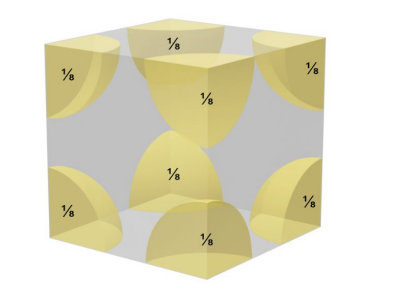
Unit cell with only 1 atom in the entire cell
Simple cubic unit cell
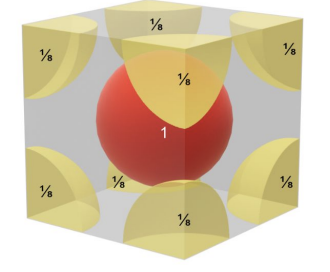
Unit cell with 2 atoms per unit cell
Body centered cubic unit cell
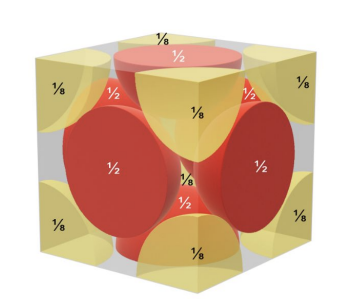
Unit cell with 4 atoms per cell
Face centered cubic unit cell
List the endothermic phase changes.
Fusion (melting)
Vaporization
Sublimation
What is fusion?
Solid ⟢ liquid
What is vaporization?
Liquid ⟢ gas
What is sublimation?
Solid ⟢ gas
What does it mean to be endothermic?
The phase change REQUIRES heat
What is the ΔH and ΔS of an endothermic reaction?
They are both positive
ΔH > 0
ΔS > 0
List the exothermic phase changes.
Crystallization
Condensation
Deposition
What is crystallization?
Liquid ⟢ solid
What is condensation?
Gas ⟢ liquid
What is deposition?
Gas ⟢ solid
What does it mean to be exothermic
The phase change RELEASE heat
What is the ΔH and ΔS of an exothermic reaction?
They’re both negative
ΔH < 0
ΔS < 0
Which requires more energy; evaporation (liquid to gas) or fusion/melting (solid to liquid)?
Evaporation needs more energy then melting
Which requires more energy; condesation or crystallization?
Condesation releases more heat energy into the surroundings than crystallization
Why is this the case?
Melting: In a solid, particles are held tightly in place. When you melt it, you only need to give them enough energy to move around more freely.
Evaporation: In a liquid, particles are already moving around, but they are still attracted to each other. To become a gas, a particle has to get enough energy to completely escape those attractions.
Because escaping those attractions takes much more energy than simply loosening the particles, evaporation requires more energy than melting
What is the relationship between vapor pressure and boiling point?
Vapor pressure is inversely related to boiling point
What is the tea between atmospheric pressure at higher altitudes?
At higher altitudes there is less atmospheric pressure (this is b/c there are fewer air molecules bove and around to press down on the liquid)
Due to this, at higher altitudes, vapor pressure can…
Exceed atmospheric pressure more easily
How does boiling differ between high altitudes and sea level?
Liquids boil at lower temperatures than they do at sea level
On a typical phase diagram, where does the solid region occur?
At low temperature and high pressure
On a typical phase diagram, where does the gas region occur?
At high temperature and low pressure
On a typical phase diagram, the liquid region lies…
At moderate temperatures and pressures
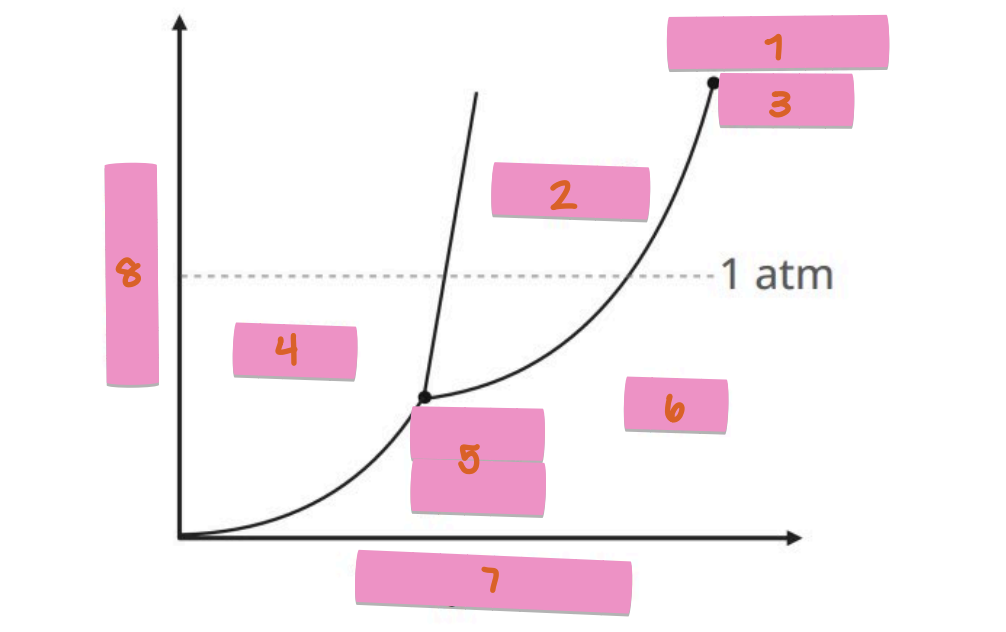
What is #1/#3?
Critical point
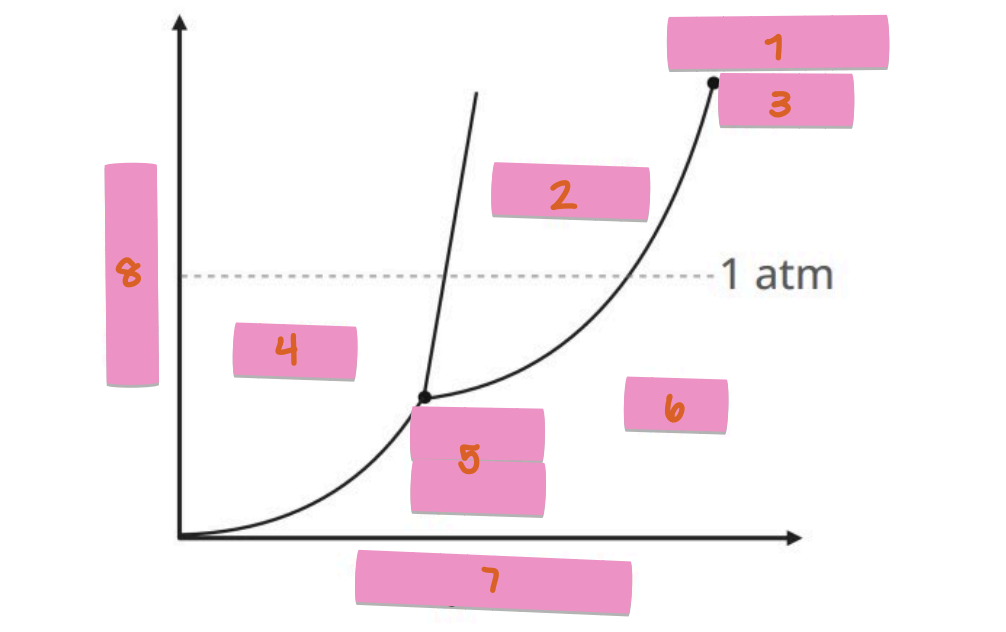
What is #2?
Liquid phase
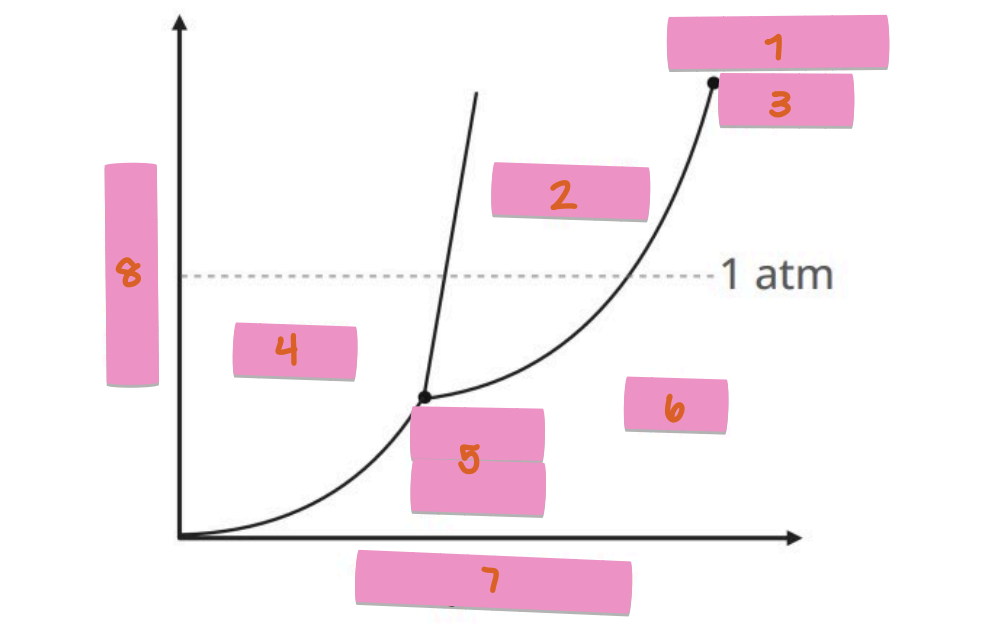
What is #4?
Solid phase
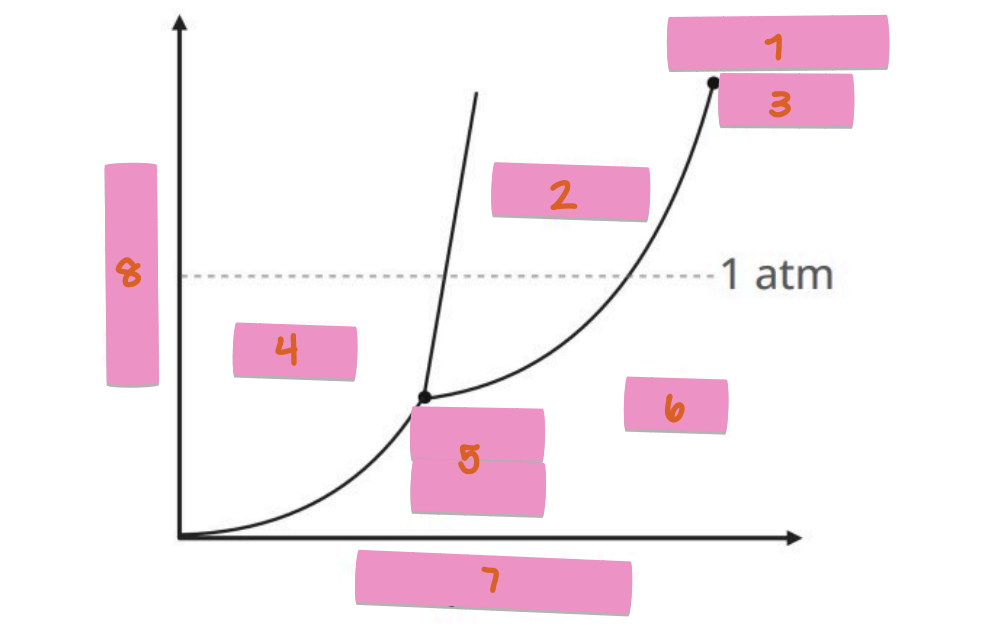
What is #5?
Triple point
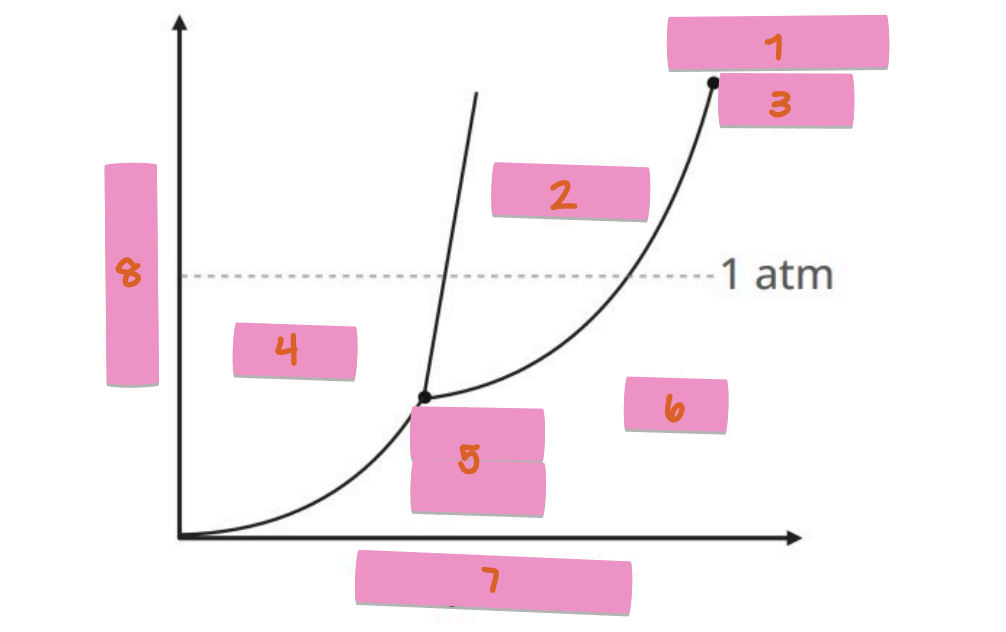
What is #6?
Gas phase
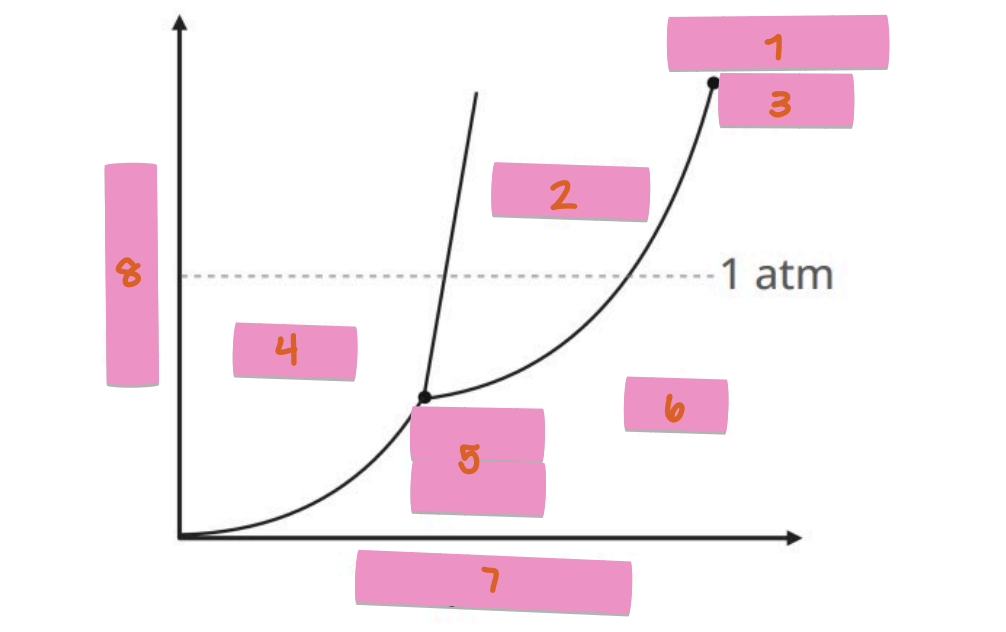
What is number 7?
Temperature
What is number 8?
Pressure
What is the critical point on a phase diagram?
The temperature and pressure where liquids and gases no longer exist as distinct phases
Beyone the critical point, what happens to liquids, and gases?
They merge into a supercritial fluid
What is the triple point on a phase diagram?
The point at which all three phases exist in equilibrium
What is the densest phase between solids, liquids, and gases?
Solids
Why are solids more dense than the other phases?
Becuase their particles are packed together the tighest
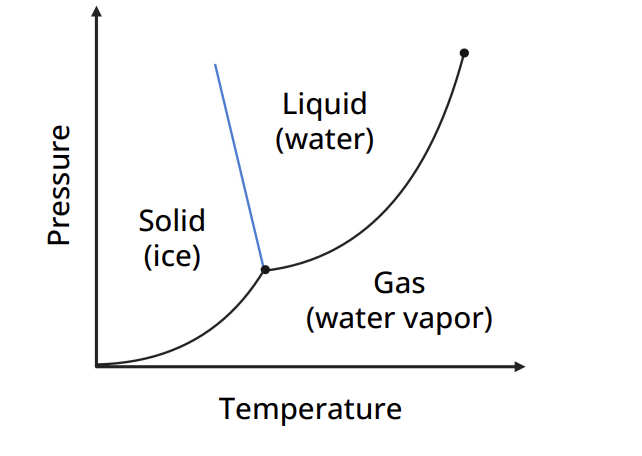
How does water differ in terms of their most dense phase?
Water is denser in the liquid phase than the solid phase
Why is water more dense in the liquid phase?
In liquid water, molecules are packed closely due to hydrogen bonding
So how does water’s phase diagram look?
It’s slope is negative
What does it mean for the slope to be negative?
Applying pressure can convert ice into liquid water rather than vice versa
What is molar heat of vaporization?
The amount of energy required to convert one mole of a substance from liquid to gas at boiling point