Chapter 16
 Call Kai
 Learn
Learn Practice Test
 Spaced Repetition
 Match
Match Flashcards
 Knowt Play
1/27

Earn XP
Description and Tags
Carbohydrates
Name | Mastery | Learn | Test | Matching | Spaced | Call with Kai | Chat |
|---|
No analytics yet
Send a link to your students to track their progress
28 Terms
Carbohydrate
Nutrient and biomolecule made of carbon, hydrogen, and oxygen
ex: sugar/starches, are polyhydroxy aldehydes or ketones, or compounds that can be hydrolyzed to them
Carbohydrates can be classified as monosaccharides, disaccharides, and polysaccharides
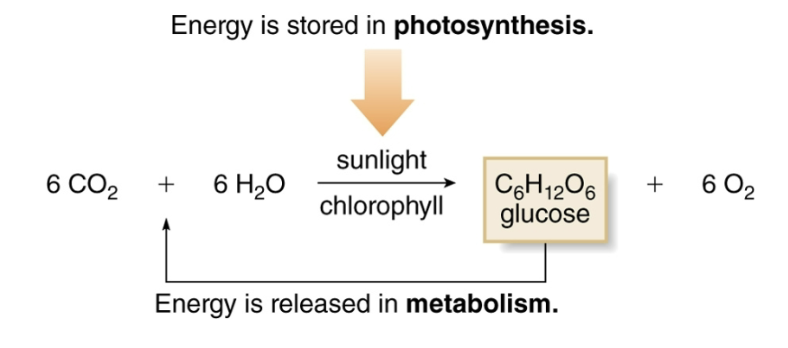
Carbohydrates are synthesized in green plants through photosynthesis
In the body, they are used for burst of energy needed during exercise in the form of glucose (lots pf marathon runners hvae carbons beforehand)
Photosynthesis
process that uses the energy from the sun to convert carbon dioxide and water into glucose and oxygen
Monosaccharides
the simplest carbohydrates, generally have 3 to 6 carbon atoms in a chain with a carbonyl group and many -OH (hydroxyl) groups
Monosaccharides are sweet tasting, but their relative sweetness varies a great deal
they are polar compounds with high melting points
The presence of so many polar functional groups capable of hydrogen bonding makes the monosaccharides very water soluble
ALL MONOSACCHARIDES ARE CHIRAL EXCEPT HYDROXYACETONE
Aldoses (Aldehyde)
Monosaccharides with a carbonyl group at C1
Ketoses (Ketone)
Monosaccharides with carbonyl group at C2
Glyceraldehyde
Simplest aldose (C3H6O3)
Constitutional isomer (same formula diff shape) of Dihdroxyacetone
Has one chiral center can change the function of the molecule and two possible enantiomer (the l and d cuz they the same just diff on where the molecule is attached)
Dihdroxyacetone
Simplest ketose (C3H6O3)
Constitutional isomer (same formula diff shape) of Glyceraldehyde
Chiral center
tetrahedral atom that have four different substituents
The orientation of these chiral centers can change the function of the molecule
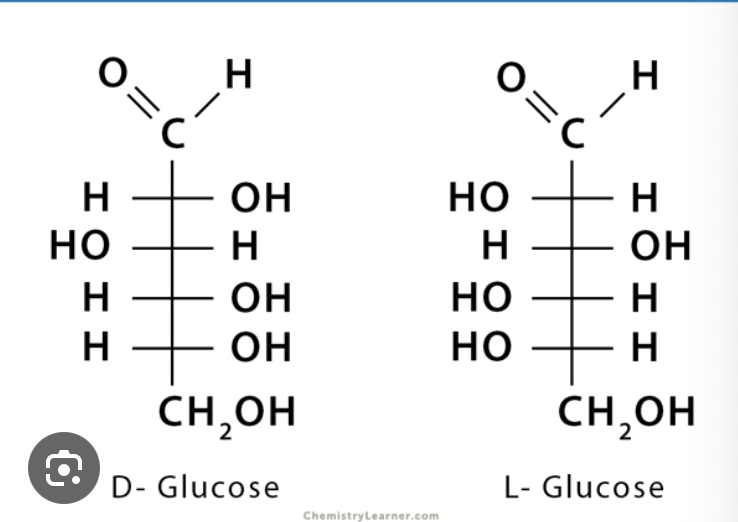
To determine whether it is D or L (if OH is right or left), look at the arm that is farthest from the chiral center and see what side its on
All naturally occurring sugars are D sugars
Number of carbons in its chain
Triose → 3 carbon
Tetrose → 4 carbon
Pentose → 5 carbon
Hexose → 6 carbon
ex: aldotriose
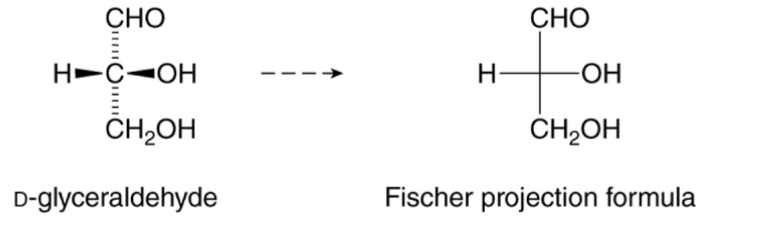
Fischer projection formula
Prefix D is used when the -OH group is drawn on the right side of the carbon chain
The prefix L is used when the OH group is drawn on the left side of the carbon chain
the wedged and dashed line can be re-drawn in a Fischer projection formula
Glucose
has four chirality centers
Glucose is blood sugar and the most abundant monosaccharide
Normal blood glucose levels are 70-110 mg/dL
Insulin regulates blood glucose levels by stimulating the uptake of glucose into tissues or its conversion to glycogen
Patients with diabetes type 1 produce insufficient insulin to adequately regulate blood sugar levels, so they must monitor their diet and/or inject insulin daily
Disaccharide lactose
Galactose + glucose
Disaccharide sucrose
fructose + glucose
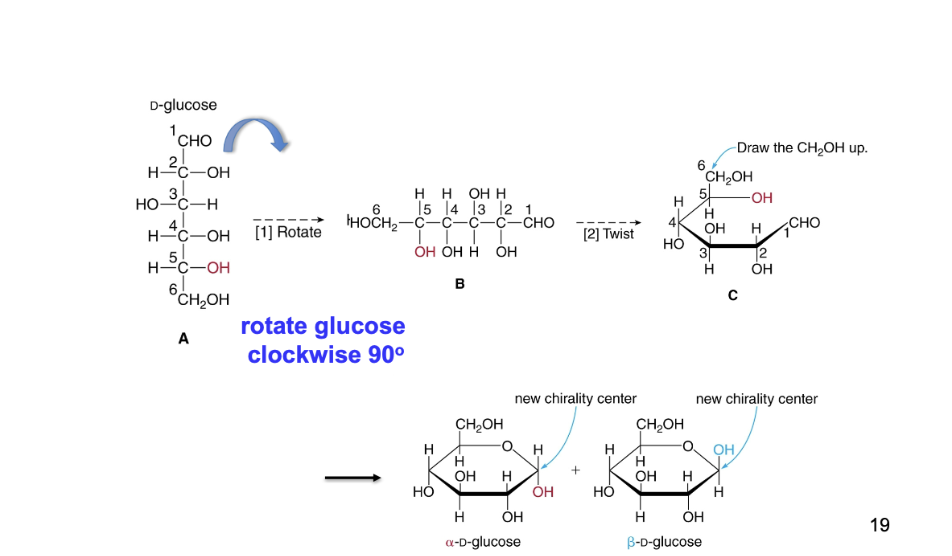
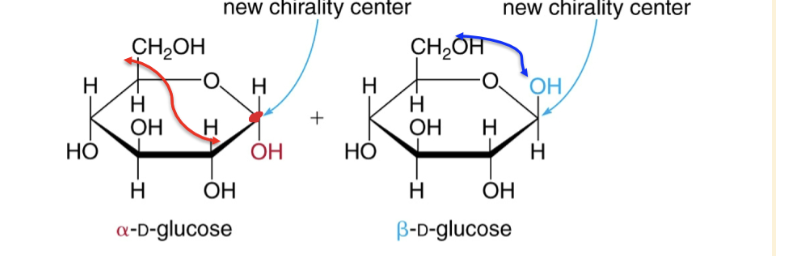
Forming a ring
hydroxyl and carbonyl reacting together
Cyclic form of monosaccharides
The first step in cyclization is to rotate glucose 90 degrees
Second step, chain must be twisted around to form a six-membrane ring
THE POINTY THING ON THE RIGHT IF OH IS BOTTOM IT IS ALPHA IF IT IS TOP IT IS BETA
Fischer Projection
A line shape
Haworth projection
the circular ring shape sugar molecule
Disaccharides
Carbohydrates composed of monosaccharides
Formed when a hydroxyl group of one monosaccharide reacts with a hydroxyl group of a second monosaccharide
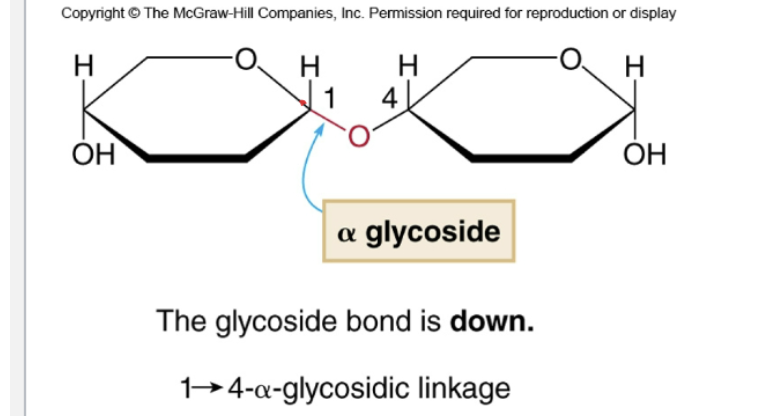
Glycosidic linkage
The bond that joins the two rings when this reaction occurs between two monosaccharides
bonds can be alpha or beta
hydrolysis of maltose
yields 2 glucose molecules
Lactose
disaccharide in milk; it consist of 1 galactose ring going 1→ 4 glycosidic bond (1 starts on the right pointy thing)
the disaccharide bond is cleaved by the enzyme lactase in the body
Individuals who are lactose intolerant no longer produce this enzyme
Without the enzyme, lactose cannot be digested, causing abdominal cramps and diarrhea
Sucrose
disaccharide of 1 Glucose + 1 Fructose
sweet but many many calories
Tor educe calorie intake, many artificial sweeteners have been developed
Polysaccharides
contain three or more monosaccharides joined together
Cellulose
an unbranched polymer made up of repeating glucose units joined by 1→ 4 glycosidic linkages
found in the cell walls of all plants, where it gives support and rigidity to wood, plant stems, and grass
Humans do not possess the enzyme to hydrolyze cellulose and cannot digest it
Cellulose makes up the insoluble fiber in our diets, which is important in adding bulk to waste to help eliminate it more easily
Starch
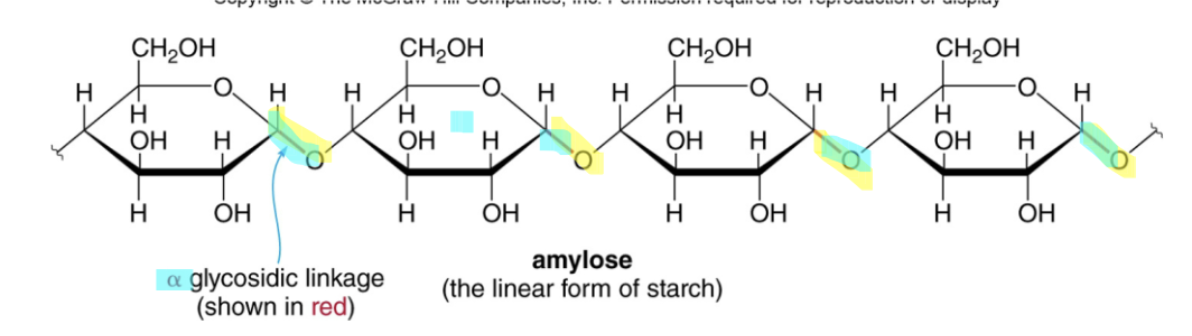
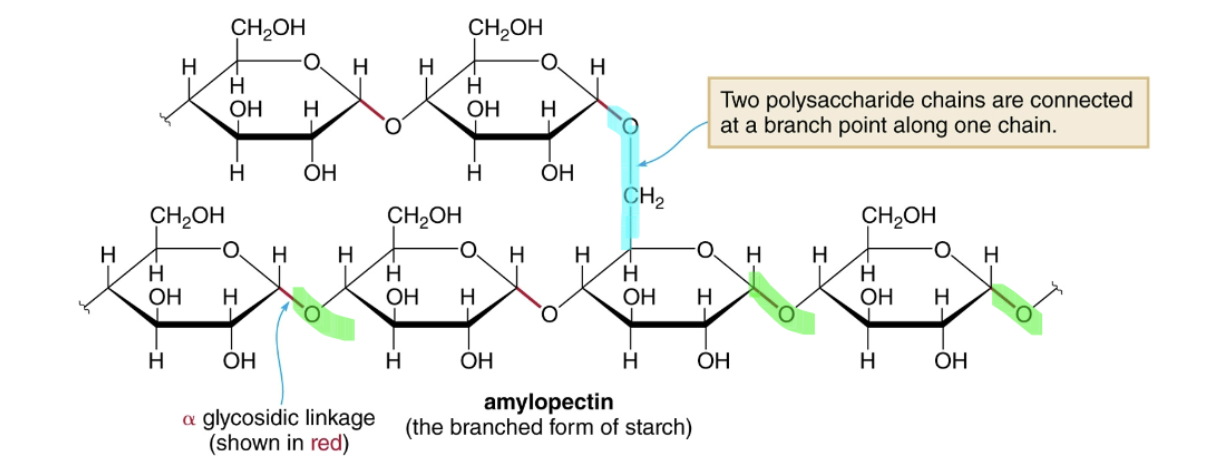
Polymer made up of repeating glucose units joined by alpha glycosidic linkages
present in corn, rice, wheat, and potatoes
two common forms of starch are amylose and amylopectin. Both starch molecules can be digested by humans using the enzymes and amylose
amylose
unbranched (linear) polymer
Amylopectin
branched (has side chains extending off main backbone) polymer
Glycogen
Major form of polysaccharide storage in animals, similar in structure to amylopectin
stored mainly in the liver and in muscle cells
when glucose is needed for energy, glucose units are hydrolyzed from the ends of the glycogen polymer
Because glycogen is highly branched, there are many ends avilable for hydrolysis