MGT03 CO3
 Call Kai
 Learn
Learn Practice Test
 Spaced Repetition
 Match
Match Flashcards
 Knowt Play
1/21

There's no tags or description
Looks like no tags are added yet.
Name | Mastery | Learn | Test | Matching | Spaced | Call with Kai | Chat |
|---|
No analytics yet
Send a link to your students to track their progress
22 Terms
Reasons for starting a venture
Personal Characteristics - your skills, abilities and interests
The Environment - if its conductive to entrepreneurship (able to create ideas and present freely)
The Venture - if its related to what you want to do
PITFALLS IN SELECTING NEW VENTURES
1. Lack of objective evaluation
2. No real insight into the market
3. Inadequate understanding of technical requirements
4. Poor financial understanding
5. Lack of venture uniqueness
6. Ignorance of legal issues
PHASES IN NEW-VENTURE START-UPS: Prestart-up Phase
• Begins with an idea for the venture and ends when the doors are opened for
business.
PHASES IN NEW-VENTURE START-UPS: start-up Phase
• Commences with the initiation of sales activity and the delivery of products
and services, and ends when the business is firmly established and beyond
short-term threats to survival.
PHASES IN NEW-VENTURE START-UPS: Post startup Phase
• Lasts until the venture is terminated or the surviving organizational entity is
no longer controlled by an entrepreneur.
CRITICAL FACTORS FOR NEW-VENTURE
DEVELOPMENT
1. Uniqueness
• Range can be considerable, extending from fairly routine to highly non
routine; product differentiation
2. Investment
• Capital investment to start a new venture can vary from some
industries less than $100,000 to other industries requiring millions of
dollars.
3. Product Availability
Availability of a salable good or service when venture opens its doors
possible problem because the product or service is still in
development or needs modification
4. Customer Availability
• A critical consideration is how long it will take to determine who the
customers are, as well as their buying habits.
WHY NEW VENTURES FAIL• Product/Market Problems
• Poor timing
• Product design problems
• Inappropriate distribution strategy
• Unclear business definition
• Overreliance on one customer
WHY NEW VENTURES FAIL• Financial Difficulties
• Initial undercapitalization
• Assuming debt too early
• Venture capital relationship problems
WHY NEW VENTURES FAIL• Managerial Problems
• Concept of a team approach
• Human resource problems
Pathways to entrepreneurial ventures
Creating the New Venture
Acquiring an Existing Venture
Obtaining a Franchise
Creating new Ventures
New-new approach
Create a new and unique product or service
New-Old Approach
Adapt an existing product or service or to extend an offering into an area where it is not presently available
ADVANTAGES OF ACQUIRING AN ONGOING
VENTURE
Less fear about
successful future
operation
Reduced time
and effort
Purchasing at
a good price
KEY QUESTIONS TO
ASK BEFORE BUYING A VENTURE
• Why is this business being sold?
• What is the current physical condition of the
business?
• What is the condition of the inventory?
• What is the state of the company’s other
assets?
• How many employees will remain?
• What type of competition does the business
face?
• What does financial picture of the business
look like?
FRANCHISING
oAny arrangement in which the owner of a
trademark, trade name, or copyright has licensed
others to use it in selling goods or services
HAS A FRANCHISEE (PURCHASER) AND FRANCHISOR (SELLER)
HOW FRANCHISING WORKS• Franchisee Obligations
1. Make a financial investment in the operation.
2. Obtain and maintain a standardized inventory and/or equipment package
usually purchased from the franchisor.
3. Maintain a specified quality of performance.
4. Follow a franchise fee as well as a percentage of the gross revenues.
5. Engage in a continuing business relationship.
HOW FRANCHISING WORKS• Franchisor Provides
1. The company name
2. Identifying symbols, logos, designs, and facilities
3. Professional management training for each independent unit’s staff
4. Sale of merchandise necessary for the unit’s operation, equipment to run
the operation, and the food or materials needed for the final product
5. Financial assistance, if needed
6. Continuing aid and guidance to ensure that everything is done in
accordance with the contract
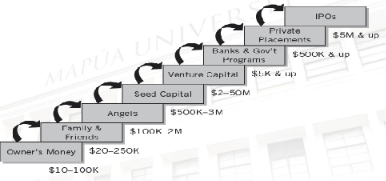
SOURCES OF CAPITAL FOR ENTREPRENEURIAL
VENTURES: Who Is Funding
Entrepreneurial
Start-Up
Companies?
DEBT VERSUS EQUITY
Debt Financing
o Secured financing of a new venture that involves a
payback of the funds plus a fee (interest for the use of
the money)
• Private Placement
In a private placement, a company sells shares
of stock in the company or other interest in the
company, such as warrants or bonds, in exchange for
cash
DEBT FINANCING• Commercial Banks
o Make 1–5 year intermediate-term loans secured by collateral (receivables,
inventories, or other assets)
o Questions in securing a loan:
1. What do you plan to do with the money?
2. How much do you need?
3. When do you need it?
4. How long will you need it?
5. How will you repay the loan?
DEBT FINANCING• Peer-to-peer Lending (P2P)
o The practice of lending money to unrelated
individuals, or “peers,” without going
through a bank or traditional financial
institution.
o Are often Internet-based sites that pool
money from investors willing to lend
capital at agreed-upon rates.
o Fees are applied for brokering and
servicing loans.
OTHER SOURCES OF CAPITAL FOR
ENTREPRENEURS• The Venture Capital Market
are professional investors who invest in business
ventures, providing capital for start-up, early stage, or expansion. And are looking for a higher rate of return than would be given by
more traditional investments.
• Provide:
• Capital for start-ups and expansion
• Market research and strategy
• Management-consulting, audits and evaluation
• Contacts—customers, suppliers, and businesspeople
• Assistance in negotiating technical agreements
OTHER SOURCES OF CAPITAL FOR
ENTREPRENEURS
• Informal Risk Capital: Angel Financing
o Wealthy individuals who are looking for investment opportunities.
o They are referred to as “business angels” or informal
risk capitalists.