Alcohols ✅
 Call Kai
 Learn
Learn Practice Test
 Spaced Repetition
 Match
Match Flashcards
 Knowt Play
1/39

Earn XP
Description and Tags
Name | Mastery | Learn | Test | Matching | Spaced | Call with Kai | Chat |
|---|
No analytics yet
Send a link to your students to track their progress
40 Terms
define the term functional group
atom or group of atoms that determine the chemical properties of a compound
what functional group do alcohols contain
-OH
what is the general formula for alcohols
CnH2n+1OH
give 3 properties of alcohols
soluble in water
neutral pH
toxic
what is the molecular formula of ethanol
C2H6O
naming alcohols:
suffix: -ol
prefix: hydroxy-
show position of -OH
e.g. Butan-2-ol

shape of alcohols:
what is the bond angle in the C-O-H bond in an alcohol
why?
104.5
oxygen atom has 2 bonding pairs and 2 lone pairs
two lone pairs repel more than electron pairs
Classification of alcohols:
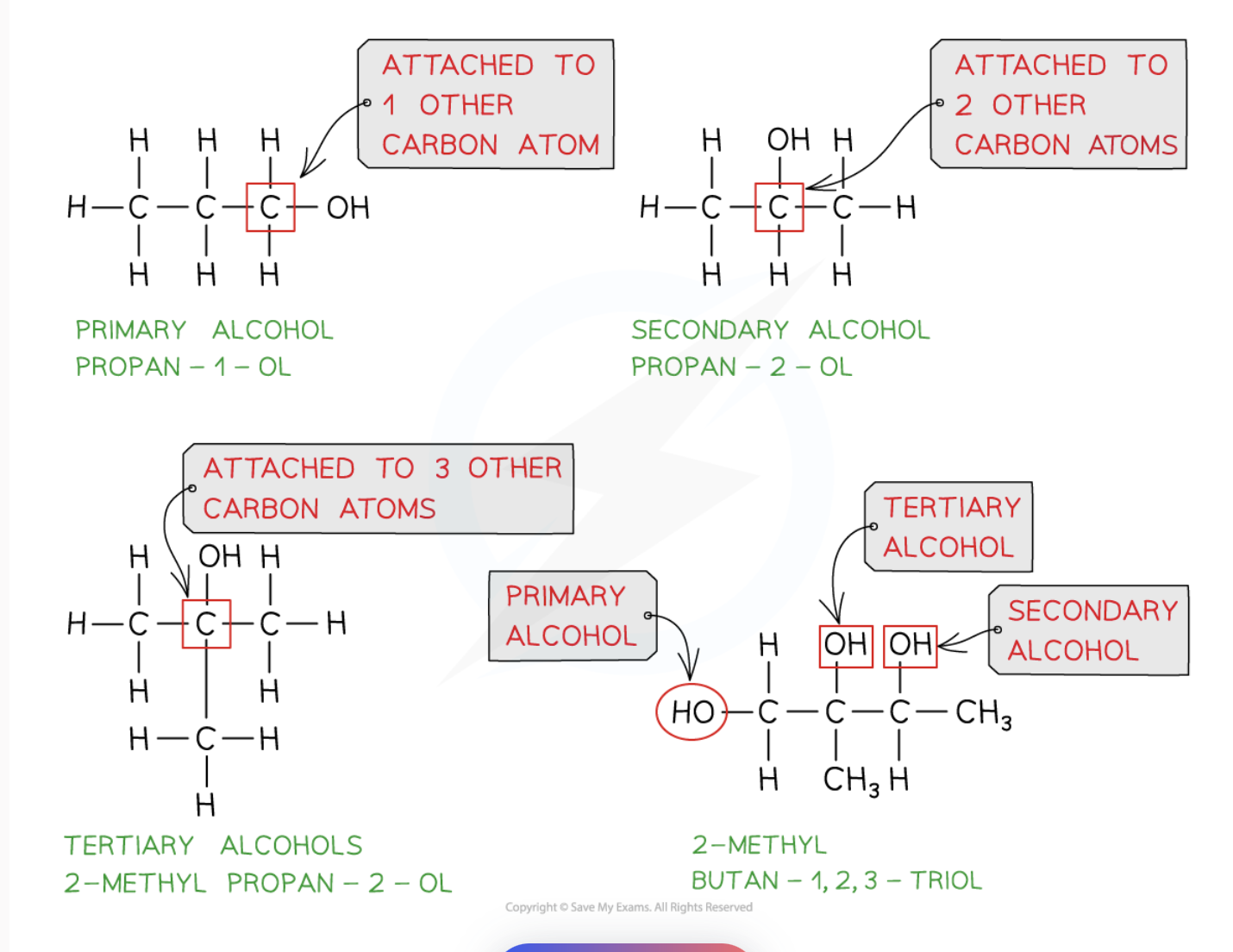
primary alcohol
secondary alcohol
tertiary alcohol
-OH group attached to a C with at least 2 H atoms on it and 1 alkyl group
-OH group attached to a C with only 1 H atom on it and 2 alkyl groups
-OH group attached to a C with 0 H atoms on it and 3 alkyl groups
which primary alcohol will have 3 Hs on the carbon bearing the OH?
methanol
use formula C3H8O to draw a primary alcohol
CH3–CH2–CH2–OH
use formula C3H8O to draw a secondary alcohol
CH3-CH(OH)-CH3
use formula C5H12O to draw a tertiary alcohol
CH3C(CH3)(OH)CH2CH3
Properties of alcohols:
explain why alcohols have a relatively high mp and bp
due to presence of strong hydrogen bonds between alcohol molecules
Summary of oxidation of alcohols:
Primary alcohols can be oxidised to form aldehydes, which can undergo further oxidation to form carboxylic acids
Secondary alcohols can be oxidised to form ketones only
Tertiary alcohols do not undergo oxidation
Common oxidising agents for alcohols include acidified potassium dichromate(VI), K2Cr2O7 and acidified potassium manganate(VII), KMnO4
Oxidation of alcohols: PRIMARY (heating under distillation)
what is the oxidising agent used to oxidise primary alcohols
what are primary alcohols oxidised to when using limited oxidising agent?
give the equation to show this reaction with ethanol
what type of conditions is this mixture heated under in this reaction
why is this important
what is the colour change for this reaction and why
acidified potassium dichromate (K2Cr2O7)
aldehydes
CH3CH2OH + [O] → CH3CHO + H2O
distillation
aldehyde has a lower boiling point than alcohol → it can be distilled off as soon as it forms otherwise further heating under reflux with excess oxidising agent will oxidise it to a carboxylic acid
orange → green, dichromate is being reduced to chromium (III) and gains electrons
![<ol><li><p><strong>acidified potassium dichromate</strong> (K<sub>2</sub>Cr<sub>2</sub>O<sub>7</sub>) </p></li><li><p>aldehydes</p></li><li><p>CH<sub>3</sub>CH<sub>2</sub>OH + [O] → CH<sub>3</sub>CHO + H<sub>2</sub>O</p></li><li><p>distillation</p></li><li><p>aldehyde has a lower boiling point than alcohol → it can be <strong>distilled off</strong> as soon as it forms otherwise further <strong>heating under reflux</strong> with excess oxidising agent will oxidise it to a carboxylic acid</p></li><li><p><strong>orange → green,</strong> dichromate is being reduced to chromium (III) and gains electrons</p></li></ol><p></p>](https://assets.knowt.com/user-attachments/e8bd1262-7782-49cd-b75b-3801a8579a3e.png)
Oxidation of alcohols: PRIMARY (heating under reflux)
what happens if the oxidising agent is used in excess
what is formed?
what type of conditions is this mixture heated under for this to occur?
reagents?
give the equation to show the oxidation from ethanal to ethanoic acid
give the equation to the show oxidation from ethanol to ethanoic acid
further oxidation occurs
carboxylic acid
heat under reflux (so that any aldehyde initially made goes back into the flask to be further oxidised)
reagents?
CH3CHO + [O] → CH3COOH
CH3CH2OH + 2[O] → CH3COOH + H2O
![<ol start="7"><li><p>further oxidation occurs</p></li><li><p>carboxylic acid</p></li><li><p>heat under reflux (so that any aldehyde initially made goes back into the flask to be further oxidised)</p></li><li><p>reagents?</p></li><li><p>CH<sub>3</sub>CHO + [O] → CH<sub>3</sub>COOH</p></li><li><p>CH<sub>3</sub>CH<sub>2</sub>OH + 2[O] → CH<sub>3</sub>COOH + H<sub>2</sub>O</p></li></ol><p></p>](https://assets.knowt.com/user-attachments/2360029a-c2eb-487b-bf9b-6163e5996246.png)
DIAGRAM- Oxidation of ethanol by acidified potassium dichromate(VI) to form an aldehyde by distillation

Oxidation of alcohols: SECONDARY (heating under reflux)
what product is formed when secondary alcohols are oxidised
what is the oxidising agent used
what condition is the mixture heated under
can further oxidation of secondary alcohols occur
give the equation to show the the oxidation of propan-2-ol to propanone
ketone
acidified potassium dichromate
under reflux
no- ketones can’t be oxidised as there is no H attached to C with OH attached
CH3CH(OH)CH3 + [O] → CH3COCH3 +H2O
DIAGRAM- Further oxidation of the aldehyde via reflux can be done to produce a carboxylic acid

when heating under reflux, why is it critical that the top of the condenser is never sealed
to avoid pressure buildups and explosions
what would the observation be when acidified potassium dichromate is added to a tertiary alcohol
no colour change
tertiary alcohols can’t be oxidised
give 4 uses of ethanol
alcoholic drinks
fuel
antiseptics
solvent
Fermentation
give the word equation for this reaction
give the chemical equation for this reaction
name the catalyst for this reaction
name the conditions for this reaction
why can’t temp be too low
why can’t temp be too high
glucose → ethanol + carbon dioxide
C6H12O6 → 2C2H5OH (aq) + 2CO2 (g)
yeast
anaerobic, temp 30
ROR is too slow
enzymes in yeast are denatured
why does a fermentation reaction to produce ethanol require anaerobic conditions
needs no oxygen- if oxygen were present, ethanol would be converted to ethanoic acid
name 1 problem with fermentation
as ethanol is produced, concentration of ethanol in mixture increases
15% conc of ethanol will kill yeast
name 2 methods that produce ethanol
fermentation
hydration of ethene
hydration of ethene
give the word equation for this reaction
give the chemical equation for this reaction
name the catalyst for this reaction
name the conditions for this reaction
type of reaction
ethene + steam → ethanol
C2H4 (g) + H2O (g) → C2H5OH (g)
conc phosphoric acid H3PO4
pressure- 60-70 atmospheres, temperature- 300
electrophilic addition
Comparison of Methods of ethanol production
Fermentation vs hydration of ethene
renewable vs non renewable
type of process
rate of reaction
quality of product
reaction conditions
renewable vs non renewable
batch reaction = inefficient vs continuous reaction = efficient
slow vs fast
impure ethanol- purify using fractional distillation = expensive vs purer product
low temp + pressure = lower cost vs higher temp + pressure = lots of energy = high cost
define the term dehydration
removal of H2O from a molecule
what do alcohols form when they are dehydrated
alkenes
dehydration of an alcohol
how are alcohols dehydrated
name 2 good dehydrating agents / catalysts for this reaction
name the conditions for reaction
what is made
what structure does the alcohol need in order to be dehydrated
Alcohol vapour passed over a hot aluminium oxide (Al2O3) powder (or pieces of porous pot)
excess, hot conc H2SO4 or conc H3PO4
heat under reflux
alkene
contain an H atom on the C atom adjacent to the C atom with OH group

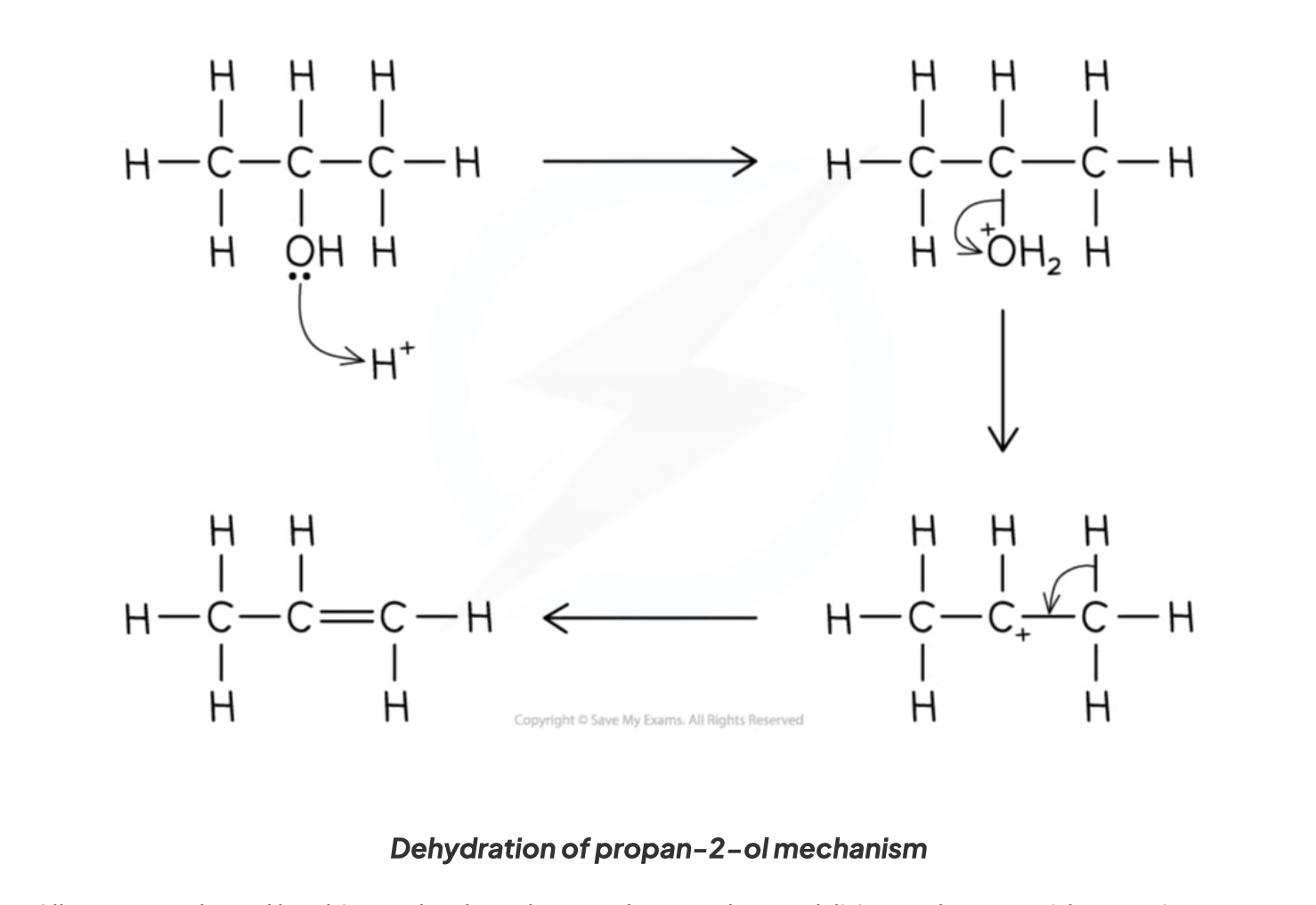
draw the mechanism for the dehydration of propan-2-ol and name the product formed
product = propene
(for stage 3 add +H2O when drawing mechanism)
(for stage 4 add H+ when drawing mechanism)
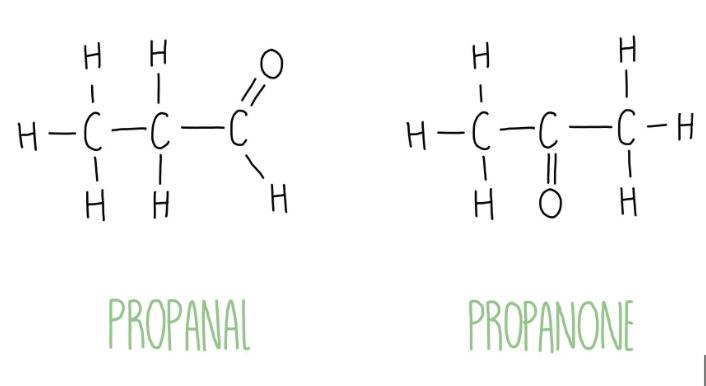
what functional group do aldehydes and ketones both have in common
C=O (carbonyl group)
in aldehydes, where is the carbonyl group in the hydrocarbon chain
at the end

in ketones, where is the carbonyl group in the hydrocarbon chain
in the body of the chain

draw propanal vs propanone
okay
what is a primary alcohol
C with OH attached to it is only attached to 1 other carbon i.e. OH group on end carbon
what is a secondary alcohol
C with OH attached to it is attached to 2 other carbon
what is a tertiary alcohol
C with OH attached to it is attached to 3 other carbon
draw out the displayed formula of dimethylpropanol
why can’t it be dehydrated
okay
no H attached to C adjacent to C with OH attached