Biochem exam 1 content set 1 UGA Lee
 Call Kai
 Learn
Learn Practice Test
 Spaced Repetition
 Match
Match Flashcards
 Knowt Play
1/201

There's no tags or description
Looks like no tags are added yet.
Name | Mastery | Learn | Test | Matching | Spaced | Call with Kai | Chat |
|---|
No analytics yet
Send a link to your students to track their progress
202 Terms
normal haemoglobin is...
globular
sickle cell hameoglobin is...
clumped (fibrous)
sickle cell anemia majorly affects eyes, brain, kidneys, and heart because...
they have more little capillaries
why is water essential to life?
it is a polar molecule, but it is not charged, making it useful as a universal solvent (can dissolve wide variety of molecules)
what environment do most biochemical reactions in the body occur in?
watery
water is electronegative, meaning it has....
high affinity to the electron
Proteins, polysaccharides, nucleic acids and membranes all
assume their characteristic shapes in response to what solvent?
water
WHY does water have so many important properties?
because of its angled shape- permanent dipoles made because O is more electronegative than H, making angled shape
what happens when you add Na+ to a flask of H2O?
the partially negative O will interact with the Na+ ion, sodium ion will dissolve in water (same with NaCl)
what happens when you add ammonia (NH3) to H2O?
nitrogen and oxygen=same column= same chemical properties, partially negative charged N will interact with the partial charged H on H2O, dissolving ammonia in water
what happens when you add a benzene molecule to water?
benzene has no charge or partial charge so there will be NO interaction (interaction means both compounds CHARGED!)
what kind of bond is formed between water and other molecules?
hydrogen bond
what happens when you add two benzene molecules to water?
benzene will clump together without any energy added because it is hydrophobic (entropy increases) but will not interact with each other
entropy is _________ and it measures....
spontaneous, randomness (degree of disorder)
spontaneous reactions will always decrease entropy. T or F
F- will always INCREASE entropy
subcellular location of hemoglobin
the cytoplasm (of RBCs)- mainly in water
DeltaG in protein folding is negative. T or F
T
does a negative deltaG in protein folding make the reaction favorable (energy releasing) and therefore spontaneous?
Yes- protein folding is spontaneous and energy releasing
structure of hemoglobin
a four-subunit protein containing iron
what is the driving force of protein folding?
hydrophobic and partially charged interactions (ENTROPY INCREASE)
amino acids are linked by _______ bonds
peptide
what drives protein folding?
hydrophobic effect
every amino acid contains:
carboxyl group (COO-), amino group (NH2), Side chain (R)
Peptide bond
The chemical bond that forms between the carboxyl group of one amino acid and the amino group of another amino acid
A polypeptide chain has directionality: an α-amino group is at one end, and
an ______________ group is at the other
a-carboxyl
deltaG eq
deltaG= deltaH - TdeltaS
how does the pH level change proteins?
by protonating them or deprotonating them (adding an H molecule or subtracting)
amino acid structure

normal bodily tissue pH
7.4
what group on the amino acid gets protonated?
the amino group (will have 3 H's when protonated)
pKa
pH value when protonated form and deprotonated form are at half and half
low pKa means
strong acid
if pH is higher than pKa which form is more prevalent?
deprotonated form
if pH is lower than pKa which form is more prevalent?
protonated form
what is pKa of the carboxyl group at pH of 7.4? What does this mean for the amino acid?
2; part of amino acid is deprotonated (?)
which form of amino acids is more prevalent at 7.4 pH?
deprotonated form
Zwitterionic form
has NH3+ and COO-
If the pH is more than the pKa
deprotonated
low pH= lots of hydrogens=
there will be hydrogens on everything
Henderson-Hasselbalch equation
pH = pKa + log [base]/[acid]
Learn how to draw peptide bond at different pHs-
draw Met- Glu- Arg- Pro- Phe- Cys- Thr at pH 7.4, 10, and 1
Noncovalent Interactions of Biomolecules are essential for...
proper functioning of biomolecules (Much weaker (10-100 times) than covalent bonds
• weakness important
• noncovalent interactions continually being formed and
broken
• life processes require this -- they're dynamic. (You
can't get much biological activity from a rock)
Weak interactions- Electrostatic Interactions (Ionic Interactions) Are Between
Electrical Charges
Hydrogen bonds form between
Electronegative Atom and Hydrogen
van der Waals Interactions Depend on
Transient Asymmetry in Electrical Charge
electrostatic interactions- 3 diff names for same thing
electrostatic interactions, ionic bonds, salt bridges
ionic interactions are called
charge-charge interactions, or salt
bridges
E=kq1q2/Dr
E is the force.
q1 and q2 are the charges on the two atoms (in units of the electronic charge).
r is the distance between the two atoms (in angstroms).
D is the dielectric constant (which accounts for the effects of the intervening
medium).
k is the proportionality constant
van der Waals Interactions
Nonspecific, weak transient electrostatic forces between ANY 2 atoms that approach each other
The energy is most favorable at the van der Waals...
contact distance (The energy rises rapidly owing to electron-electron repulsion as the atoms
move closer together than this distance)
a negative charged amino acid and a positive charged amino acid are both on the inside of a folded protein bc...
they neutralize each other (?)
disulfide bonds are formed by
the oxidation of a pair of cysteine residues
is oxidation or reduction energetically favorable?
oxidation (ex: fire)
enthalpy is a kind of _____ energy
bond (energy to break or make bond)
When you make a covalent bond, heat is given off because
the potential energy of the system has decrease
you need to put in energy (heat) in order to _____ a
covalent bond (?)
break
When ∑BEbroken is smaller than ∑BEformed, heat is ___________, the
overall change in enthalpy is _______, making the reaction
exothermic
given off, negative
Why does the wrong protein for hemoglobin made from a mutated nucleotide make for sickle cell disease?
there are hydrophobic residues forms a pocket on the surface of both globin β chains. These pockets play an essential role in the pathology of one form of Sickle Cell Disease (Valine not happy w water, tries to go to hydrophobic pocket because of entropy increase, ends up making a big pocket with two hemoglobin- becomes big polymer)
what kind of interaction occurs between the 4 hemoglobin subunits?
noncovalent (salt bridge ionic bonds)
What does Bartter Syndrome cause?
impaired trafficking of ions across a membrane
tails of the lipid bilayer are _________ and _______
hydrophobic and nonpolar
why do ions need channels to cross a cell membrane?
cannot cross the hydrophobic part of the membrane (ion is charged molecule)
what type of amino acid makes ion channels?
nonpolar amino acids (lipid bilayer is polar)
Cytosol proteins
Proteins synthesized on free ribosomes in cytosol.
secondary structure of protein
alpha helix and beta pleated sheet
sodium potassium channel protein has ____ subunits and a _____
4, a pore in the middle
What lines the wall of the pore in a sodium potassium channel?
carbonyl groups
why cant sodium cross through potassium channels?
sodium ion is energetically unfavorable to pass bc it is too "small" for interaction w carbonyl groups (potassium is bigger) ****** this is too simple for the test!!!
ions bind to _____ on the protein in the ion channel
carbonyl groups
Bartter syndrome symptoms
vomiting, polyuria, lethargy, lack of sodium chloride in blood (main symptom)
mutation of what gene causes Bartter Syndrome?
KCNJ1 mutation (mutates ROMK protein)
normal transport mechanisms in the kidney
Reabsorption of sodium chloride achieved with the sodium chloride/potassium chloride cotransporter (driven by the low intracellular concentrations of sodium, chloride, and potassium). Low concentrations maintained by the basolateral sodium pump (sodium-potassium adenosine triphosphatase), the basolateral chloride channel (ClC-kb),
and the apical potassium channel (ROMK).
what is the normal net gain in the blood from the kidney sodium potassium channels (loop of henle)?
sodium chloride absorbed into blood (Na+ and Cl-)
ROMK protein is supposed to do what normally?
export potassium from loop of henle into lumen for waste
What happens in the loop of henle with ROMK protein does not work?
potassium ions get trapped into cell, so reactions bringing potassium ions into cell will not work (so no more potassium, Cl or Na can get into cell since they all get transported together), then Na+ and Cl- cannot get transported into the blood
Why does O bind to potassium ions? What molecule does this cause K to bond to?
bc K is positive and O is partially negative (K binds to water for this reason)
Does K+ bind to proteins?
yes- K+ binds to amino acids through K and O bond
where does K+ bind to proteins?
On the backbone chain of the protein
Tight binding sites for ion selectivity should slow the progression of ions through a channel, yet ion channels achieve rapid rates of ion transport. How?
List the steps for potassium dissolved in water to bond with proteins. Is this process energetically favorable? Why?
1. Potassium ion breaks its bonds with H2O to make room for bonds with proteins. Energy is required to break these bonds (desolvation energy).
2. Potassium ion then binds to the backbone of proteins. Energy is released because it is a non-covalent interaction between charged/partially charged molecules. The amount of energy gained from the new bonds is more than the energy required to break bonds with water, making this process energetically favorable.
Desolvation energy
Energy required to remove water from ions
Why is it energetically favorable for potassium ions to leave bonds with water molecules (desolvation) but energetically unfavorable for sodium ions to leave a water solution?
The sodium ion is smaller, so when it enters the channel the distance between it and the protein backbone is longer. Since there is more distance between sodium and the protein backbone, the electrostatic interaction is weaker.
secondary structure of proteins (4)
alpha helix, beta sheet, turns and loop
peptide bonds are _______ _______ bonds
partially double
Ca1 (alpha 1 carbon)
first carbon in amino acid backbone
why cant a C-N bond in an amino acid rotate?
the partial double bond (double-bond nature of the resonance hybrid form)
Why is the trans form of proteins favored?
Because of steric clashes in the cis form
T or F; bonds making up proteins can rotate around a plane, allowing for many different shapes in the secondary and tertiary structures of proteins.
T
Peptide groups (blue planes) are planar because they cannot rotate. T or F
T

freedom of rotation about ___ bonds of each amino acid allows
proteins to fold in many different ways
two

a helix; All side chains project ______ from helix axis
outward
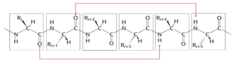
The hydrogen-bonding scheme for an α helix. In the α helix, the
CO group of residue i forms a hydrogen bond with the NH group
of residue i + 4.
T or F; beta sheet proteins are great structurally for transmembrane integral proteins.
F- alpha helixes are
why do hydrophobic proteins not interact with water?
they do not have a charge to attract water
what happens if there are no hydrogen bonds made in an a-helix?
the a-helix would become partially charged, then not be able to stay in transmembrane proteins (H's neutralize the charges from the protein)
which part of the amino acids do potassium ions interact with? Why?
The oxygen on the carbonyl backbones of the amino acids- the oxygen is free while the side chains are in the helix due to H bonds
All secondary structures of amino acids are stabilized by
hydrogen bonds between NH and CO
Reverse turns and loops facilitate what?
change of direction in polypeptides
turns and loops lie on the _____ of proteins and participate in ________ between other proteins and the environment
surface, interactions
Loops are composed of what kind of protein in what environment?
Proteins with hydrophilic R groups, in an aqueous environment