Psych 211 - Lecture 21 :Moral Development & Gender Development
 Studied by 0 people
 Call Kai
 Learn
Learn Practice Test
 Spaced Repetition
 Match
Match Flashcards
 Knowt Play
1/46

There's no tags or description
Looks like no tags are added yet.
Name | Mastery | Learn | Test | Matching | Spaced |
|---|
No study sessions yet.
47 Terms
Moral Judgment
• Morality of a given action is not always obvious
• Morality of a behaviour is based partly on the thinking (conscious intentions and goals) that underlies the behaviour
• Reasoning behind a given behaviour is critical to determine if behaviour is moral or immoral
• Changes in moral reasoning form the basis of moral development
Piaget's Theory of Moral Judgment
• Piaget defined two stages in children’s moral reasoning (The Moral
Judgment of the Child, 1932/1965)
• Moral reasoning changes from rigid acceptance of rules of authorities to modifiable moral rules related to social interactions
• Younger children
• Outcome is more important than the intention
• Older children
• Intention seen as important
• Individual differences
The Stage of Heteronomous Morality
• Characteristic of children
• Younger than 7 years
• Rules and duties to others regarded as unchangeable due
to social and cognitive influence
• Rigid acceptance of authorities’ rules
Transition Period
Children
• Enter a transition period in which interactions with their peers lead them
to develop the ability to take one another’s perspective and to develop
beliefs about fairness
The Stage of Autonomous Morality
• Children around 11 or 12 years
• No longer accept blind obedience to authority as the basis of moral
decisions
• Fully understand that rules are the product of social agreement; changed
by majority agreement
• Consider fairness and equality in rule construction and individual motives
and intentions in behaviour evaluation
Critique of Piaget’s Theory
Contributions
• Developmental systematic changes in moral reasoning
Critique
• Overall rejection of the theory
• Underestimation of intentionality in morality
• Role of cognitive development in moral reasoning
Kohlberg's Theory of Moral Reasoning
• Kohlberg was interested in sequences through which children
develop moral reasoning
• Develops over time
• Proceeds through specific stages:
• Discontinuous and hierarchical
• Advanced thinking with each new stage
• Heinz dilemma used to assess moral reasoning
Preconventional and Conventional Levels
Preconventional level
• Self-centred, focusing on getting rewards and avoiding punishment
• Stage 1: Punishment and obedience orientation
• Stage 2: Instrumental and exchange orientation
Conventional level
• Centred on social relationships, focusing on compliance with social
duties and laws
• Stage 3: Mutual interpersonal expectations, relationships, and interpersonal
conformity
• Stage 4: Social system and conscience orientation
Basic Moral Reasoning
• Most children and adolescents
engage in only basic moral
reasoning
• Even if their reasoning is at a
higher level, they sometimes
act in ways that do not reflect
their highest level of moral
reasoning, such as the person
in this photo, who knows
stealing is immoral
Postconventional level
• Centred on ideals, focusing on moral principles
• Stage 5: Social contract or individual rights orientation
• Stage 6: Universal ethical principles
Critique of Kohlberg’s Theory
Contributions
• Contribution of cognitive
processes to moral behaviour
• Developmental systematic
changes in moral reasoning
• Individual’s levels of moral
reasoning and moral behaviour,
especially for people reasoning
at higher levels
Critique
• No sufficient distinction
between moral issues and social
convention
• Reasoning not continuous
• Use of dilemmas not valid
across cultures
• Gender differences not
indicated; theory based on
studies of boys
Gilligan’s Theory of Moral Development
• Differences in the way males and females reason morally because
of the way they are socialized
• Males: Tend to value principles of justice and rights
• Females: Tend to value caring, responsibility for others, and avoidance of
exploiting or hurting others
Social Domain Theory of Moral Development (4)
Moral reasoning grows
gradually
• Through social interactions with
peers and adults and parental
guidance
Differences occur in moral
judgment
• From diverse environments with
bidirectional relationship
influences
Parents transmit values
• Explicitly through teaching and
discipline
• Implicitly by example
Peer relationships involve
equal power
• More behavioural agency in
moral situations
• Observation and initiation of
moral behaviour in numerous
settings with peers
Moral Development Timeline (according to SDT)
• By age 3: Violations of moral rules are more wrong than violations of
social conventions
• By age 4: Moral transgressions, but not societal transgressions, are
wrong
• From ages 4 to 9: Moral transgressions are morally wrong
• Children, but fewer adolescents, feel that parents have authority
• Parents feel otherwise
• This leads to adolescent–parent conflicts
Domains of Social Knowledge (3)
• Successful negotiation of social worlds requires understanding
principles in three social knowledge domains
• Moral domain
• Societal domain
• Personal domain
Cultural and Socioeconomic Similarities and Differences
• Culture shapes social judgment
• Meeting others' needs is seen as
a moral duty, not just a personal
choice
• Lower SES children may struggle
to distinguish between moral and
social-conventional actions
compared to middle-class
children
The Development of Conscience
Conscience
• Integral regulatory mechanism that
increases individual’s ability to conform to
standards of conduct accepted in their
culture
• Restrains antisocial behaviour or
destructive impulses
• Promotes compliance with adults’ rules
and standards and adherence to cultural
standards
• Fosters prosocial behaviour
Conscience Development: Nature or Nurture?
• Conscience is tied to cultural standards, historically seen as
learned (nurture) rather than innate (nature)
• Studies with infants indicate an innate preference for helping over
hindering actions
• Infants show early signs of a moral sense before parental teaching
• Innate preferences for prosocial behaviour may form the foundation upon
which learned morality from family and culture is built
Timing of Development of Conscience
• Conscience develops slowly
• By age 2, recognize moral standards;
exhibit guilt with wrongdoing
• With age, take on parents’ moral values
• Temperaments matter
• Fearless children show less guilt than
do fearful children, even with gentle
discipline
• Allele variant of the gene SLC6A4
makes children reactive to their rearing
environment; goodness of fit
Prosocial Behaviour, Empathy, Sympathy
Prosocial behaviour
• Voluntary behaviour intended to benefit another;
helping, sharing with, and comforting others
Empathy
• Emotional response to another’s state or condition
that reflects other person’s state or condition
Sympathy
• Feeling of concern for another in response to other’s
emotional state or condition
Developmental Timeline of Prosocial Behaviour
The perspective of others is required to sympathize or empathize:
• By 14 months
• Distressed when others are seen in distress
• Cooperation driven by sympathy and sense of fairness
• By 18 to 25 months
• Sharing demonstrated
• By 2 to 4 years
• Other prosocial behaviours increase
• Middle childhood and adolescence
• Moral reasoning and perspective-taking influence helping, sharing, and donating
Cooperation
• Another form of prosocial
behaviour
• May be driven by sympathy
and child’s sense of
fairness
• May have evolved
Individual Differences in Prosocial Behaviour
Biological factors
• Humans have a biological (evolutionary)
predisposition for prosocial behaviour;
necessary for the survival of the species
Genetic factors
• Identical twins are more similar in prosocial
behaviour than fraternal twins
• Specific genes identified that might
contribute to individualized, prosocial
tendencies
• Temperament contributes to individual
differences in social cognition
The Socialization of Prosocial Behaviour: Parents
• Three ways parents socialize
children’s prosocial behaviour:
• Modelling and teaching prosocial
behaviour
• Arranging opportunities for their
children to engage in prosocial
behaviour
• Disciplining their children and
eliciting prosocial behaviour from
them
The Socialization of Prosocial Behaviour
• Modelling and communication of values
• Imitation of adult and positive relationship
• Similarity of parent-child prosocial behaviour levels
• Opportunities for prosocial activities
• Performance in household tasks
• Voluntary community services and activities; community learning
• Discipline and parenting style
• Constructive and supportive, authoritative parenting; reasoning
• Physical punishment, threats and authoritarian approach
• Eliciting prosocial behaviour
• Peer influences
• Relationships with other children
• Conflict resolution practice
• Interventions
• Experience helping and cooperating with others
• Exposure to prosocial values and behaviours
Antisocial Behaviour
Disruptive, hostile, or
aggressive behaviour
that violates social
norms or rules and that
harms or takes
advantage of others
The Development of Antisocial Behaviours (3)
• Aggression
• Behaviour aimed at harming or injuring others
• Instrumental aggression
• Aggression motivated by the desire to obtain a
concrete goal
• Relational aggression
• Intending to harm others by damaging peer relationships; leads to conduct disorders
Individual child uses of both kinds of aggression; tends to be consistent across childhood
The Development of Aggression
Aggressive behaviour occurs before 12 months of age, usually over objects; it does not involve bodily contact or hitting
• By 18 months, physical aggression is normative (goal-directed)
• During elementary school, overt physical aggression remains low or declines for most (hostile; relational)
• Serious violent acts increase in mid-adolescence
• Differences
• Individual differences
• Gender differences
• Conduct disorders
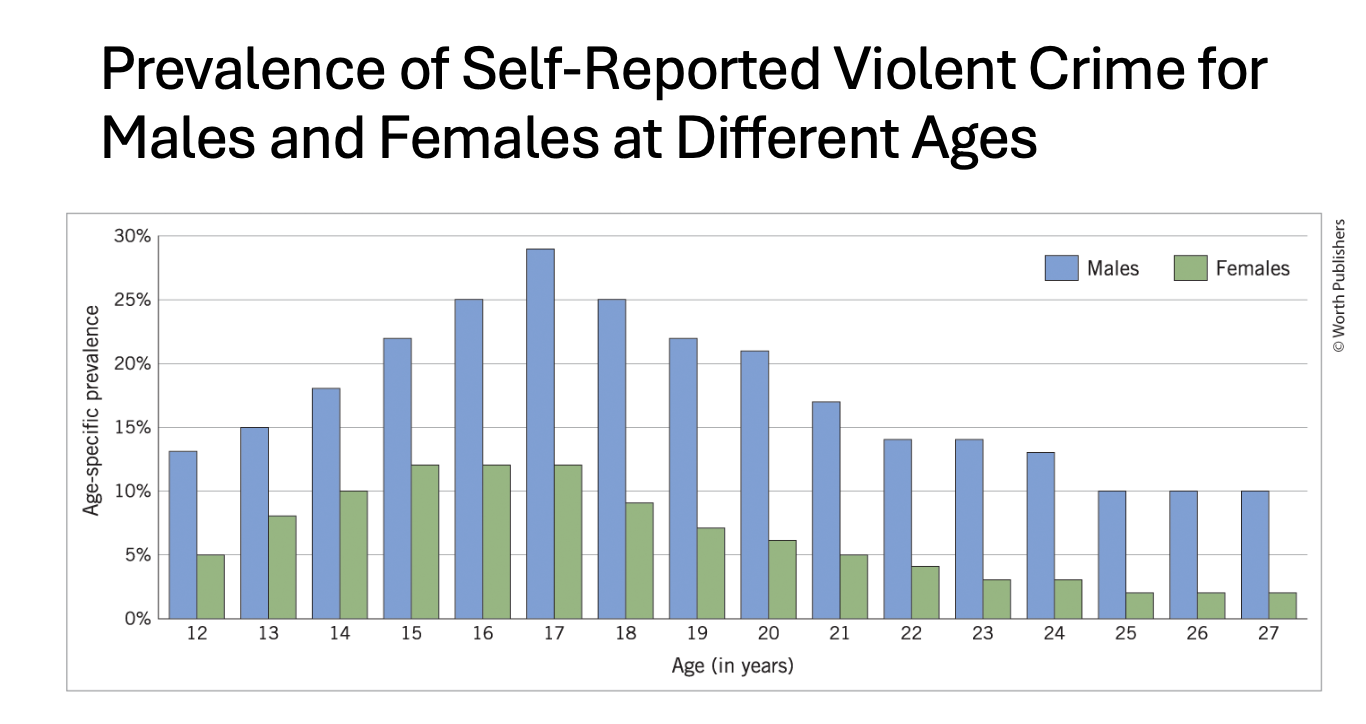
Individual Differences in Aggression
• Considerable consistency in individual
differences in both girls’ and boys’
aggression across childhood and
adolescence
• Aggression in middle childhood and
adolescence; especially in boys
• Relational aggression in childhood and
subsequent conduct disorders; girls
• Early life neurological deficits
Oppositional Defiant Disorder and Conduct Disorder (4)
Definitions
• Oppositional Defiant Disorder
• Conduct Disorder
Diagnostic criteria and prevalence
• DSM-5-TR
• Relatively low prevalence; 3.3%
Treatment gaps and comorbidity
• Only 54% receive mental health treatment
• High comorbidity with other disorders
Predictors and influencing factors
• Various family, child, and contextual factors
• Age of onset, specific problem behaviours, and individual characteristics
The Origins of Aggression: Biological Factors
• Consistency between aggressive behaviour in childhood and
adolescence
• Biological correlates
• Genetic risks, heredity, temperament
• Neurological deficits
• Hormonal
The Origins of Aggression: Social Cognition
• Aggressive children tend to interpret the work
through an aggressive lens
• They may evaluate aggressive responses more
favourably
• Reactive aggression
• Emotionally driven, antagonistic aggression sparked by
one’s perception that other people’s motives are hostile
• Proactive aggression
• Unemotional aggression aimed at fulfilling a need or desire
The Origins of Aggression: Family Influences
• Cold, punitive parenting
• Troubled family interaction
• Poor parental monitoring;
parental conflict
• Poverty, neighbourhood
violence, and family stress
Peer Influences: Aggression and Antisocial
Behaviour
• Having aggressive friends and being
exposed to violence
• Peer pressure to be involved in
antisocial behaviour
• Culture oriented toward adults’
expectations
• More aggression in less acculturated
children
Biology and Socialization: Their Joint Influence on
Children's Antisocial Behaviour
• Genetically informed recent research findings:
• Often combination of genetic and environmental factors predict
antisocial, aggressive behaviour
• Some children are more sensitive to parental quality
• Children with specific gene appear to be more responsive to their
environment than children with different variants
• SLC6A4
• DRD4
• MAOA
Interventions for Aggressive and Antisocial Children
• Children with aggressive or antisocial problem behaviours
can be successfully treated
• Individual psychotherapy
• Combination of psychotherapy and drug therapy
• Parent education and intervention
• School-based intervention
• Community-based programs
• Positive youth development
• Service learning
Sex vs. Gender definitions
Sex
Categories distinguishing between biological males and females on the basis of characteristics such as hormones, reproductive organs, sex chromosomes, etc. (varies by context)
Gender
Socially defined category encompassing expectations of behaviour, social roles, or other characteristics; includes men, women, as well as many other non-binary categories
Both involve fuzzy categories with lots of exceptions
cisgender, transgender, gender binary, Non binary
Cisgender
Identifying with the gender that
one’s culture assumes/pushes
based on biological sex
Gender Binary
Classification of gender into two
anatomy-based categories:
Men/Boys and Women/Girls
Transgender
Identifying with a gender other
than what one’s culture assumes
based on biological sex
Nonbinary
People whose gender does not fit
within the gender binary
prescribed by their culture
Perceiving Gender Categories
Between 18 and 24 months, children
begin to develop gender schemas
• Organized beliefs and understanding of gender
Ingroup/outgroup gender schema
• What/who “matches” their gender”
Own-gender schema
• Knowledge tied to one’s own gender identity
Show early gender expectations
• Surprise at gender-atypical behaviours; preferential looking patterns (e.g.,
habituate to female face → look longer at car than doll
Gender Labelling
Stereotypical gender labelling increases
over the course of the preschool years
• Objects, activities, characteristics
Shortly after learning to label others,
begin to reference their own gender
• Identify as a boy, girl, or other gender
Preschoolers don’t appear to exhibit
consistent belief in gender constancy
• If you change your appearance or
behaviour, your gender changes too
Gender-Typed Behaviour
By age 2, many children exhibit
gender-typed preferences or tendencies
• E.g., prefers “boy toys” over “girl toys”
Lots of individual variability!
• Some children are rigid, others flexible
• Many prefer “cross-gender-typed” play
Gender Segregation
Tendency to affiliate with same-gender
peers, avoid other-gender peers
• Increases between 3 and 6
Gender in-groups reinforce both
gender stereotyping and conformity
• More time with children of a given
gender, more gender-typed behaviour
• Conflict between nonconforming interests
and pressure to conform puts children at
risk of anxiety/depression
Gender in Middle Childhood
By age 6, most children see gender as a
stable aspect of identity (gender constancy)
• Still stereotypical thinkers, but more flexible
and realize there are exceptions
• “Some girls have short hair!”
• Trans children are less stereotypical in their
thinking about gender
• And so are their cis-siblings!
Beliefs about gender are learned!
By age 9 or 10, children recognize that gender
is a socially constructed category
• Not necessarily a reflection of biology
Also aware that there can be social
repercussions for violating gender norms
• Recognize gender discrimination and judge
it to be unfair
• Nonetheless, children frequently exclude
others on the basis of gender in middle
childhood
Gender in Adolescence
Adolescence is a time of both gender-role
intensification and gender-role flexibility
• Varies between individuals, contexts
Some teens become increasingly
concerned with adhering to gender roles
• Increases in rates of gender discrimination
and harassment
• Particularly towards girls, gender-
nonconforming children, and LGBTQ+
children
For other teens, adolescence is a time of
identity flexibility and exploration
• Peers typically tolerate more flexibility
in girls than in boys
• Dependent on opportunities and
support offered by others
Social support is particularly important for
gender-nonconforming youth
• Increased stigmatization when their
community is highly hetero-/cisnormative
Development of Gender Identity: Terms
Felt gender typicality: Sense of similarity and belonging with one’s gender in group
Gender-role contentedness:Satisfaction with the expected roles and opportunities associated with one’s gender in group
Gender centrality: Personal importance of one’s gender identity relative to other social identities
Development of Gender Identity
How do kids develop their view of themselves as boys, girls, non-binary etc.?
• They interact with the environment and internalize societal norms and expectations in the process of self-socialization
• Self-socialization experiences vary from kid to kid because the relationship between child and environment is bi-directional
• Family, peers, teachers, media, cultural context, etc. are the “environment” providing input to the child
• Then children makes sense of that environmental input
Development of Gender Identity:
Making sense of input
Balanced identity model predicts kids
make choices that establish consistency
across their group identity (e.g., “I identify
as a boy”), group-attribute associations
(e.g., “Boys like cars”), and self-concepts
(“I like cars”).
Stereotype emulation hypothesis predicts children will emulate stereotypes associated with their gender to gain social acceptance or approval, especially if they identify strongly with their gender ingroup
Children don’t just passively accept stereotypes…
The stereotype construction hypothesis predicts they are likely to assume other members of their gender ingroup are like them.
• “I like dolls and I’m a girl. Girls like dolls.”