Genetic diversity and adaptation
 Call Kai
 Learn
Learn Practice Test
 Spaced Repetition
 Match
Match Flashcards
 Knowt Play
1/4

There's no tags or description
Looks like no tags are added yet.
Name | Mastery | Learn | Test | Matching | Spaced | Call with Kai | Chat |
|---|
No analytics yet
Send a link to your students to track their progress
5 Terms
What is genetic diversity?
The number of different alleles of genes in a population
Natural selection
random mutation can result in new alleles of a gene
in certain environments, the new allele might benefit its possessor, leading to increased reproductive success
advantageous allele is inherited by members of the next gen
result = over many generations, the new allele increases in frequency in the population
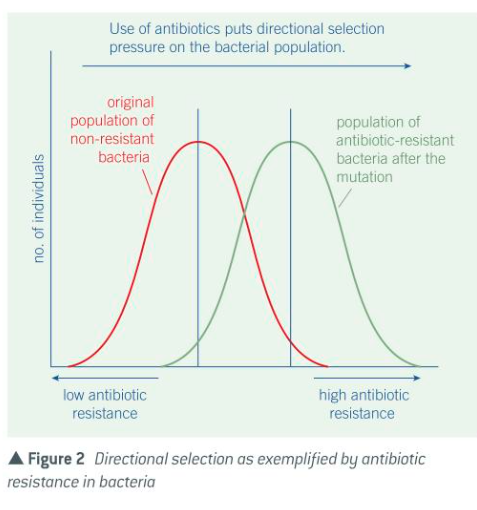
Directional selection + bacteria
Selection may favour individuals that vary in one direction from the mean of the population - this changes the characteristics of the population e.g. bacteria resistance to penicillin
spontaneous mutation occurred in the allele of a gene in a bacterium that enabled it to make a new protein
protein able to break down penicillin
surviving bacterium divided by binary fission and built up a population of penicillin-resistant bacteria
Stabilising selection
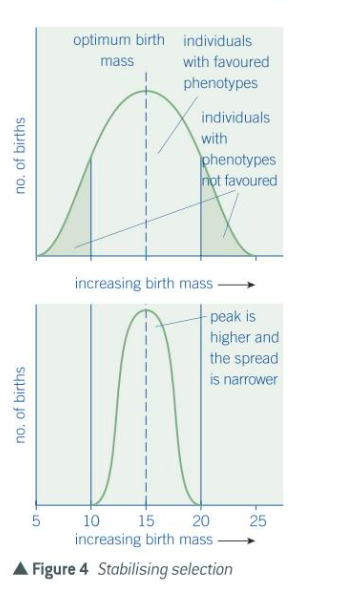
Selection may favour average individuals - this preserves the characteristics of a population e.g. human birth weight
mortality rate is greater at the two extremes
infants with highest and lowest birth masses are more likely to die while those around the mean are less likely to die
Three types of adaptation
anatomical - such as shorter ears and thicker fur in arctic foxes compared to foxes in warmer climates
physiological - e.g. oxidising of fat rather than carbohydrate in kangaroo rats to produce additional water in a dry desert environment
behavioural - e.g. autumn migration of swallows from the UK to Africa to avoid food shortages in the UK winter